
“Despite enormous investments and widespread hype around artificial intelligence, the financial payoff for corporate America outside the tech sector has been zero.” On October 24, 2026, Torsten Slok, partner and chief economist at Apollo Global Management, laid down this verdict in his Daily Spark note. He bypassed benchmarks and model parameter counts entirely, presenting five charts tracking the hard financials of American enterprise.
Over the past three years, Silicon Valley expanded compute clusters to unprecedented scales, while Wall Street priced the wave accordingly. Yet turning the spotlight toward traditional public equities across retail, manufacturing, healthcare, and logistics reveals that the anticipated earnings explosion never arrived. AI’s astronomical bills and tangible financial returns sit on two entirely separate balance sheets. The next phase of this wave has evolved into an accounting battle over who ultimately foots the compute bill—and the final say rests firmly with the 493 non-tech companies in the S&P 500.
Seven Tech Giants Reaping the Spoils While 493 Traditional Firms Stagnate
Splitting the S&P 500 into two distinct cohorts makes the temperature gap across American business immediately visible. On one side stands the “Magnificent 7” (Apple, Microsoft, Nvidia, Alphabet, Amazon, Meta, and Tesla); on the other, the remaining 493 enterprises spanning traditional sectors (the S&P 493). Slok’s team plotted revenue per employee alongside net profit margin trends for both groups over recent years.
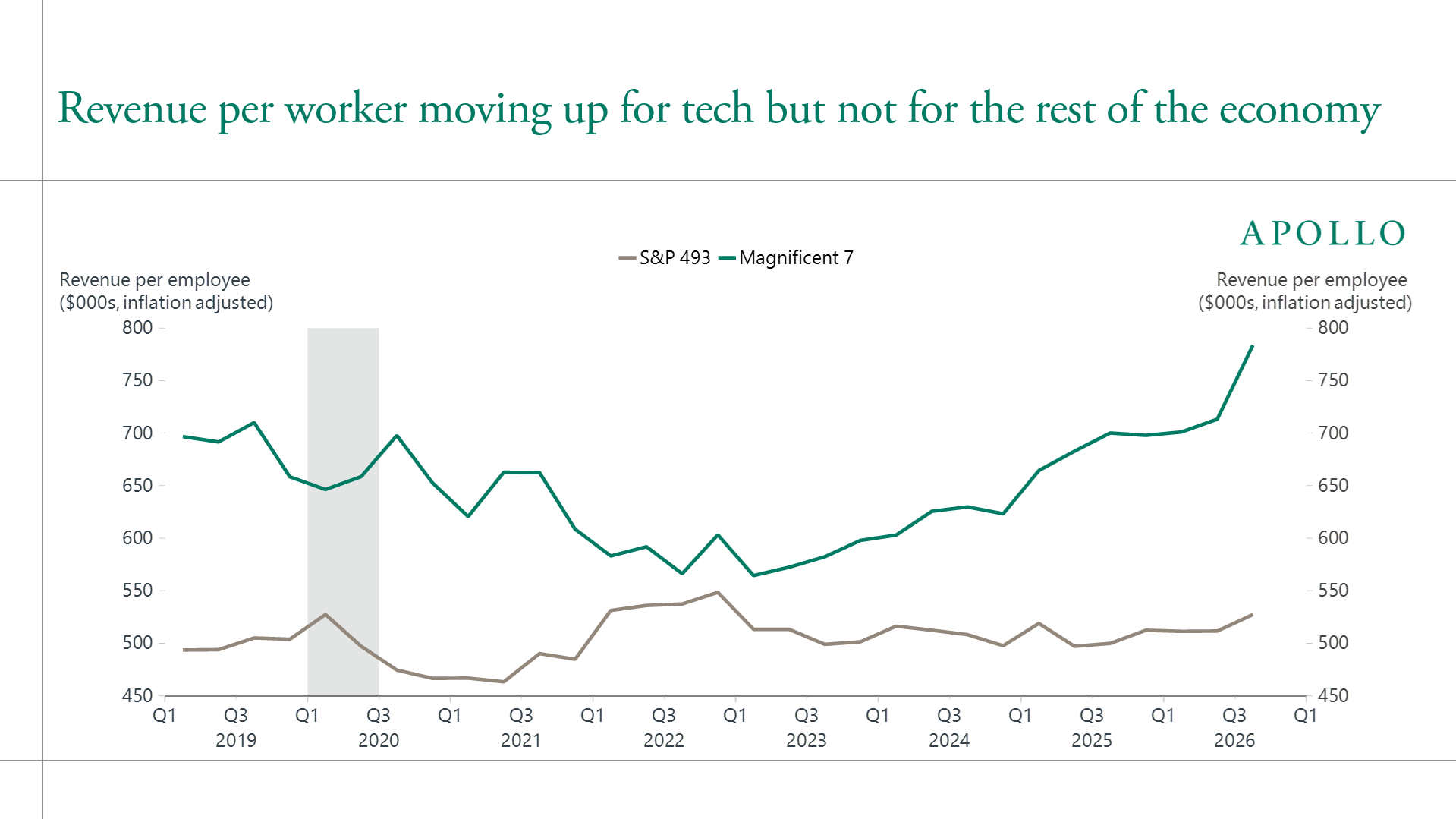 Chart: Mag 7 revenue per employee continues climbing while the remaining 493 stay flat. Source: Apollo Chief Economist (Torsten Slok, Oct 24, 2026)
The visual divergence is stark. Revenue per employee and margins for the tech giants climb sharply, while the line for the other 493 firms remains entirely horizontal. The revenue growth of the Magnificent 7 is, in essence, the accounting monetization of other enterprises purchasing their chips and cloud infrastructure.
If AI had genuinely overhauled day-to-day corporate operations as onstage keynotes claimed, at least one telltale signal should have materialized on the income statements of those 493 incumbents: either identical headcounts generating expanded top-line revenue, or shrinking operational overhead expanding margins. Neither has moved. Providers selling compute are generating record profits; enterprise buyers funding the tokens have yet to see capital return to their P&L statements.
Flatline in Total Factor Productivity: Compute Purchases as an Internal Loop
Beyond corporate earnings, macroeconomists rely on an even more fundamental yardstick: Total Factor Productivity (TFP). TFP isolates output gains driven purely by technological progress after accounting for capital and labor inputs. In his third exhibit, Slok plotted the San Francisco Fed’s utilization-adjusted TFP series (based on John Fernald’s methodology) alongside official Bureau of Labor Statistics (BLS) figures.
Both authoritative curves paint a similarly sobering picture. Across the broader US macroeconomy, there is zero statistical evidence of AI accelerating productivity growth. Hundreds of billions poured into hardware and data center infrastructure have manifested as electricity bills, depreciation, and amortization; these massive outlays have not translated into aggregate economic efficiency per unit of output.
If non-tech corporate filings show no tangible output surge, who has been paying for the astronomical consumption of tokens? Slok’s fourth and fifth charts draw on the Ramp AI Index, curated by Ramp chief economist Ara Kharazian. These figures unmask who is really bankrolling the compute surge.
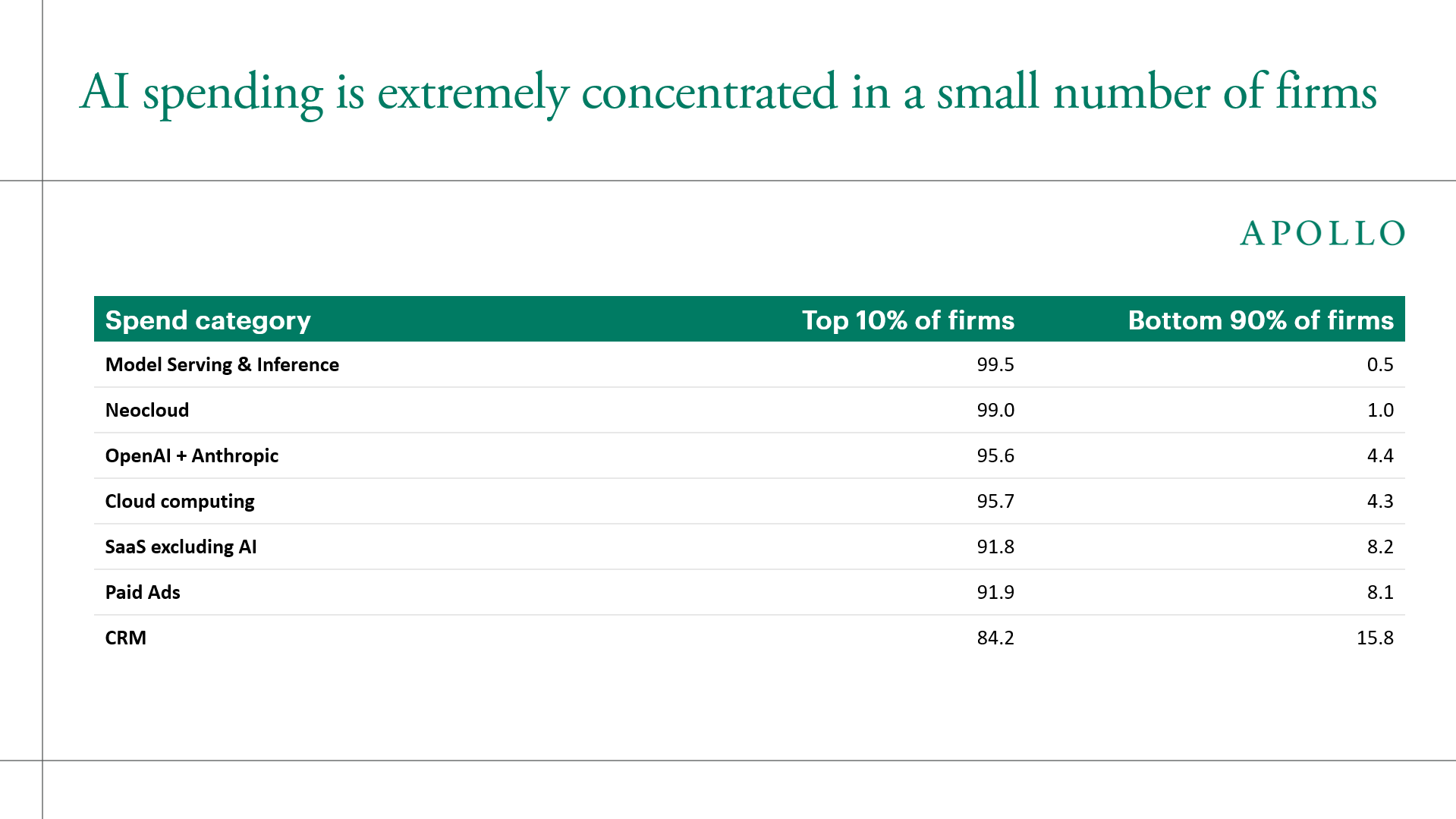 Chart: AI enterprise spending remains concentrated among a tiny fraction of companies. Source: Apollo Chief Economist / Ramp AI Index
The data highlights two striking anomalies. First, corporate AI expenditure is overwhelmingly concentrated within a tiny cohort of companies. Second, compute usage exhibits intense “circularity.” VC-backed startups funnel round after round into cloud providers for API tokens; frontier labs then turn around and allocate those cash flows to hardware vendors for next-generation silicon. Revenue churns in a closed loop within tech, struggling to penetrate the broader real economy.
Mainstream Enterprise Tightens Wallets as Compute Gets Branded a Cost Center
Silicon Valley’s self-contained spending dynamics are now sparking pushback from corporate CFOs. Slok highlighted a critical shift in corporate posture: having failed to detect meaningful revenue acceleration, mainstream enterprises are reclassifying AI budgets. They are labeling API token outlays and agentic AI systems as margin-dragging “cost centers.”
On enterprise budget allocation sheets, a “growth engine” and a “cost center” receive drastically different treatment. Projects classified as growth engines enjoy executive tolerance for early burn, experimentation, and trial-and-error. Once branded a cost center, procurement and finance teams immediately look to trim budgets, seek low-cost open-source alternatives, and enforce rigid per-seat token caps.
This explains why the frontier model arms race stalls inside corporate America. VC-funded startups chase astronomical benchmark scores regardless of inference pricing to support private valuations. In contrast, automotive manufacturers, consumer goods distributors, and logistics giants run austere math. Routine document parsing and automated triage do not demand bleeding-edge reasoning tiers; enterprise buyers neither require the latest flagship model nor will they pay the exorbitant premium. As long as agentic workloads and token consumption remain confined to the venture-backed tech echo chamber, AI’s tangible macroeconomic contribution will remain bottlenecked.
Faster Calculations Cannot Replace Business Judgment: The Electricity Analogy Fires Back
Why do large language models, so adept at generating code and drafting prose, struggle to monetize inside traditional workflows? Slok offered a sharp diagnosis: “AI may be a great calculator, but in the business world, most of intelligence is judgment.”
Calculators excel at deterministic, tightly bounded problems. Real-world commercial decision-making, however, is heavily situational and context-dependent. The same strategic dilemma put before different department heads—or fed into different LLMs—yields radically conflicting recommendations.
Current frontier models remain incapable of navigating the tacit social contracts that underpin business outcomes. Slok cataloged AI’s core blind spots: accountability, trust, organizational culture, unwritten rules, ethical trade-offs, and fairness. In day-to-day operations, closing high-stakes sales, handling PR crises, and retaining critical accounts involve subtle assessments of reputational liability. It is precisely these unquantifiable risk calculations that ultimately govern an enterprise’s revenue trajectory and operational survival.
Naturally, declaring a “zero return” on AI based solely on current income statements has drawn fierce pushback from Silicon Valley and technological historians. In Hacker News discussions, the most prominent counterargument compares AI to the early adoption curve of electrification. When electrical utilities and power grids first rolled out, the primary beneficiaries were not the power companies themselves. The windfall accrued decades later to manufacturing plants that dismantled steam engines, re-architected assembly floors, and absorbed lengthy operational redesigns before unlocking historic productivity leaps.
Under the framework of General Purpose Technologies (GPTs), attempting a static cross-sectional comparison between Magnificent 7 margins and S&P 493 returns fundamentally chooses the wrong yardstick. Practitioners on engineering front lines added another microeconomic nuance: in many enterprises, AI’s actual payoff takes the shape of defensive cost avoidance—handling work with two fewer backfilled heads, or absorbing routine legal contract triage in-house instead of retaining external counsel. Such cost-containment measures get masked by broader inflationary overhead, rarely surfacing cleanly in blunt metrics like revenue per employee.
The Decisive Phase Leaves the Lab: The S&P 493 Holds the Final Gavel
Weighing Apollo’s sobering charts against the tech community’s electricity analogy clarifies the real crux of the debate. Electrification reshaped human industrial history because factory owners eventually tore down steam workshops and willingly paid power utilities every month—the incremental capacity unlocked on factory floors comfortably cleared the electricity bill.
Today, LLM providers and hyperscalers continue projecting sweeping future horizons backed by multi-gigawatt compute clusters. Meanwhile, financial officers across the S&P 493 sit with calculators, scrutinizing monthly cloud invoices. Slok closed his note with the central takeaway: “The bottom line is that the ending of the AI story will be written by the S&P 493, not the Mag 7, and so far there is zero evidence of an improvement in revenues or earnings outside tech.”
Model leaderboards update weekly, but patience among corporate procurement teams for expanding cost centers has an expiration date. Only when the 493 traditional companies—flipping burgers, assembling airframes, and underwriting insurance policies—can point to a discrete line on their quarterly 10-Q and say “this new profit was delivered by AI compute,” will artificial intelligence have truly escaped Silicon Valley’s internal loop.
Reference Links:
- Apollo Global Management Chief Economist Torsten Slok, Daily Spark Research Note (Oct 24, 2026)
- Ramp AI Index Enterprise Spend Tracking Report (Ara Kharazian)
- Federal Reserve Bank of San Francisco Total Factor Productivity Data Series (John Fernald, 2014)
- Hacker News Community Discussion on Non-Tech Enterprise AI ROI