
When picturing the crown jewel of American exports, most think immediately of Boeing commercial airliners, cutting-edge semiconductors, or liquefied natural gas tankers. Yet starting in October 2025, an unexpected contender seized the pinnacle of U.S. customs outbound manifests: gold exports have eclipsed all other merchandise categories virtually every month, solidifying bullion as America’s number-one commodity export. For a superpower long accustomed to importing physical wealth in exchange for printed greenbacks, the cargo it is now rushing abroad in record volumes is humanity’s most ancient monetary metal.
Patrick A. Heller, columnist for the numismatic trade journal Numismatic News, highlighted this historic realignment in an analysis updated May 15, 2026. Data pulled directly from the St. Louis Fed’s open macroeconomic database (FRED, Federal Reserve Economic Data) reveals an extraordinary breakout: series IEAXGG, tracking “Exports of Goods: Nonmonetary Gold,” surged vertically in late 2025, with customs data cited by Heller suggesting outbound tonnage in February 2026 challenged all-time records. Trade ledgers categorize these transatlantic gold bars as ordinary commercial freight; the conviction motivating their overseas buyers, however, extends far beyond ordinary mercantile commerce.
Behind this unprecedented export anomaly lies an overt confrontation between fiat credit and hard physical collateral. The United States is shipping out core reserve-grade assets as if they were everyday consumer merchandise, propelled by central banks harboring deep misgivings over the long-term purchasing power of the U.S. dollar.
Surging to $47.2 Billion a Quarter: Bullion Flowing Across Three Global Hubs
A look at the quarterly, seasonally adjusted IEAXGG series compiled by the Bureau of Economic Analysis (BEA) in FRED puts the scale into perspective. Across more than twenty-five years of records dating back to 1999, U.S. nonmonetary gold exports rarely breached $13 billion in any single quarter, averaging just $4.8 billion per quarter in 2019. Even when gold prices set major intermediate highs in 2012, quarterly exports barely touched $10.4 billion. Beginning in 2025, that trajectory went vertical: quarterly outbound exports averaged $27.9 billion throughout 2025 and exploded to $47.2 billion in the first quarter of 2026—nearly ten times the 2019 baseline. Such an abrupt surge far outstrips any routine growth in jewelry demand or electronics electroplating; only sovereign-scale portfolio reallocations can absorb physical volume of this magnitude.
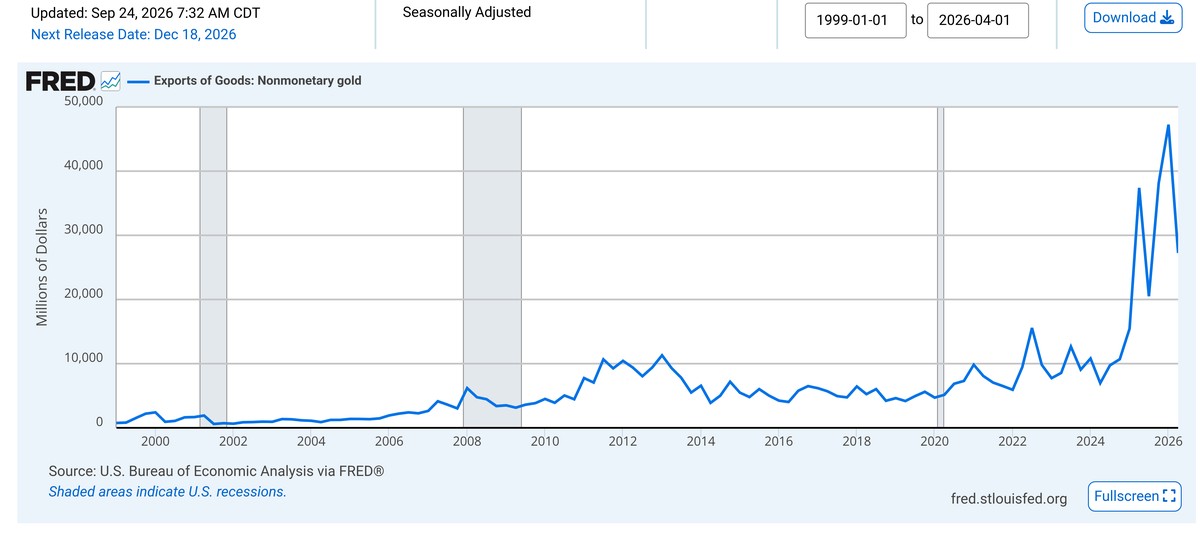 Figure: U.S. “Exports of Goods: Nonmonetary Gold” (Series code IEAXGG, quarterly, seasonally adjusted, Millions of Dollars); spiked to $47.2 billion in Q1 2026, far breaking out of its historical twenty-year corridor. Source: Federal Reserve Bank of St. Louis (FRED)
Outbound customs manifests delineate the transoceanic itinerary of this bullion wave. Departing shipments head predominantly toward three global conduits: first is Switzerland, home to the highest concentration of specialized gold refineries in the world, where large American bars are remelted and assayed into refined kilobars and ingots matching European and Asian delivery standards. Second is the United Kingdom, home of the London Bullion Market Association (LBMA, the global over-the-counter hub for physical clearing), which manages vaulting, custody transfers, and institutional settlement for sovereign entities. Third is Hong Kong, operating as the premier physical gateway into broader Asian markets.
Round-the-clock Swiss smelting operations, coupled with London vault clearings and Hong Kong transshipment logistics, constitute an intercontinental pipeline for physical wealth transfer. With every border crossing, trade surpluses previously held as digital dollar balances are converted into physical delivery. Logistics routing through the world’s three preeminent refining and settlement hubs underscores the institutional and sovereign custody driving this export torrent.
Ledger Invariance at the Vault: Mine Output and Scrap Fill the Cargo Holds
With unprecedented tonnages of bullion leaving U.S. shores each month, observers understandably wonder whether official government vaults are being drained. According to official Treasury reserve audits, however, the sovereign gold stock remains completely untouched—its balance sheet figure has not dropped by a single fine troy ounce. Record-breaking monthly outbound customs manifests on one side, and an immutably static sovereign stockpile on the other, present an intriguing paradox.
The explanation lies in the exact terminology of FRED’s data series: “Nonmonetary Gold” (physical gold trade excluding official transfers between central banks). Under international balance-of-payments accounting, gold is partitioned across two separate ledgers: reserve gold transferred directly between sovereign central banks is designated “monetary gold.” So long as the U.S. government does not directly liquidate bullion housed at Fort Knox or West Point, those official sovereign holdings remain entirely static. Inbound customs tallies of exported bullion instead comprise newly mined ore from domestic U.S. mines alongside secondary recovered gold recycled from discarded jewelry, electronic scrap, and private bars.
While this accounting firewall safeguards the headline figure of official U.S. gold reserves, it cannot obscure the continuous drain of domestic physical supply. Newly excavated mine output across the country, blended with scrap bullion recycled and recast by refiners, is packed into air cargo crates Bound for Zurich and London before ever having the chance to settle into domestic balance sheets. Exporting an entire nation’s annual mine production and secondary scrap as ordinary merchandise essentially exchanges physical collateral for digital trade surplus entries.
The Reserve Balance Tips: Global Central Banks Trade Treasuries for Bullion
Who is absorbing the relentless stream of gold departing American ports? Examining aggregate global sovereign balance sheets reveals a defining milestone of the post-war financial architecture: the aggregate market value of gold reserves held by foreign central banks has officially overtaken their total holdings of U.S. Treasuries. For decades, international trade ran on a familiar loop: foreign nations exported goods to earn dollars, then recycled those balances back into U.S. Treasury bonds. With the physical value of bullion in foreign central bank vaults eclipsing Treasury debt balances, the foundation of that recycling engine is shifting.
 Figure: Story illustration (Adobe Stock photo); the aggregate value of foreign central bank gold reserves has surpassed their holdings of U.S. Treasuries. Source: Numismatic News / Adobe Stock
Conventional financial orthodoxy long viewed gold with skepticism: it pays no yield and incurs ongoing vault security, insurance, and environmental climate control costs. By contrast, U.S. Treasuries offer deep liquidity and regular coupon payouts, cementing their status as the cornerstone of global foreign exchange reserves. Yet that classic textbook premise hinges entirely on one foundational assumption: the purchasing power of the dollar must remain durable over time. When sovereign debt expands relentlessly and currency value is gradually diluted, fixed coupon yields fail to compensate for the real erosion of principal.
For central banks stewarding national reserves, book-entry debt instruments also entail counterparty risk (the vulnerability that an issuer defaults or access is impaired by political and regulatory sanctions), whereas allocated bullion locked inside a sovereign vault requires no foreign government guarantee. Bypassing Treasury yields to acquire freshly refined bars straight from American mines represents a decisive vote of confidence in tangible value. With foreign central bank gold holdings officially eclipsing their U.S. Treasury portfolios, the primary role of bullion has unequivocally shifted from ornament and industrial input to a premier currency substitute.
A Modern Echo of 1834: Currency Dilution Reawakens Monetary Instincts
Deploying physical gold to hedge against fiat debasement has clear historical precedent on American soil. In 1834, the U.S. Congress enacted the Coinage Act of 1834, adjusting the statutory gold-to-silver mint ratio from 15:1 to 16:1. This legislative shift lowered the legal gold content required in newly minted American gold coins. The moment the law took effect, all full-weight pre-1834 U.S. gold coins instantly held intrinsic metal value substantially exceeding their stamped dollar face values.
Market participants reacted swiftly and rationally. Merchants, bankers, and private citizens withdrew full-weight pre-1834 gold coinage from active circulation, feeding whole bags into crucibles to be melted into bullion for sale at market spot prices or exported overseas. That wave of demonetization melted down the vast majority of early U.S. gold coins produced prior to 1834; surviving specimens rank today among the rarest prizes in numismatic auctions.
Nearly two centuries ago, when legislation altered the gold content of the currency, citizens turned coins into ingots; today, as international authorities question the dollar’s long-term purchasing power, central banks are channeling newly mined and recycled American bullion straight into sovereign vaults. From gold cementing its place as the top U.S. export since October 2025 to outbound flows hitting $47.2 billion in Q1 2026, customs statistics reaffirm an age-old monetary reality. As America ships reserve collateral across the oceans, and foreign gold stockpiles overtake U.S. debt, gold has discarded its ornamental disguise to reclaim its seat as the ultimate hedge against fiat currency.
References:
- Numismatic News: Gold Now Top U.S. Export
- St. Louis Fed FRED: Exports of Goods: Nonmonetary gold (IEAXGG)
- Hacker News Discussion