On October 21, 2026, the PHP project urgently rolled out security updates addressing two critical 9.2-severity vulnerabilities in core code powering nearly 80% of all dynamic websites. However, six hours before the coordinated embargo lifted, malicious scanners had already begun targeting servers globally. A distribution partner prematurely published container images, exposing the unannounced patch details to attackers worldwide.
Container Vendor Pushes Images 6 Hours Early, Shattering Coordinated Disclosure
Coordinated vulnerability disclosure (CVD) serves as a foundational pillar of modern cybersecurity. By coordinating a synchronized release window, defenders are granted critical lead time to patch before exploitation begins. But when an upstream partner breaks embargo, the defensive runway collapses instantly, destroying confidential trust established over years.
Official timeline records show container vendor Chainguard pushed updated container images at 07:41 UTC on October 21—six full hours prior to the coordinated announcement. Because public container registries allow anyone to freely pull images, security researchers and threat actors diffed the new layers against previous ones, pinning down the exact vulnerability within ten minutes.
In modern cloud-native architectures, container images are public artifacts. Anyone pulling an image can extract granular source diffs in minutes using automated comparison tools. Fast automated CI/CD build pipelines effectively converted a sensitive patch into a public roadmap for weaponization. The downstream drive for rapid turnaround completely severed upstream synchronization.
Telemetry from multiple security firms confirmed the immediate fallout. Within two hours of the registry push, Cloudflare observed an aggressive surge in reconnaissance scans across public IP ranges. Security firm watchTowr subsequently detected live in-the-wild exploitation attempts, and working public exploits surfaced in hacker communities shortly after. Long before defenders even received notification emails, attackers already wielded turn-key exploits.
 Figure: Datadog Security Labs header research graphic analyzing the php2shell vulnerability. Source: Datadog Security Labs.
The vulnerable code span impacted PHP branches 8.2, 8.3, 8.4, and 8.5. The official patch releases landed as versions 8.2.35, 8.3.36, 8.4.27, and 8.5.12. Although security organizations assigned advisory identifiers shortly after, exploit scripts were already circulating freely. Conventional security advisory workflows simply could not keep pace with pipeline leaks.
A 12-Year-Old Code Path Turns Memory Limits into an Execution Backdoor
The flaws causing widespread panic carry catastrophic potential. Tracked under CVE-2026-109618 and CVE-2026-109619, both vulnerabilities earned a critical CVSS score of 9.2. Unauthenticated remote attackers can take complete control of backend worker processes simply by transmitting crafted network requests. Datadog Security Labs dubbed the attack chain “php2shell”.
The vulnerable code path traces back to PHP 5.4.0, introduced in 2012. For twelve years, the runtime relied on memory limits (memory_limit) as a safeguard against resource exhaustion. When a script breached its memory cap, the engine threw an out-of-memory (OOM) exception, aborted execution, and tore down allocated objects.
Under the hood, PHP allocates runtime memory using Zend Engine’s memory manager. Under normal conditions, each HTTP request operates inside an isolated memory pool. Upon request completion, the runtime reclaims all pooled memory and readies the worker for subsequent connections. However, during bailouts triggered by memory exhaustion, an abnormal invocation sequence in object destructors disrupted the memory block lifecycle.
This self-protection mechanism consequently became an arbitrary code execution backdoor. When memory exhaustion occurred at specific execution boundaries, cleanup routines left unreset global pointers. Attackers could craft request payloads of a precise byte size to trigger OOM, hijack dangling pointers, and redirect process execution flow. The exploit chain operates quietly, bypassing most conventional signature-based traffic inspect filters.
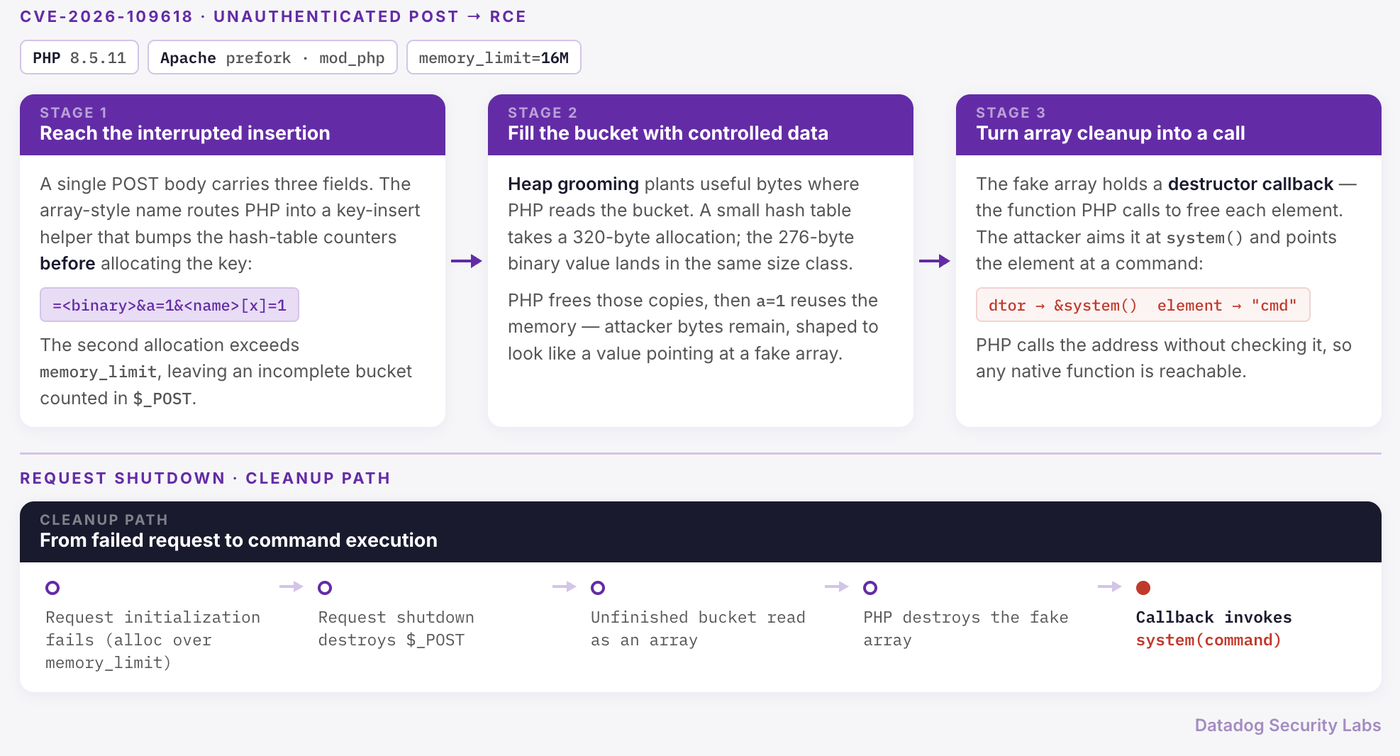 Figure: Step-by-step diagram showing how CVE-2026-109618 leverages OOM cleanup flaws to achieve remote code execution. Source: Datadog Security Labs.
The blast radius spans the modern web landscape. More than 40% of all websites globally run on WordPress, and major e-commerce frameworks rely heavily on PHP runtimes. Cloud giant AWS promptly issued security bulletin 2026-143-aws, urging hosted workload operators to audit instances immediately. With core infrastructure shaken, sysadmins faced global scanning before receiving formal vulnerability notices.
Three Competing Engineering Trade-offs Paralyzed Official Fixes for Months
Perplexingly, core maintainers were aware of the vulnerability months in advance. Security research firm Quarkslab had identified and reported the underlying flaw in late 2024. The PHP Foundation subsequently admitted that delaying the patch was a severe engineering failure, driven by three irreconcilable technical trade-offs.
Modifying the memory model of a 30-year-old runtime ecosystem presents immense friction. The first proposed fix broke backward compatibility with native C extensions. The second fix—immediately terminating erratic processes—introduced severe denial-of-service (DoS) vulnerabilities, allowing low-bandwidth request flooding to crash entire application clusters.
The third proposal would have required recompiling thousands of third-party C extensions across the global ecosystem. Facing the stability demands of hundreds of millions of production sites, every viable architectural change threatened massive operational disruption. Protracted deliberation over these trade-offs stalled decisive action, leaving critical vulnerabilities lingering in private repositories for months.
Automated Pipelines Outrun NDAs, Shattering Downstream Defenses
The challenging engineering reality necessitated an orchestrated, multi-vendor deployment. To support smooth upgrades across versions, the core team shared advance access with select distribution partners under embargo. However, modern cloud automation systems do not honor human legal agreements.
Cloud-native container distributors tout immediate security patching as a flagship feature. When upstream private repositories staged release candidate commits, automated CI/CD pipelines picked them up, compiled fresh binaries, and built container layers without intervention. Unattended automation bots strictly executed release rules, skipping human communication calendars entirely. The moment images landed in public registries, embargoed vulnerability details became public domain.
This failure highlights an operational chasm between open-source governance and commercial automation. Open-source maintainers rely on social trust and synchronized embargoes, whereas downstream vendors have delegated deployment authority to automated scripts. Once code enters commercial distribution pipelines, human intervention cannot easily halt the countdown to disclosure.
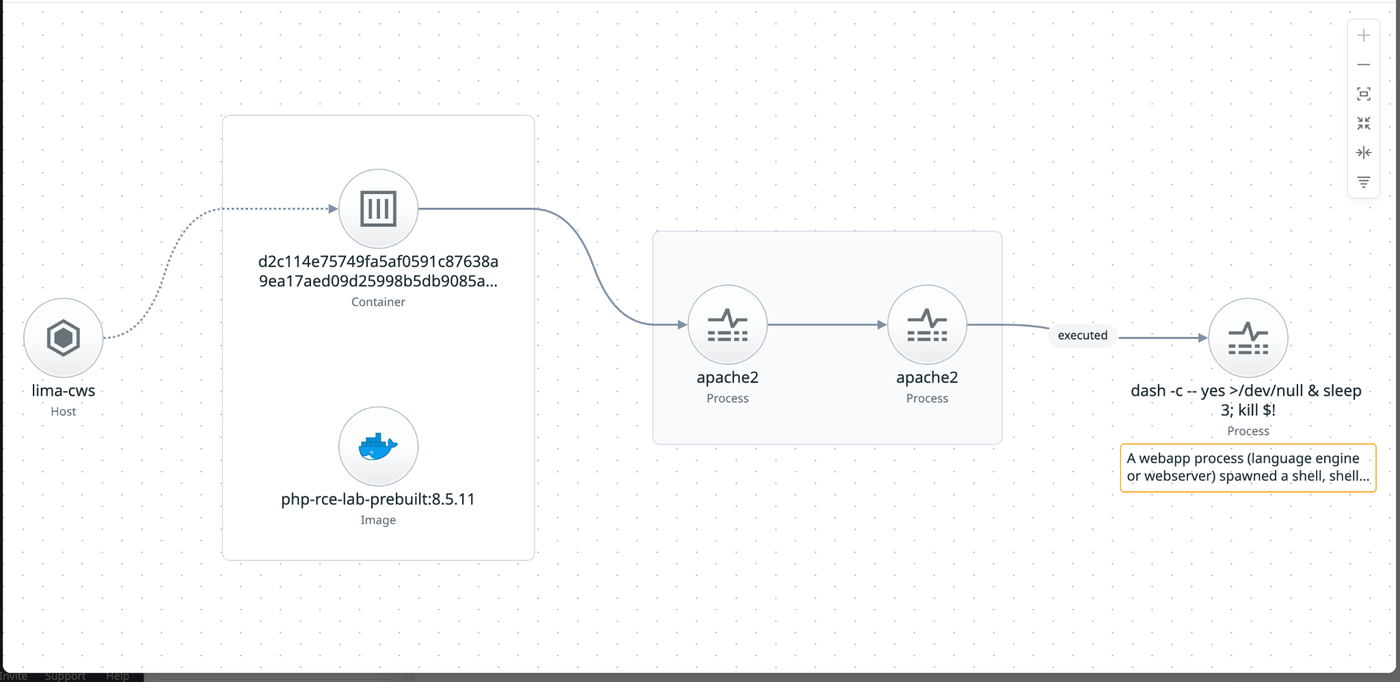 Figure: Investigation graph from runtime security defenses tracing an active attack path. Source: Datadog Security Labs.
Commercial incentives prioritizing “zero-delay patching” metrics undermine defensive depth across the wider internet. When automated speed supersedes coordinated safety, the short-term agility praise garnered by first-to-patch vendors is paid for by the broader community. The runner broke embargo for bragging rights, while the collective defensive ecosystem absorbed the fallout.
Auditing Legacy Code with AI Cannot Fix Ecosystem Distribution Failures
Faced with mounting maintenance burdens, the PHP Foundation is accelerating structural reforms. In 2026, the team established a dedicated Ecosystem Security Group and brought on full-time security engineers focused on legacy codebases. Partnering with external institutions, they deploy advanced AI reasoning models to audit millions of lines of legacy C code, uncovering subtle pointer hazards that evaded human review for decades.
To address engineering deficits, maintainers continue scaling full-time security staff and leveraging frontier models to inspect legacy code paths. Automated tools excel at spotting out-of-bounds reads and dangling pointers. Yet while algorithms accelerate code audits, computational power alone cannot sustain ecosystem coordination and trust.
Uncovering security bugs only resolves the first hurdle. When patches must traverse an intricate web of global cloud and container providers, the real challenge begins. No matter how swiftly audit algorithms run, they cannot prevent an automated pipeline from leaking embargoed fixes at the finish line. Technological solutions alone cannot heal broken trust across the software distribution chain.
This incident serves as a stark wake-up call for open-source supply chains. As long as structural misalignments between upstream development and downstream delivery remain unresolved, premature disclosures will recur. Rather than merely patching legacy pointers, the open-source community must redesign vulnerability distribution protocols tailored to an automated world.
References:
- PHP Foundation: Official announcement regarding today’s security release and security strengthening initiatives.
- Datadog Security Labs: php2shell technical deep-dive report on critical PHP vulnerabilities.
- AWS Security Bulletin: Security notification regarding PHP remote code execution vulnerabilities.