
Step outside on a crisp late-October night—taking out the trash or walking home after a long shift—and tilt your gaze upward. Every few minutes, a sudden streak of incandescence might slash across the darkness.
According to the latest advisory from BBC Weather, the Orionid meteor shower—an annual celestial display caused when Earth plows through the debris stream shed by Halley’s Comet—has officially begun. The shower will remain active through November 7.
The peak arrives on the night of October 21 into the early morning of October 22, when observers can expect between 10 and 20 meteors per hour under clear, dark skies.
While astronomy enthusiasts eagerly anticipate the return of Halley’s Comet (Comet 1P/Halley, with its famous ~76-year orbital period) in 2061, skywatchers do not need to wait another 35 years. Every glowing streak seen overhead this month is a microscopic calling card delivered directly from Halley itself.
Peak Activity on October 21: A Rendezvous 35 Years Ahead of Schedule
Halley’s Comet is arguably the most storied celestial traveler in recorded astronomical history. With an orbital period of roughly 76 years, its last close encounter with Earth was in 1986, and its next perihelion voyage will not happen until 2061.
For most people, the chance to view the comet’s icy nucleus—a pristine, dirty snowball of volatile frozen gases and primordial dust—comes at best once in a lifetime. Yet that long orbital intermission does not mean humanity is cut off from the comet for three-quarters of a century.
As comets loop around the Sun, solar radiation heats their surfaces, boiling off volatile gases and releasing clouds of rocky dust. Long after the comet swings back out toward deep space, these fragments linger along the orbital path, forming a vast, diffuse stream of cosmic litter.
Each year, Earth’s orbit intersects this ancient debris belt twice. The first crossing occurs in May, creating the Eta Aquariid meteor shower; the second rendezvous is happening right now with the October Orionids.
Twenty Meteors an Hour: Ancient Debris in Earth’s Orbital Path
The shooting stars slicing through the upper atmosphere are, fundamentally, a high-speed collision between our planet and Halley’s remnants.
Away from city light pollution, the peak produces roughly 10 to 20 visible meteors per hour. That translates to a brief, brilliant flash of atmospheric combustion every three to six minutes.
Viewed in everyday terms, these fiery projectiles are astonishingly tiny. The overwhelming majority of meteoroids responsible for the Orionids measure between a few micrometers and several millimeters across—finer than a single grain of rice or a flake of beach sand.
Pebbles and dust particles cast off by Halley’s Comet centuries ago have drifted silently in the vacuum of space, entirely undisturbed. Only when Earth plows through the stream at nearly 30 kilometers per second do these microscopic grains strike our atmosphere.
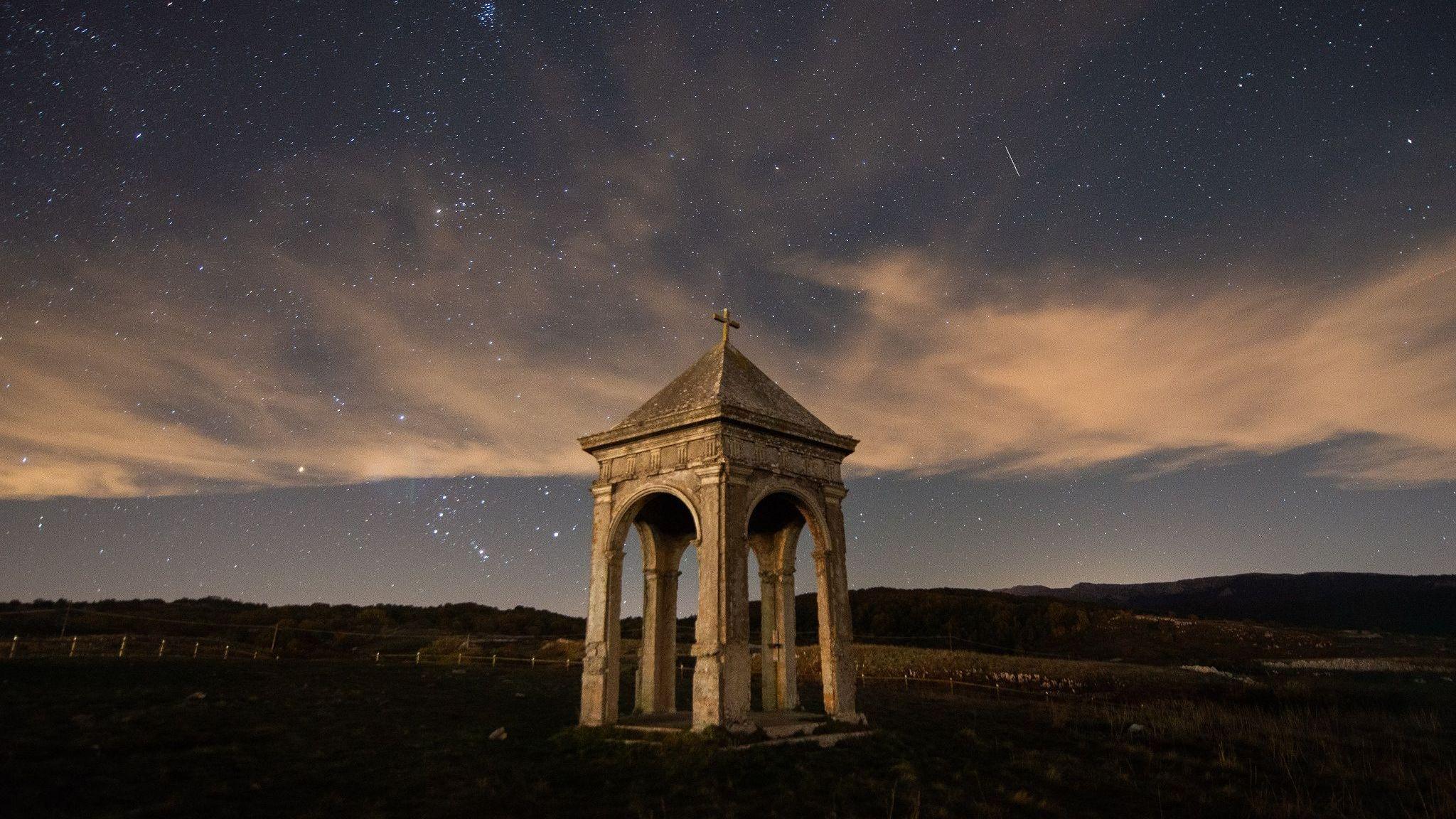 Figure: The Orionid meteor shower lighting up the night sky above Abruzzo, Italy. Source: BBC Weather (NurPhoto/Getty Images)
Blistering Speeds Ignite Grain-Sized Cosmic Dust
Why does a grain of dust no larger than a grain of rice produce such an intense blaze visible from eighty kilometers below? The secret lies in sheer relative velocity.
Orionid meteoroids strike the upper atmosphere at an astonishing speed of roughly 66 kilometers per second (about 41 miles per second, or nearly 148,000 mph). To put that in perspective, a traveler moving at that pace could journey from London to Paris in under five seconds, or across the entire continental United States in a little over a minute—outpacing high-speed trains by a factor of hundreds.
At such extreme speeds, atmospheric compression heats the incoming particle to thousands of degrees Celsius almost instantaneously. The surrounding atmospheric molecules are stripped into an ionized incandescent plasma, creating the brilliant streak of light.
During this violent ablation, larger grains frequently leave behind persistent trains—glowing corridors of ionized gas that remain visible for several seconds after the meteor itself has vanished. It is Halley’s flash-in-the-pan signature, announcing in seconds a voyage centuries in the making.
The Radiant in Orion: How to Spot Meteors with the Naked Eye
Novice stargazers often make the mistake of staring directly at the constellation Orion, assuming meteors will only appear there.
In observational astronomy, the radiant point—the celestial coordinate from which all meteor paths appear to diverge due to perspective—is merely a visual projection. The shower is named the Orionids simply because tracing their trails backward points toward the northeastern edge of Orion, near the border with Gemini.
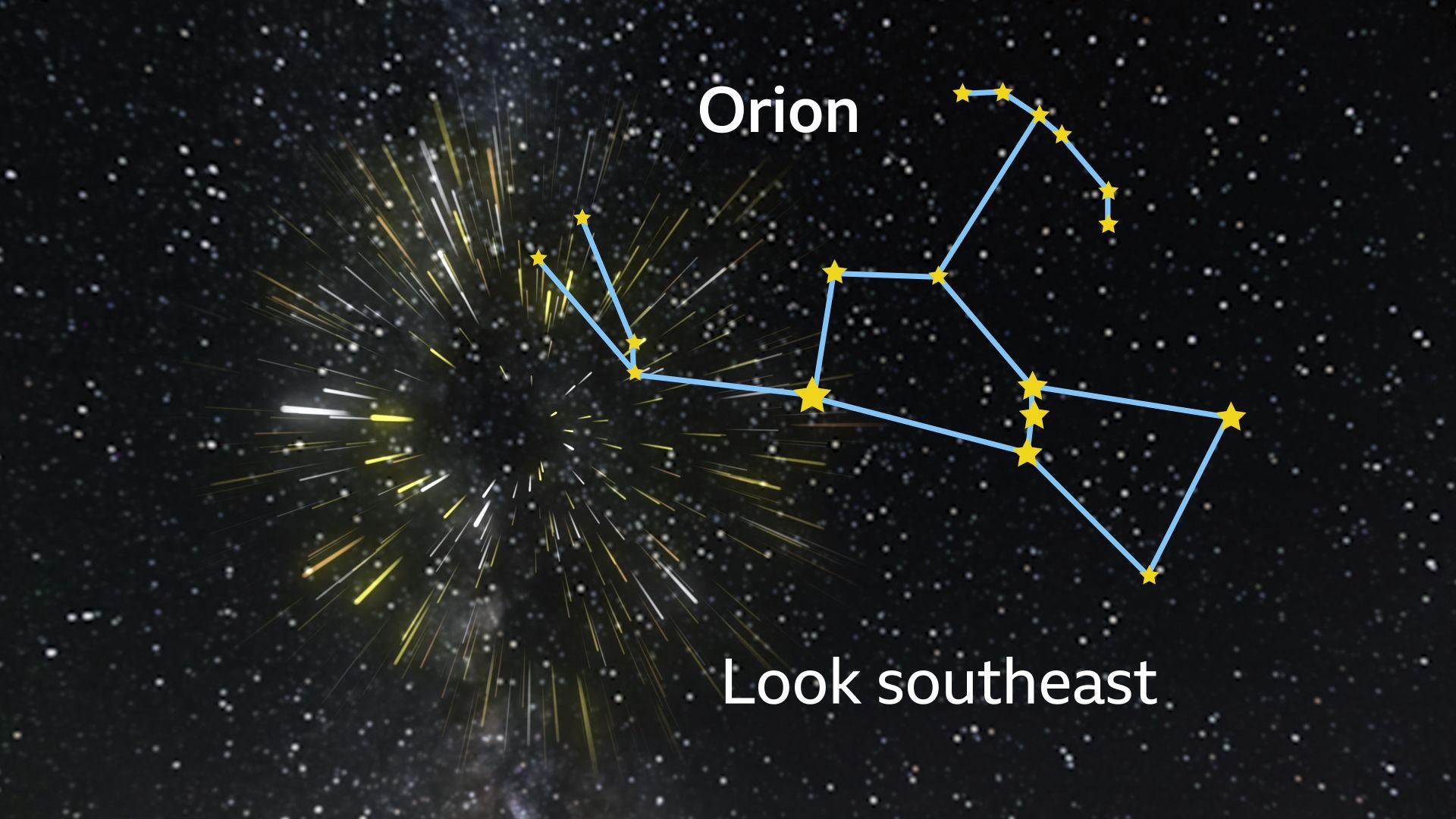 Figure: The recognizable constellation pattern of Orion in the night sky. Source: BBC Weather
In reality, meteors can ignite across any quarter of the sky. While Orion climbs higher after midnight, providing better viewing geometry, restricting your gaze to any single cluster of stars is counterproductive.
Observing a meteor shower requires virtually no specialized gear. Telescopes and binoculars actually hurt your chances because their narrow field of view cuts out the wider sky. The human eye, with its expansive peripheral vision, remains the best instrument for catching random streaks. All you need is an open vantage point free from streetlights, lying back and scanning the canopy overhead.
Moonlight Challenges and the Best Hours to Watch
For the 2026 display, lunar conditions present a moderate hurdle.
The Moon reaches full phase on October 26, meaning that during the October 21-22 peak, a bright waning gibbous moon will wash out dimmer meteors like a natural light filter.
While this lunar wash reduces the overall tally of faint shooting stars, the Orionids are renowned for high speed and brightness, with occasional fireballs easily piercing through moonlight. Astronomers advise observing between midnight and the onset of dawn, when the constellation Orion stands highest in the southern sky and meteors plunge through a deeper cross-section of the atmosphere.
Once outside in the dark, give your eyes 15 to 20 minutes to adapt to the darkness. Put away glowing smartphone screens to preserve your night vision. That brief adjustment window dramatically improves your odds of catching even subtle flashes across the night sky.
A Comet Hidden in Deep Space, an Annual Legacy on Earth
Halley’s Comet itself is currently near aphelion—the furthest reach of its elongated elliptical orbit—tucked away billions of kilometers out in the freezing outer Solar System. Even through the largest professional optical telescopes, its nucleus is nearly impossible to spot.
Yet the trail of tiny particles it jettisoned centuries ago continues its quiet loop around the Sun. Every autumn, Earth keeps its appointment with that stream, transforming dormant space dust into fleeting flashes of light.
There is no need to wait until 2061 to catch a glimpse of Halley. As you stand under the crisp October sky and watch a meteor burn across the darkness, you are already watching a piece of Halley’s Comet come home.
References:
- BBC Weather Report