The Git project is targeting late 2026 for Git 3.0, planning to make SHA-256 the default object format for all newly initialized repositories. Alongside this shift, the milestone release intends to mandate a Rust build toolchain, make reftable the default reference backend, and drop a slate of long-deprecated commands. While a buffer period remains before general availability, engineering teams and tooling authors need to audit their compatibility now.
Ecosystem-Wide Verification Triggered by a Default Change
Core maintainers emphasize that legacy SHA-1 repositories will continue to operate normally under Git 3.0. This messaging attempts to quarantine the breaking changes strictly to greenfield projects. In real-world engineering environments, however, altering the default for new repositories effectively severs the smooth evolution of the existing ecosystem. The moment an engineer initializes a new local scratchpad repository, older IDE plugins refuse to parse it. Aging deployment pipelines and release automation immediately slam into error walls caused by dual-format conflicts.
The fundamental risk stems from the tooling ecosystem’s deeply entrenched assumption that object hashes are 40 hexadecimal characters. In new repositories, identifiers suddenly expand to 64 characters. This jump in string length shatters parsing rules, regexes, and log scrapers written across the industry over the past fifteen years. Continuous integration runners and release dashboards will throw immediate truncation or unhandled format exceptions the first time they process commit objects from a SHA-256 repository.
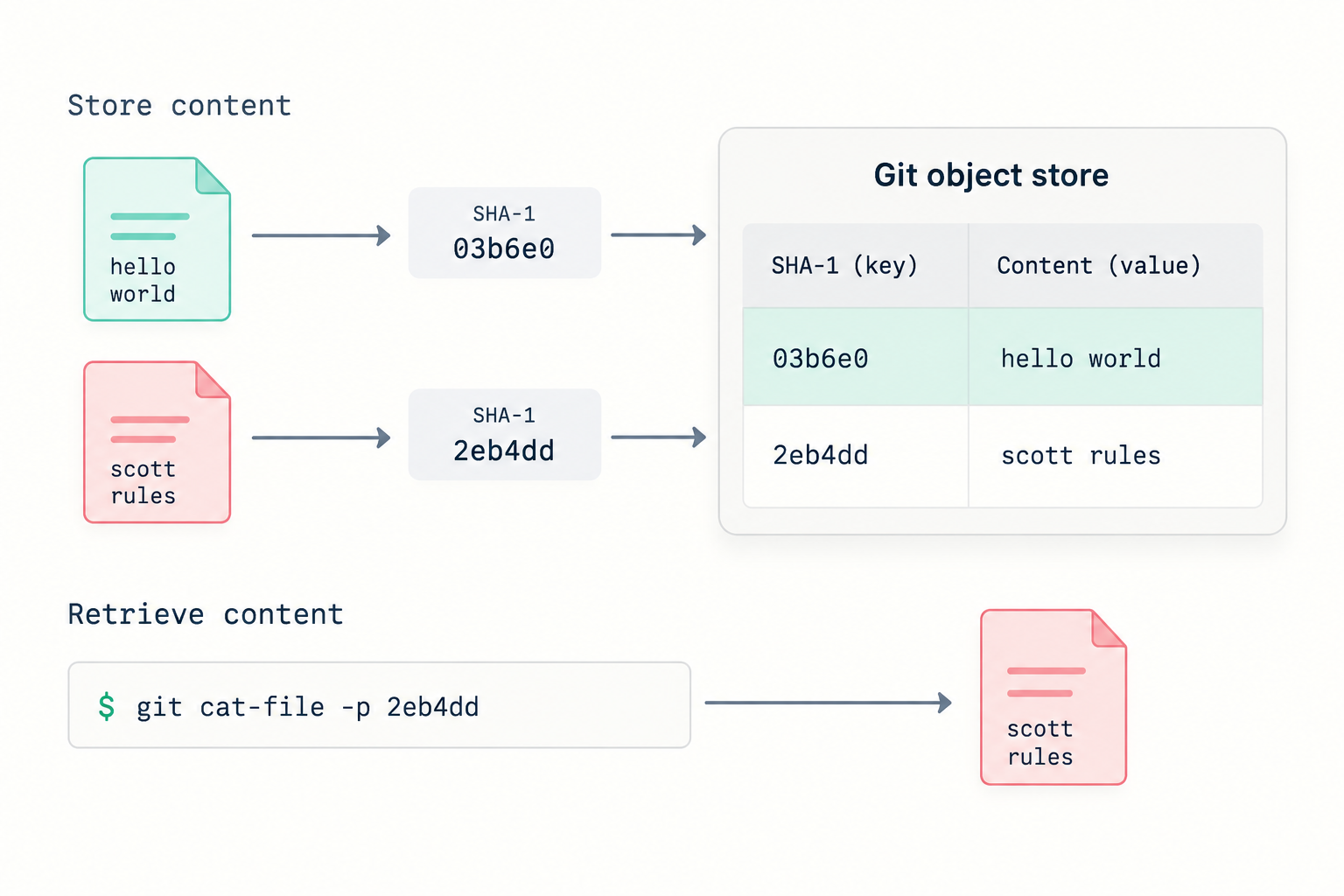 Figure: Diagram illustrating Git as a key-value object database using content hashes. Source: GitButler / Butler’s Log
Git has actually supported experimental opt-in SHA-256 repositories since 2018, allowing security-conscious teams to migrate manually. Over that eight-year window, however, the number of projects willing to shoulder the friction of an optional migration has been virtually negligible. Flipping the default setting has thus become the core team’s only realistic lever to forcefully drive adoption across the broader ecosystem.
Why Collision Attacks Are Not Second-Preimage Attacks
NIST formally placed SHA-1 on its deprecation list back in 2011, establishing a clear regulatory verdict fifteen years ago and mandating its retirement by 2030. The primary argument from Git’s core contributors for switching the default is straightforward: newly minted codebases should not continue to rely on an algorithm that security standards bodies have officially repudiated.
Critics such as Scott Chacon point out that this rationale conflates distinct levels of cryptographic threat. The security research community demonstrated practical collision attacks against SHA-1 in the 2017 SHAttered milestone and the 2020 SHA-1 is a Shambles paper. However, engineering two specially crafted files that share an identical hash digest is entirely different from mounting a second-preimage attack—forging malicious code to match an existing, pre-determined commit without altering its hash.
In software engineering reality, mounting a second-preimage attack against an existing repository remains computationally out of reach. Even if Git downgraded its integrity check to MD5—an algorithm universally recognized as fundamentally broken—a brute-force second-preimage attack would remain impossible. If every one of the roughly 3 billion GPUs on Earth were magically replaced with an RTX 5090 running at peak capacity, cracking a preimage would still take on the order of 16 billion years. Existing global compute capacity cannot bridge the astronomical chasm between theoretical cryptographic vulnerabilities and practical exploits.
Furthermore, weaponizing an academic collision attack within real-world development workflows lacks operational feasibility. An attacker would first need write access to the upstream repository, insert carefully crafted malformed binary bloat into a commit, and then convince upstream maintainers to merge that specific branch. Constructing an elaborate malicious artifact merely to coax a merge yields virtually zero return on investment in real-world cybercrime.
Trust Derives from Where You Pull, Not the Hash Function
This debate touches the core architectural boundaries of source code management security. Linus Torvalds articulated this philosophy back in 2005: the true line of defense is in distribution, not in relying on a cryptographic formula. What determines the security baseline of a developer’s machine is which trusted server updates are pulled from. That operational trust is far more decisive than whichever checksum algorithm was executed on the local disk.
Real-world software supply chain attacks overwhelmingly favor social engineering over cryptographic cryptanalysis. Threat actors routinely bribe maintainers of abandoned open-source packages or patiently pose as contributors for months to obtain commit rights—as witnessed in the high-profile xz backdoor incident of 2024. Securing direct commit privileges to inject a trojan is billions of times cheaper, faster, and more reliable than burning enormous compute farms to engineer a hash collision.
Treating hash bit-length as the primary fortress against malicious code injection blinds teams to genuine authentication gaps across build and delivery pipelines. Swapping out a release tarball beneath a validly signed tag requires no collision whatever. Stopping poisoned artifacts depends entirely on the airtightness of release pipelines; lengthening the object hash by 24 characters cannot plug that operational hole.
The Unbalanced Migration Bill: Incompatible Object Formats
The hardest part of changing the default is that transitioning existing projects cannot happen invisibly in the background.
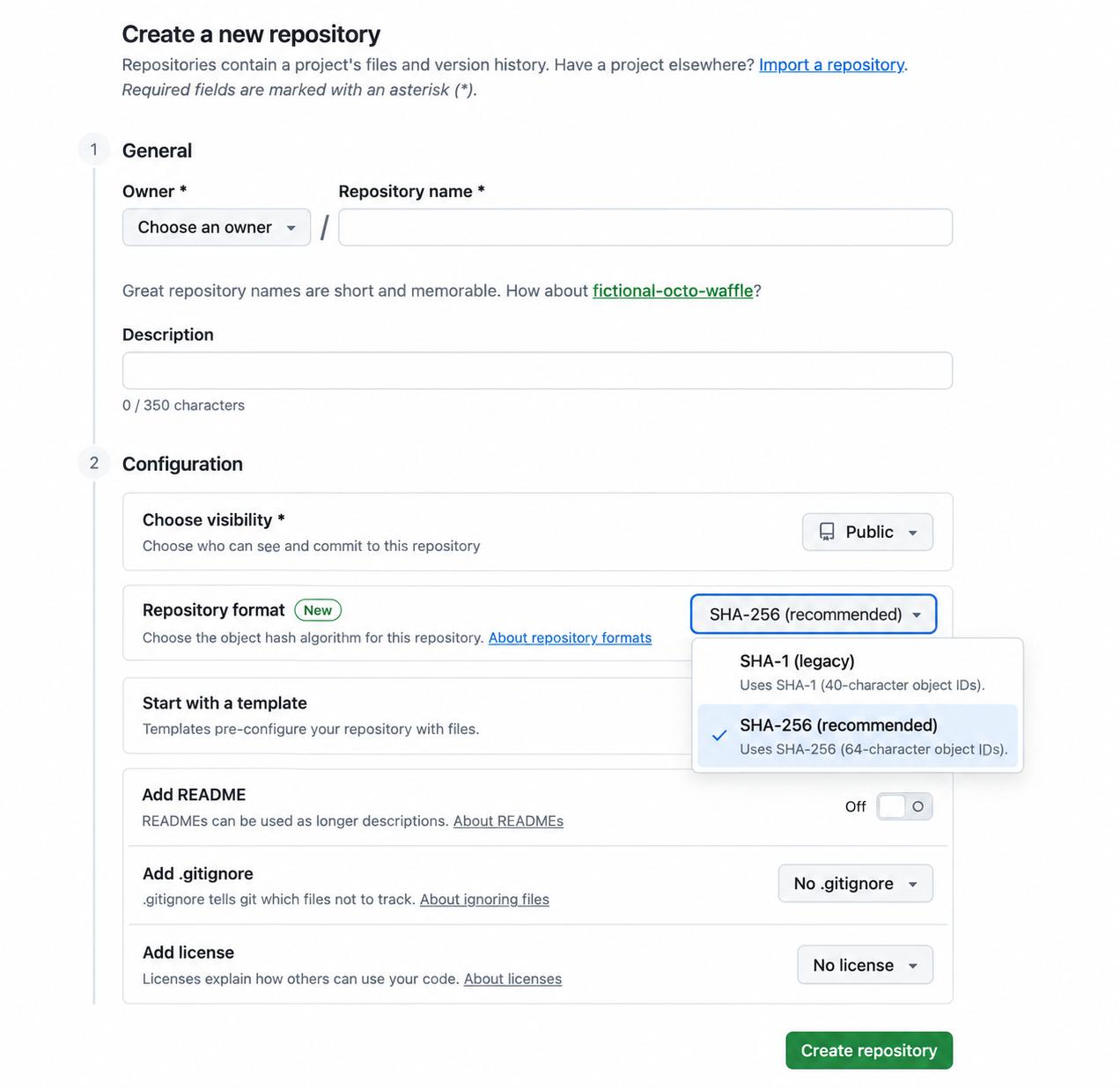 Figure: Hosting platform UI requiring users to explicitly choose an object hash algorithm during repository creation. Source: GitButler / Butler’s Log
Engineering teams creating repositories on internal or self-hosted platforms must manually align client and server configurations. The moment a local Git environment diverges from remote server support, push operations fail immediately. The underlying transport rejects the push with: fatal: the receiving end does not support this repository's hash algorithm.
Migrating a large, established repository requires rewriting its entire historical timeline. Converting a SHA-1 repository to SHA-256 means recalculating and re-encoding every single blob, tree, and commit object. This total reset immediately invalidates all existing GPG and SSH cryptographic commit signatures. Furthermore, engineering wikis, issue trackers, and Slack histories contain countless links referencing 40-character commit hashes; once the underlying history is rewritten, every single one of those references breaks overnight.
Git’s submodule architecture magnifies the fragmentation. Current Git rules require that nested submodules share the exact same object format as their parent repository. If a project depends on a third-party submodule still on SHA-1 while the main project moves to SHA-256, build servers must maintain separate, mirrored checkouts of both formats. If automated build pipelines fail to synchronize this dual-track dependency state, team workflows grind to an abrupt halt.
Many third-party Git libraries and language bindings (such as libgit2 or custom parsers) have been sluggish in rolling out comprehensive SHA-256 support compared to upstream core Git. Industry discussions suggest that engineering leadership at major organizations like Google has considered mandating that internal repositories continue using the legacy SHA-1 format. Large tech firms would rather freeze the underlying hash format than burn senior engineering capacity chasing compatibility errors across their internal toolchains.
The Alternative: Shifting Computational Costs to Commit Signatures
The Git core team’s push for a new standard is not an arbitrary impulse. Object interoperability mapping schemes and transition proposals have been discussed on the Git mailing list for years. From a core maintainer’s perspective, trading short-term migration friction for decades of tamper-proof integrity is a rational architectural trajectory. Systems architects naturally strive to eliminate theoretical weaknesses at the foundational storage layer.
Conversely, dissenters in the community argue for bounding defense expenditures within a pragmatic scope. Independent maintainers propose skipping the disruptive overhaul of the underlying storage format altogether. Instead, they advocate injecting an independently calculated content verification header—such as SHA-256 or BLAKE3—directly into commit and tag signature objects, a pattern pioneered by Colin Walters’ git-evtag.
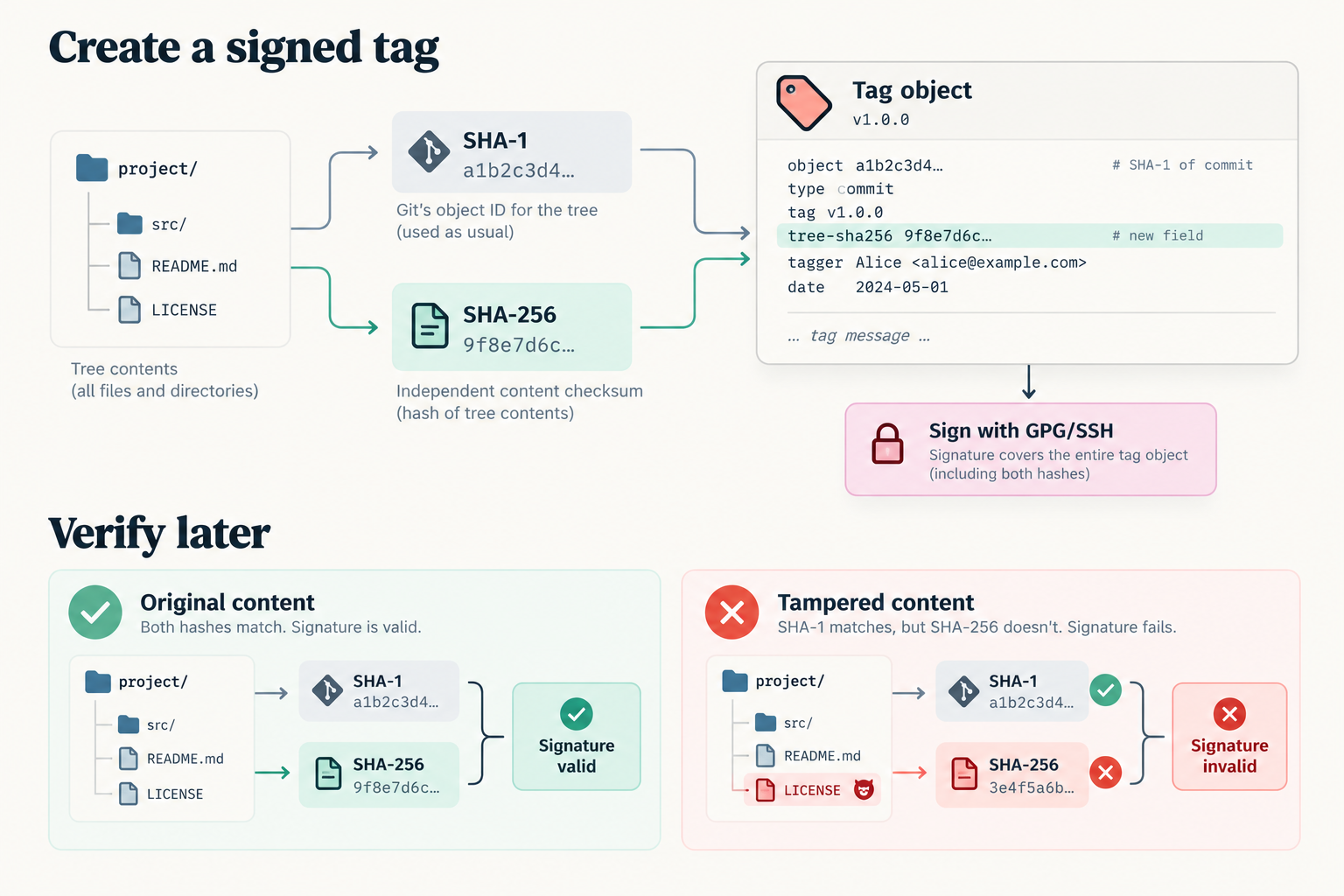 Figure: Diagram showing an independent tree content hash injected into the signed fields of a Git object. Source: GitButler / Butler’s Log
This architecture shifts the computational overhead of cryptographic integrity exclusively to the signing phase. An attacker attempting to forge commit history would be forced to break two completely decoupled verification mechanisms simultaneously.
The primary benefit of an independent verification header is that it shields day-to-day development from ongoing performance penalties. Benchmarks show that computing a checksum across Chromium’s massive 35 GB repository (spanning 2.1 million files) requires just 5 seconds. Processing the Linux kernel’s 1.5 GB tree takes only 257 milliseconds, while a standard small repository completes in 17 milliseconds. By confining the extra hashing workload to release tags and milestone commits, high-frequency daily commits remain free from unnecessary computational overhead.
Forcing repositories onto SHA-256 buys decades of theoretical cryptographic headroom; maintaining the current default spares the software ecosystem an immense migration invoice. The underlying premises of both camps are clear: if you believe the storage hash itself must serve as the foundation of trust, migration cannot begin soon enough; if you believe trust derives from distribution channels and remote sources, the urgency evaporates. The format interoperability mapping debated for years on the mailing list remains the only realistic shock absorber for this transition.
Reference Links:
- Git 3.0 and the SHA-256 Migration
- The hidden cost of Git’s SHA-256 migration