758 Nights, 669 Million Galaxies Counted One by One
The thing about year-end audits is that each line item can look fine on its own, yet the total refuses to reconcile with the ledger. That’s the situation cosmology just ran into: a team of astronomers spent 20 years making the universe’s books as precise as they could, and the cracks in those books only got wider.
The auditor in question is the Dark Energy Survey (DES): launched in 2003, over 400 scientists across 7 countries, with a single goal — count the galaxies in the universe and figure out what the cosmos is made of and how fast it’s really expanding. For that, they built the most powerful digital camera in the world at the time: the 570-megapixel Dark Energy Camera, DECam, mounted on the 4-meter Blanco Telescope in the Chilean Andes.
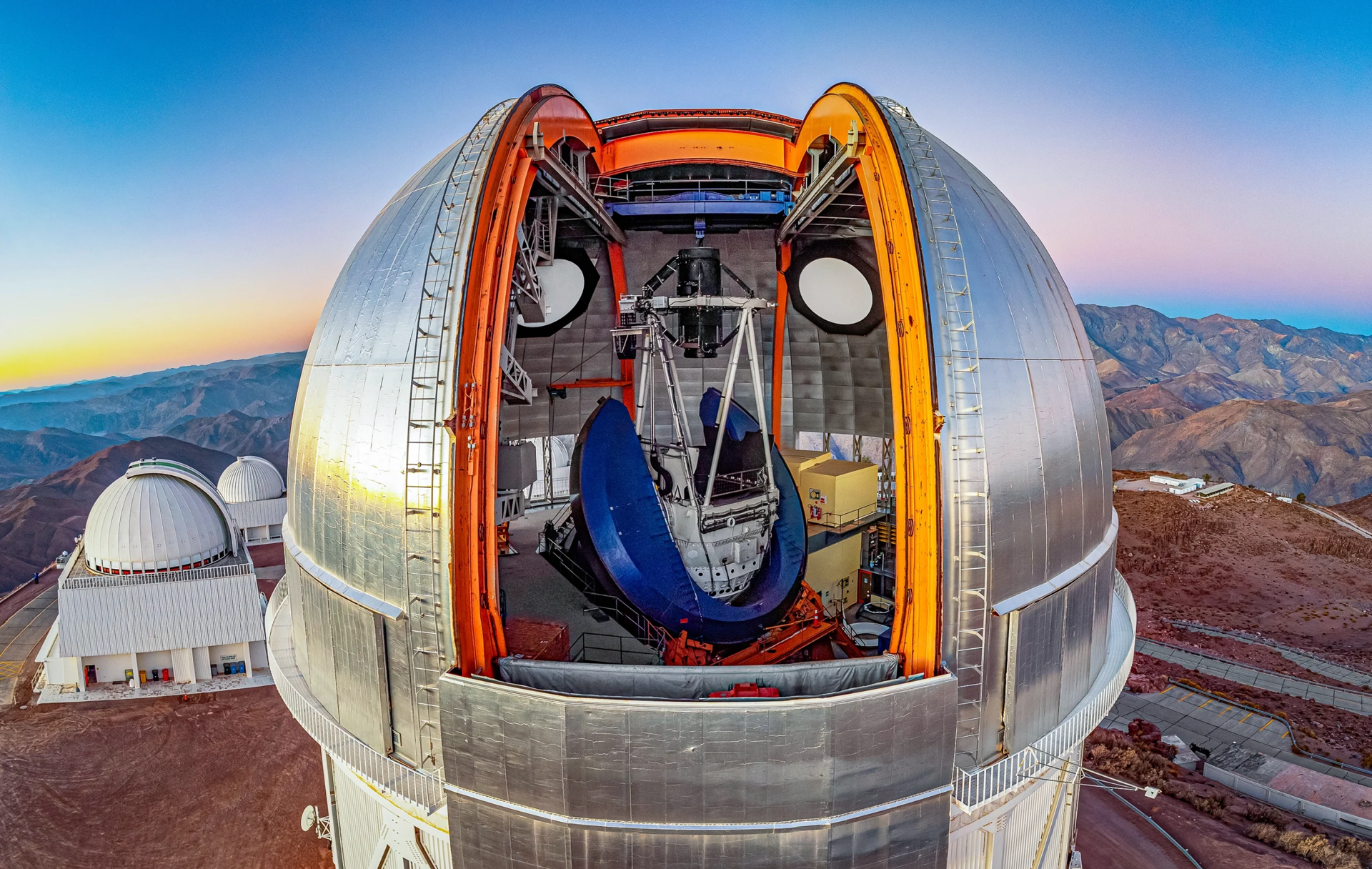 Image: The Blanco Telescope dome at dawn in the Chilean Andes. DES used it to scan the sky for 758 nights. Source: NOIRLab/NSF/AURA
From 2013 to 2019, DES observed on 758 nights — over six years, that’s roughly one night of work for every three. The original plan called for wrapping up in 2018, but El Niño (the climate phenomenon of abnormal ocean warming that disrupts weather worldwide) pushed thick cloud cover over the mountaintop, forcing an extra year of observations to complete the dataset. The final tally: 669 million galaxies, covering about 1/8 of the celestial sphere. Cut the entire sky into eight pieces and DES pinned down one of them.
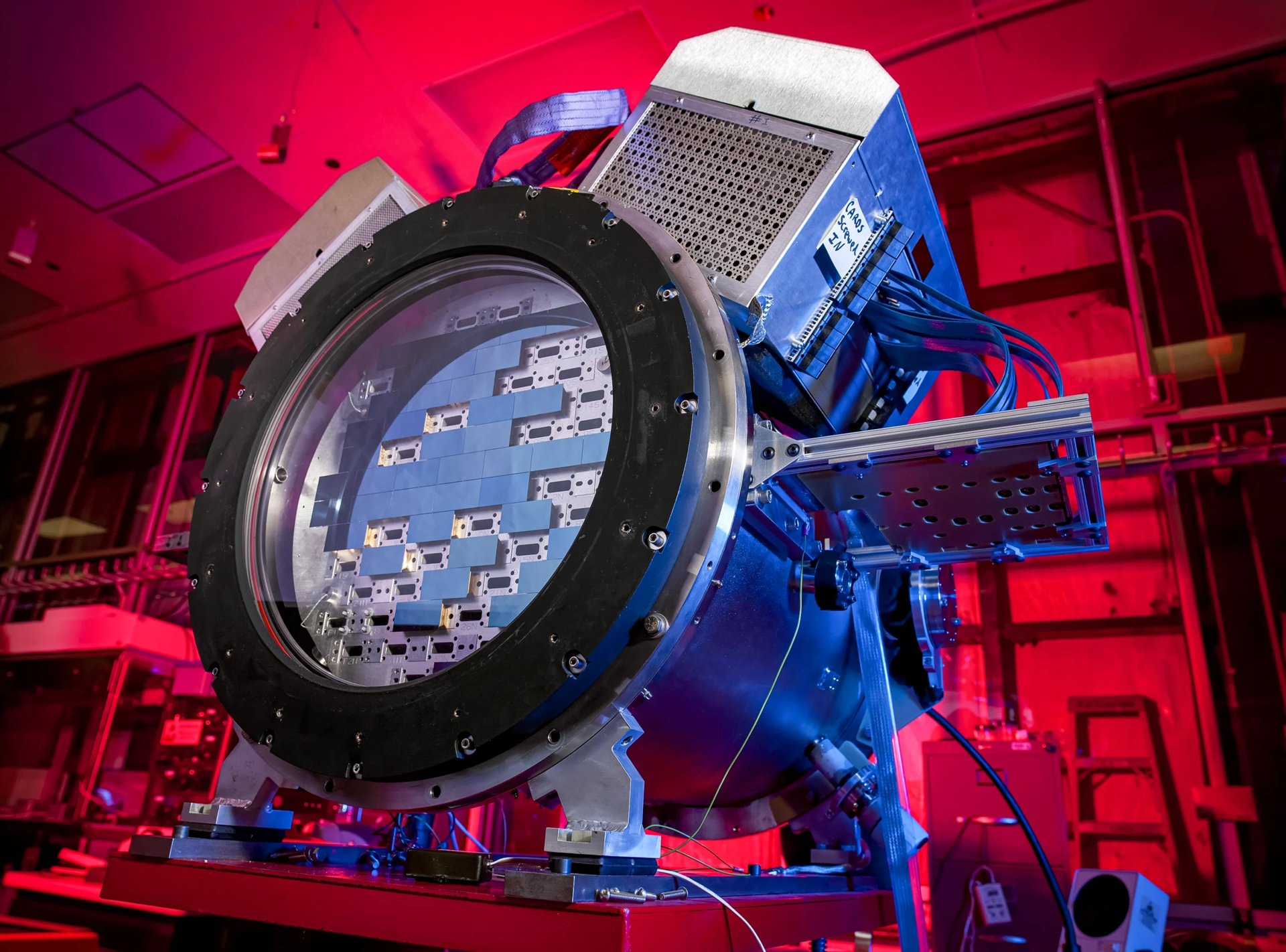 Image: Close-up of DECam’s 570-megapixel CCD focal plane. The eyes of this “most powerful digital camera of its time” captured all 669 million galaxies. Source: DOE/Fermilab/R. Hahn
1998: Supernovae Blew Dark Energy Into the Open
The ledger’s framework dates to 1998. Two teams were independently tracking a class of stellar explosions — supernovae (the violent death throes of stars, which can briefly outshine an entire galaxy) — hoping to log an entry on the universe’s expansion rate. Instead, they recorded an answer nobody expected: the expansion is accelerating. Some invisible push lurks behind the cosmos, and scientists named it dark energy (the mysterious driver making the universe expand ever faster). Under the current recipe, it accounts for about 70% of the universe.
The remaining ~30% is matter, most of it dark matter (substance that neither emits nor blocks light, revealing itself only through gravity); ordinary matter — the stuff of stars, Earth, and our own bodies — makes up just a small slice. Write these proportions into the equations and you get the standard cosmological model, formally known as Lambda-CDM: the universe’s master ledger. Feed in a few parameters, and it computes how the cosmos expanded from the beginning to now, and how galaxies clustered along the way.
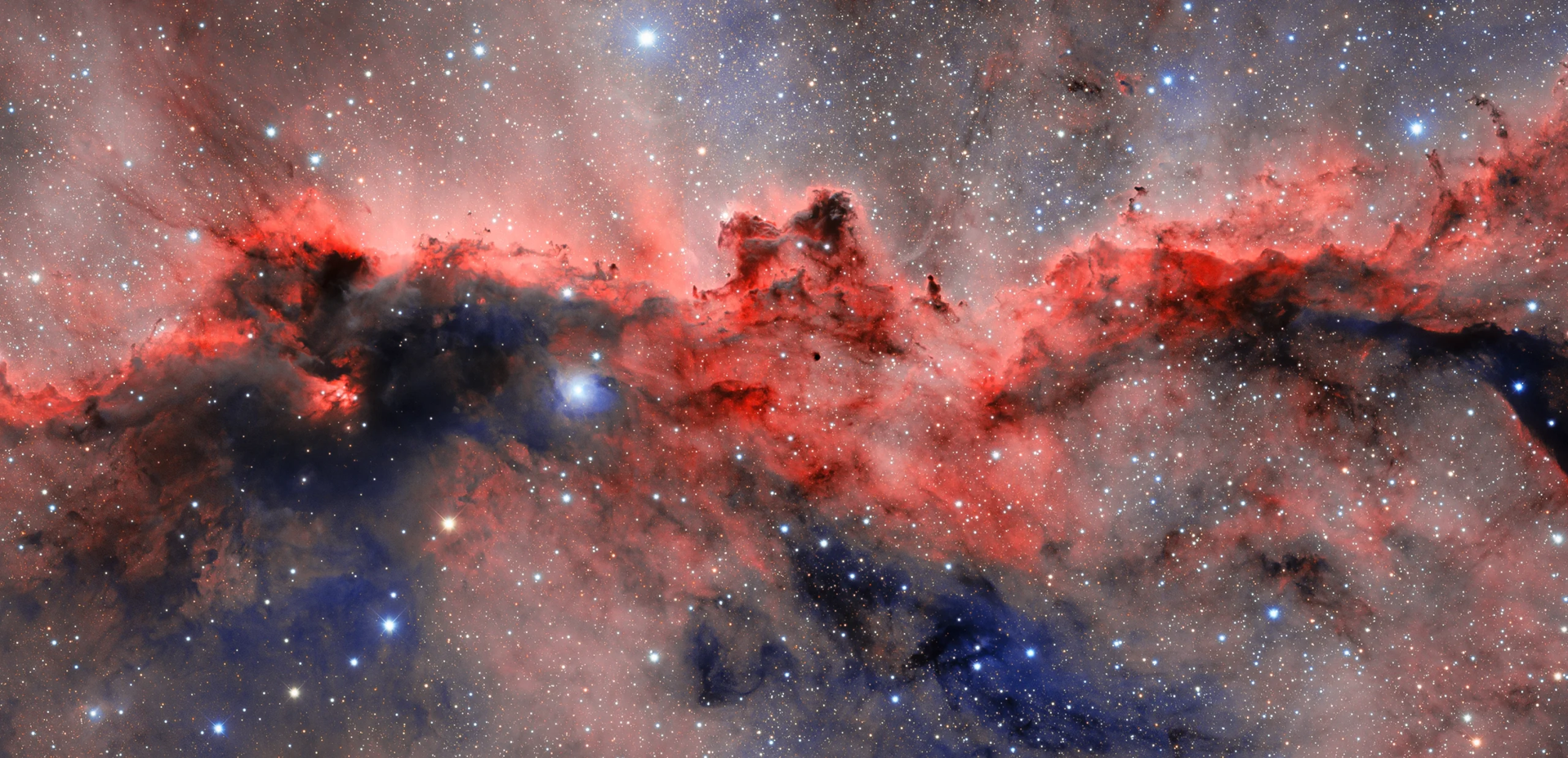 Image: The “Two Dragons” nebula captured by DECam — all the glowing gas and dust in this frame belongs to the small slice of the ledger labeled “matter.” Source: Dark Energy Survey/DOE/FNAL/DECam
DES files a reconciliation statement every few years: plug its own data into the master ledger, and for 20 years everything fit snugly — “about 30% matter + about 70% dark energy” kept holding up under repeated tests. Then in 2024 the plot turned. A new-generation instrument, DESI (Dark Energy Spectroscopic Instrument), stitched together DES’s galaxy data, a sharper cosmic microwave background (the CMB — the afterglow left over 380,000 years after the universe’s birth, essentially the cosmos’s baby photo), and its own observations, and Lambda-CDM started to fail. The version that fits better: dark energy that weakens over time.
Nothing Is Wrong With Any Dataset — What Can’t Fit Is the Model
In early 2026, DES delivered its final analysis of all six years of data: 18 papers, more than 100 named authors — the scale of an entire research institute digging into a single dataset for years. Constraints are more than twice as precise as previous analyses, and the team reprocessed 1,600 supernovae to boot — the sharpest observational snapshot of the modern universe to date.
The combined test produced exactly the mess from the opening paragraphs: assuming Lambda-CDM is correct, the CMB and the matter-distribution maps disagree; the matter maps and the supernovae disagree; the supernovae and the CMB disagree. Three independent methods fail pairwise, and no single dataset can simply be discarded. It’s like three accountants each keeping their own ledgers — clear individually, contradictory together. There’s no way to dismiss any of the books.
Three mutually independent observations failing to fit under a single model can’t be explained away as “one instrument broke.” The more plausible explanation: the model itself is missing a piece. Simone Ferraro, a cosmologist at Lawrence Berkeley National Laboratory who wasn’t involved in DES, delivered a pointed verdict: “There appear to be cracks in that model,” “There’s something that doesn’t fit,” and “This is enough to make you uneasy, or excited.” Of the DES analysis itself, he said it was “a real tour de force” that pushed the analysis to a new level.
Three Sigma Deserves Attention; Five Sigma Counts as Discovery
The combined test also returned a directional reading: the data favor “dark energy is weakening” at three sigma. Sigma is the physicists’ confidence scale: announcing a “discovery” requires five sigma — roughly a 1-in-3.5-million chance of error. Three sigma falls well short of a discovery claim, but it’s enough to lift “dark energy is weakening” from a casual aside to a candidate answer that must be taken seriously.
Seshadri Nadathur, a cosmologist on the DESI team, added a peer’s perspective: the dataset he trusts most is precisely this reprocessed supernova data — the neighboring team has signed off on the ledger directly.
2026 to 2028: Two New Eyes Take Over the Watch
The evidence will keep accumulating. DESI observations run through at least 2028, and the Vera Rubin Observatory atop Cerro Pachón in Chile begins survey operations in 2026. New data will either sharpen the crack or smooth it over — either way, observation calls the shots, and that process is the hardest, best part of science.
Back to that year-end audit. DES spent 20 years making the universe’s ledger as precise as it could be, and its most valuable output may be precisely this failure to reconcile: the crack didn’t vanish with higher precision — instead, it’s now attested simultaneously by three independent lines of evidence, the CMB, the matter-distribution maps, and the supernovae, and discarding any one of them doesn’t close it. The cosmic recipe of “about 30% matter + 70% dark energy” isn’t dead yet, but its three witnesses no longer agree with each other — and the next edition of the cosmology textbook will likely be rewritten from this crack.
References:
- Quanta Magazine: Final analysis of DES’s 20-year census
- NOIRLab press release
- Fermilab press release