350 Items Audited, a Third of the “Deals” Save You Not a Cent
A pair of yellow Hunter short rain boots listed at $126.99 on Amazon during Black Friday 2025, marked as a “special deal.” Nine days before the sale started, they sold for $79.97. A customer who waited nine days for the “deal” paid 59% more for the label.
That pair of boots comes from Deal or Decoy? Amazon’s Deceptive Discounts, a report published November 16 by Groundwork Collaborative, a US economic policy research organization. The research team focused on Amazon’s own “Black Friday and Cyber Monday Best Deals” page, auditing more than 350 items across 2024 and 2025. Everything they checked was from the storefront Amazon itself had picked to showcase.
 Image: Cover of the Groundwork Collaborative report — the title translates literally as “Deal or Decoy,” and the report’s data makes the “decoy” part stick. Source: Groundwork Collaborative, Deal or Decoy? report
The audit found that 29.1% of the “deals” were priced the same as or higher than the month before the sale — not a cent saved — and 9.4% were actually more expensive during the event. Over the same period, 203 million Americans shopped between Thanksgiving and Cyber Monday, a record, with online spending approaching $70 billion. Nearly four in ten items on Amazon’s showcase carried no real discount, behind a $70 billion shopping season.
Stretch the Window to 90 Days and 60% of the Discounts Vanish
How much a discount is worth depends entirely on how long the comparison window is. Groundwork stretched it from 30 days to 90: the share of “deals” with no savings rose from 29.1% to nearly 60%, and the share that were more expensive rose from 9.4% to 27%. The further back you look, the bigger the gap.
For the items that got more expensive, the median sale price was 19% above the lowest price from the weeks before the promotion — catch one of those “deals” and you pay nearly a fifth more on average. Within the 30 days before the sale, half of the “no savings” items sold at or below the discount price on at least 8 days: the so-called special offer was just the everyday price.
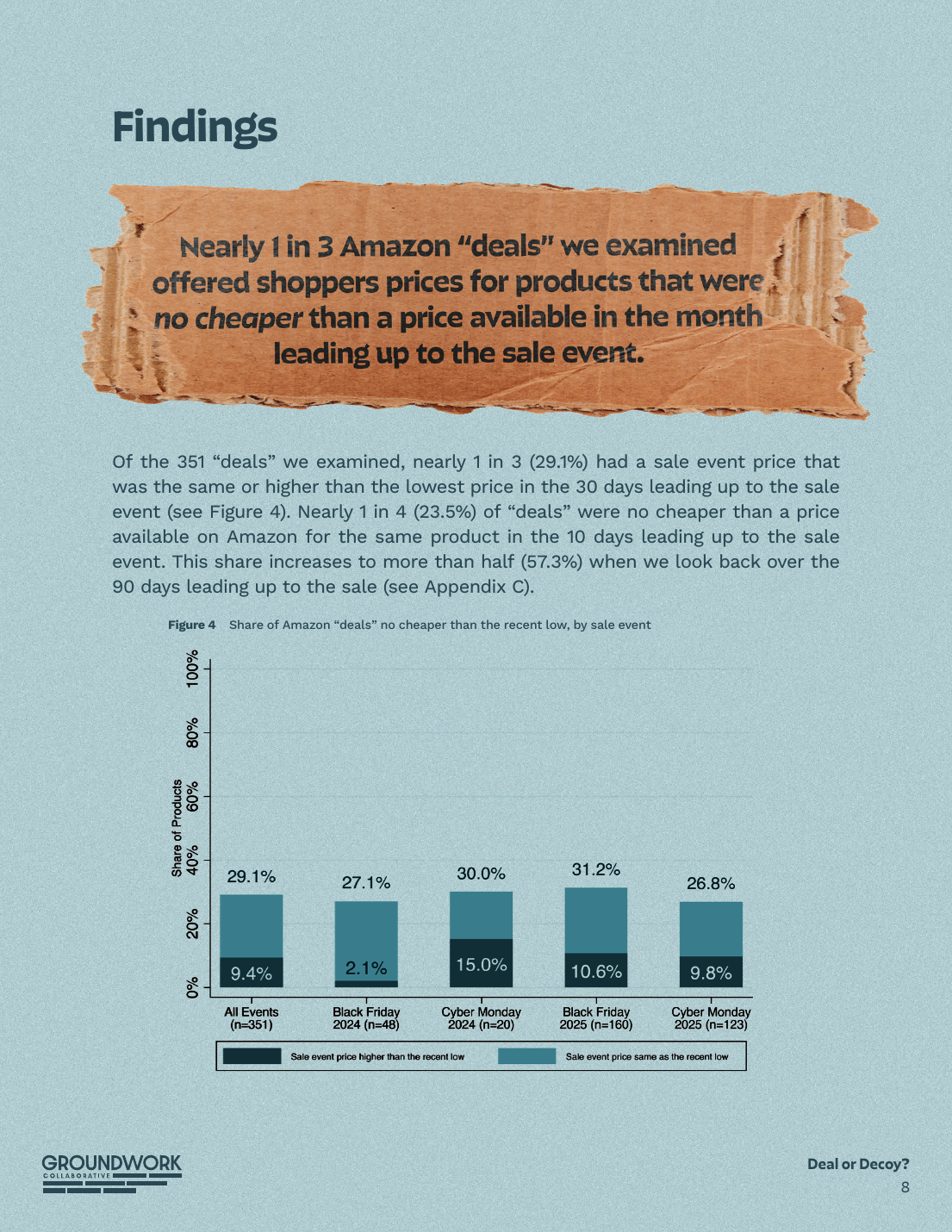 Image: Report Figure 4, showing the share of “deals” priced the same or higher under 30-day and 90-day comparison windows — stretch the window and both numbers more than double. Source: Groundwork Collaborative, Deal or Decoy? report PDF
One Pair of Boots: Raise the Price First, Then Discount It
UGG Butte men’s boots were listed as a “deal” at $179.98 on Cyber Monday 2025 — about four weeks earlier they had sold for $98.40, meaning customers waiting for the sale paid 83% more. Add the Hunter boots’ 59% from the opening, and the price records in both cases tell the same story: raise it, wait a few weeks, then “discount” it.
The size of the markdown is determined by the size of the markup. The percentage on the page is real — the baseline it’s measured against was manipulated. Customers waiting for the discount waited for the price hike to land.
Before the sale began, Amazon Worldwide Stores CEO Doug Herrington said the event would offer “incredible Black Friday and Cyber Monday deals… some of them at the lowest prices of the year.” Between “lowest prices of the year” and an 83% price gap, only one can survive.
Only Amazon Holds the Ledger
This playbook runs year after year on one positional advantage: the power to change prices sits with Amazon, the power to allocate placement sits with Amazon, and the historical price data sits with Amazon too. A customer opens the page and sees one price — this moment’s price. No yesterday, no last month.
When we comparison shop, most of us open two tabs and check today’s prices side by side. But spotting “raise it, then discount it” requires history: what it sold for yesterday, what it sold for last month. The platform doesn’t hand over that ledger.
The research team used Keepa, a third-party database of Amazon price histories, with scraping scripts open-sourced on GitHub. The truth about the discounts was crawled out item by item with external tools. The historical price data needed to comparison shop is held precisely by the opposing party.
After Groundwork published the report, the audited promo pages were taken down. The pages can now only be reconstructed through four Internet Archive snapshots — one each for Black Friday and Cyber Monday in 2024 and 2025. Amazon offered no explanation for how the discounts were calculated; it simply removed the storefront first.
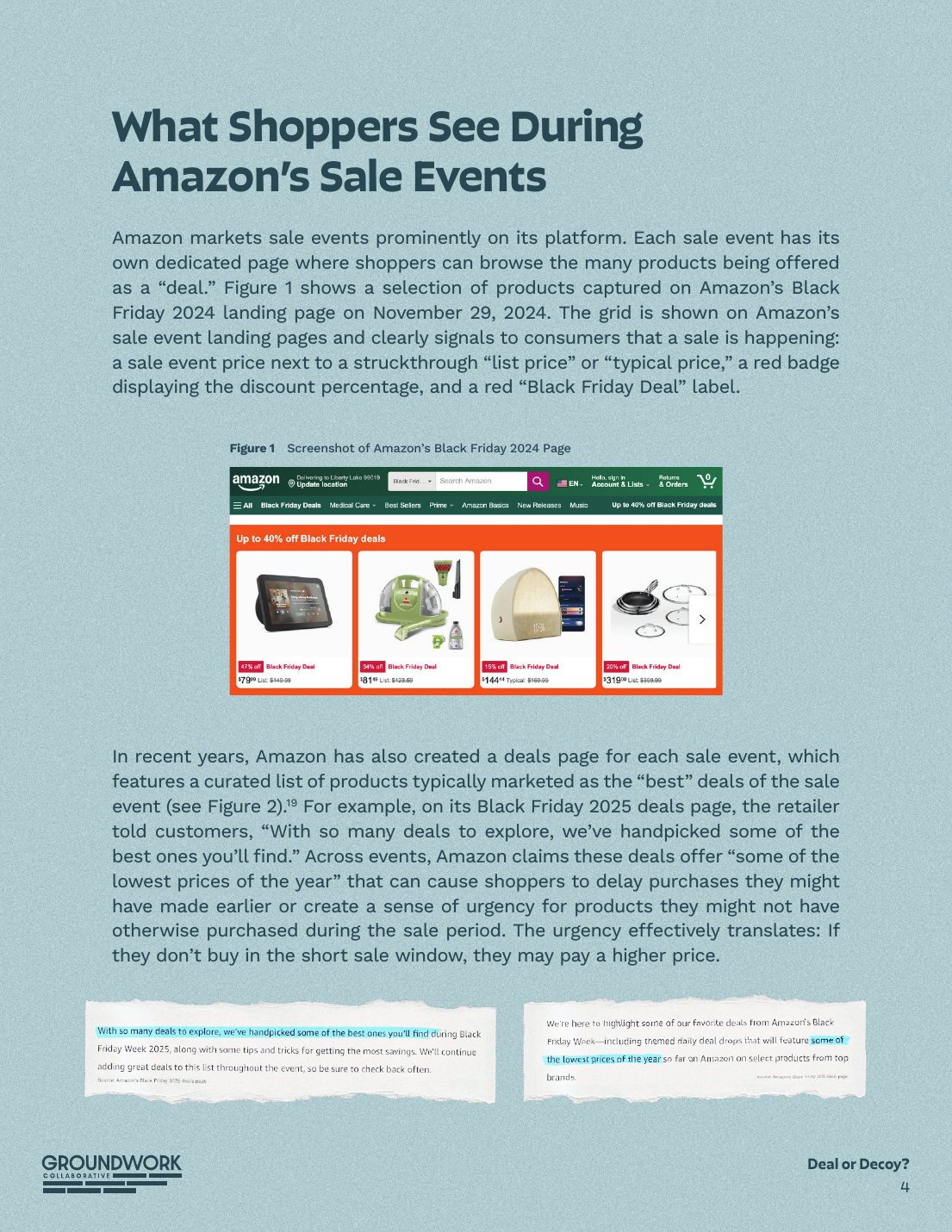 Image: Report Figure 1, the original “Black Friday Best Deals” page as audited — the page was pulled after the report’s publication and now survives only in Internet Archive snapshots. Source: Groundwork Collaborative, Deal or Decoy? report PDF
Keepa Kept the Ledger Consumers Couldn’t
Third-party data plus regulatory follow-up — this route has been tested in the field once before. Groundwork previously exposed Instacart for charging different users different prices for the same item at the same store at the same time: different people, different prices. The FTC and the New York Attorney General opened investigations, and Instacart ended the practice within weeks. In October 2026, the FTC launched another investigation into personalized pricing.
What exposed Instacart was, again, external data. Platforms have no incentive to fact-check their own discount claims; they change quickly because the pressure comes from outside. Whether a discount is real can’t be fixed by platform self-policing — it takes someone confronting the platform with a ledger.
Print the 30-Day Lowest Price on the Tag
Groundwork’s ask is in the report: regulators should require retailers to display, next to a sale price, the item’s lowest transaction price over the past 30 days, while also noting how patchy current rules are. The cost of enforcement is trivial — one extra line on the price tag, one extra line of code for the merchant.
One line of numbers is enough. If the Hunter boots’ tag had read “30-day lowest price: $79.97,” the neighboring “special deal: $126.99” would have to explain itself. No comparison-shopping extension to install, no investigation report to wait for — the customer could calculate the discount’s worth right there on the page.
Who gets to define a promotion depends on who holds the ledger. Print the ledger on the price tag, and “lowest prices of the year” has to answer to the numbers. A $70 billion shopping season is worth that one line.
References:
- Groundwork Collaborative, Deal or Decoy? Amazon’s Deceptive Discounts report
- Keepa, Amazon price history database
- Four Internet Archive snapshots of Amazon’s promo pages