Amazon’s official goal is to achieve net-zero carbon emissions by 2040. Yet in August 2026, a gas-fired power plant co-funded by Amazon broke ground in West Texas. Under its permit, the facility can emit up to 33 million metric tons of CO2 annually—more than any existing power plant in the United States. Its sole purpose: to fuel AI data centers.
The contradiction is so stark that even an Amazon spokesperson admitted: “The world and our energy demands have evolved since we co-founded The Climate Pledge.”

Image: Smoke emissions from a natural gas power plant smokestack. Source: Getty Images (via Ars Technica)
One Power Plant, Enough to Feed How Many Data Centers
Located on the GW Ranch site in Pecos County, Texas, the facility spans roughly 8,000 acres—equivalent to more than 4,000 standard soccer fields. Developed by Pacifico Energy, it sits adjacent to a newly acquired Amazon data center campus. According to its construction permit, the plant will install 35 gas turbines with a total capacity of 7.65 gigawatts (GW).
What does 7.65 GW actually mean? A typical large nuclear reactor generates around 1.2 GW, making this plant equivalent to six nuclear reactors operating simultaneously. Connected to the grid, it could power roughly 6 million American homes at once.
Commenters on Hacker News quickly did the math: a “mega” AI data center campus draws about 500 MW to 1 GW. At full load, 7.65 GW could theoretically power 8 to 15 such mega-campuses at once—or several times more if measured by standard large data centers (100 MW scale). And this isn’t the only one: Amazon is also negotiating a 4.5 GW gas plant in Homer City, Pennsylvania, budgeted at around $10 billion on the site of a retired coal plant.
The engineering consensus behind these numbers is clear: this facility is essentially a full-fledged “power city,” yet its output is dedicated entirely to a single company’s AI operations.
Why AI Demand Is So Power-Hungry
AI power consumption falls into two buckets: training and inference. Training a foundation model requires thousands of chips calculating day and night for months. Inference occurs whenever a user asks a question—every single query mobilizes substantial compute in real time. According to Stanford University estimates, a single AI query consumes roughly 2.9 watt-hours—enough to power a 10-watt LED bulb for 17 minutes, or 10 times the electricity of a traditional web search.
A single query seems negligible, but multiplied by hundreds of millions of daily users, the aggregate is staggering. The International Energy Agency (IEA) estimates global data center power consumption could exceed 1,000 terawatt-hours (TWh) by 2026—nearing the total annual electricity consumption of Japan. On Amazon’s late-July earnings call, CEO Andy Jassy noted that demand for AI and custom chips is “exploding,” warning that supply constraints could persist into 2027.
Tech companies simply cannot wait—and that urgency is where the issue begins. Grid interconnection queues routinely take years. Research firm Cleanview found that bringing a data center online just a few months earlier can represent billions of dollars in revenue. Consequently, “speed trumps all”—pushing environmental reviews and community concerns to the back burner. Over the past year, this “behind-the-meter” strategy has shifted from a niche tactic to mainstream practice, with Google, Microsoft, Meta, Oracle, OpenAI, and Anthropic all following suit.
Why Natural Gas Plants Are Anything But Clean
Natural gas is frequently marketed as a “bridge fuel” because burning it emits roughly half the CO2 of coal per unit of fuel. But the reality is far more complex. Natural gas consists primarily of methane—a potent greenhouse gas with a global warming potential more than 28 times that of CO2 over a 100-year timescale, and over 80 times on a 20-year horizon. Methane leaks continuously across extraction, pipeline transport, and storage.
Even more troubling is the emergency nature of these power additions. Rushing to deploy, tech companies are utilizing whatever power generation equipment they can find. Last year, xAI hauled gas generators mounted on flatbed trucks directly into Memphis, Tennessee. Other projects rely on converted aero-derivative gas turbines or cruise ship engines—equipment with lower fuel efficiency and higher emissions per megawatt-hour, chosen purely for “immediate power.”
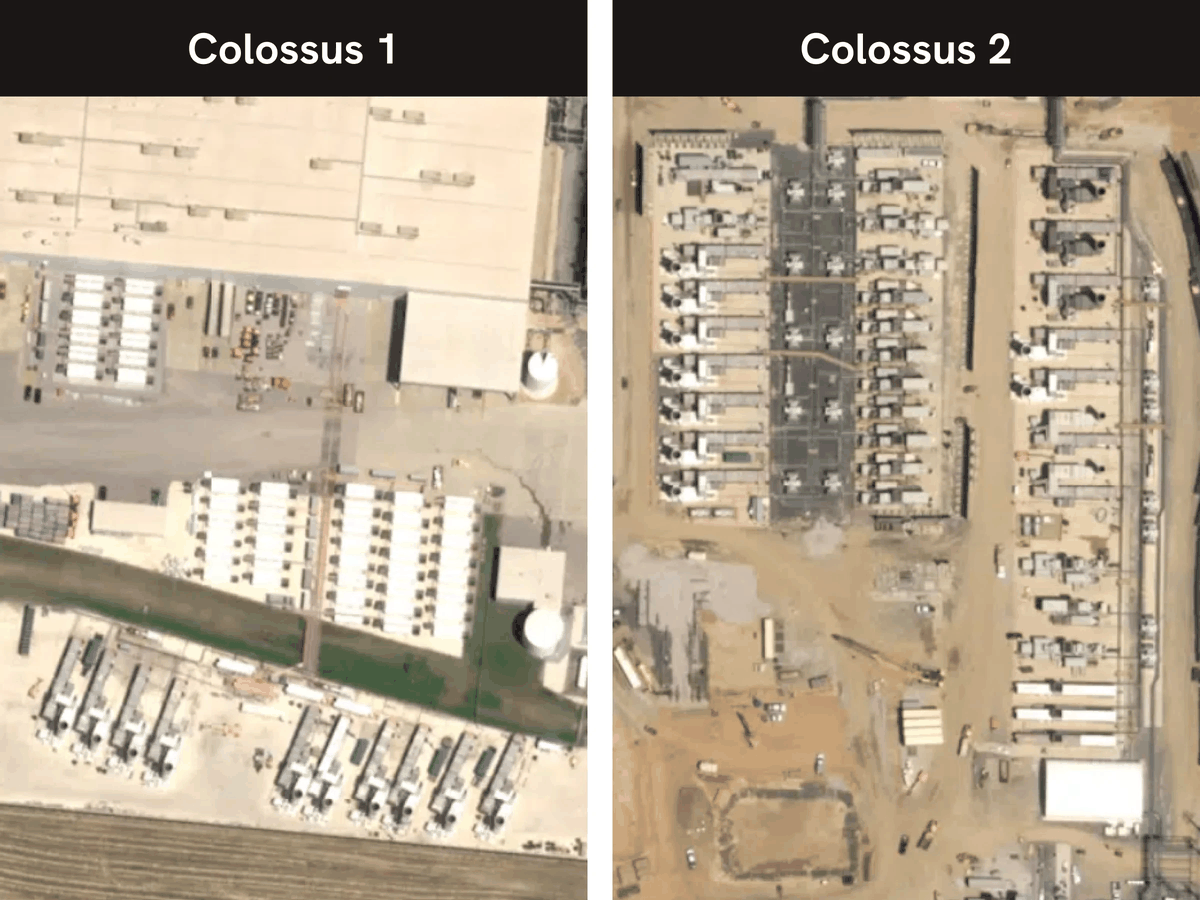
Image: Satellite imagery of xAI’s data center near Memphis, Tennessee, showing rows of gas generator units clearly visible. Source: Cleanview / Airbus DS
According to its permit, the Texas plant is authorized to emit up to 33 million metric tons of CO2 per year. To put that in perspective: that equals the annual emissions of roughly 7 million passenger cars, and approaches nearly half of Amazon’s current company-wide annual carbon footprint.
To be fair, 33 million tons represents the permitted upper limit. Power plants rarely run at 100% capacity year-round, and engineers in community discussions point out that permitted limits are often significantly higher than operational realities. Yet even at half capacity, it would rank among the largest single carbon polluters in the United States.
How Net-Zero Pledges Are Calculated
In 2019, Jeff Bezos personally launched The Climate Pledge, committing Amazon to reach net-zero carbon emissions by 2040—10 years ahead of the Paris Agreement’s 2050 target. Hundreds of corporate signatories followed.
The crux of the matter lies in the word “net.” Net-zero allows companies to offset emissions through carbon credits, tree planting, and carbon reduction projects to achieve zero on paper. Furthermore, Amazon has long highlighted that its renewable energy purchases exceed its total electricity consumption. But those are financial procurement contracts—matching grid usage on paper—which does not mean every megawatt-hour entering its servers originates from wind or solar. Building a gas-fired plant in the Texas desert to supply power behind the meter effectively draws an inequality sign between “green power purchasing” and “actual electricity usage.” Reporting from The New York Times also noted that Amazon’s emissions have been rising in recent years; the company is aware these data center expansions jeopardize its climate goals, but earnings growth remains the immediate priority.
In response to criticism, Amazon states it is simultaneously pursuing solar and battery storage solutions, adding that the plant could eventually connect to the grid to supply local power without raising utility rates for Texas residents. While technically true, the timeline is clear: build the plant and burn gas first; scale up clean energy later.
Google and Microsoft Are in the Same Boat
Amazon is by no means alone. Google has pledged 24/7 carbon-free energy by 2030, Microsoft committed to being carbon negative by 2030, and Meta, OpenAI, Anthropic, and Oracle all display ambitious environmental targets on their websites. Yet according to Cleanview data, 59 data center projects across the US now plan to construct on-site power plants, totaling roughly 90 GW of capacity—representing a quarter of all planned data center developments.
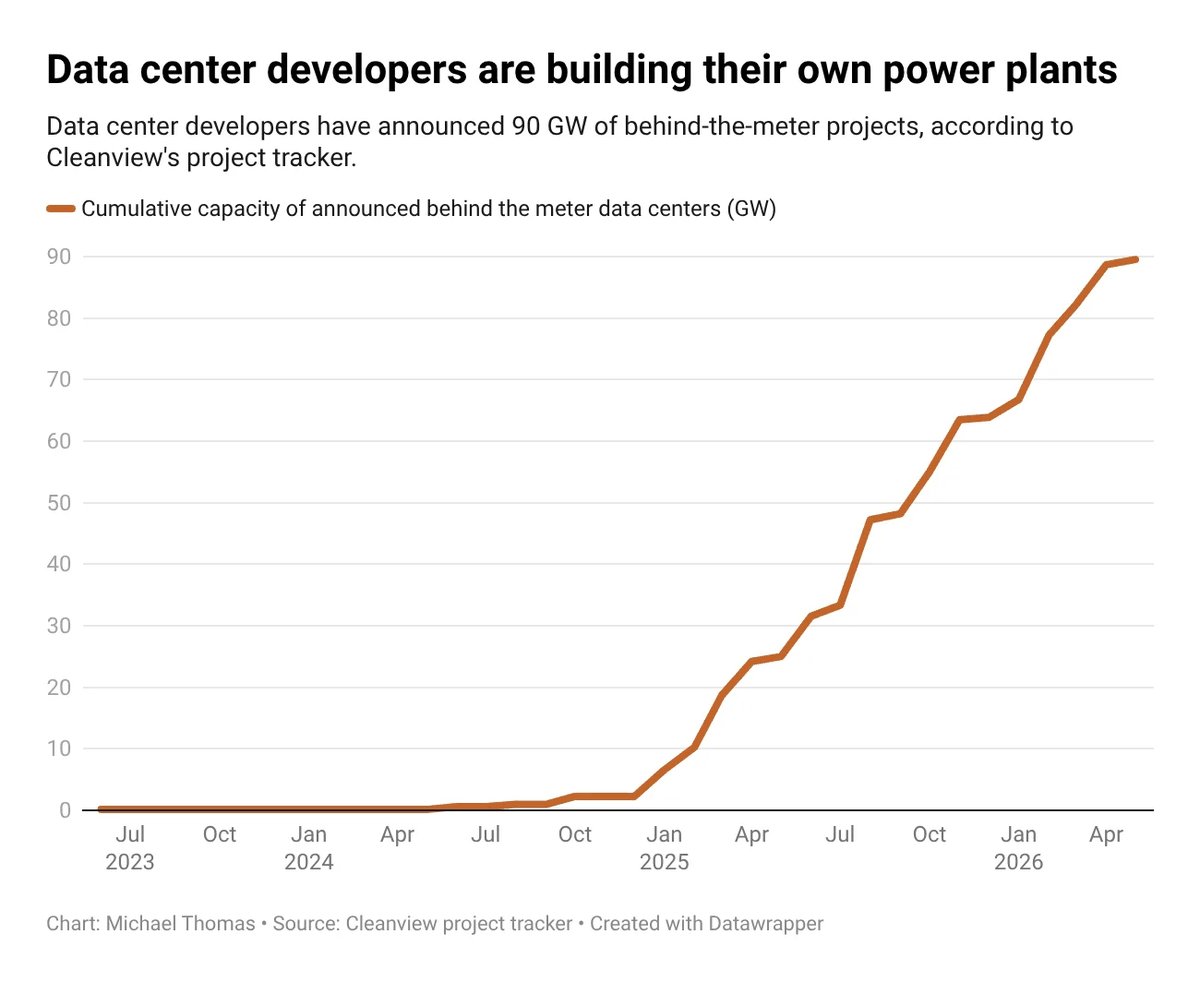
Image: Cumulative capacity of behind-the-meter power projects for US data centers, surging sharply from 2025 onward. Source: Cleanview
Meanwhile, the regulatory landscape is easing constraints. The US EPA is no longer setting national power plant emission standards, and environmental reviews are being fast-tracked or bypassed. When xAI faced a lawsuit in Memphis from the NAACP seeking to halt its gas turbines, the Trump administration stepped in to back xAI, arguing citizens lack standing to sue under the Clean Air Act. Opposing voices remain, but pushing against the tide grows increasingly difficult.
Bottom-Line Economics
The location of the Texas facility speaks volumes: Pecos County sits squarely in the Permian Basin, America’s premier oilfield region. Oil extraction yields vast amounts of associated natural gas that often has little local market value—during oversupply, prices even dip into negative territory, where producers pay to flared or offload gas. Generating power for AI using virtually free gas makes perfect commercial sense.
A lucrative business deal and mathematically clear emissions are now racing on the exact same timeline. Whether the 2040 net-zero pledge remains intact will likely only become clear when Amazon publishes its annual carbon emissions report after the plant fires up in 2027. We simply present the numbers here; the final judgment is left to the reader.
Reference links:
- Ars Technica: Amazon backs power plant that may become top source of US climate pollution
- The New York Times: Amazon Data Center Stokes Worry It Would Be the Most Polluting Power Plant in the US
- Cleanview: Bypassing the Grid — Behind-the-Meter Data Centers
- Utility Dive: Largest US gas-fired power plant planned for data centers
- Hacker News discussion (HN)