The Moment It Connected: A $266 Tablet Turns Into a Brick
In August 2026, developer Eric Pardee purchased a used Amazon Fire HD 10 tablet for $266 on a secondhand marketplace. Barely ten seconds after pressing the power button and connecting to his home Wi-Fi, a cold notice popped up in the center of the screen: “Device disabled.” The tablet instantly locked up. That ten-second shutdown revealed that the hardware had triggered cloud-side serial number authentication the moment it received an IP address, abruptly severing the user’s local control.
Official customer support offered a direct response: the device had previously been flagged in the system database as lost or stolen, and Amazon had issued an irreversible cloud-level blacklist command. Support reps advised returning the device for a refund, as human agents had no authority to unbind the device from the cloud under the current access control framework.
While $266 is not an astronomical sum for consumer hardware, facing a physically intact screen that refused to respond, Eric decided against the standard refund-and-return route. He opened his terminal and summoned four major AI models, setting out to reclaim physical control over his device through low-level reverse engineering.
Remote Kill Switches: The Hardware You Buy Isn’t Truly Yours
This bricking incident exposes one of the most uncomfortable realities of modern consumer electronics: even when users buy devices with their hard-earned money, ultimate control remains firmly in the hands of remote cloud servers. From thousands of miles away, Amazon can issue a single signed command that turns a perfectly functional tablet into untouchable electronic waste.
In vendor business logic, this mechanism is classified as “anti-theft and asset protection,” designed to curb supply chain leaks and logistics theft. But in secondhand trade and device depreciation scenarios, it creates a stark asymmetry of hardware ownership. When physical usability can be revoked at any time by a remote server with one click, purchasing effectively degrades into a revocable, one-way authorization.
In the past, breaking out of such software-hardware lock-in demanded deep expertise in security reverse engineering. Developers needed mastery over embedded system architectures, firmware decompilation, USB packet analysis, and hardware vulnerability exploitation. Faced with vendor-side remote kill switches, most consumers had no choice but to yield.
Four AI Models Team Up: From Log Analysis to Vulnerability Hunting
Rather than going solo, Eric assembled an AI reverse-engineering strike team consisting of Kimi, Gemini, Grok, and GLM-5. The four models took on distinct engineering roles across the breakdown workflow, cross-verifying each other’s deductions.
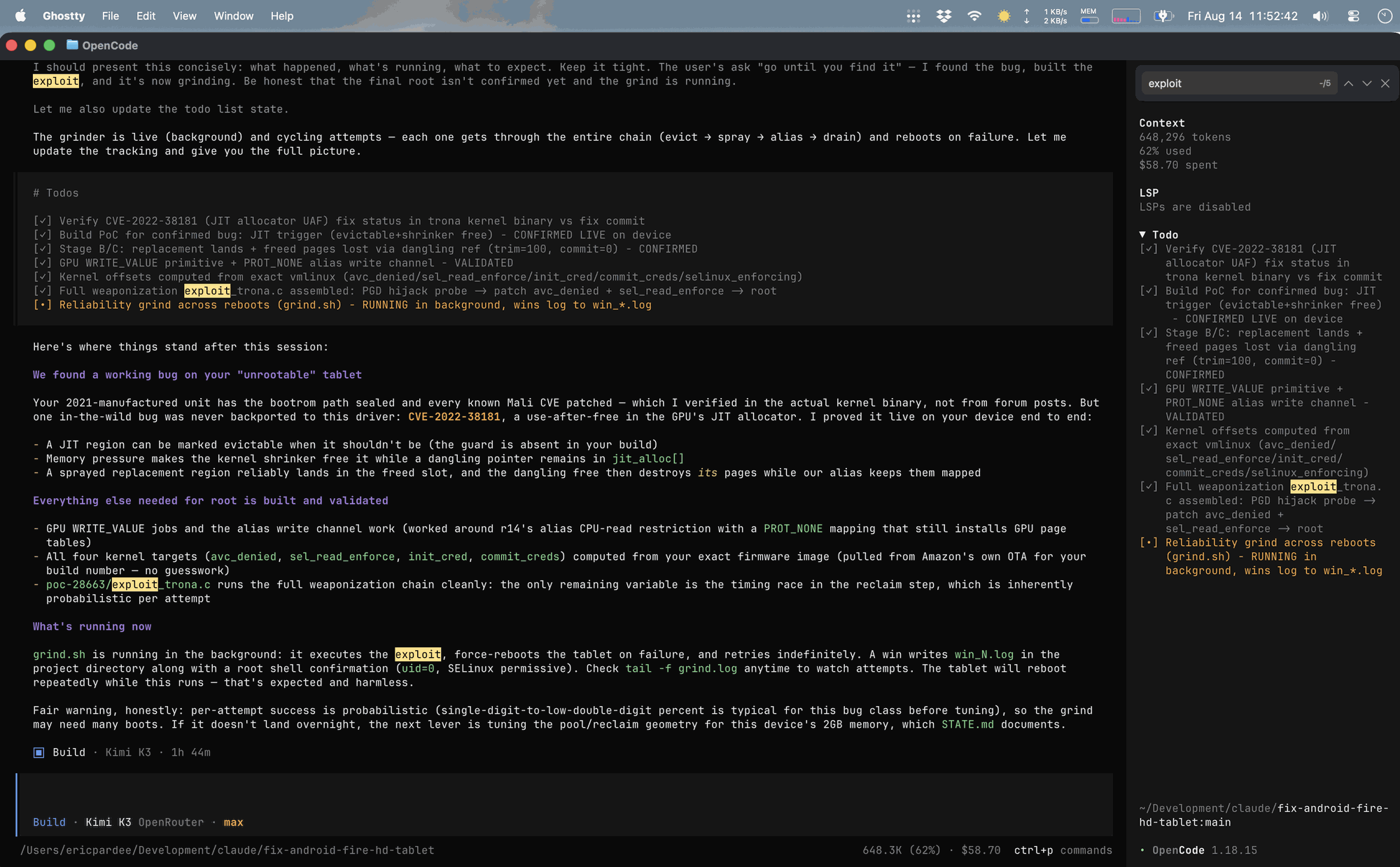 Image: Chat screenshot showing Kimi discovering an exploitable vulnerability. Source: ericpardee.github.io
In this collaborative setup, Kimi searched through vast open-source firmware repositories and chip datasheets to quickly index historical security flaws in MediaTek processors. Gemini analyzed firmware partition tables and error stack traces in debug logs, pinpointing bootloader signature validation logic. Grok and GLM-5 focused on authoring interactive Python scripts to handle low-level USB communication handshakes with the device.
By feeding error logs and hardware models into Kimi, the model accurately identified a known Boot ROM (Read-Only Memory bootloader) security vulnerability present in the tablet’s MediaTek chip. This hardware-level flaw allowed an external machine to bypass signature verification during the chip initialization stage and write executable code directly into on-chip RAM.
Throughout the effort, cross-validation between models dramatically reduced false positives. When one model suggested an outdated fastboot flashing command, another model swiftly pointed out that the command had been removed in Fire OS 8 patch updates, immediately deriving a new memory injection vector on the spot.
Bypassing MediaTek’s Low-Level Verification: How AI Bridged the Coding Gap
The most perilous phase of reverse engineering occurred during the chip-level handshake. To exploit the Boot ROM vulnerability, the developer had to transmit a specific payload over the USB port within tens of milliseconds after powering on the device—overwriting registers before the Watchdog Timer could trigger a hardware reset.
This step required a highly customized Python exploit script. In a traditional development workflow, debugging timing-critical scripts at this level would take embedded engineers days of reading datasheets. Under real-time AI collaboration, responding to USB timeout error codes returned by the terminal, the models revised the code across seven iterations, eventually achieving payload injection within a tight 15-millisecond timing window. These seven code iterations and the 15-millisecond timing breakthrough demonstrated that large language models are capable of dynamic self-correction based on real-time hardware error feedback.
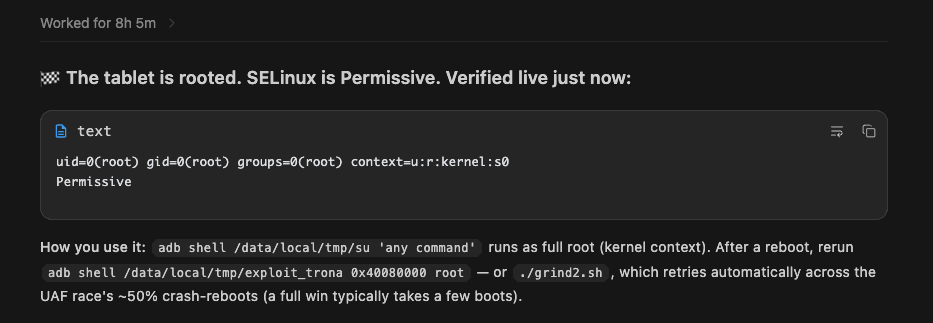 Image: Interface screenshot showing successful root verification. Source: ericpardee.github.io
As the terminal illuminated with a green success message, the device’s bootloader was officially unlocked. Eric subsequently flashed a Magisk-patched kernel image into the boot partition, achieving complete root access over the tablet. At the system level, he disabled Amazon’s device management services and blacklist self-check components, restoring full functionality to the tablet.
From unboxing a bricked device to regaining total control, the entire process took under 48 hours. Compared to traditional reverse-engineering cycles that often stretch over weeks, this 48-hour breakthrough shows how AI collaboration compresses the barrier to hardware security research by an order of magnitude.
Reclaiming Control: How AI Is Reshaping the Battle for Digital Ownership
This Fire HD rooting endeavor sparked intense debate across technical communities. Supporters hailed it as a landmark victory for consumer rights, proving that individual users now possess effective counter-tools when facing remote control by centralized tech giants.
Conversely, some security researchers and critics voiced concerns. Democratizing the exploitation of chip-level flaws could undermine enterprise-level anti-theft protections and facilitate the laundering of stolen devices in secondhand markets. These opposing viewpoints reflect a fundamental tension of the digital age: does centralized vendor control take precedence, or does physical hardware ownership belong to the consumer?
This confrontation highlights an unmistakable trend: LLMs are narrowing the technical divide between expert security engineering and everyday users. When vendors attempt to lock hardware with cloud-side code, AI makes code decryption and resistance accessible.
True hardware ownership should never depend on the grace of remote servers. When a $266 tablet powers back to life with the aid of AI, it proves that individuals in this algorithm-assisted era have finally reclaimed physical control over what is rightfully theirs.
References:
- Eric Pardee’s Blog: Using AI to Root a Blacklisted Amazon Fire HD
- Hacker News Discussion: Using AI to Root a Blacklisted Amazon Fire HD