Software engineer Lars Faye recently raised a concerning observation within the engineering community: developers who rely heavily on AI tools for daily coding show a visible decline in their ability to independently diagnose and resolve failures when confronted with unfamiliar system crashes. While feature delivery speed has multiplied and repository commits are more active than ever, engineers’ understanding of the internal mechanics of their tech stack is rapidly diluting.
This contrast highlights one of the deepest paradoxes in modern software development. Engineering management celebrates climbing efficiency curves, yet rarely recognizes the crisis of cognitive hollowing hidden behind this apparent prosperity.
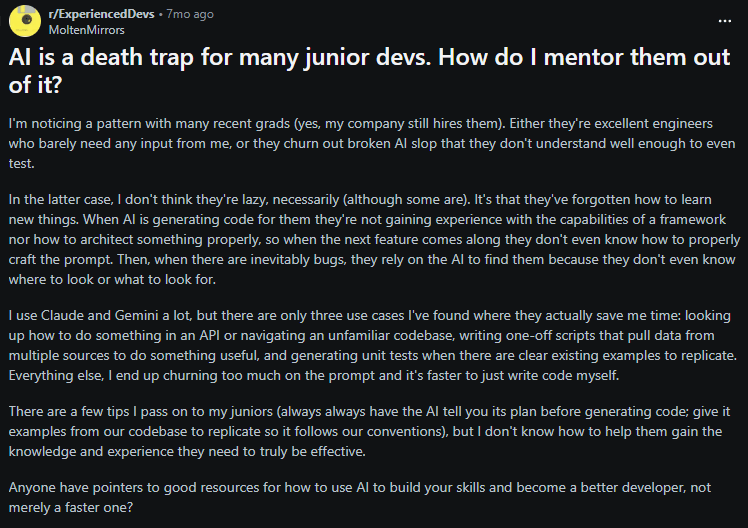 Figure: As AI evolves from an assistant to an autonomous agent doing the work, human engineers risk being deprived of the learning process. Source: larsfaye.com
Atrophy of Cognitive Muscles: From Mental Math to Code Aphasia
Looking back at the history of computing tools, similar skill degradation has played out repeatedly. Before electronic calculators became ubiquitous, engineers possessed strong instincts for mental math and order-of-magnitude estimation, spotting anomalies in numbers almost instantly. Once tedious arithmetic was replaced by keystrokes, human mental calculation speed and numerical intuition weakened significantly, forcing technical professionals to rely entirely on digital displays.
AI-assisted coding is replicating this process in software engineering, with even more profound implications. Coding involves extensive logical deduction, syntax organization, memory management, and boundary condition forecasting. In the past, engineers had to construct a complete state machine model in their heads to write accurate conditional branches.
Today, a developer needs only to type a brief natural language comment, and a code completion model generates dozens of lines of fully structured function implementation within milliseconds. When the mental workout of logical reasoning and syntax construction is taken over by automated tools, the cognitive muscles responsible for deep thinking atrophy from a lack of exertion. Developers under this workflow appear effortless during routine, smooth-sailing tasks, but freeze up in paralysis when hit by complex concurrency deadlocks or unpredictable memory leaks.
The Cost of Bypassing Pain: Losing the Foundation of Productive Struggle
There are no shortcuts to building deep expertise. In the traditional career path of software engineering, the transition from a junior programmer to a senior expert hinges precisely on those hours or days spent in “productive struggle.”
Before AI could step in, when facing obscure error messages, developers had to manually consult technical documentation, inspect system call stacks line by line, place breakpoints in code, and repeatedly test and invalidate hypotheses. This trial-and-error process was slow and frustrating, but those very obstacles forced the brain to deeply internalize programming language design philosophies, operating system scheduling mechanisms, and network protocol constraints.
 Figure: Modern software development environments are deeply integrated with AI capabilities, generating code on-screen in an instant. Source: Pexels
AI tools smooth over this friction with extraordinary efficiency. When an exception is thrown in the terminal, developers can paste the error log into a model with a single click and instantly receive a ready-made patch. Obtaining instant fixes while skipping trial and error deprives developers of the opportunity to comprehend the system’s underlying causal chain. This pattern cultivates “operators” who merely trigger quick-fix commands, rather than domain experts who possess a deep intuition for system architecture.
A Clash of Perspectives: Liberating Productivity or Building Castles in the Air?
The debate over the impact of AI-assisted coding on engineering skills has split the technical community into two opposing camps. Proponents argue that AI liberates programmers from tedious syntax details and boilerplate code, allowing them to focus valuable energy on high-level architecture, business domain modeling, and system design. In fast-paced commercial environments, rapidly delivering working software remains the top priority.
Opponents counter that high-level abstractions without solid low-level practice are ultimately fragile castles in the air. Software architecture is not an abstract drawing exercise; every elegant architectural decision is grounded in a deep understanding of underlying details—such as network invocation overheads, lock contention costs, and cache invalidation stampedes.
Without hands-on experience in low-level troubleshooting, developers struggle to evaluate how AI-generated solutions perform under extreme concurrency or massive traffic spikes. When engineering teams are filled with members who can write prompts but cannot audit underlying risks, overall system robustness faces unpredictable vulnerability.
Hidden Technical Debt: From Code Bloat to System Black Boxes
Another serious engineering challenge posed by AI-generated code is the accumulation of hidden technical debt and codebases becoming black boxes. When human engineers write code manually, they tend to streamline logic to ensure every instruction serves a clear purpose.
Model-generated code, however, is often bloated with defensive structures and boilerplate glue code that seem reasonable on the surface but are ultimately redundant. When reviewing AI-submitted pull requests, reviewers easily slip into a relaxed mindset of “looks fine at a glance” and click approve. Code audit data from a prominent open-source community revealed that after adopting AI tools, average code review time dropped by 42%, while subtle edge-case defects rose by 28%. While review throughput appears higher, technical debt is quietly compounding in the deeper layers of codebases.
Over time, project code volume expands exponentially, yet no single team member can articulate the underlying interaction mechanisms between modules. The system gradually mutates into a massive, brittle black box. When core pipelines suffer from ghostly performance degradations, the team can only hope that AI happens to generate another patch that works.
Preserving Core Competencies: Maintaining Engineering Depth in the Age of Automation
Faced with the widespread adoption of AI coding tools, engineering teams must re-examine the boundaries of automation and skill development. Rejecting AI completely is neither realistic nor aligned with technological evolution. The key lies in establishing disciplined usage habits while safeguarding human engineers’ core judgment.
In daily practices, engineers should use AI as an advisor to validate ideas and expand options, forcing themselves to understand the operating principles and performance costs behind every line of code before adopting it. For critical core modules and complex incidents, teams should preserve manual deep-debugging and post-mortem review processes to keep engineers’ minds grounded in system mechanics.
AI tools can generate millions of lines of code at astonishing speeds, but when catastrophic failures occur, the survival of software systems still depends on the deep intuition and troubleshooting mastery of human engineers. Maintaining curiosity and hands-on rigor toward underlying mechanisms remains the only way to prevent professional expertise from eroding in the wave of automation.
Reference Links:
- Lars Faye: Coding Agents Mentoring and the Loss of Software Expertise
- Hacker News community deep dive on AI-assisted coding and skill degradation
- GitClear: 2024-2026 Research Report on AI-Generated Code Quality and Code Smells