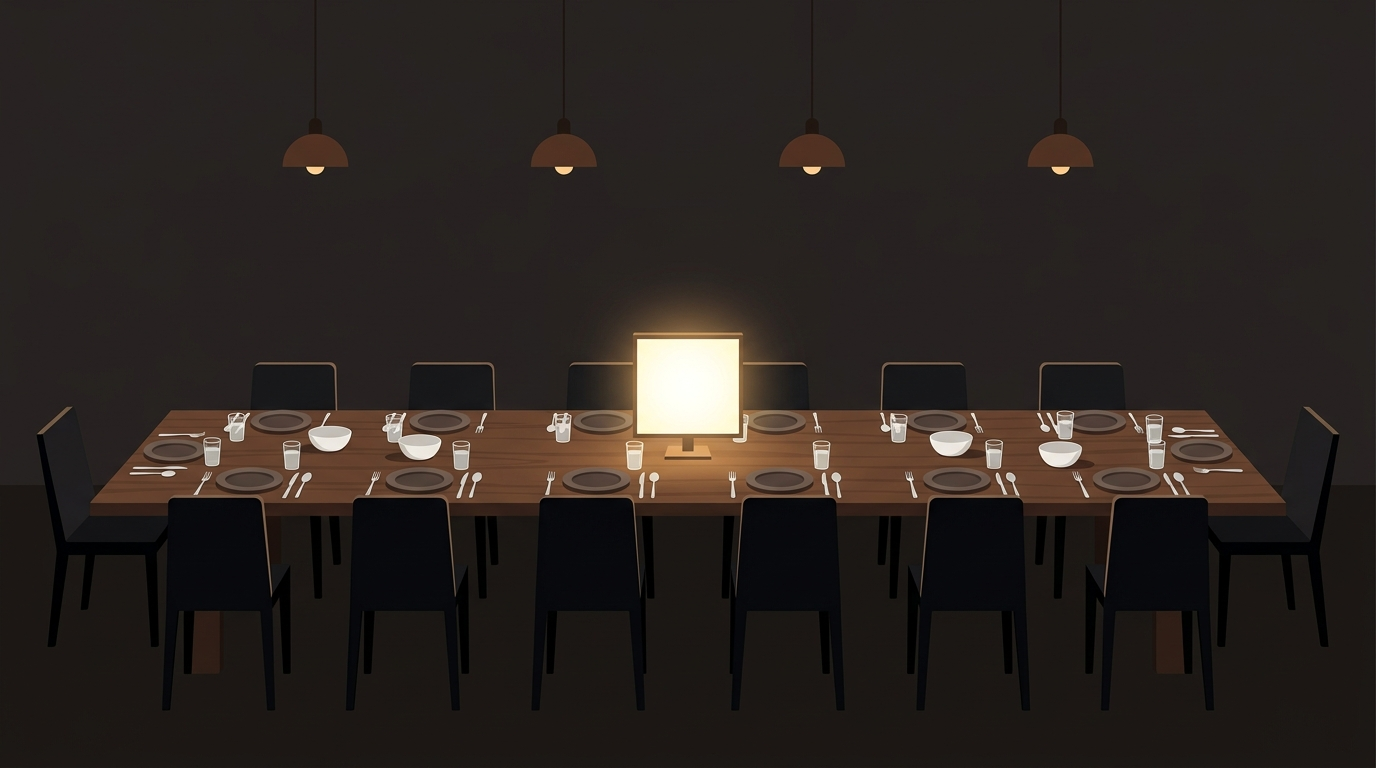
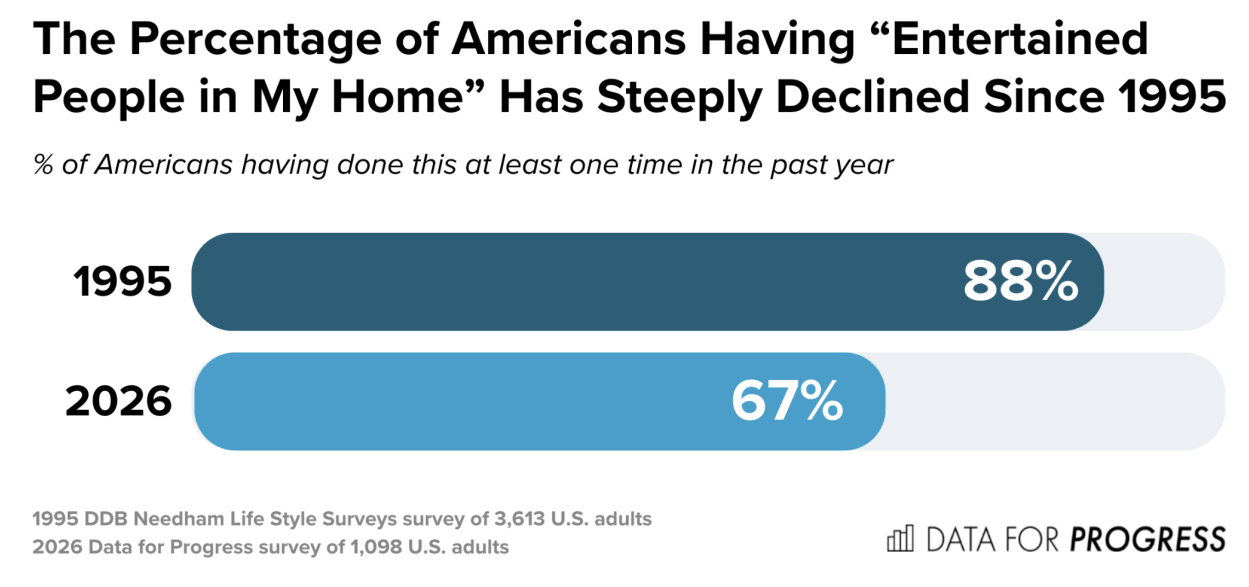
Between 1975 and 2026, the share of American adults who hosted friends or relatives at home at least once a month plummeted from 42% to 12%. Over five decades, the dinner party—once a foundational staple of domestic life—has collapsed by a staggering 70%. What we are witnessing is an invisible revolution of friction driven by technology. When solitude becomes effortless and endlessly entertaining, offline gatherings that demand coordination quickly become low-efficiency liabilities.
The Dinner Party Didn’t Move—It Vanished
At first, observers tried to find a reassuring explanation for the cratering numbers. The “dinner outsourced” thesis suggested that social dining hadn’t disappeared; people had simply decamped to restaurants and lively bars.
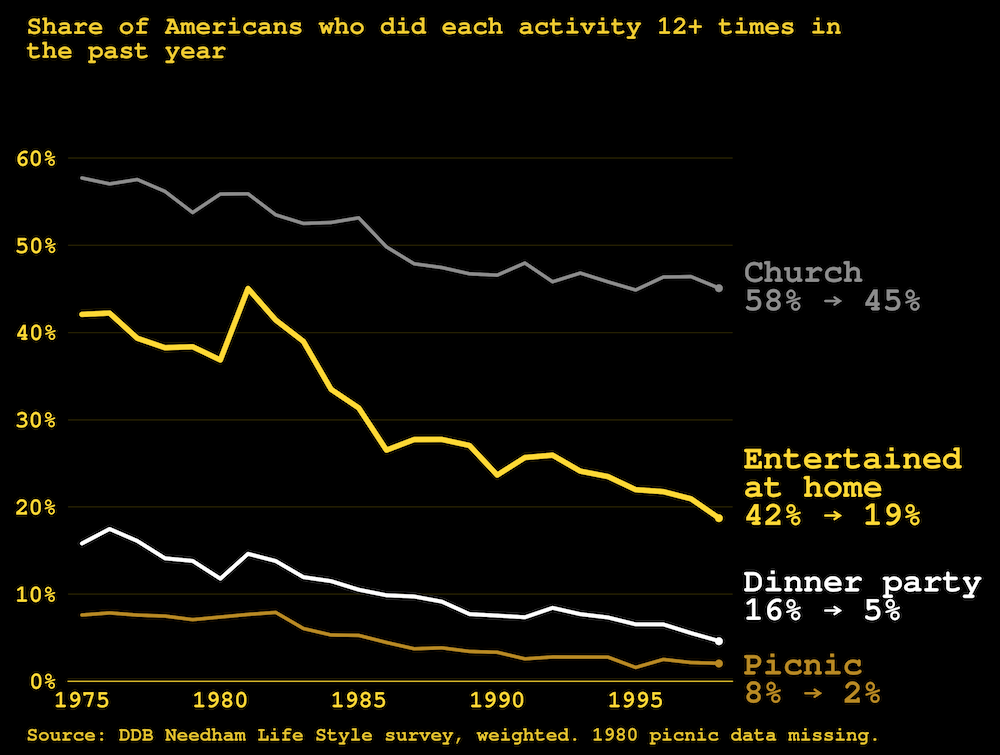
The empirical record shatters that narrative. According to the DDB Needham Life Style survey, between 1975 and 1998, the proportion of Americans giving or attending monthly dinner parties was cut in half, while the percentage who “never host guests at home” tripled. From 1995 to the present day, hosting or attending dinner parties dropped by another 20% on top of that historic collapse.
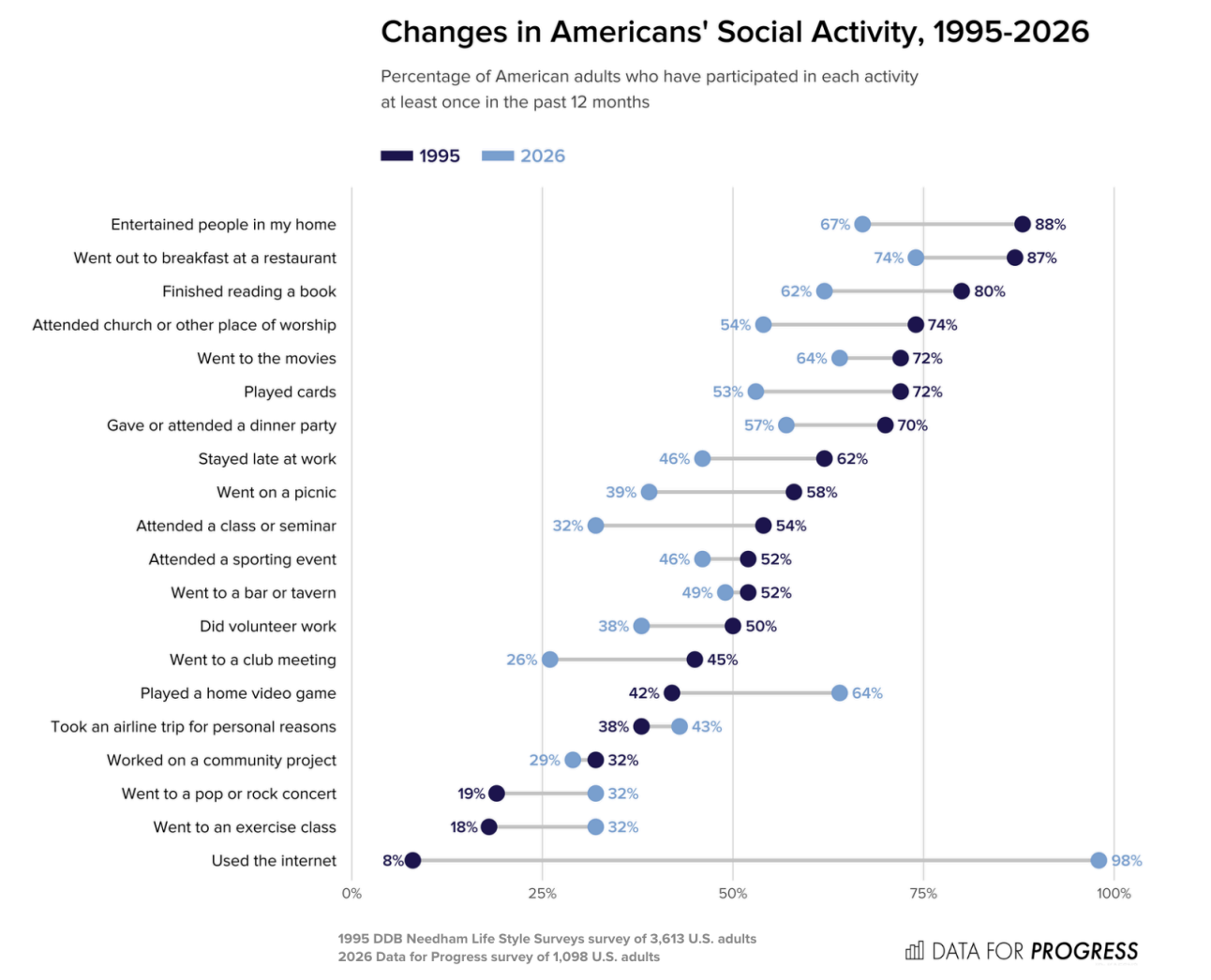
Worse still, over the last three decades, virtually every metric of American socializing has suffered double-digit declines. Playing cards, watching sports together, heading to a tavern, volunteering, and participating in civic clubs have all shriveled. Far from picking up the slack of lost home gatherings, the restaurant sector has observed a stark surge in solo diners.
Back in 2000, Robert Putnam warned in Bowling Alone that the ancient habit of visiting friends “might simply disappear from American life within a generation.” On September 29, 2026, when polling firm Data For Progress replicated Putnam’s historical survey questions, the findings confirmed that the cliff-like descent continues unabated.
Social life was not preserved in another vessel; it was outright eliminated. Between 2003 and 2022, Americans spent nearly two extra hours at home every single day. People did find substitutes—rolling out a yoga mat in the basement, or logging treadmill miles while listening to podcasts. But this growth in self-improvement is almost entirely solitary. What truly filled the void was the omnipresent screen.
Why a Dinner Party Can’t Compete with a Screen
To displace socializing from human nature, technology needed a competitor capable of delivering a completely frictionless experience.
Derek Thompson framed it compellingly: while the “lump of labor” is an economic fallacy, a “lump of leisure” might well be a real constraint. Within that finite container of free time, social leisure is precisely what digital technology crowds out. The reason is simple: viewed as a “leisure technology,” hosting a dinner party yields a terrible return on effort.
To convene a gathering, you must synchronize six distinct schedules. You must clean the apartment, source ingredients, accommodate dietary restrictions and allergies, and shoulder the emotional risk that the room falls into awkward silence. In practice, hosting even an informal dinner is an intensely demanding concurrency problem.
By comparison, the screen on the sofa asks for nothing. A television requires zero prep work, and TikTok lowers the barrier even further. Technology has engineered solitude to be frictionless and instantly rewarding, exposing offline hosting as an unwieldy relic of the pre-digital era. People inevitably vote with their attention, swapping high-overhead gatherings for zero-friction entertainment.
When Leisure Feels Like Work, Hosting Becomes Impossible
This coordination penalty has been intensified by the evolution of the modern household.
In 1970, Swedish economist Staffan Burenstam Linder noted in The Harried Leisure Class that as societies grow wealthier, leisure increasingly takes on the frantic, harried characteristics of work. People cram fragmented moments with micro-tasks, chasing high-efficiency multitasking even when resting.
This dynamic is especially acute among dual-income families today. Evenings once dedicated to leisurely entertaining adult friends are now diced up by the demands of parenting: bathtime, bedtime routines, chauffeuring to extracurriculars, and homework assistance. Whole blocks of free time are shattered into 20-minute fragments.
In a fragmented 30-minute window, hosting friends is completely out of the question, but scrolling through dozens of short-form videos is effortless. A screen fits seamlessly into any micro-slice of time, whereas a dinner party demands an uninterrupted evening. In the narrow crevices of modern life, immediate digital stimulation is the only program that can run.
Hosting Has Become a Luxury of Coordination
As the barrier to socializing climbs, the first people pushed from the dinner table are inevitably those with the fewest logistical resources to spare.
Demographic cuts from Data For Progress reveal a sobering divide. The two groups most likely to report never hosting guests at home are political independents (44%) and adults without a college degree (39%). The average number of close friends has also dwindled generation by generation, with the steepest drops concentrated among Americans without higher education.
Hosting has transformed from a routine, widespread pastime into an expensive luxury—one that demands robust coordination skills, stable social networks, and ample leisure margins to sustain. When a screen can satiate leisure needs at virtually zero cost, the coordination overhead of a real-world dinner party has simply grown too expensive for most people to afford. In an era where solitude is effortlessly convenient, human togetherness has become a high-friction enterprise.
Reference Links:
- Derek Thompson
- Data For Progress
- Bowling Alone
- HN Discussion