Why Does Your Dog Comfort You the Moment You Walk in After a Hard Day?
Coming home late after working overtime, exhausted from a frustrating day at work, you have no appetite for dinner. As you slump silently on the sofa without uttering a word, your pet dog walks over, rests its chin on your knee, and gazes up at you with soft, wet eyes.
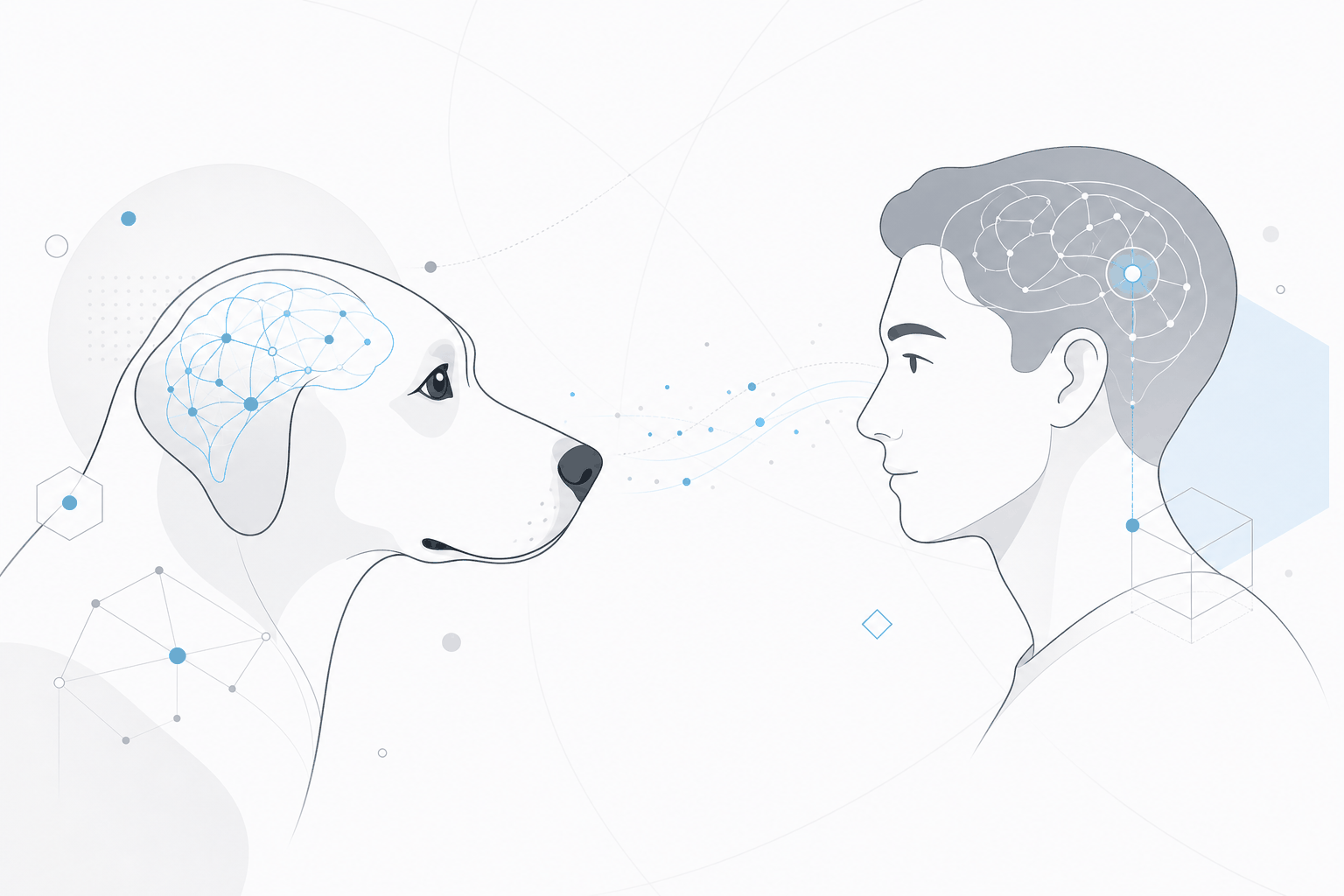
Many people attribute this behavior to dogs smelling stress hormones or picking up on heavy sighs. However, a brain imaging study published in iScience on August 10, 2026, reveals a fascinating scientific insight: even without auditory or olfactory cues, dogs can precisely decode human emotional states from photographs of human faces alone.
The research confirms that dogs recognize human happiness and, for the first time, demonstrates that their brains distinguish between different negative emotions. When presented with sad, angry, or fearful expressions, distinct neural activation patterns light up across the canine cerebral cortex.
Border Collies Lying in the MRI Scanner
To observe the neural activity inside the canine brain, a research team designed a high-precision comparative experiment. Scientists Raúl Hernández-Pérez and Laura Cuaya, affiliated with the University of Vienna, the National Autonomous University of Mexico (UNAM), and Eötvös Loránd University in Hungary, recruited 14 domestic dogs, including Border Collies and Golden Retrievers.
Scanning a dog’s brain is an extraordinary challenge. Functional Magnetic Resonance Imaging (fMRI)—a technique that detects brain activity by tracking changes in blood flow—generates loud, thundering noise and requires subjects to keep their heads completely motionless for extended periods.
Over several months of positive reinforcement training, the 14 dogs learned to wear custom noise-canceling earmuffs and voluntarily lie still inside the narrow scanner bore while fully awake, viewing photographs of human faces displayed on a screen.
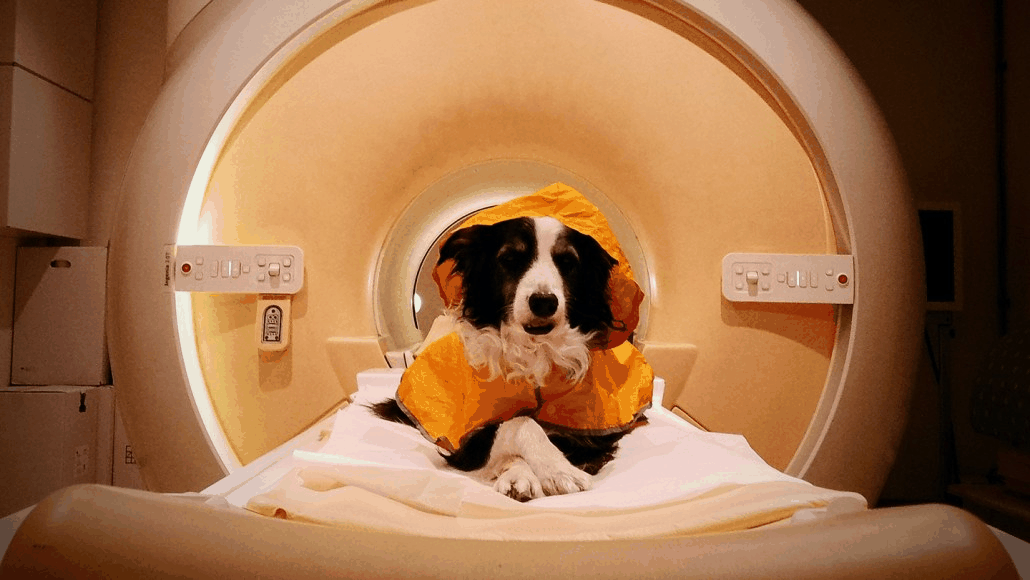 Figure: Kun-Kun, a Border Collie wearing noise-canceling earmuffs, undergoing a brain scan inside an MRI machine. Credit: Laura V. Cuaya / Science News
Remaining motionless inside a cramped, noisy scanner tube for minutes is intimidating even for human adults. Yet all 14 dogs completed the full scanning protocol without any anesthesia or physical restraint, providing scientists with rare, high-quality neural data from awake, conscious dogs.
Seeing a Smile Instantly Lights Up the Brain’s Reward Center
In the first phase of the experiment, researchers showed the dogs photographs of happy and neutral facial expressions. The brain scan data revealed a remarkably clear neural response pathway.
When a smiling face appeared on the screen, the caudate nucleus—a deep brain structure key to reward processing and emotional motivation—was strongly activated. In contrast, neutral expressions evoked only baseline activity.
In human neuroscience, the caudate nucleus lights up when eating sweets or receiving a financial bonus. The fMRI data demonstrated that the blood-oxygen-level-dependent (BOLD) signal in the caudate nucleus was significantly stronger for happy faces than for neutral ones. In a dog’s brain, a human smile carries a psychological value akin to a food reward.
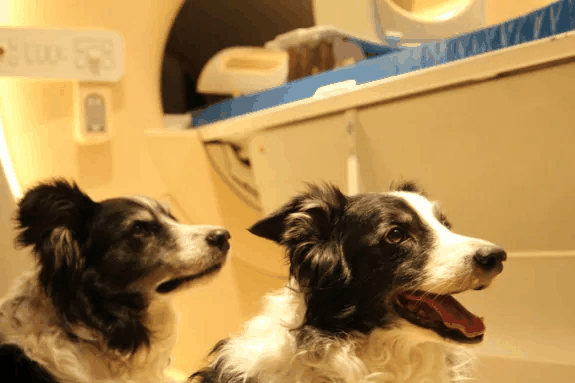 Figure: Two Border Collies sitting next to the MRI scanner, waiting for their session. Credit: Laura V. Cuaya / Science News
While previous studies demonstrated that dogs respond to their owners’ expressions, this study tested photographs of strangers. Even with unfamiliar faces, the dogs captured the reward signal embedded in a smile within a millisecond-level scanning window.
Angry or Fearful? Canine Brains Activate Distinct Neural Regions
The team’s most groundbreaking discovery emerged during the second phase of experiments, when dogs were shown expressions of anger, sadness, and fear.
Historically, researchers speculated that animals could only categorize human expressions broadly as positive or negative. The fMRI data overturned this assumption. When viewing angry or sad faces, the dog’s brain activity concentrated in cortical regions dedicated to social information processing; when viewing fearful faces, neural circuits associated with threat perception were activated.
These distinct activation patterns prove that canine brains possess dedicated decoding mechanisms for different negative emotions. A fearful expression signals potential environmental danger, whereas anger or sadness indicates shifts in social dynamics. Dogs rapidly extract key emotional cues from micro-expressions such as widened eyes or tense facial muscles.
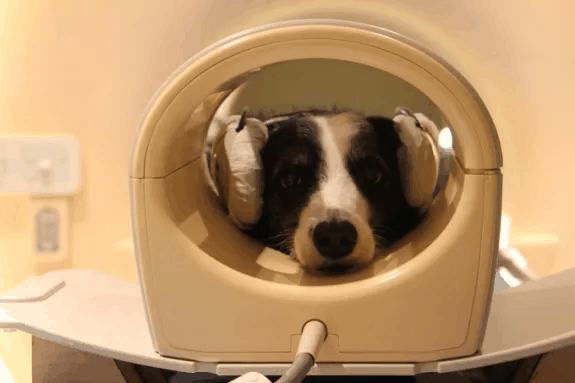 Figure: A Border Collie wearing earmuffs, prepared to undergo a brain scan. Credit: Laura V. Cuaya / Science News
First author Raúl Hernández-Pérez noted that the dogs proved remarkably adept at the task. The neural activation maps triggered by different negative expressions showed minimal overlap, confirming that the canine cerebral cortex differentiates negative emotions with high precision.
Cats Couldn’t Do This: Millennia of Domestication Rewired the Canine Brain
The researchers highlighted an intriguing contrast. When asked if a similar awake brain scan experiment could be conducted on domestic cats, Hernández-Pérez stated it would be a “nearly impossible” task.
This neurobiological divergence stems from the shared evolutionary history of humans and dogs. Over tens of thousands of years of domestication, dogs integrated into human society, developing specialized facial recognition pathways and neural architecture fine-tuned to interpret human emotions.
Data spanning thousands of functional imaging frames across 14 dogs confirmed consistent, high accuracy even when decoding expressions of complete strangers. This indicates that emotional recognition in dogs is not merely a learned memory of a specific owner’s habits, but a universal biological trait encoded in their genetics and neural circuitry.
Without requiring long-term training, a dog’s brain translates complex human micro-expressions into specific neural commands—a depth of cross-species emotional processing exceptionally rare in the animal kingdom.
Decoding the Emotional Decoder Behind Those Gazing Eyes
When you feel anxious or down in your living room, the dog sitting quietly beside you is actively perceiving your state through its neural circuits. It doesn’t need you to say a word; it reads your emotional state directly from subtle facial cues.
Behind that steady gaze lies a sophisticated emotional decoder that has evolved over tens of thousands of years. The fact that a dog’s brain can distinguish sadness from fear proves that their understanding of human feelings is far more nuanced than we ever imagined.
Those warm, wet eyes gazing at you are profoundly tuned into your joys and sorrows—a lasting neural signature left by millennia of interspecies companionship.
Reference Links:
- Original iScience Paper
- Science News Coverage