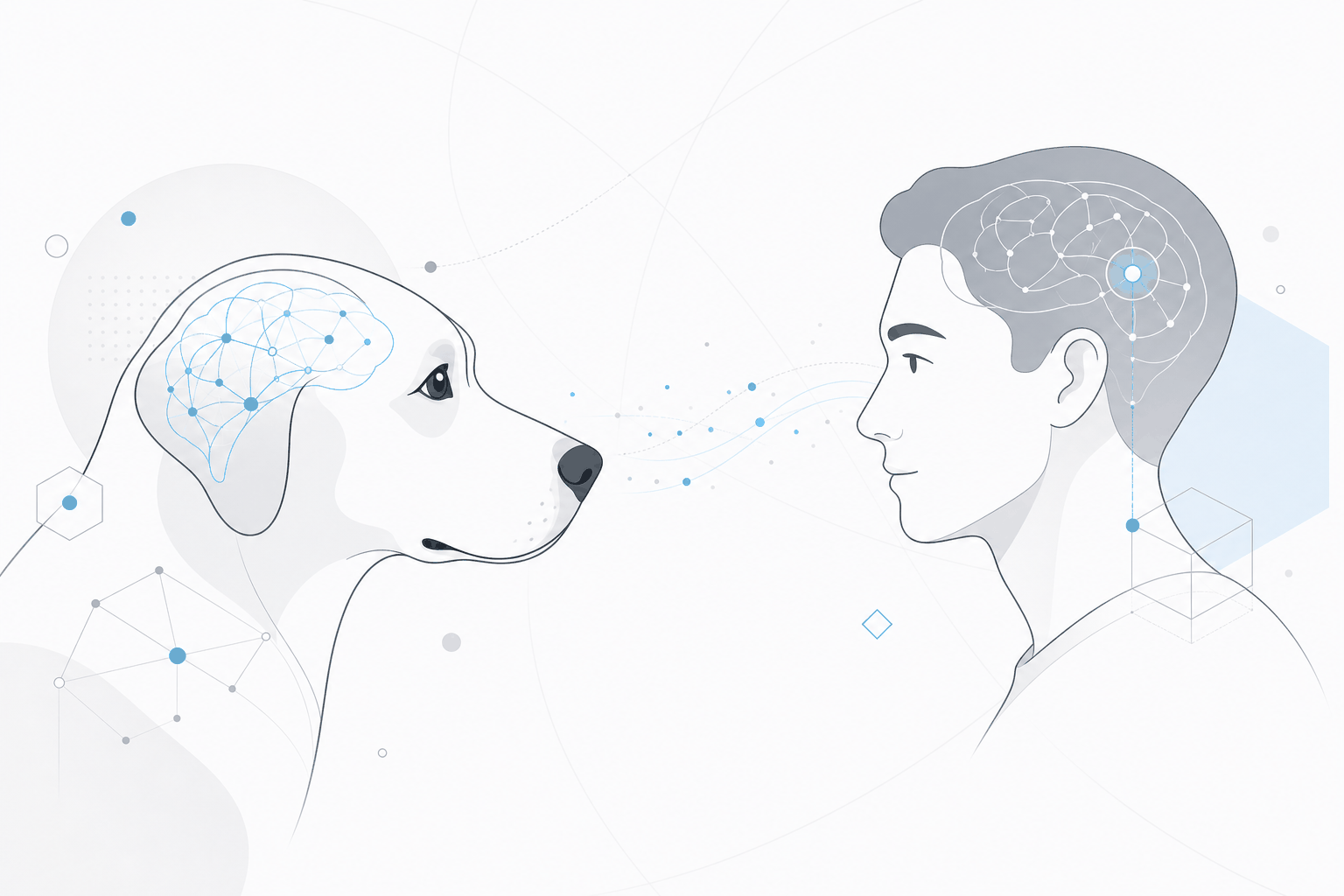
Anyone who has lived with a dog or cat is familiar with the scene. As the pet slumbers on the rug, whiskers twitch, and paws jerk softly in the air. We instinctively assume our furry companions are chasing birds in their dreams. In biology, dreaming typically aligns with Rapid Eye Movement (REM) sleep—a physiological phase during deep sleep characterized by high-frequency ocular oscillations and skeletal muscle atonia.
Hardly anyone ever associates dreaming with arthropods. Common intuition views spiders as creatures operated by pinhead-sized nerve clusters. Lacking a cerebral cortex and unable to close their eyelids, spiders seemed fundamentally incapable of cycling through multi-stage deep sleep.
On October 26, 2026, behavioral ecologists Daniela Rößler and Nadja Geiger from the University of Bonn published findings in the Proceedings of the National Academy of Sciences (PNAS) after extensive experiments. Tracking suspended jumping spiders through the night using infrared night-vision lenses and conducting sudden acoustic arousal tests, the team provided the first robust behavioral evidence for two-stage sleep in arachnids.
Twitching Upside Down on a Silk Thread: Infrared Cameras Capture Nocturnal Shifts
The protagonist of this experiment is Portia fimbriata, a small diurnal jumping spider measuring 5 to 10 millimeters, native to the rainforests of northern Australia, celebrated for its keen vision and specialized hunting of other spiders. In entomology, Portia is recognized as a pinnacle of micro-world intelligence, capable of complex path detour maneuvers to ambush prey, demonstrating remarkable spatial perception during daylight hunts.
Come midnight, this nimble predator takes on a completely different posture. The spider spins a single silk safety line beneath foliage, hanging suspended upside down in midair to sleep. This hanging posture keeps it away from crawling ground predators while providing researchers with an unobstructed field of view.
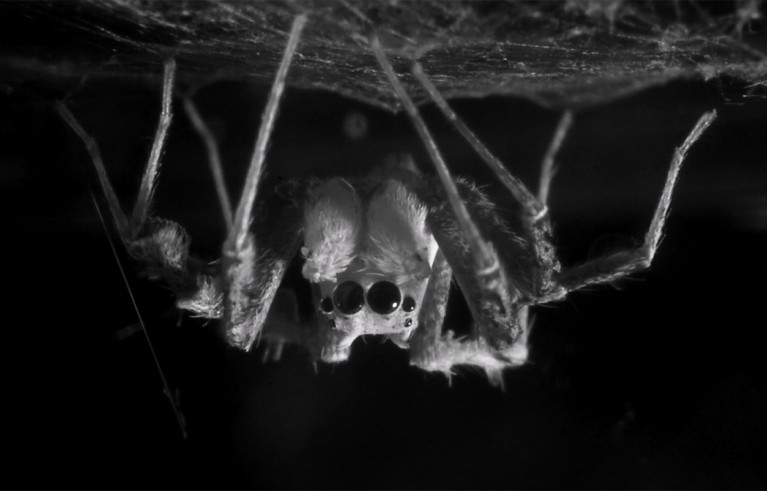 Figure: Jumping spider sleeping suspended under silk; limbs and compound eyes clearly visible. Source: Nature (Photo by Daniela C. Rößler)
Across thousands of hours of infrared footage, the researchers documented an unambiguous circadian cycle. The spider’s nocturnal rest is divided into at least two distinct physiological stages.
The first stage is a quiescent state—a low-activity condition where the organism remains motionless for extended stretches, lowering metabolism while maintaining its posture. In this state, Portia hangs suspended in midair, occasionally performing sluggish self-cleaning by grooming its legs. As the night deepens, its body relaxes slightly along the silk line, sliding into deep rest.
Then arrives the second phase, puncturing the nocturnal calm. After ten to twenty minutes of stillness, the suspended spider undergoes a sudden transformation. Its eight legs curl inwards; the tarsi begin regular rhythmic twitching; the cephalothorax and abdomen shudder in involuntary spasms. This twitching episode lasts anywhere from a dozen seconds to several minutes before the limbs relax once more, sliding back into quiescent repose.
Deaf to the Horns: Diminished Arousal Confirms Genuine Sleep
Capturing body twitches on camera does not automatically prove true sleep. In animal physiology, distinguishing a passive stupor from genuine restorative slumber hinges on the arousal threshold—the minimum intensity of external stimulation needed to wake a resting animal. If an animal is simply zoning out, any disturbance triggers instant alert and flight. In true sleep, the central nervous system gates sensory signals, leaving the animal sluggish or unresponsive to external stimuli.
To verify whether Portia was truly asleep, the University of Bonn team devised acoustic arousal tests. Aiming sound generators at spiders across different behavioural states, the researchers played sharp, jarring noises during active vigilance, quiescent rest (still for over 15 minutes), and during the limb-twitching bouts, while high-speed cameras tracked evasive maneuvers.
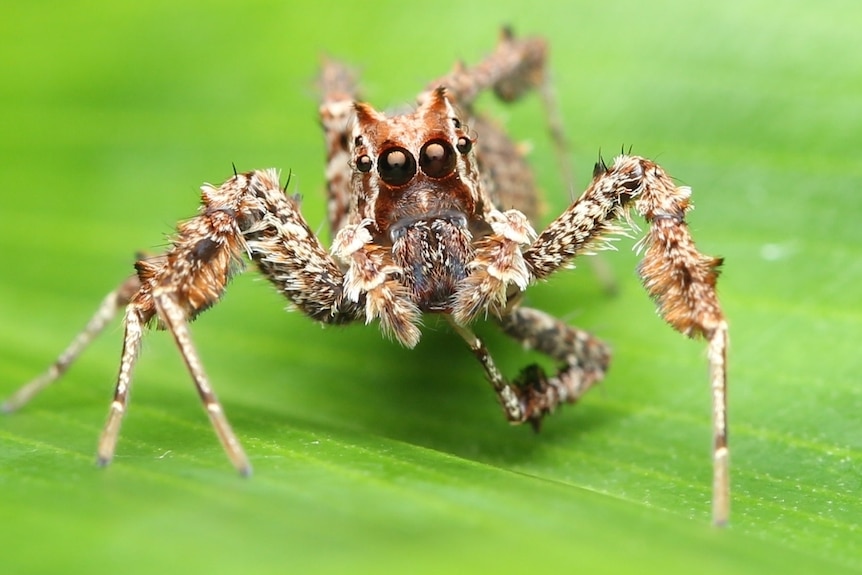 Figure: Live specimen of Portia fimbriata, found in northern Australia, reaching up to 10 mm in body length. Source: ABC News / iNaturalist (Photo by Kurtese Templeton, CC BY-NC 4.0)
The experimental data revealed stark discrepancies in responsiveness. Alert spiders reacted instantly to loud bursts, turning vigilantly or assuming defensive and retreat postures. Those in the quiescent state exhibited noticeable response delays. But during the twitching phase, spiders showed an extraordinary sluggishness to loud noises; several individuals failed to initiate any evasive reaction whatsoever.
This delayed responsiveness after awakening closely mirrors human sleep inertia—the grogginess and temporary impairment of sensory and motor performance when jolted awake from deep slow-wave or REM sleep. The dramatic escalation of arousal thresholds paired with documented sleep inertia confirms behaviorally that Portia is locked in deep sleep during twitching episodes, with sensory gates closed by underlying physiology.
Translucent Exoskeletons: Retinal Movements Unmask REM-Like States
Back in 2022, Daniela Rößler’s team had already reported preliminary signs of REM-like sleep in jumping spiders in PNAS. That discovery stemmed from the peculiar anatomy of juvenile spider hatchlings.
Humans easily recognize REM sleep because human eyeballs visibly dart back and forth behind closed eyelids. Adult jumping spiders, however, possess a rigid dark carapace, with simple eyes embedded like beads across their heads. They have neither eyelids nor movable eyeballs within sockets.
Freshly hatched jumping spider spiderlings, however, sport a translucent exoskeleton. Through their crystalline head carapaces, high-powered microscopy peers straight into their internal workings. Researchers observed that their photoreceptive retinas sit at the ends of elongated, muscular ducts—specialized retinal tubes that move and pivot to steer their line of sight.
In 2022, microscopic footage revealed that sleeping translucent spiderlings regularly curled their limbs while their deep retinal tubes rapidly swiveled back and forth. At the time, lacking behavioral acoustic arousal assays, peers could not entirely dismiss the possibility of random passive muscular twitches.
The 2026 acoustic arousal experiments finally delivered the missing piece of the puzzle. From the swiveling retinal tubes under the transparent carapaces of juveniles to the pronounced twitching and deep sensory decoupling in adults, two-stage sleep in arachnids has now achieved dual validation across both physiology and behavior.
Across 500 Million Years of Divergence: Convergent Neural Mechanisms
Thomas White, an entomologist at the University of Sydney, remarked that this provides the most complete behavioral evidence for sleep in arachnids to date. White pointed out that when we watch a dog twitching on the rug, we readily accept it is dreaming; facing arthropods separated by greater evolutionary distance, science has no valid reason to reject the same deduction.
This discovery opens fresh horizons for evolutionary biology. The last common ancestor shared by arthropods and vertebrates traces back roughly 500 million years to early Cambrian primitive organisms. Over vast evolutionary spans, both lineages charted entirely distinct trajectories: vertebrates developed complex spinal cords and cerebral cortices, while arthropods pursued chitinous exoskeletons and compact ganglia.
Yet beneath the night sky, two fundamentally distinct neural architectures execute remarkably similar sleep programs. Nervous systems separated by half a billion years of evolution independently evolved quiescent rest and REM-like sleep—defined here by periodic eye-tube movement and involuntary limb twitching in animals lacking cerebral cortices. This implies that the core architecture of structured sleep had already solidified over 500 million years ago.
The persistence of structured sleep rhythms in the microscopic realm underscores the universal evolutionary imperative of partitioned sleep. Whether a brain commands billions of cortical neurons or just a few tens of thousands of nerve cells, neural networks require dedicated cyclical windows to reorganize sensory inputs and reset synaptic metabolic loads.
Beyond the Lab Box: Setting Infrared Cameras in the Rainforest
While temperature-controlled plastic boxes in laboratories ensure consistency, they cannot reflect genuine survival dynamics in the wild. Rößler’s team plans to take their apparatus out of the lab and into the tropical rainforests of northern Queensland and Western Australia.
In the dense understory of the bush, a Portia measuring less than a centimeter faces grueling survival pressures. Daytime demands razor-sharp vision to hunt, while nighttime carries relentless threat from predators. Researchers aim to uncover how wild Portia balance deep restorative slumber with predatory vigilance under natural selection.
The spread of artificial lighting poses another emerging hazard to these microscopic creatures. As roads and settlements expand near rainforest borders, Artificial Light at Night (ALAN) increasingly disrupts the circadian rhythms of diurnal insects and spiders. If a jumping spider trapped in deep sleep inertia is suddenly blinded by ambient glow, both its escape reflexes and neural recovery could suffer severe setbacks.
A jumping spider dangling beneath the canopy reveals the nocturnal cadence of the micro world. Two-stage sleep in spiders confirms that structured sleep evolved at least 500 million years ago, surviving divergent paths to converge on identical biological rhythms. As night settles over the jungle, tiny creatures suspended from silk threads quietly repair their nervous systems, keeping rhythm with the rest of the animal kingdom.
References:
- Nature News: “Spider snooze stages”
- PNAS Paper: “Behavioral evidence for two-stage sleep in spiders”
- ABC News Science: “Scientists video REM-like sleep in Australian jumping spider species”