On November 4, 2026, Tencent officially introduced Hy4, its next-generation flagship model. Rather than leading with headline parameter scales, the technical announcement opened directly with error mitigation metrics: internal benchmarks showed retrieval hallucination rates dropping to 5.45% and speculative errors falling to 5.6%. In an industry often fixated on peak benchmark records, elevating factual verification signals a distinct engineering philosophy.
High scores on academic leaderboards rarely translate cleanly into production reliability. The battleground for open-weight models is shifting from theoretical capability ceilings to operational dependability floors. Tencent’s roadmap for Hy4 reflects this priority: suppress confabulation and hallucination in generation pipelines before expanding multimodal and agentic system interactions.
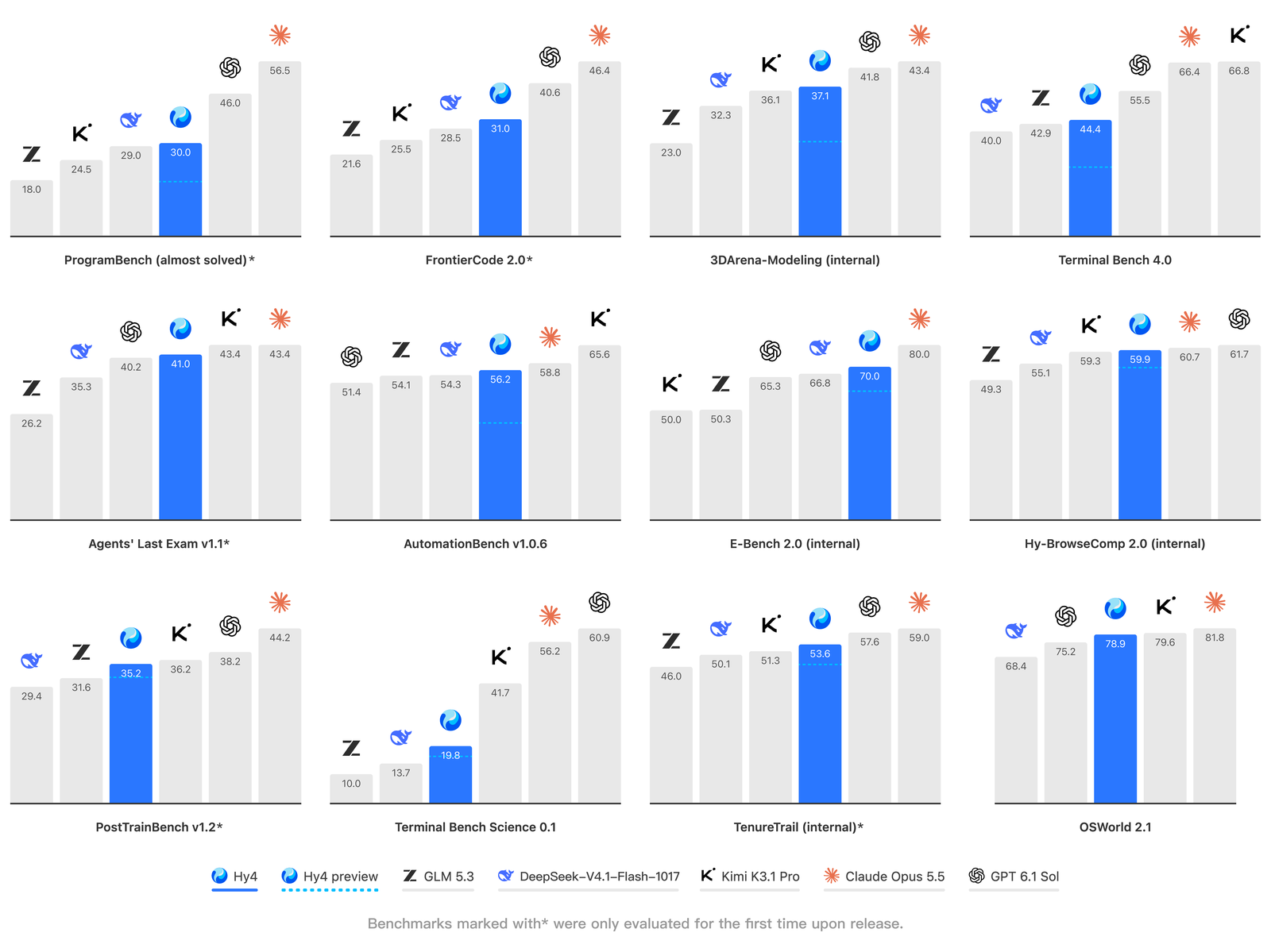 Figure: Hy4 primary benchmark performance distribution, highlighting stability gains across knowledge retrieval and domain-specific reasoning tasks. Source: Tencent Hunyuan (Official Announcement Blog).
Slashing Retrieval Hallucinations by Nearly 70%: Engineering Beyond Leaderboard Ceilings
In enterprise retrieval-augmented generation (RAG) architectures, system failures frequently stem from factual drift during context retrieval. According to Tencent’s internal evaluations, Hy4 cut retrieval hallucination rates from 15.76% in earlier previews down to 5.45%, while speculative error frequency dropped in tandem from 23.1% to 5.6%. For rigorous audit workflows, compressing hallucination rates below the 6% threshold makes automated verification practically viable.
The post-training pipeline introduced targeted upgrades for time-sensitive queries, multi-source synthesis, and automated factual consistency verification. Tencent also extended these mechanisms to enterprise productivity tools, addressing multi-user real-time collaborative editing in office suites where concurrent edits often trigger state desynchronization.
These error and hallucination figures derive from Tencent’s proprietary evaluation datasets, reflecting internal optimization priorities that still await blind third-party replication. Nevertheless, anchoring a flagship release on error reduction metrics marks a decisive shift toward quantitative reliability.
213 Financial Professionals Test 579 Real Tasks: Open-Weight Leadership Built on Production Validation
Financial operations have virtually zero tolerance for factual hallucinations. Tencent Financial Technology (FiT) collaborated with 213 industry practitioners to evaluate the model across 579 production scenarios. Among the evaluators, 153 represented Tier-1 financial institutions, and over 70% brought more than five years of domain experience across high-stakes workflows like financial statement audits and regulatory compliance.
On a 5-point scale, Hy4 achieved an average score of 3.04, leading open-weight contenders. In comparison, DeepSeek-V4.1-Flash-1017 scored 2.97, while Kimi K3.1 Pro and GLM-5.3 each scored 2.68. The performance delta widened during structured financial table comparisons, where suppressed hallucination rates ensured stable metric extraction.
External industry benchmarks echo these findings. In RabyteTech’s IRAB benchmark covering 101 investment research tasks, Hy4 scored 61.63 points, up 12.03 points over its preview release. In specialized financial data query evaluations, Hy4 logged 75.4 points, outpacing GPT-6.1 Sol by nearly 20 points. When synthesizing multi-tiered analyst reports, precision retrieval proved crucial in mitigating speculative chain-of-thought errors.
From 280-Megapixel Component Spotting to Blender Control: Unifying Vision and Computer Use
Hy4 is the first model in Tencent’s Hunyuan series to incorporate native vision and computer use, spanning both command-line environments and graphical user interfaces. In official demonstrations, the model pinpointed a two-meter rooftop fixture within a 280-megapixel aerial image, verifying geometric consistency across vast multi-scale feature hierarchies.
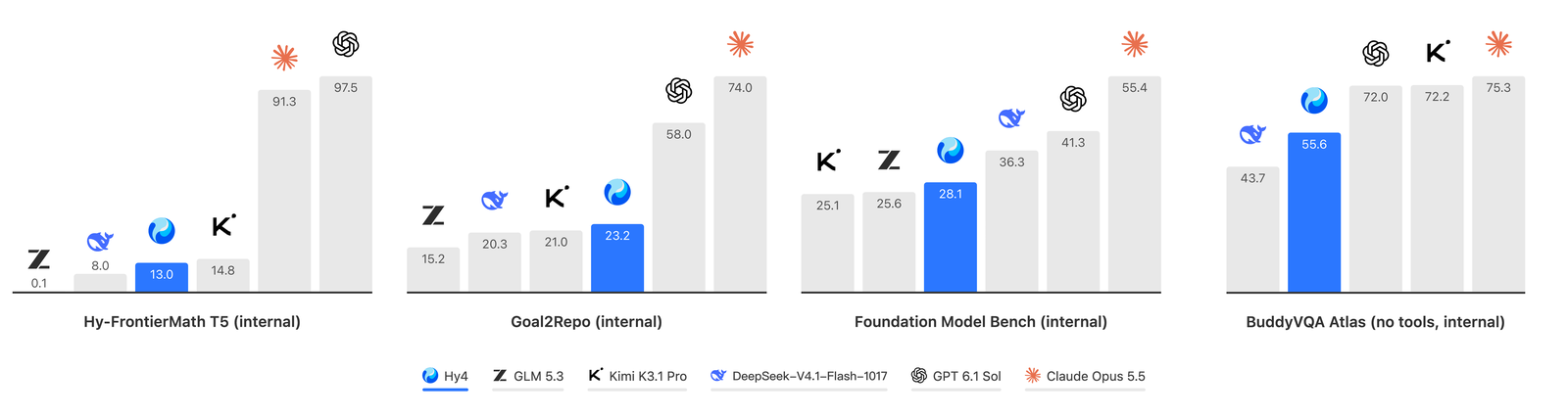 Figure: Hy4 locates a 2-meter rooftop component within a 280-megapixel ultra-high-resolution aerial photograph, demonstrating fine-grained visual acuity across extreme scale variations. Source: Tencent Hunyuan (Official Announcement Blog).
Enhanced visual perception directly enables robust interaction with professional engineering software. Tencent trained the model specifically on 3D modeling environments like Blender, enabling long-horizon workflows across diverse software ecosystems. Where traditional UI agents often lose state when navigating dense nested menus, binding pixel coordinates directly to functional tool invocations reduced operational derailment.
In digital entertainment and interactive media, Tencent Interactive Entertainment Group (IEG) collaborated on dataset curation and evaluation design. Hy4 incorporates direct support for Unreal Engine, Unity, and Godot, extending into multiplayer game logic. Internal benchmarks showed gains of 19.1% in GameDev and 9.8% in GameLogic benchmarks, reducing developer overhead in generating boilerplate engine code.
Proprietary Infrastructure, Rigorous Red-Teaming, and Frank Disclosures of Frontier Gaps
Beyond enterprise automation, Hy4 is taking on scientific computing workloads. Across 123 research tasks spanning seven core scientific disciplines in internal benchmarks, the model led open-weight alternatives. In biological modeling, a single node completed 3D embryo reconstructions across seven million cells in 1.5 hours. Alongside the release, Tencent open-sourced two foundation models: HyPDE for physical systems and HyCell for single-cell biology, utilizing customized infrastructure to improve training efficiency.
 Figure: Complete Hy4 benchmark evaluation table, detailing comparative performance gaps and convergence across coding, long-context reasoning, and specialized domain tasks. Source: Tencent Hunyuan (Official Announcement Blog).
As agentic computer control expands, security boundaries become paramount. The training pipeline restricted cybersecurity data exclusively to defensive paradigms like patch validation and PoC analysis, strictly filtering out exploit creation and penetration tooling. Independent red-teaming by Tencent Xuanwu Lab and Keen Security Lab concluded that Hy4 introduces no elevated risk in binary obfuscation bypass or exploit weaponization. On the Hy-BioExperimentBench evaluation, it scored 30.4 out of 100, showing no evidence of lowering the barrier to biological threats.
Crucially, the release technical report openly documents existing capabilities ceilings. Tencent acknowledged persistent gaps between Hy4 and frontier closed-source models in research-level mathematics, long-horizon software architecture, and advanced visual reasoning. Disclosing limitations upfront allows system architects to design proper fail-safes, establishing credibility where marketing hype often creates production risks.
Production-First Deployment Before Weight Release: Reliability as Acceptance Criteria
A notable nuance of the announcement is that Hy4’s model weights have not yet been released. The official documentation notes that Tencent “plans to open-source the model weights” alongside comprehensive system cards in coming phases, having already coordinated ecosystem support with vLLM and SGLang. Before distributing weights publicly, Tencent deployed Hy4 directly into its own high-concurrency internal products.
Commercial pricing remains identical to earlier preview versions: cached input is priced at $0.042 per million tokens, with standard input and output at $0.834 and $2.501 respectively. Available via Tencent Cloud with a lightweight Hy4 flash edition scheduled next, fixed pricing simplifies cost projections for enterprise migration.
Internal telemetry across Tencent products provides substantial operational validation. Tencent Yuanbao’s internal benchmark climbed from 65.25 to 72.53 with notable agent task completion gains; Honor of Kings configuration automation reached 99.32% accuracy after self-repair loops with bug localization improving to 73.8%; and WorkBuddy multi-step browser tasks logged a 96.15% pass rate, validating the practical necessity of low hallucination baselines.
The open-weight ecosystem is outgrowing the early phase of simply stacking parameters and chasing benchmark leaderboards. Hy4’s trajectory demonstrates that compressing factual error rates into verifiable bounds addresses the single greatest bottleneck to real-world deployment. While open-weight verification by the broader community remains ahead, establishing reliability floors through rigorous production testing sets a pragmatic standard for enterprise delivery.
Reference Links:
- Tencent Hunyuan Hy4 Official Announcement and Technical Blog
- Tencent Financial Technology (FiT) Professional Evaluation Report
- RabyteTech IRAB Investment Research Benchmark
- Tencent Xuanwu Lab & Keen Security Lab Red-Teaming Reports