Chase’s Data Center Goes Down, and Everyone Else’s Transfers Stall
“Some services are temporarily unavailable. We’re working on it — please try again later.”
On Monday, November 16, 2026, that message filled the screens of JPMorgan Chase customers. On the same day, customers at several other major U.S. banks found they couldn’t access their online accounts, and Zelle — the real-time interbank transfer network — was broadly stuck.
AP’s reporting that day pinpointed the source: the failure originated in Chase’s own data center, with no sign of hacking. By contrast, Bank of America and Citibank were running normally; the ones that froze were precisely the banks with money flows touching Chase. The pattern made the picture clear: the outage traveled along the flow of funds, not spread evenly.
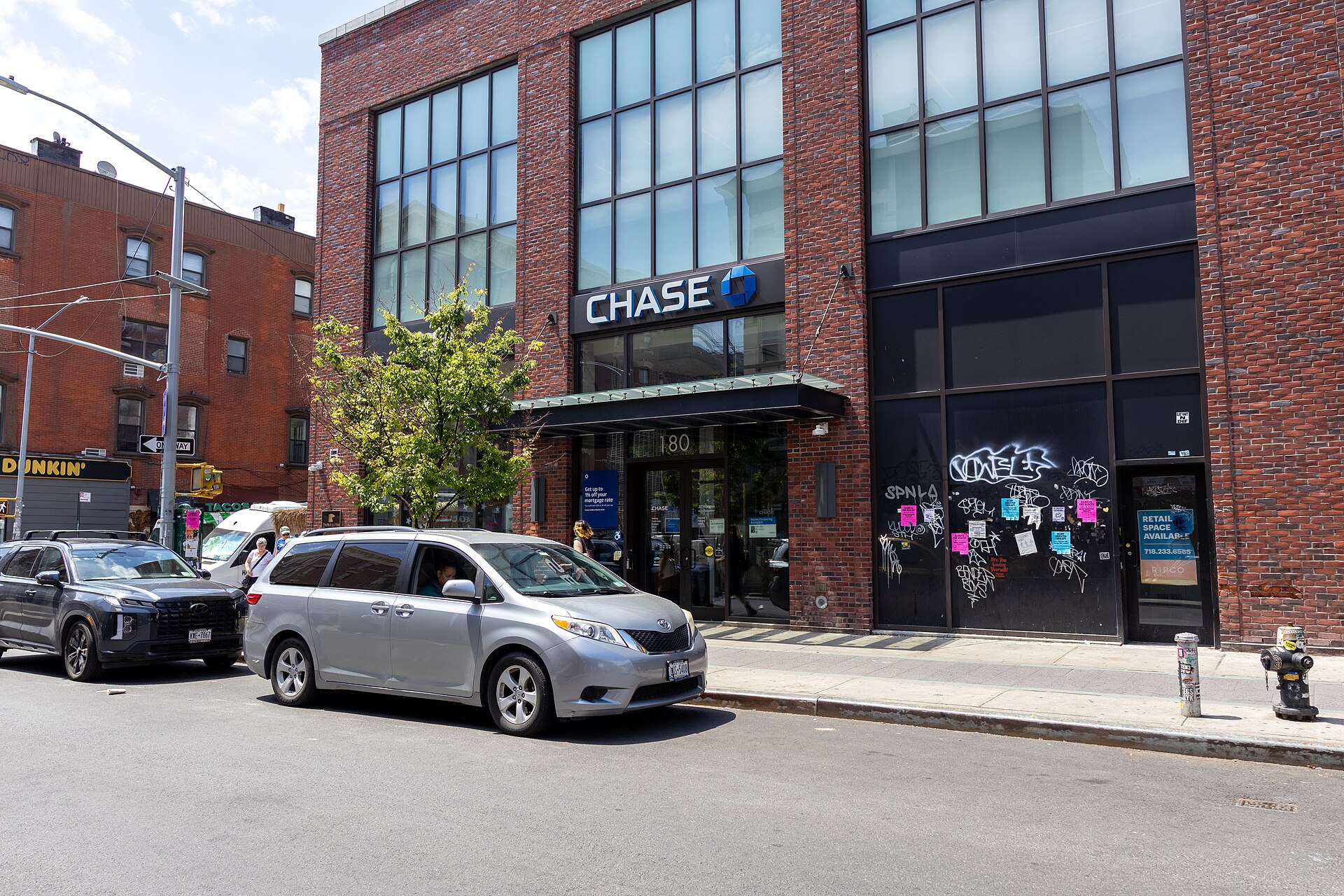 Image: A Chase branch in Brooklyn, New York. The source of the outage sat in the company’s own data center — nothing to do with the branch on the corner. Source: Wikimedia Commons
First Rule Out Hackers, Then Point the Finger Inward
Chase spokesperson Joe Evangelisti set the official narrative: “JPMorgan Chase experienced a temporary issue related to a software bug in on-premises hardware systems — not related to a cyberattack.” The two heaviest words in that sentence: on-premises and software bug. On-premises means the systems run on servers the bank bought itself and installed in its own data center — its own machines, its own operations.
In 2026, a bank with assets measured in the trillions still running its core systems on hardware it owns isn’t surprising — bank system migrations are notoriously slow, and regulators and auditors don’t like moving day. Chase ruled out a cyberattack ahead of the rumors for good reason: in bank-outage news cycles, hacker speculation spreads faster than any official statement.
The same statement also drew a boundary: other banks may have experienced slower transaction speeds merely because they transacted with Chase. In effect, Chase admitted in advance: my outage becomes your outage.
Whoever Settled with Chase Got Slow
Zelle is operated by Early Warning Services, based in Arizona — the real-time rail Americans use for everyday interbank transfers, with settlement typically measured in minutes. The operator drew the responsibility line crisply: the Zelle network itself was functioning; the delays affecting some customers came from the financial institutions’ side.
U.S. Bank’s statement completed the picture: its systems were not directly affected, but customers sending or receiving Zelle transfers with other financial institutions could see delays. Translated: the bank itself was fine — the queue jammed at someone else’s door.
Think of interbank transfers as a highway system: Zelle is the expressway shared by all the banks, each with its own on-ramp. Chase’s on-ramp had an accident. The expressway itself was intact, but every car that had to pass through the Chase station sat stuck halfway; Bank of America’s and Citibank’s traffic took other ramps and kept flowing. The blast-radius list is ranked by money flow: whoever has accounts with Chase makes the list — bank size and technical sophistication aren’t selection criteria.
 Image: An ATM. Real-time transfer’s selling point is compressing settlement to seconds; once the rail jams, seconds snap back to hours. Source: Wikimedia Commons
The Zelle Rail Is Owned by Seven of the Biggest Banks
Early Warning Services’ shareholder list is itself a preview of the blast radius: Bank of America, Capital One, JPMorgan Chase, PNC, Truist, U.S. Bank, and Wells Fargo — seven co-owners. The rail customers use every day for interbank transfers belongs to the very seven banks it connects.
That structure explains why the failure could spread across banks. Chase is both an owner of the rail and a node on it — ownership doesn’t shield a node from failure. On the day its data center broke, customers of the other six shareholders queued up all the same. A shared rail means shared failure: the savings from not building your own rail come with availability tied to everyone else’s. That trade-off was written into the shareholder agreements long ago; customers have never seen the terms.
In the Same Week: Cloud, On-Prem, and Air Traffic Control Each Broke Once
Stretch the timeline out to seven days: on Thursday, Microsoft’s cloud services suffered a broad outage — Outlook, Teams, and Copilot all went down for hours; on Friday, a U.S. air traffic control failure grounded flights nationwide for hours, scrambling weekend travel; on Monday, it was Chase’s data center’s turn. AP itself got the Microsoft outage’s timing wrong once — first reporting it as Friday, then correcting to Thursday. In a week this dense with failures, even the media’s timeline got squeezed out of shape.
There was a comparison case the month before: Revolut in the UK, knocked out by a Google Cloud incident, took 12 hours to recover. Self-hosted data centers and cloud托管 both produce single points of failure — no architecture choice grants immunity; the only thing left to choose is the size of the blast radius. The three failures spanned three architectures — a big company’s cloud, national infrastructure, and a bank’s own data center. Single points of failure don’t pick architectures; they pick who you’re connected to.
Availability Follows Money Flow, Not Technical Skill
Put three facts from this incident side by side: no hackers, no data breach, no cloud provider outage — and the official statement narrowed the scope to the circle of “those transacting with Chase.” Even so, interbank transfers stalled, customers sat and waited, and other banks kept explaining to users: our systems are fine — the break is elsewhere.
Look back at that error message: “Some services are temporarily unavailable” acquired, by the next day, a readership far longer than Chase’s customer list. “Real-time settlement” is a promise signed jointly by seven banks, and any one of them has the power to hit pause for everyone — customers’ right to know about this hidden clause is exactly zero. Fixing its own data center took Chase one software patch; dismantling the money topology that binds seven banks together has to wait until the shareholders next sit at the same table.
References:
- AP report, November 16, 2026
- Early Warning Services’ statement on the Zelle network
- Community discussion of the Revolut outage