A single 3.5-inch black floppy disk holds merely 1.44MB—barely enough space for an uncompressed photo taken by a modern smartphone. Yet when slotted into a pocket-sized white plastic enclosure, a phone connects to its web portal, and vintage photos appear almost instantly.
Hardware developer bigcrimping named the project floppy3.5. At its core, it functions as a portable wireless storage device tailored exclusively for high-density FAT12-formatted floppy disks. Photos captured by vintage Sony digital cameras transfer seamlessly over local Wi-Fi to a smartphone or back up automatically to an onboard microSD card.
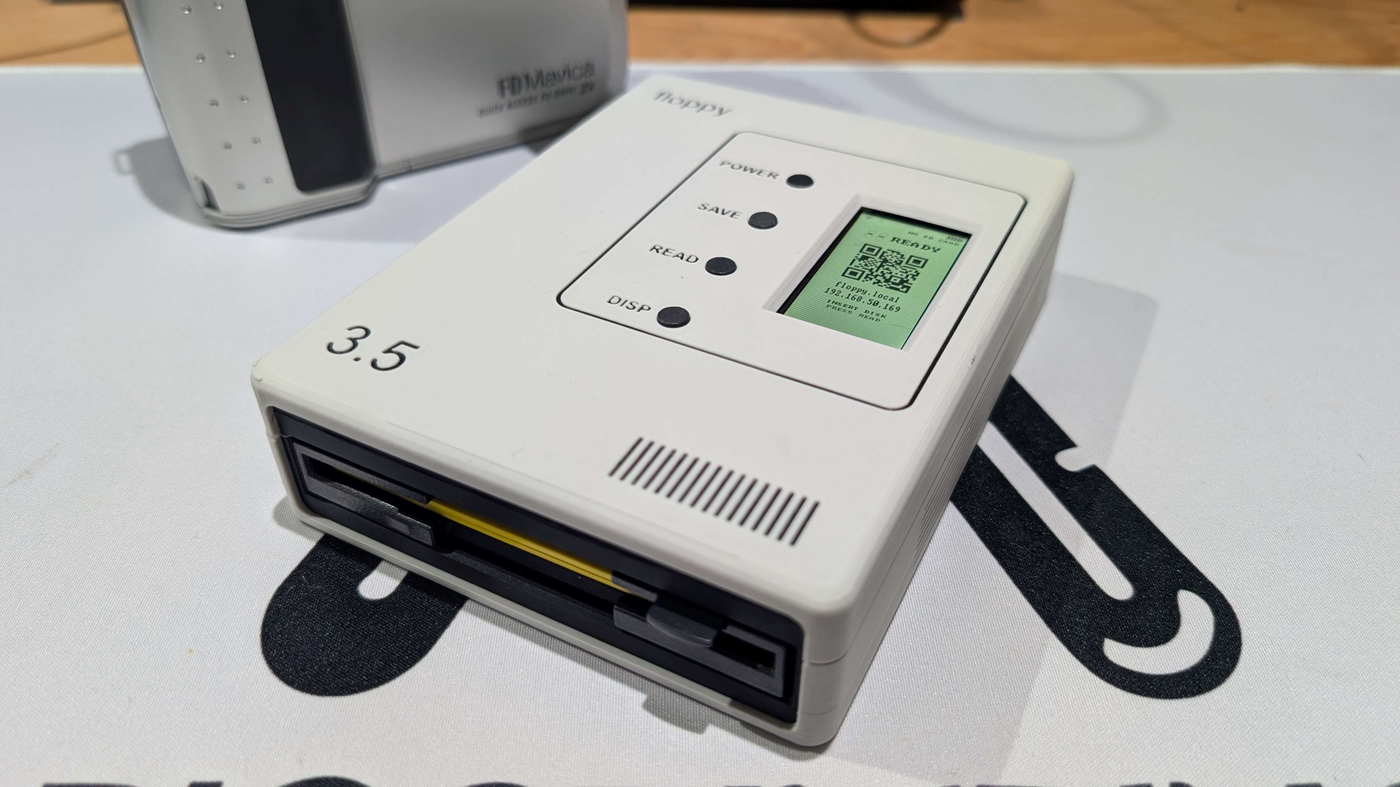 Figure: The floppy3.5 reader alongside a vintage Sony Mavica camera; the photos on the floppy disk were captured by this camera. Source: bigcrimping repository
From Vintage Sony Cameras to the Modern Web: Floppies Faded from Missing Drivers, Not Wear
The disappearance of floppy disks from daily computing seems, on the surface, like a defeat in the face of skyrocketing storage capacity. A single disk holds only a dozen 640×480 snapshots. But in the eyes of retro digital photography enthusiasts, these aging magnetic disks are far from dead. The real obstacle lies in modern computing infrastructure.
In the late 1990s, Sony’s Mavica camera lineup used standard floppy disks directly as storage media. In an era when flash memory was prohibitively expensive, utilizing off-the-shelf floppies was the most practical choice to keep consumer retail prices accessible. Today, the mechanical shutters and lenses of these cameras remain functional, yet the pictures sealed on the magnetic coating are locked out of contemporary devices.
Motherboard manufacturers stripped out floppy controller interfaces decades ago. Modern operating systems no longer bundle low-level legacy controllers. Cheap USB floppy drives on the market only support a narrow set of rigid formats; when faced with subtle track aging or minor degradation, they immediately throw read errors and lock up. Ordinary users are left with virtually no recourse.
Floppy disks were not retired due to widespread physical failure; modern hardware and software ecosystems severed the low-level communication pipeline. The analog magnetic fluxes across the platter remain largely intact. What vintage hardware truly lacked was an interpreter capable of bridging the gap to modern systems. Once that translation bridge is reconstructed, legacy media readily rejoins the digital world.
Hardware State Machines Replace Timers: Nanosecond Flux Sampling on Microcontrollers
Reading raw floppy disks differs fundamentally from reading modern USB flash drives. A floppy drive does not serve up packaged file blocks on request. Instead, it sweeps a read head across spinning tracks to detect microscopic, analog magnetic transitions.
As magnetic poles reverse across the passing track, the drive head produces delicate voltage pulses. By precisely recording the timing between these transitions, decoding algorithms reconstruct raw binary streams. Open-source tools like Greaseweazle historically relied on dedicated hardware timers to measure these intervals. However, that design depended heavily on specific microcontroller timer interrupts, limiting flexibility in configuring signal pipelines.
floppy3.5 migrates the flux-reading engine to the Raspberry Pi RP2354A. By leveraging its Programmable I/O (PIO) state machines alongside Direct Memory Access (DMA), the project completely overhauled the underlying sampling logic. Dedicated hardware state machines now shoulder the high-speed capture of nanosecond-level pulses.
Running independently of the primary processor cores, the RP2354A’s state machines register pin transitions with zero interrupt latency. The main cores remain free from interrupt thrashing while DMA autonomously transfers incoming buffers. Dedicated state machines managing low-level acquisition deliver industrial-grade sampling fidelity to fragile analog magnetic signals.
Beyond coordinating with the onboard system, the RP2354A exposes an independent communication interface. The chassis features dual USB ports, allowing the secondary port to link straight to a PC. Advanced users can deploy command-line flux utilities to extract raw disk images for archival preservation and low-level data recovery.
Dual-Core Bus Coordination: Throttling Wi-Fi Output to Stabilize Drive Spindles
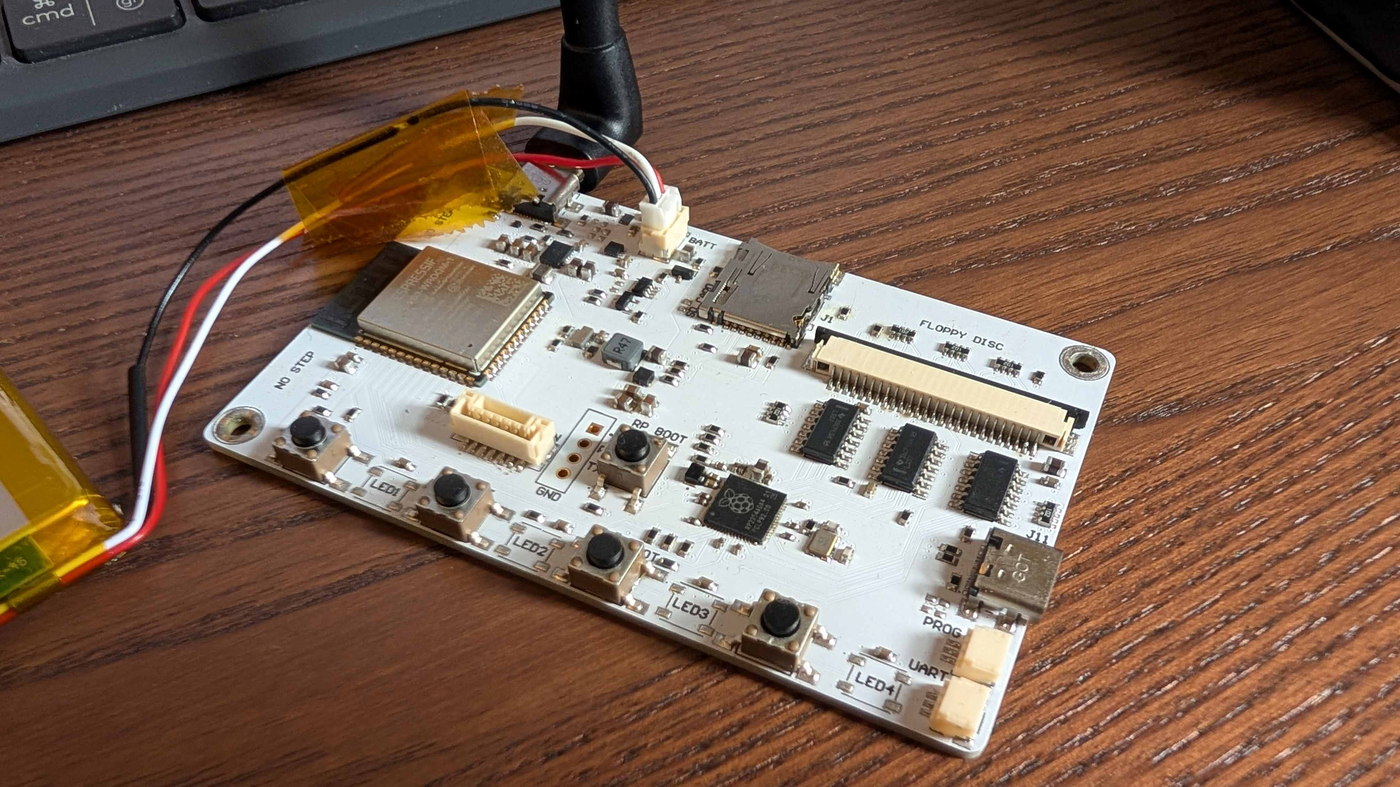 Figure: The assembled custom PCB integrating dual processors, battery charging, and power regulation on a single board. Source: bigcrimping repository
The portable unit relies on a dual-chip architecture. The RP2354A interfaces directly with the 26-pin ribbon cable of the laptop-style floppy drive, passing captured data across a high-speed bus to an ESP32-S3. The ESP32-S3 takes charge of FAT filesystem decoding, driving the onboard color display, and hosting the captive Wi-Fi portal.
The built-in color LCD provides real-time diagnostics, displaying the disk volume label, battery percentage, and read progress. An integrated microSD slot automatically saves and archives extracted photos into organized folders. Both microcontrollers support over-the-air (OTA) firmware updates.
Powering a portable handheld floppy reader introduced severe engineering hurdles. The unit packs a roughly 4000mAh lithium battery, paired with dual voltage regulators outputting 3.3V logic and 5V motor power. The boost circuitry must cope with significant current spikes when the drive spindle spins up.
During early breadboard tests, sudden voltage dips triggered spontaneous system brownouts. Whenever a phone refreshed the web page while the floppy spindle engaged, the entire board shut off abruptly. The simultaneous surge from RF transmission and inductive motor draw instantly dragged battery voltage beneath the regulator threshold.
The developer devised a clever firmware compromise: upon detecting a read command, the system temporarily dials down Wi-Fi transmission power to 11dBm. Yielding electrical headroom during mechanical seeks trades a momentary dip in network throughput for rock-solid power stability.
Complementing power scheduling, updated firmware bundles further practical fail-safes. The device automatically shuts down after five minutes of inactivity preceded by a 30-second on-screen countdown. Fuel gauge telemetry triggers two-stage low-power warnings at 15% and 5% battery, and a five-second button hold clears cached network configurations.
Open Protocols Outlive Media: Open Hardware Defeats Planned Obsolescence
Consumer electronics cycles rely on rapid obsolescence. Proprietary interfaces vanish, leaving unsupported hardware abandoned as electronic waste. Yet against open-source toolchains, magnetic tracks laid down thirty years ago remain readable and verifiable.
The original prototype began as an unwieldy desktop drive wired to external breakout boards. Today, dual microcontrollers, power management, and display circuitry coalesce onto a single custom PCB. The enclosure is 3D-printed, reinforced internally with heat-set brass threaded inserts.
The developer released all firmware, schematics, and CAD models into the public domain. Anyone is free to download the design files, assemble their own unit, or tailor the driver code. While vendors abandon legacy media according to market incentives, open-source communities preserve technical heritage. Collaborative open engineering gives forgotten hardware a new lease on life.
Preserving digital memory depends on maintaining open, transparent protocols. Physical magnetic coatings will inevitably decay over time. So long as open protocols capable of decoding electromagnetic flux remain accessible, legacy media will never be stranded beyond the reach of modern computing.
Reference Links:
- bigcrimping/floppy3.5 Open Source Hardware Repository
- Greaseweazle Floppy Flux Analysis Toolchain