A strand of human hair is roughly 70 microns across. A typical hobbyist 3D printer extrudes plastic filaments about 400 microns wide, with layer heights hovering around 100 microns (0.1 mm). Historically, pushing fabrication resolution down to a single micron required investing tens of thousands of dollars in industrial-grade precision linear stages, optical encoders, and vibration isolation tables. Yet on October 13, 2026, with the release of document version 37, open-source project μRepRap (RepRapMicron) achieved 1-micron bidirectional repeatability using parts printed on a standard home 3D printer, drugstore acupuncture needles, and retail UV nail gel. The twenty-year-old dream of self-replicating machines is far from dead; as positioning accuracy leaps from 100 microns to 1 micron, home workshops are crossing into the physical realm of microfabrication for the first time.
Two decades ago, the RepRap project proposed a radical vision: a machine that could print its own components. While that idea birthed the modern desktop 3D printing industry, the true spirit of self-replication was gradually sidelined by commercialization. Consumer printers grew sleeker, but increasingly dependent on CNC-machined aluminum plates, ground metal guide rails, and custom control boards. Open-source hardware pioneer Vik Olliver founded μRepRap (licensed under GPL v3, hosted at GitHub under VikOlliver/RepRapMicron) to challenge that trend, setting out to conquer micron and sub-micron fabrication with ubiquitous, low-cost parts. Industrial precision manufacturing buys accuracy by machining away metal tolerances; μRepRap harnesses compliant geometry, coaxing ordinary desktop plastic into taming mechanical tolerances at the microscale.
Plastic Flexures Replace Metal Rails to Reach 1-Micron Repeatability
When mechanical engineers aim for micron-level tolerances, their first instinct is to specify ultra-tight ball screws and linear guides. But down at 1 micron, sliding friction between metal surfaces, hydrodynamic variations in lubricant film thickness, and microscopic gear backlash turn into devastating stochastic errors. A stray speck of dust settling on a rail can ruin tens of microns of positional accuracy—making conventional industrial approaches fundamentally ill-suited for a home garage.
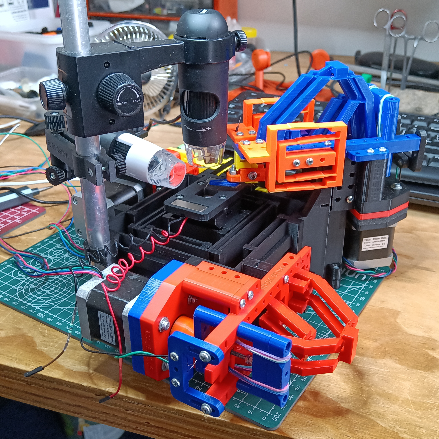 Figure: The primary recommended PIKA V0.02 model, relying on a monolithic 3D-printed flexure stage to achieve approximately 1-micron repeatability. Source: RepRapMicron project wiki
μRepRap sidesteps metal-on-metal friction by borrowing a core design principle from the OpenFlexure open-source microscope platform: the flexure mechanism. The printer features no linear ball bearings or sliding joints; instead, the entire motion stage is 3D printed as a single monolithic block of plastic. It relies on thin flexible hinges engineered into specific zones that deflect elastically to transmit motion. As long as the displacement stays well within the plastic’s elastic limit, there is zero mechanical backlash and none of the stick-slip friction typical of sliding contacts. Trading sliding friction for controlled elastic deformation is the key engineering insight allowing desktop plastics to outperform affordable metal guide rails at microscopic scales.
To understand the quirks of plastic flexures, Vik Olliver built an early test rig codenamed MAUS. The most extensively documented iteration, MAUS C (V0.04, published on Printables under ID 1286343), demonstrated roughly 5-micron repeatability over a 4 mm × 4 mm envelope. However, its kinematic path suffered from noticeable non-linear distortion: equal pusher travel translated to different probe displacements depending on whether it was near the center or edges. After several iterations culminating in the V0.05 revision compatible with upgraded pushers, MAUS completed its mission and was retired, handing the torch to the primary PIKA architecture.
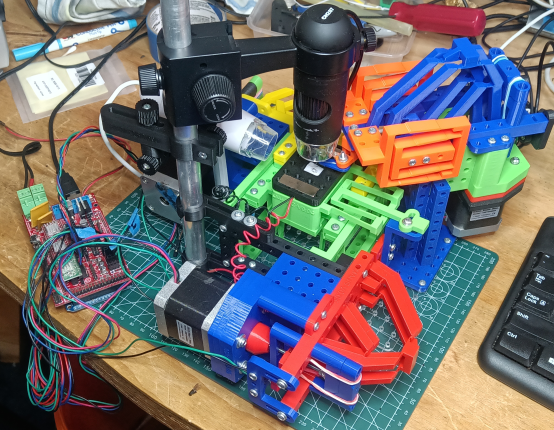 Figure: MAUS “L” V0.05, an experimental test rig refined through February 2026; the MAUS series demonstrated ~5-micron positioning in a 4 mm cube and has now been retired in favor of PIKA. Source: RepRapMicron project wiki
The project originally aimed for sub-3-micron repeatability across a 10 mm working envelope, with all structural elements printable in a home workshop. PIKA V0.02 has largely delivered on that promise. It reliably maintains sub-10-micron precision across an 8 mm × 8 mm workspace, while single-point repeatability reaches approximately 1 micron. An 8 mm travel range might sound no larger than a fingernail, but in microelectromechanical systems (MEMS) and microfluidics, that postage-stamp area is more than enough to host an entire lab-on-a-chip.
400-Step Steppers and Lever Stages: Sub-Micron Resolution on Standard Boards
Eliminating guide rail backlash solved only half the challenge; the next barrier was the drive mechanism. Industrial micropositioning stages rely on piezo ceramic actuators, which exploit microscopic crystalline expansion under voltage to move a platform. However, a single piezo actuator and closed-loop controller easily costs thousands of dollars—instantly shattering any dream of garage self-replication.
PIKA’s countermeasure is surprisingly pragmatic: standard NEMA 17 stepper motors familiar to any maker. Where common 3D printers use 200-step-per-revolution (1.8° step angle) motors, μRepRap opts for 400-step (0.9° step angle) variants. Combined with the mechanical reduction built into the flexure levers, a full step on a 200-step motor produces roughly 1 micron of travel; with a 400-step motor and microstepping drivers, single-step resolution drops comfortably into the sub-micron regime. By baking kinematic gear ratios directly into the geometry of 3D-printed levers, an off-the-shelf stepper motor costing a few dollars replaces thousands of dollars in piezo hardware.
The control architecture is equally accessible. The entire rig runs off an inexpensive Arduino board running standard open-source GRBL firmware, receiving standard GCODE commands over a serial connection. Any retired laptop with a USB-to-serial cable can orchestrate micron-scale toolpaths. Relying entirely on the consumer maker ecosystem slashes the electronics bill for a microfabrication machine to well under twenty dollars.
Acupuncture Needles as Nozzles and Machine-Etched Probes
Holding a 1-micron coordinate is only step one; depositing material with that precision is arguably harder. Conventional fused deposition modeling (FDM) melts and extrudes thermoplastic filament. At the single-micron scale, thermal expansion and viscous surface tension cause molten plastic to bead up into uncontrolled blobs, rendering extrusion impossible. μRepRap pivots instead to photopolymer resin, backed by an inventive array of hacky DIY tooling.
On PIKA, a single probe wears three hats: a Z-axis contact touch-sensor, a micro-carving stylus, and a resin deposition tip. For coarse tasks, the dispensing head uses a 0.5 mm hypodermic needle or a 0.25 mm (250 micron) traditional acupuncture needle. When feature sizes drop below 10 microns, even acupuncture needles become too blunt. At that scale, the system switches to ultra-fine wire sharpened via electrochemical etching. Dipping a needle tip to transfer microdroplets via capillary action neatly bypasses the nightmare of controlling fluid backpressure in microscale pumps.
 Figure: A “Hello, World” pattern and a 100-micron square printed in UV resin using a 125/9 optical fiber probe. Source: RepRapMicron project wiki
Here lies the project’s truest expression of the RepRap ethos: fabricating ultra-sharp probes requires no specialized lab supplies, because PIKA etches its own tips. The printer chucks a generic wire, dipping it into an electrolyte solution with precise Z-axis microsteps while timing the current exposure. Once the electrochemical reaction sharpens the wire into a sub-micron tip, the printer immediately puts the newly etched tool to work. A machine capable of manufacturing and sharpening its own precision tooling closes the loop on self-replication at the microscale.
Consumables are similarly bargain-basement: standard UV-curable nail top coat from local beauty supply shops. The probe taps a microscopic droplet of nail gel onto the substrate via surface tension, and a UV LED mounted on the bed cures it on the spot. With this technique, PIKA has deposited droplets as small as 4 microns and traced cured resin lines just 9 microns wide using an optical fiber probe. A 9-micron trace is roughly one-eighth the thickness of a human hair; producing features that small with dollar-store nail polish demolishes the exorbitant cost of proprietary microfabrication materials.
When Mechanics Hit 1 Micron, Oxygen Stops the Cure
Once Vik Olliver proved that 3D-printed flexures and 400-step motors could achieve 1-micron positioning, the platform hit a wall that clever mechanical design could not breach. This time, the bottlenecks were the physical wavelength of UV light and the air we breathe.
In conventional resin 3D printing, liquid pools are thick enough that ambient oxygen at the liquid-air interface doesn’t prevent bulk polymer crosslinking. But when droplets shrink to micron and sub-micron thicknesses, their surface-area-to-volume ratio skyrockets. Atmospheric oxygen penetrates the entire droplet almost instantaneously, scavenging free radicals and neutralizing photoinitiators. Despite adequate UV irradiation, a 4-micron resin droplet can fail to polymerize due to severe oxygen inhibition; unreacted droplets often evaporate or collapse before solidifying. Once mechanical precision breaks the 1-micron barrier, the central battlefield of microfabrication shifts abruptly from mechanical engineering to surface chemistry and optical physics.
This physical barrier has spurred lively debate across the open-source hardware community. Optimists maintain that oxygen inhibition and diffraction limits can be mitigated with simple, low-cost engineering tricks. Surrounding the 8 mm print zone with a lightweight shroud and purging it with nitrogen or carbon dioxide could displace ambient oxygen. Optically, near-field curing with optical fiber tips has already demonstrated 9-micron line widths, with further electrochemical deposition showing strong upside.
Skeptics counter that a yawning gulf separates depositing a 4-micron dot from building functional, multi-layer 3D microstructures. At this scale, van der Waals forces and surface tension dominate classical physics; getting a droplet to release cleanly from a probe onto a substrate demands meticulously tuned substrate surface energies. Furthermore, 3D-printed thermoplastics are notoriously prone to mechanical creep and thermal expansion. During multi-hour prints, even a microscopic thermal drift of two microns between layers will ruin structural alignment. Hitting 1-micron repeatability demonstrates instantaneous structural stiffness, but resisting thermal drift over multi-hour runs remains the true litmus test separating an experimental bench curiosity from a dependable fabrication tool.
Self-Replicating Machines Return to the Garage: Microfabrication Within Reach
Throughout the history of computing and fabrication, the democratization of foundational tools has always begun with hackers using bargain components to crack open industrial fortresses. Forty years ago, home microcomputers ran on cassette tapes; twenty years ago, the first RepRap cobbled together threaded hardware-store rods and crudely extruded plastic brackets. Few industrial veterans then believed those rickety open-source frames would revolutionize global prototyping and supply chains over the following decade.
μRepRap stands in that exact lineage today. Assembled from 400-step motors, an Arduino, acupuncture needles, and retail nail polish, PIKA V0.02 looks almost comical next to industrial photolithography steppers and two-photon polymerization printers. Yet inside a home garage, it has objectively proven 1-micron repeatability, 4-micron droplet deposition, and 9-micron cured line widths.
The quest for self-replicating machines hasn’t stalled; it has simply reset its scale by orders of magnitude. One-micron mechanical motion no longer requires a hundred-thousand-dollar cleanroom ticket; the only obstacles left between garage tinkerers and desktop microfabrication are UV wavelengths and ambient oxygen molecules. And as long as the laws of physics don’t impose a hard stop, garage engineers will inevitably find a clever way around.
Reference Links:
- RepRapMicron Project GitHub Repository & Wiki Documentation (VikOlliver/RepRapMicron)
- RepRap Official Blog Progress Updates
- Printables Open Source Hardware Archive (ID 1286343)
- Hacker News Community Discussions