In 1943, Selfridges department store on London’s Oxford Street remained open for business as usual. Few shoppers walking past knew that hidden deep in the building’s basement hummed a 50,000-kilogram, 30-kilowatt behemoth. Every time British Prime Minister Winston Churchill picked up the phone to confer with President Franklin D. Roosevelt, his voice had to pass through more than 30 racks of vacuum tubes and four precision phonograph turntables. Built at a staggering cost of over $1 million per terminal, this system was designed for a single purpose: to lock out German intercept operators across the English Channel. Absolute voice security did not rely on complex mathematical formulas; it hinged on the brute logistical power of shipping 50 tons of iron racks and crates of vinyl records across the Atlantic Ocean.
German Wiretappers Breached Transoceanic Calls as Analog Scramblers Failed
In the early stages of World War II, top-level transatlantic communications relied on AT&T’s A-3 analog speech scrambler. The system split human speech into frequency sub-bands, inverted their spectrum, and transmitted them over high-frequency shortwave radio channels. To an ordinary radio amateur, the broadcast sounded like screeching static. But analog scrambling suffered from a fatal flaw: no matter how frequencies were chopped and rearranged, the physical energy characteristics of the underlying voice waveforms remained intact. Any intercept operator equipped with a matching set of inverse filters could piece the original speech back together.
Engineers at the German Post Office Research Institute (Forschungsanstalt der Deutschen Reichspost) quickly decoded the inversion patterns of the A-3. Operating listening stations across occupied Europe, they monitored Roosevelt and Churchill’s private discussions as if tuning into a radio play. Once the physical transformation rules of an analog scrambler were mapped out, its security evaporated overnight; minor knob tweaks by Allied technicians bought only a few extra minutes of confusion. As long as signals traveled through the airwaves as continuous analog waveforms, adversaries would inevitably reconstruct the spoken words from their physical curves.
In 1941, Bell Telephone Laboratories received an urgent mandate: engineer a telephone system that was mathematically unbreakable. Mathematicians, including Claude Shannon, pointed to the only proven solution—the One-Time Pad (OTP). The concept required digitizing speech and mixing it with a stream of truly random noise, with each segment of noise used exactly once. While the mathematical theory was watertight, the engineering reality was daunting: in 1942, before the invention of the transistor, the team had to construct this digital cryptographic engine entirely out of glass vacuum tubes.
Slicing Speech 50 Times a Second: Squeezing 1500 Baud into Shortwave Channels
Applying a one-time pad to human voice required converting a continuous analog acoustic wave into discrete digital symbols. SIGSALY marked the first practical, real-world deployment of Pulse-Code Modulation (PCM). Instead of directly transmitting modulated sound waves, a vocoder analyzed incoming speech 50 times per second—slicing it into 20-millisecond windows. The system extracted fundamental vocal-cord pitch, voiced/unvoiced characteristics, and energy levels across 10 distinct frequency bands, transforming a living human voice into a compact stream of dry parametric measurements.
Why deconstruct human speech so aggressively? In the 1940s, transatlantic high-frequency radio bandwidth was precious and narrow; digitizing full analog audio waveforms directly would have overwhelmed the available spectrum. Bell Labs compressed the extracted parameters and distributed them across 12 independent narrowband radio channels. Each channel transmitted digital 6-level Multiple Frequency-Shift Keying (MFSK) tones, achieving an aggregate data rate equivalent to just 1500 baud today. Sustaining a full-duplex transatlantic voice link over a 1500-baud bandwidth came at a price: the receiving terminal synthesized an eerie, emotionless robotic voice.
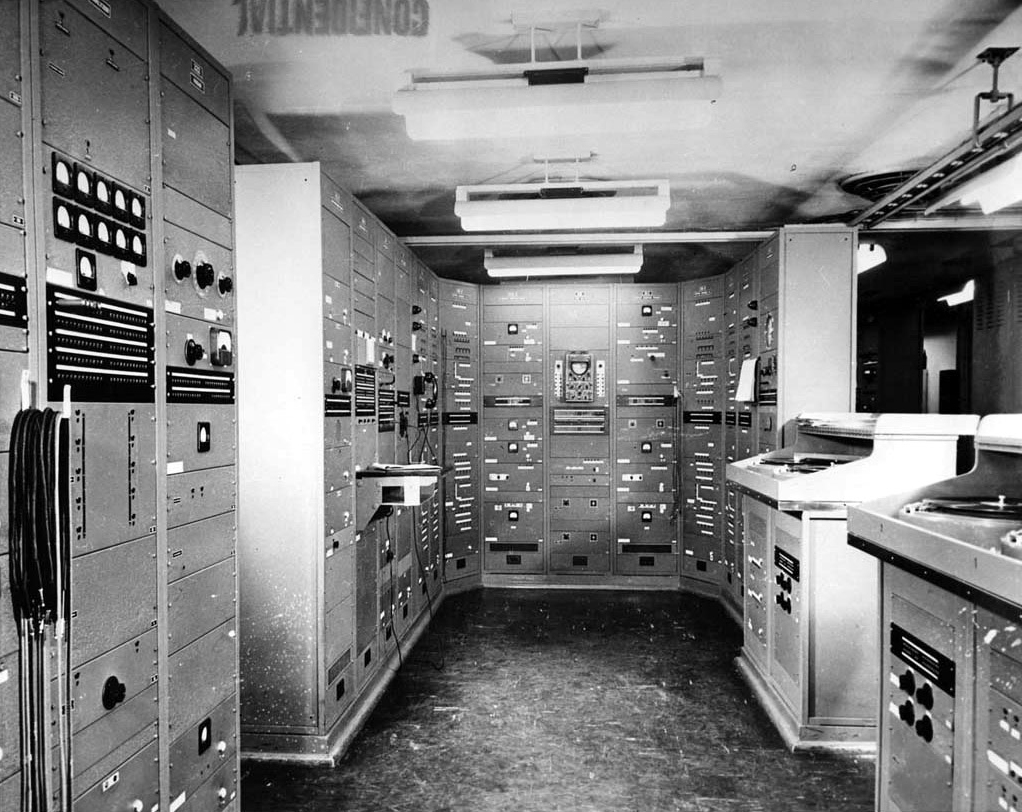 Photo: One half of a SIGSALY terminal (the receiver side). The complete installation comprised over 30 full-height 19-inch racks and four turntables, requiring a dedicated air conditioning unit to dissipate the heat generated by hundreds of vacuum tubes. Source: Crypto Museum
When Churchill spoke passionately on one end, Roosevelt heard only a monotone, metallic synthetic voice inside the Pentagon. Listeners could not distinguish speakers by timbre alone. Yet this loss of fidelity effectively stripped away every acoustic clue that German intercept stations relied on; the airwaves carried no natural voice dynamics, only streams of base-6 digital symbols waiting to be decrypted.
12 Minutes per Record: Four Turntables Staging Transoceanic Synchronization
With digital speech signals in hand, where could engineers source identical, perfectly random key streams on both sides of the Atlantic? Bell Labs turned to the commercial recording industry. They used large mercury-arc rectifier tubes to generate pure electronic thermal noise, engraving this physical random noise directly onto phonograph records. The initial 1943 production runs used vinyl pressings codenamed SIGGRUV; these were later replaced by acetate-coated aluminum discs codenamed SIGJINGS for greater physical durability.
To manufacture each key record, technicians cut two master grooves simultaneously on electrically coupled recording lathes, stamping precise starting index marks on each disc. Strictly two copies of each record were ever produced: one remained in Washington, while the other was escorted across the Atlantic by armed military couriers to London, or delivered to General Douglas MacArthur’s command ship in the South Pacific. Once the mathematical encryption scheme was proven unbreakable, the weak link shifted entirely from cryptography to the discipline of armed transport and physical destruction.
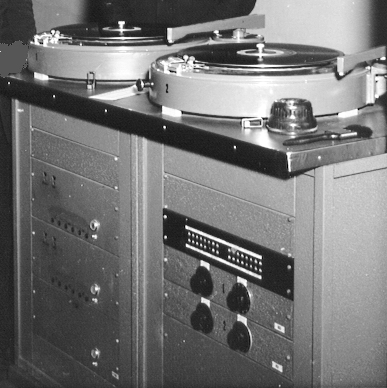 Photo: Two coupled turntables. While one played the active key disc, the second was queued up and synchronized, providing the mechanical basis for seamless record transitions every 12 minutes. Source: Crypto Museum
Each record could hold only about 12 minutes of key material, yet strategic military conferences frequently ran past half an hour. To prevent dropped calls during record changes, every SIGSALY terminal featured four precision turntables—two for transmission and two for reception to support full-duplex operation. Operating in tandem, as one turntable neared the end of its groove, the neighboring deck cued up the next disc, transitioning instantaneously at the designated mark. Once a call concluded, security-cleared personnel from the U.S. Army’s 805th Signal Service Company immediately smashed and incinerated the used records; no decoded duplicates were ever preserved.
Separated by thousands of kilometers of ocean, how did phonograph needles in London and Washington stay synchronized within milliseconds? The secret lay in the low 50-Hz (20-millisecond) sampling rate. In electronic engineering, a 20-millisecond window is forgivingly wide. The two terminals did not need real-time over-the-air synchronization pulses; instead, each turntable motor was driven by an ultra-stable quartz crystal frequency standard. Once aligned to the starting index before a call, the turntables could spin for hours without noticeable phase drift. Trading a coarse 20-millisecond sampling window for hours of drift-free mechanical synchronization across an ocean was one of the era’s finest engineering compromises.
3,000 Calls Without a Leak: When the 50-Ton Leviathans Were Scuttled
In April 1943, two months before the Allied invasion of Sicily, SIGSALY units manufactured by Western Electric in New York entered operational service. Between their debut and decommissioning in 1946, a global network of 12 terminals carried more than 3,000 top-secret wartime conferences. German monitoring stations intercepted endless barrages of 6-level multi-tone pulses, but never extracted a single intelligible syllable. When demobilization began after the war, these massive, costly rack assemblies were decommissioned alongside crates of classified documentation; lore even suggests that several retired terminals were loaded onto ships and scuttled at sea.
Bell Labs subsequently designed a compact successor codenamed Junior X (military designation AN/GSQ-3), which compressed the entire system into six racks capable of fitting inside a military truck, though it arrived too late to see wartime action. Yet SIGSALY’s technological lineage never sank into the ocean. The parametric extraction and synthesis techniques forced by the 1500-baud shortwave constraint directly laid the foundation for modern linear predictive coding (LPC-10), CELP, and MRELP. Today, voice codecs that compress cellular calls over congested networks are the direct intellectual descendants of those 30 vacuum-tube cabinets.
Looking back at the four turntables in the Selfridges basement in 1943, SIGSALY offers security engineers an enduring lesson: theoretical unbreakability has a tangible physical price tag. To deny an adversary the ability to compute a solution, you must generate a full second of physical entropy for every second of conversation. You must transport that entropy across oceans on airplanes and warships, and you must hold two phonograph needles in lockstep with 50 tons of glowing vacuum tubes. Mathematics lives on the blackboard, but real security was forged by crates of aluminum discs, delivered under armed guard and burned to ashes on schedule.
References:
- Crypto Museum: SIGSALY Secure Digital Voice System Technical Archive
- Hacker News Discussion