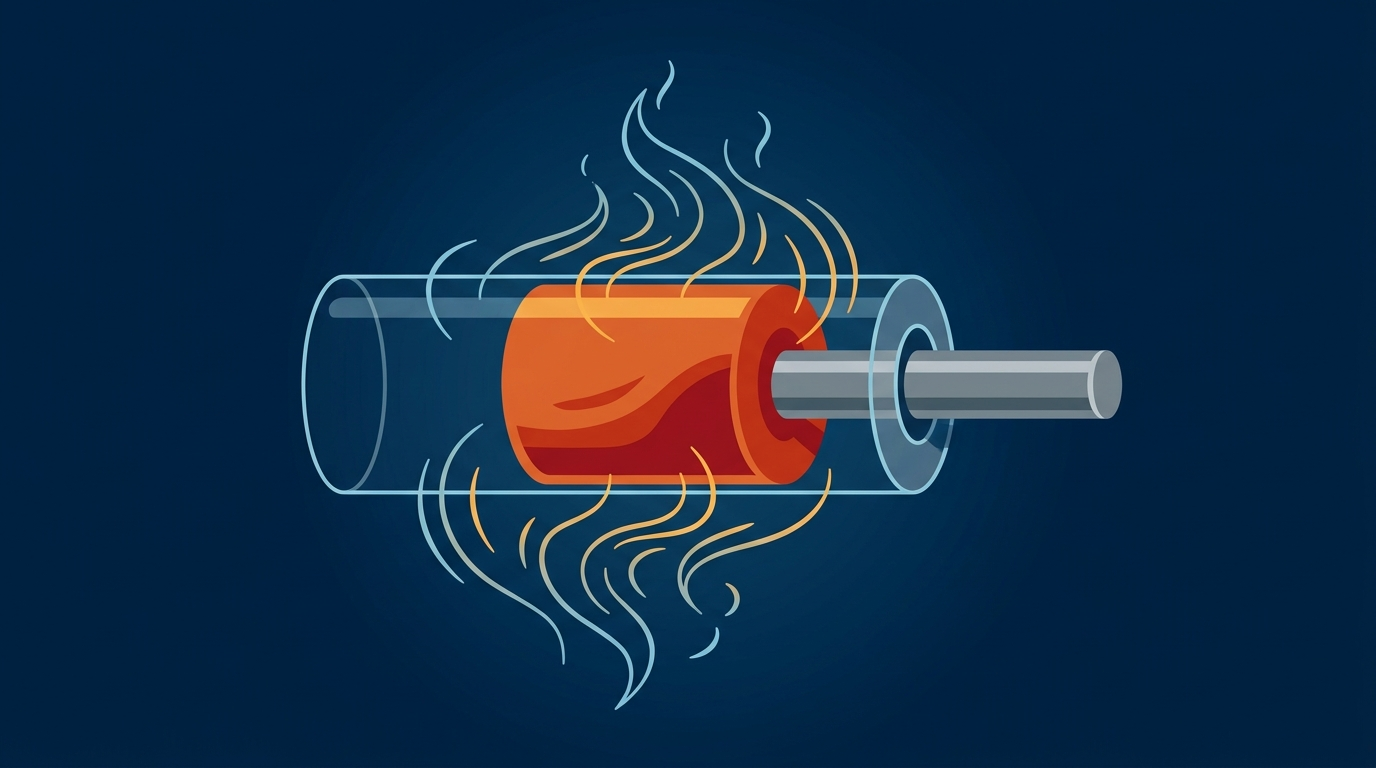
In the most demanding industrial control systems, the most mission-critical actuator often draws no inductive current, contains zero software logic, and relies entirely on a small pellet of paraffin wax.
On Hacker News, a technical deep dive into the engineering behind wax motors (thermal actuators) recently climbed to 166 points. The intense community interest stems from a striking contrast: in an era where microcontrollers and complex firmware govern virtually every electromechanical process, this coil-free, solid-state mechanical assembly remains irreplaceable in punishing operational environments. From front-loading washing machines to high-pressure aviation hydraulic lines, critical operations depend on the simple thermal expansion of wax.
Phase-Change Expansion: Delivering 4,000 Newtons of Thrust
Disassemble a conventional electromagnetic solenoid actuator, and you will find tightly wound copper coils surrounding a laminated iron core. Energizing the coil induces a magnetic field that pulls an armature into place. The wax motor bypasses electromagnetic conversion altogether with an astonishingly simple hardware architecture: a hermetically sealed metal chamber filled with a specific hydrocarbon wax formulation, capped by a flexible elastomeric diaphragm and a sliding piston. Its entire motive force originates from the dramatic volume increase when paraffin transitions from solid to liquid.
Most materials expand only marginally when heated. Paraffin wax, however, undergoes a sharp volumetric expansion of 5% to 20% across its solid-liquid phase transition. When an internal Positive Temperature Coefficient (PTC) thermistor heats up under electric current, the wax’s crystalline lattice breaks down into liquid. Confined within a rigid metallic housing, the expanding liquid converts volumetric growth into immense hydraulic pressure, driving the piston outward with brute force.
The resulting mechanical force is staggering. A thumb-sized wax actuator can generate linear thrust of approximately 4,000 Newtons—equivalent to supporting a 400-kilogram load on a single point. To guarantee smooth retraction once power is cut and cooling begins, engineers incorporate an internal return spring, which absorbs 20% to 30% of the gross stroke force. Actuator logic is never exposed to software glitches or firmware crashes; it is governed directly by thermodynamic law. Once the critical temperature threshold is reached, phase transition and mechanical displacement are physically inevitable.
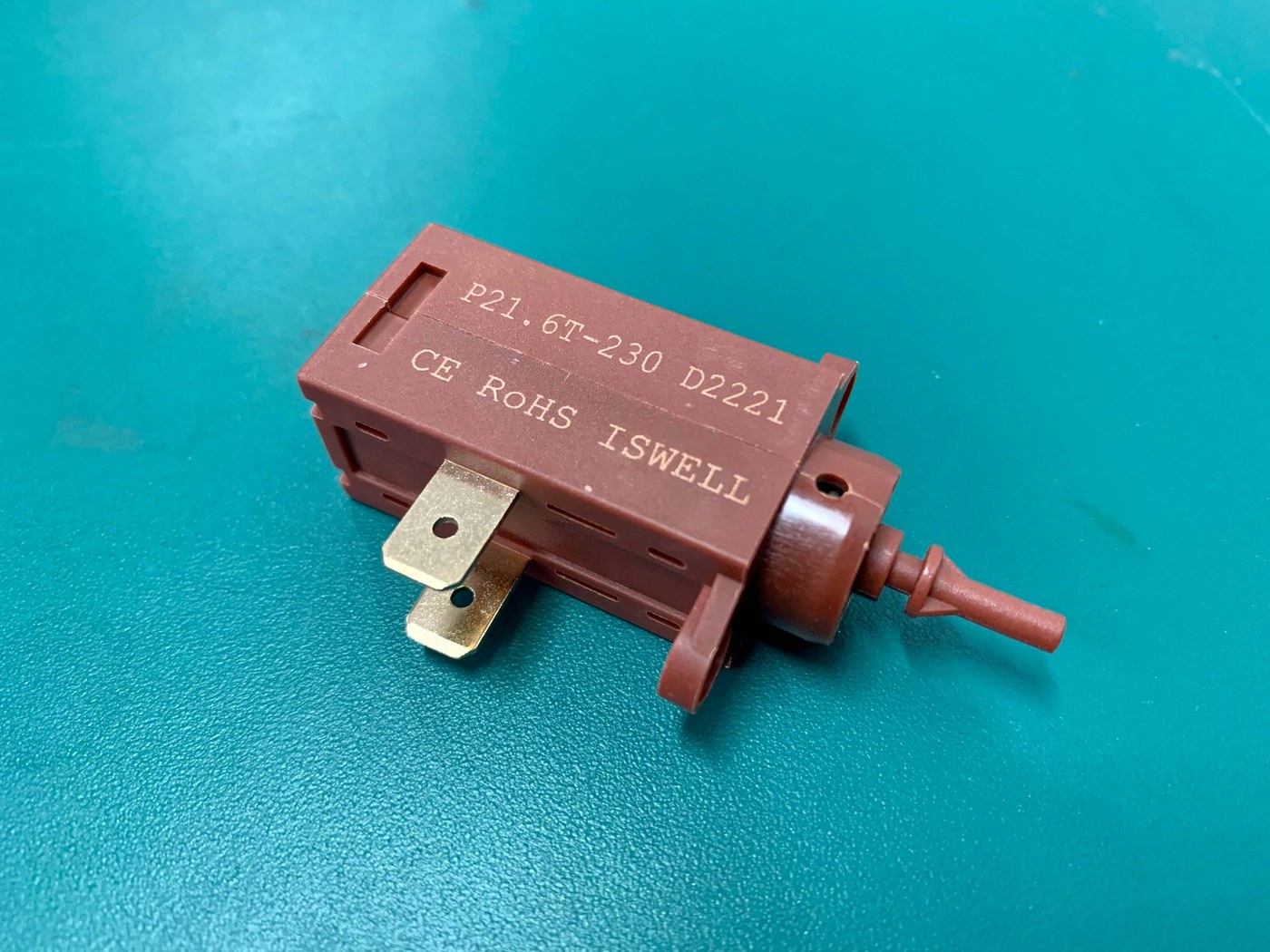 Figure: Cutaway of a commercial wax motor (thermal actuator). Source: iSwell / Wikimedia Commons
Pure Resistive Load: Eliminating Protection Circuits
Compared to conventional electromagnetic solenoids, the wax motor enjoys a decisive electrical advantage: it behaves as a purely resistive load. Inductive solenoid coils are notorious sources of electrical interference. The instant power is interrupted, the collapsing magnetic field discharges an inductive back-EMF spike that can easily reach hundreds of volts.
To shield sensitive microcontroller I/O pins from transient overvoltage spikes, hardware engineers must design snubbers—resistor-capacitor damping networks—or solder flyback diodes in anti-parallel across the coil. This supplementary protection complicates circuit layout, adds bill-of-materials cost, and accelerates dielectric aging in nearby silicon components.
A wax motor, by contrast, typically employs a PTC thermistor as its heating element. At power-on, the thermistor presents low resistance, drawing a brief current inrush to generate heat rapidly. As temperature climbs, its electrical resistance surges exponentially, self-limiting the current and stabilizing heating power within a safe operational envelope. Because pure resistance generates zero inductive kickback, driving a high-thrust wax motor is electrically as straightforward as lighting an indicator LED. Furthermore, displacement occurs smoothly and progressively, completely eliminating the aggressive mechanical slam and acoustic chatter typical of electromagnetic solenoids.
Thermal Inertia as a Fail-Safe: Locking Down Spin-Cycle Drums
In consumer appliances, this deliberate thermal latency is leveraged as an ingenious safety interlock. Numerous front-loading washing machines rely on wax motors for door latches specifically because of their slow, predictable response time. Electromagnetic door locks respond instantaneously; the moment power drops, the latch springs open. However, when a washing machine loses power during a spin cycle exceeding 1,000 RPM, the heavy metal drum continues spinning for minutes under substantial angular momentum.
If an electronic door latch were to unlock immediately upon power failure, a user attempting to open the door could suffer severe injury from the spinning drum. The wax motor eliminates this risk at the fundamental hardware level. Throughout the wash and spin cycles, the control board supplies continuous current to the PTC element. The paraffin remains molten and expanded, extending a rugged metal locking pin that mechanically blocks the door latch.
When total power loss occurs, the wax requires two to three minutes to dissipate its latent heat into the surrounding ambient air before contracting. During this waiting window, the appliance requires no backup batteries, no uninterruptible power supply, and no costly supercapacitors. Everything unfolds naturally according to the Second Law of Thermodynamics. By the time the wax cools, solidifies, and allows the return spring to retract the locking pin, the drum has dissipated all rotational kinetic energy and come to a safe, complete halt. Similarly, in dishwashers exposed to scalding steam and aggressive detergents, this hermetically sealed assembly outlasts corroding solenoid cores by orders of magnitude.
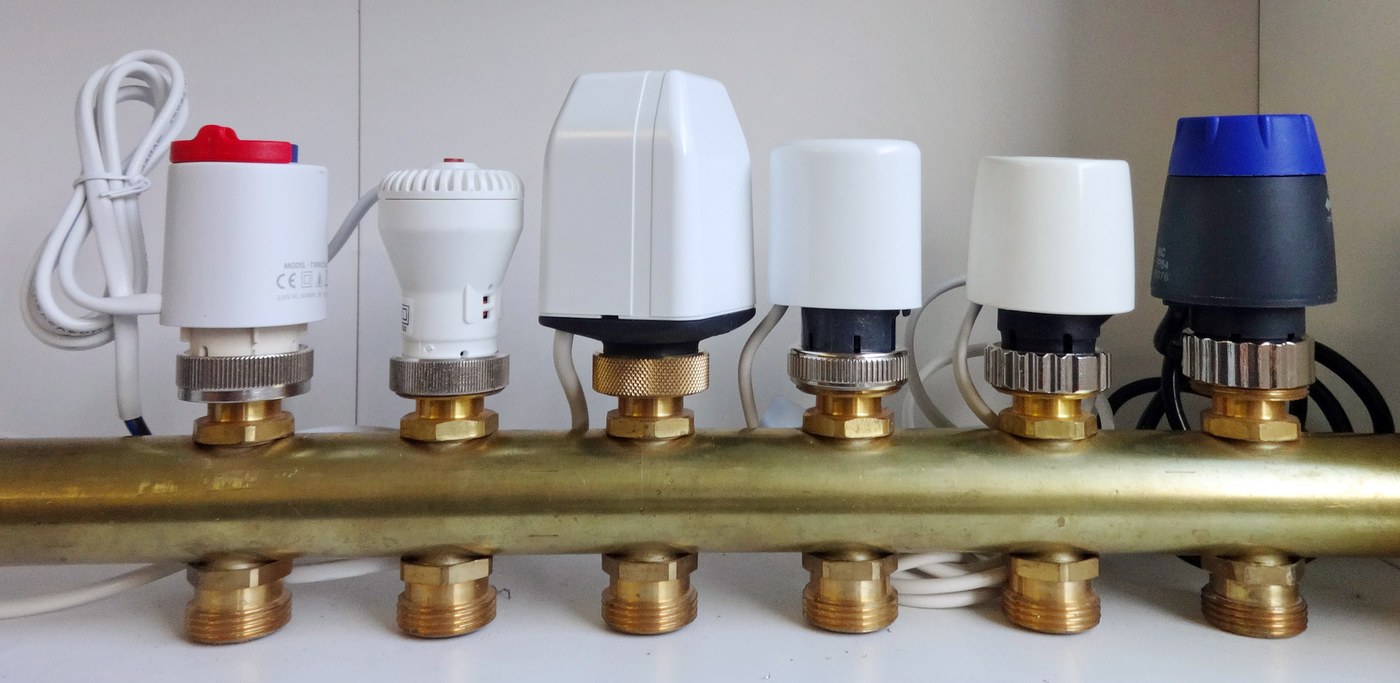 Figure: A bank of electrothermal actuators on an underfloor heating manifold, powered internally by wax motors. Source: Wikimedia Commons
Direct Ambient Heat: Passive Venting and Aerospace Resilience
Unshackled from electrical wiring, the wax motor’s system resilience becomes even more compelling. In commercial agricultural greenhouses, window actuation mechanisms harvest ambient thermal energy directly as their primary power source. By adjusting hydrocarbon polymer chain lengths, materials engineers can tune the paraffin’s phase-change melting point with pinpoint precision.
Installing an actuator calibrated to melt at 25 °C directly onto a window’s hinge linkage creates an autonomous ventilation system. When direct midday sunlight overheats the greenhouse interior, the wax absorbs ambient heat, melts, and expands, exerting thousands of newtons of mechanical force to push open heavy skylights. As cooler air circulates through and drops the indoor temperature, the wax sheds heat, contracts, and allows the windows to close under gravity and spring tension. In this passive mechanical cycle, the temperature sensor, computational logic, and mechanical actuator are collapsed into a single pellet of hydrocarbon wax—zero wiring, zero electrical components, and minimal points of failure. In radiant floor heating manifolds, thermostatic radiator valves operate on the same principle, using the thermal energy of circulating hot water to self-modulate fluid flow.
This complete decoupling from delicate electronics has made wax actuators a staple of the aerospace industry. NASA engineering reports and aviation data show widespread deployment of thermal actuators in aircraft fuel management and high-pressure hydraulic circuits. In the stratosphere and deep space, cosmic radiation routinely triggers single-event upsets (bit flips) in microprocessors, risking erroneous solenoid activation. Wax actuators are entirely blind to electromagnetic pulses and ionizing radiation across all frequencies; they respond exclusively to thermodynamic temperature changes.
Ancient Phase Change Meets Silicon: Paraffin Microactuators in MEMS
This deliberate physical force scales down to dimensions invisible to the naked eye. A 2013 review paper documented the steady evolution of paraffin microactuators within Micro-Electro-Mechanical Systems (MEMS). Semiconductor researchers adapt mature silicon etching processes to carve microchambers into wafer substrates, depositing minute quantities of phase-change paraffin.
At microscopic fluid boundaries, heated paraffin faithfully obeys the same macroscopic laws of thermal expansion, actuating micro-valves and dosing pumps across microfluidic lab-on-a-chip devices. While feature dimensions have shrunk from centimeters to micrometers and fabrication has shifted from CNC lathes to extreme ultraviolet lithography, the fundamental physics remains unchanged.
Entrusting mission-critical actuation to the intrinsic properties of matter provides far greater environmental resilience than relying on layers of abstracted software. The price of this immense force is slowness. Yet that very slowness provides a physical shield against electrical surges and electromagnetic interference, serving as the ultimate fallback against software crashes and power loss. Solutions hardwired into material physics continue to form the bedrock of industrial control safety.
Reference Links:
- Wax Motor (Wikipedia)
- Hacker News Discussion