Snap the arms off a standard quadcopter and remove three of its four motors, and powering it up will send it violently crashing into the deck. Yet an experimental flyer tested by engineer Joshua Bird in his own bedroom defies conventional aerodynamic wisdom. Powered by only a single brushless motor spinning a six-inch propeller, the entire vehicle continuously spins about its yaw axis—while its center of mass remains locked in mid-air in a rock-steady hover.
To most people, a drone is synonymous with a quadcopter. We have grown accustomed to multi-rotor crafts using symmetric sets of motors to balance aerodynamic loads. Intuition dictates that fewer actuators mean harder control. This single-motor flyer demonstrates an entirely new solution to underactuated flight: when hardware is stripped to the bare physical minimum, microsecond control algorithms and geometric mechanics take over full attitude stabilization.
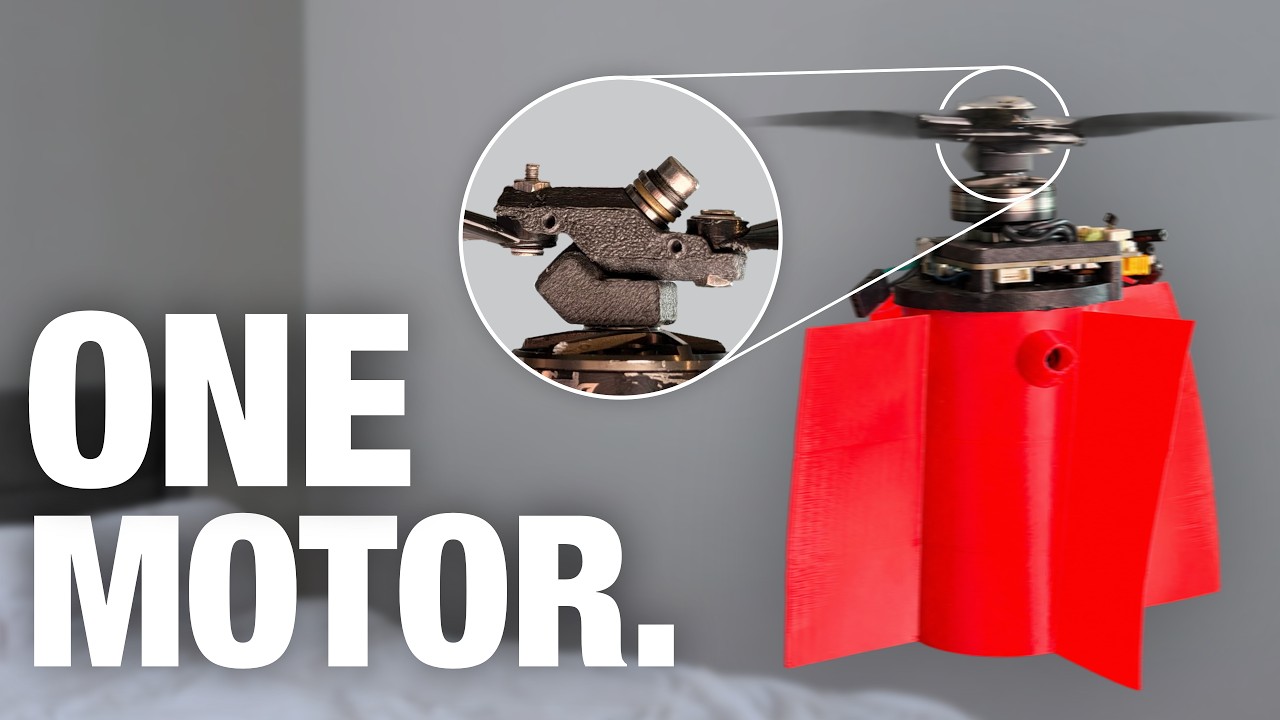 Figure: Video still showing the single-motor drone prototype. Source: Joshua Bird (YouTube)
Physics Demands Body Spin: Algorithms Turn a Gyroscope into a Steering Wheel
Multirotor drones almost universally rely on an even number of motors to tame Newton’s third law. Two clockwise propellers counteract the torque generated by two counter-clockwise blades. Traditional helicopters solve this by extending a tail boom and spinning a high-speed tail rotor to keep the fuselage facing forward.
Strip the craft down to a single propulsion source, however, and reaction torque cannot be cancelled purely in hardware. As the motor spins the blade, the fuselage must spin rapidly in the opposite direction. Conventional aerospace thinking treats yaw spin as a catastrophic failure mode. Instead of fighting it, the designer embraced the spin, using the rotating body itself as the reference frame for all control actuation.
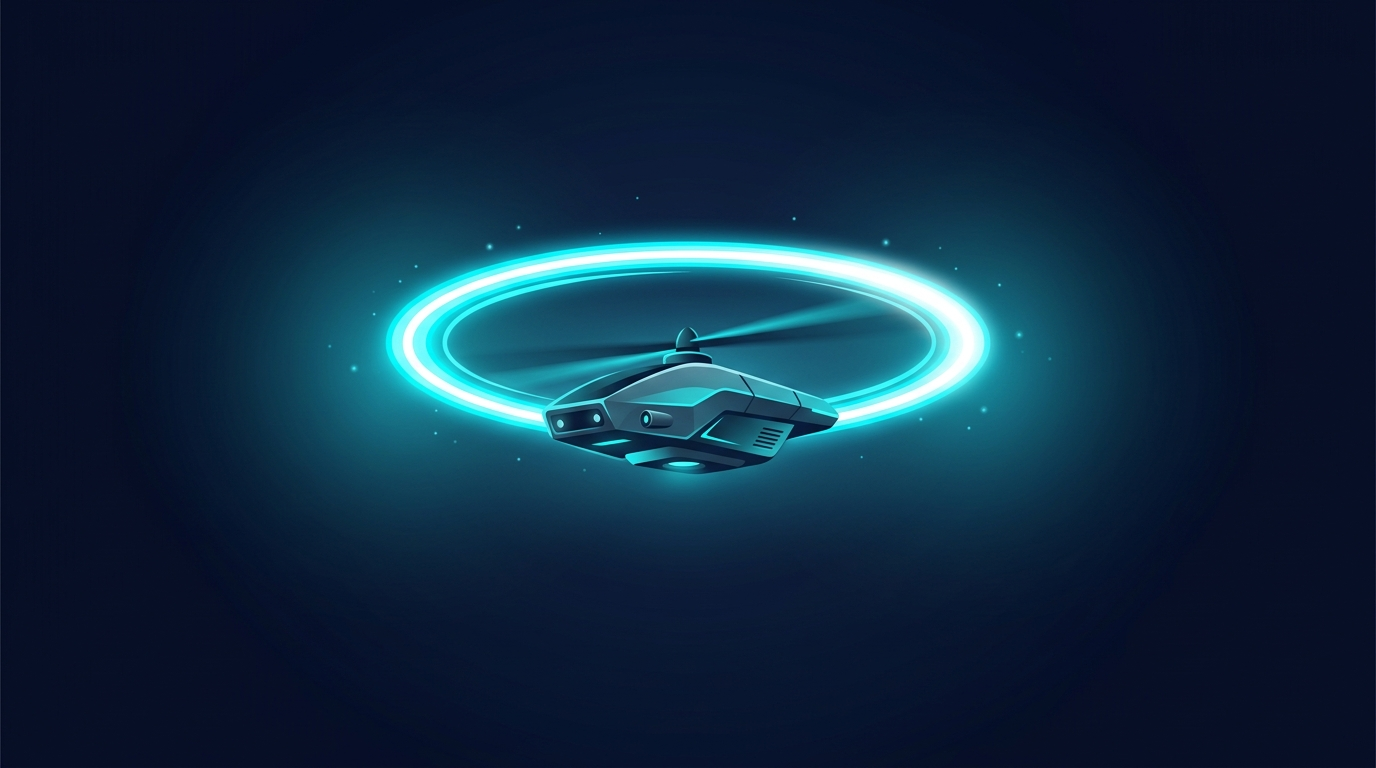
A conventional helicopter relies on a mechanical swashplate to cycle cyclic blade pitch. An uncontrolled single propeller cannot maintain attitude on its own. On this aircraft, every time the body sweeps through a full revolution, the control algorithm modulates the motor’s throttle at specific headings. The continuously spinning body effectively becomes a physical spatial scanner. Modulating the output of a single motor allows the system to synthesize roll and pitch moments across 3D space.
Twenty Thousand RPM: Passive Hinges Modulate Pitch in Milliseconds
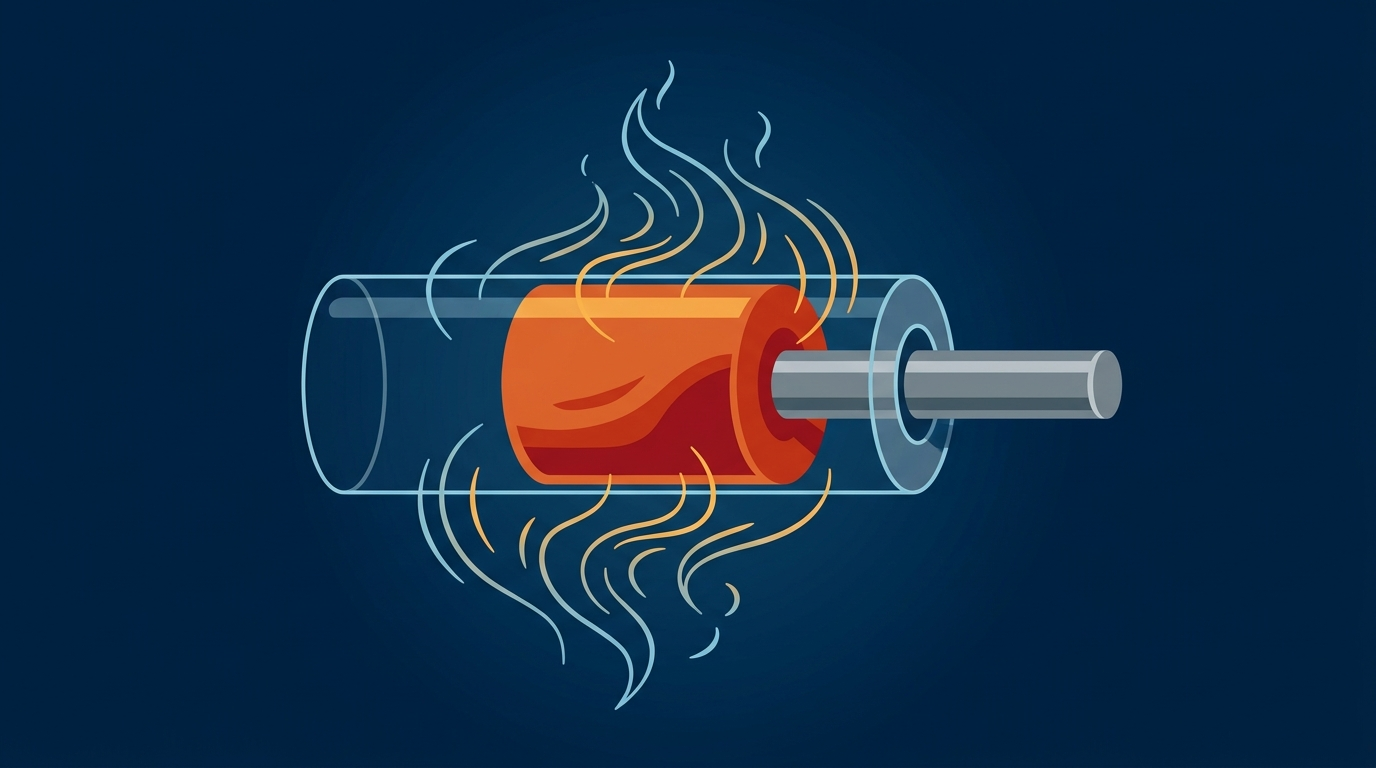
The core mechanical insight lies in the rotor hub articulation. The blade attaches to the motor shaft via a 45-degree angled hinge pin, requiring zero independent servos. When the motor accelerates or decelerates, blade inertia and aerodynamic drag force the wing to swing along the angled pivot, passively twisting its angle of attack.
Rapid motor speed modulations are instantly translated by the oblique hinge into blade pitch changes. Spinning at nearly 20,000 RPM, the motor must execute up to 300 micro-accelerations and decelerations every single second—leaving a control loop timing window of just a few milliseconds.
Off-the-shelf electronic speed controllers (ESCs) rely on back-EMF sensing, introducing latency often exceeding tens of milliseconds. Standard drone hardware is fundamentally unsuited for this caliber of high-frequency phase control. The creator opted for an industrial-grade motor controller and rewrote its low-level firmware, slashing calculation update cycles down to 0.2 milliseconds. This 0.2-millisecond responsiveness guarantees that thrust differentials can be generated precisely at targeted angles to deliver desired tilting moments.
Underneath the motor, the cylindrical chassis features several 3D-printed vertical stator fins. Downwash airflow from the propeller washes over these static fins, generating counter-aerodynamic drag. This passive resistance caps the fuselage’s spin rate within a controllable envelope. Without this aerodynamic damping, body rotation would accelerate out of control and blind the onboard sensors.
Severe Vibration Blinds IMUs: A DIY Strobe Freezes Rotor Flex
While the theory held on paper, early flight tests were plagued by repeated crashes. Intense vibration instantly saturated the flight controller’s onboard accelerometers. Swamped by sensor noise, the flight software miscalculated vehicle attitude, causing the craft to flip violently and hit the floor barely half a meter off the ground.
At hover, the propeller spins hundreds of revolutions per second. Blade tip velocity exceeds 500 km/h—nearly half the speed of sound—rendering the rotor an invisible blur to the naked eye. High-speed industrial cameras cost thousands of dollars and demand specialized high-intensity lighting, far outside an independent hobbyist’s budget. To diagnose the failure, Bird engineered a custom stroboscopic diagnostic system. The motor driver triggered an ultra-bright LED flash at exact rotational phases, synchronizing illumination with camera exposure down to the microsecond.
The DIY strobe successfully froze the high-speed motion in crystal clarity. Captured stills revealed the culprit: the six-inch plastic propeller was flexing and twisting dramatically under heavy aerodynamic loading. The elastic deformation ruined dynamic balance, triggering violent high-frequency vibrations that overwhelmed the IMU.
With the root cause identified, resolution was straightforward. The noise peaked around a 160 Hz resonance harmonic. Upgrading to a stiffer, carbon-reinforced propeller eliminated the resonance entirely. The onboard accelerometer returned clean, smooth curves, and the drone finally achieved a stable takeoff.
 Figure: Video still showing the developer debugging the prototype and controller in the workshop. Source: Joshua Bird (YouTube)
Motor Magnetic Fields Scramble Compasses: An Optical Beacon Reclaims Heading
Maintaining hover is only half the battle; the aircraft must also track its absolute orientation. Standard multirotors rely on magnetometers to sense Earth’s magnetic field. Here, however, the lone brushless motor sits directly above the flight control board. Massive phase currents through the motor coils generate severe alternating electromagnetic interference, turning electronic compass readings into pure garbage.
Because the entire frame rotates continuously, conventional gyro integration drifts into uselessness within seconds. To provide an absolute yaw reference, the author mounted a stationary infrared emitter beacon in the corner of the room, paired with an optical photodiode sensor installed on the drone’s outer shell.
Once per revolution, the photodiode catches a directional infrared pulse. This optical ping serves as a zero-reference sync signal, allowing the flight algorithm to correct yaw drift in real time. Controller gains were painstakingly tuned on a weighted test rig. Ultimately, the drone demonstrated rock-solid position hold and trajectory tracking indoors.
The current prototype relies heavily on the indoor infrared beacon, preventing it from operating autonomously outdoors. In future iterations, the designer plans to introduce linear optical array sensors to track ambient light variations, enabling completely self-contained onboard heading estimation. All CAD models and firmware source code have been open-sourced on GitHub.
Cutting Three Motors Is No Free Lunch: Shifting the Complexity Frontier
Single-motor flight is not merely a fringe maker curiosity; academia has explored the paradigm for years. The PULSAR single-actuator drone developed by the University of Hong Kong demonstrated tangible advantages: at identical rotor disc area, its power consumption dropped by 26.7% compared to a conventional quadcopter. Eliminating three motor arms significantly reduces profile drag and cross-sectional area, yielding superior aerodynamic efficiency.
PULSAR also leverages vehicle rotation as a built-in spinning radar platform. An onboard single-line LiDAR sweeps across 360 degrees without requiring any mechanical gimbals or slip rings. Similarly, combat robotics have pushed single-motor drive architectures to 3,000 RPM single-wheel spinners, executing precise phase velocity pulsing to achieve agile driving and devastating kinetic strikes simultaneously.
Yet bringing such an ultra-minimalist architecture to production comes with steep engineering trade-offs. Quadcopters dominate the consumer market because they decompose flight control into intuitive, independent motor RPM adjustments. A single-motor craft eliminates mechanical components only by pushing manufacturing tolerances and dynamic balancing to their physical limits. Facing dozens of full rotations every second, human reflexes cannot intervene.
This is a machine that cannot survive for half a second without continuous, microsecond algorithmic intervention. Where consumer gadgets add actuators to make software simpler, the single-motor flyer confronts raw physics directly. Through microsecond electronic commutation and clever passive kinematics, it harnesses a would-be flaw into forward propulsion. Every gram saved in hardware must ultimately be paid back in control intelligence.
References:
- Joshua Bird: I Built a Drone With Only One Motor (YouTube)
- Hacker News Discussion (item?id=50150089)
- Fu Zhang et al., PULSAR Single-Actuator Drone (Science Robotics, 2023)
- Tom’s Hardware: Engineering Breakdown of a Single-Motor Drone