
Two hundred trillion tokens were processed right in plain sight. Tens of thousands of developers worldwide only just realized they had spent months acting as blind test evaluators. On third-party API platforms, an anonymous model codenamed “Space Bunny” had surfaced earlier without any company branding, steadily crunching through massive volumes of high-intensity coding and debugging workloads. On October 20, 2026, the secret was finally unveiled: the low-profile powerhouse came from Chinese AI firm MiniMax, officially designated as M3.1 Flash.
The official metrics that followed sent shockwaves through the community. Online inference speeds surged nearly threefold, while blended API costs plunged by 70%. For far too long, frontier models have focused on showcasing pristine exam scores, while enterprises attempting production rollouts were greeted with punishing compute bills. M3.1 Flash shifts the battleground into full view: a model must not only solve hard problems, but also make economic sense on real-world balance sheets.
200 Trillion Tokens Processed Anonymously: Unmasking Space Bunny
In modern AI engineering, leaderboard score inflation has become routine. Teams frequently over-tune architectures specifically around popular static benchmarks. Models notch soaring test scores, only to stumble repeatedly when deployed in messy, production codebases. Confronted with this reality, MiniMax took the opposite road.
They deployed early checkpoints under the alias “Space Bunny” directly onto third-party developer platforms to face real working conditions. Over months of unannounced stress-testing, real users racked up over 200 trillion tokens across demanding tasks. This extensive, unvarnished field testing smoothed out the statistical flukes of laboratory benchmarks. Genuine runtime traces from unsuspecting users proved far more convincing than curated evaluation suites.
Alongside the official launch, MiniMax rolled out direct API access, an M Plan membership subscription, and the MiniMax Code developer tool. The team also committed to open-sourcing the model weights to the technical community down the line. Their goal is unmistakable: delivering digital workers ready to step into real workstations and produce value immediately.
Handing Over the Desktop to Agents: Can Enterprise Ledgers Bear the Cost?
Most casual users still view artificial intelligence through the lens of a chat window. What enterprises actually demand, however, are autonomous agents capable of chaining dozens of consecutive actions. Take automated banking operations: executing an international wire transfer for a client is never a matter of generating a single canned response. An agent must authenticate, query internal databases, run compliance screeners, check real-time exchange rates, and finally commit the transaction ledger.
Each step in this chain is strictly dependent on the last. At every turn, the agent must feed the entire cumulative execution history back into the context window. Across long execution chains, a single troubleshooting or compliance routine can easily consume millions of tokens. If token pricing remains steep, resolving a single business request ends up costing several dollars in raw compute alone.
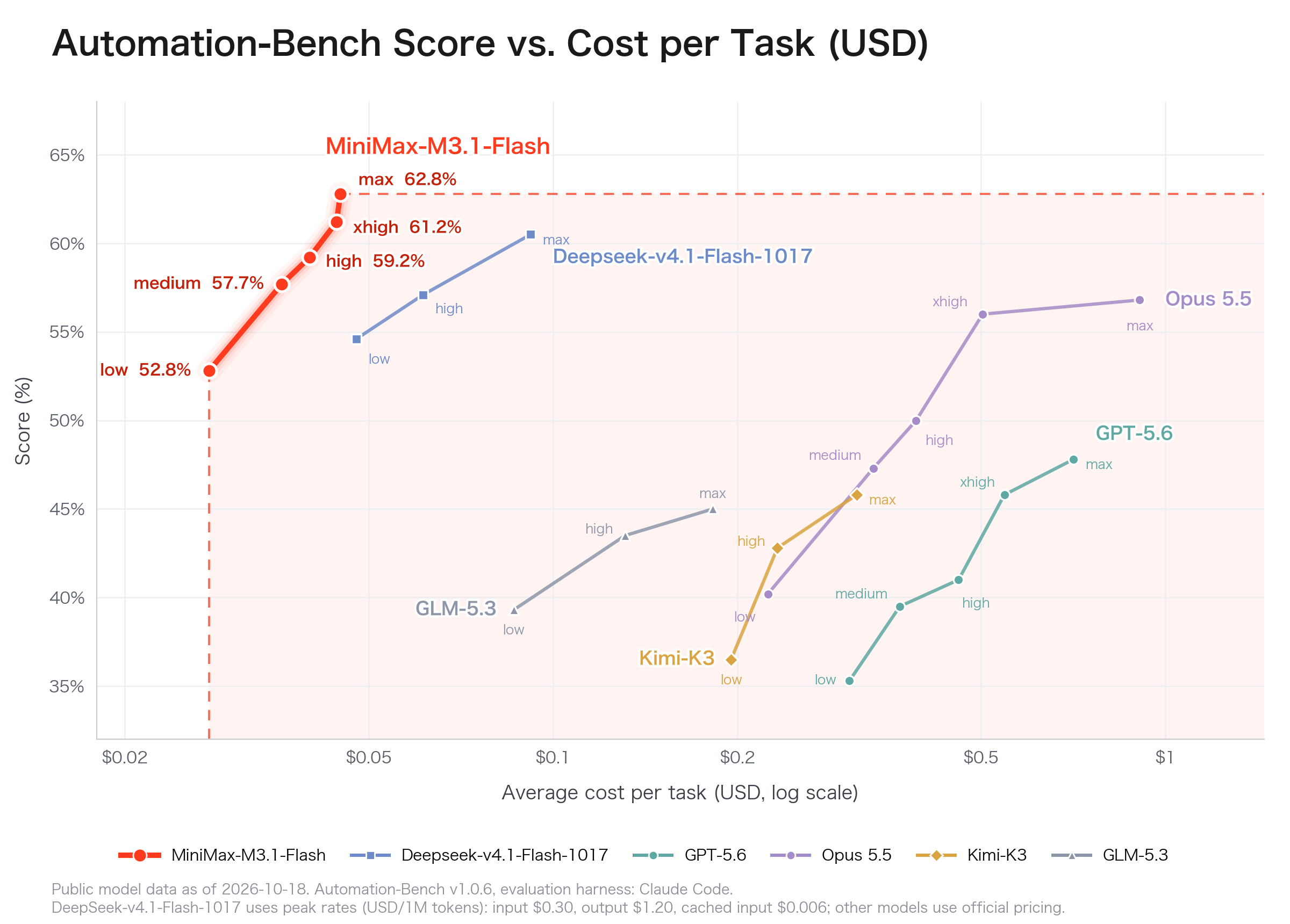 Figure: Benchmark performance and inference cost comparison between MiniMax M3.1 Flash and competing frontier models. Source: MiniMax (Official Engineering Blog)
M3.1 Flash completely restructures this economics. Under official pricing, input runs at just $0.15 per million tokens, with output at $0.60 per million tokens. When context caching is enabled, input drops all the way to $0.015 per million tokens. On BankerToolBench, a rigorous benchmark evaluating tool-use precision in complex banking workflows, M3.1 Flash scored 76.2. Ultra-low unit costs paired with reliable tool orchestration finally push enterprise automation across the profitability threshold.
Surpassing 200 Tokens per Second: Banishing Latency in Multi-Step Chains
When executing complex autonomous pipelines, latency is just as fatal as runaway cost. When an agent takes over desktop workflows to manipulate complex spreadsheets or internal tooling, lag on every discrete action shatters workflow continuity. Excessive delays drastically increase network timeout rates and cause tool executions to fall out of sync.
M3.1 Flash accelerates output rates beyond 200 tokens per second, with median P50 latency holding steady around 170 tokens per second. A structured operational instruction spanning hundreds of tokens generates completely in just over a second. For automated routines demanding dozens of back-to-back clicks and assertions, this speed difference determines whether an automated agent holds together or falls apart.
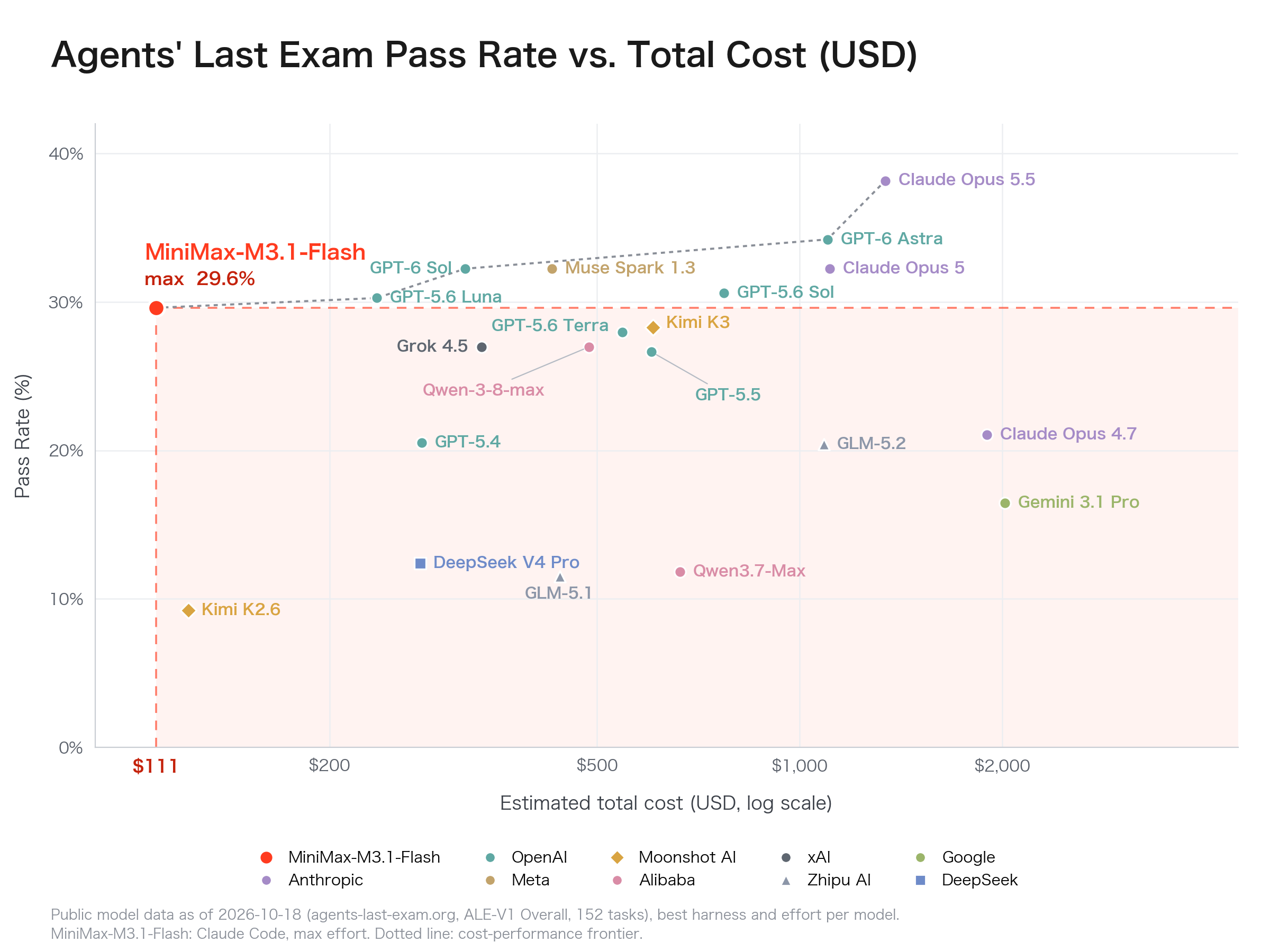 Figure: MiniMax M3.1 Flash scores across real-world operational and automation benchmark suites. Source: MiniMax (Official Engineering Blog)
High-throughput execution unlocks tangible engineering dividends. In OSWorld V2, which simulates desktop operating system environments, M3.1 Flash reached 61.7. On DeepSWE v1.1, a demanding real-world software engineering bug-fixing benchmark, it posted a 73.7% issue resolution rate. In CyberGym, a simulated cybersecurity arena, its success rate matched 82%. Rapid token emission eliminates dead time in sequential chains, establishing an uninterrupted operational cadence for automation.
Benchmark Gaming Hits a Wall: Budgets Demand Real-World Output
Over recent months, debates surrounding synthetic benchmark inflation have reached a fever pitch. Across developer forums, engineers increasingly warn that the industry is facing a credibility deficit. Certain models have been overfitted on public test banks into textbook exam aces, yet routinely crash when dropped into messy real-world engineering codebases. This disconnect between high scores and poor execution has made enterprise buyers increasingly hesitant to commit.
To strip away synthetic inflation, the community introduced harsher tests like the Agents’ Last Exam (ALE). ALE eliminates trivial questions that can be solved via rote memorization, focusing strictly on complex reasoning in unseen environments. M3.1 Flash scored 29.6 on ALE and joined the top tier on AutomationBench-AA. Official reports confirmed it ranked first among Chinese frontier models on both ALE and OSWorld V2. These rigorous, battle-tested metrics provide solid grounding against benchmark skepticism.
The pursuit of practical, cost-effective inference is gaining widespread traction. During the same window, the Inception team introduced Mercury 3, an architecture leveraging diffusion paradigms to reach 1,068 tokens per second at just $0.10 per million input tokens. While architectural bets may diverge, the industry has reached rare consensus on radically lowering operational barriers. Models relying purely on compute-heavy parameter bloat are meeting a noticeably cooler market reception.
From Vanity Leaderboards to Everyday Labor: The Rules of the Game Have Changed
The aura of mysticism around raw model capability is dissipating. Every piece of software must ultimately answer one question: can it execute the workload reliably at an affordable cost? The true significance of MiniMax M3.1 Flash lies in pulling collective industry attention back to the practical realities of enterprise operational ledgers.
A 70% price cut coupled with a nearly 3x leap in generation speed redefines how models will compete. In the emerging industrial ecosystem, the decisive factor is no longer a flashy keynote demo. Across millions of routine database queries, clicks, and record updates, the models that genuinely preserve customer budgets will be the ones that endure. The shift from the exam hall to the daily workbench has only just begun.
Reference Links:
- MiniMax Official Engineering Blog: M3.1 Flash Announcement and Technical Specifications
- Production telemetry during anonymous deployment: Space Bunny
- Hacker News Community Discussion: Inference Speed and Benchmark Authenticity
- Inception Mercury 3 Technical Release Report