On October 13, 2026, researchers from Stanford University and Together AI published a novel inference architecture dubbed HybridAgent (arXiv:2610.18861). Across 11 cross-domain benchmarks, its 8B and 14B parameter models outperformed state-of-the-art LLM agents and dedicated agentic frameworks, with the 14B variant exceeding the strongest baseline by an average of 17.4%. Concurrently, the system compressed text token consumption down to 1/2.7 of pure-text baselines, delivering an overall token reduction between 35.5% and 54.7%.
Mainstream autonomous agents executing complex tool-augmented workflows typically articulate every intermediate chain of thought into discrete natural language tokens. Hundreds of intermediate words saturate GPU VRAM and inflate serving latency. Confining internal multi-step deliberation to continuous latent space—decoding into explicit text only at moments of environmental interaction—yields more than a 2x inference speedup. The computation saved directly unlocks higher throughput across long-horizon interactions.
Folding Deliberation into Continuous Latent Space: Text Tokens Cut to One-Third
Traditional ReAct frameworks rely on verbose self-talk to propel task progress. Before issuing a web search query or executing Python code, an agent routinely generates hundreds of reasoning tokens explicating its intent. These internal reflections carry zero interactive utility for external tools, yet each token must traverse the vocabulary projection layer and Softmax. Autoregressive decoding burns valuable memory bandwidth on internal introspection.
HybridAgent redraws the boundary between internal reasoning and external action. Within a unified generation pipeline, the model smoothly alternates between two operational modes. Latent mode drives recurrent internal deliberation, while text mode handles external interaction. The authors introduce <latent> and </latent> tokens as transitions anchors. In latent space, the backbone advances one latent vector state per forward pass, with trajectory budgets typically tuned between 16 and 256 steps.
The paper documents efficiency gains across three key metrics. In hybrid mode, text token usage drops to 1/2.7 of the text-based baseline, total generation steps fall by up to 54%, and end-to-end inference speed runs 2.1x faster. Latent states bypass vocabulary projection and re-embedding matrix multiplications entirely, drastically alleviating memory bandwidth bottlenecks.
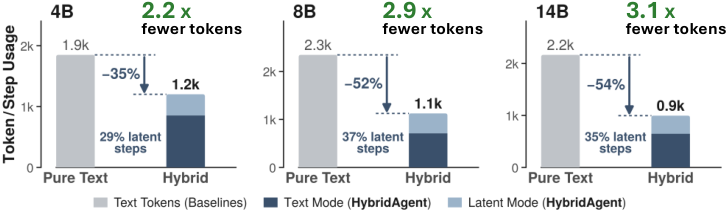 Figure: Text token consumption and total generation steps of HybridAgent across 4B, 8B, and 14B scales relative to pure-text baselines. Source: arXiv 2610.18861
Beyond raw latency, operational economics see dramatic improvements. Assuming an NVIDIA H100 rental rate of $2.50 per hour and 10% peak BF16 utilization, the estimated cost to answer one million benchmark queries drops from $359 to $98 for the 4B model, from $439 to $121 for the 8B model, and from $470 to $176 for the 14B model—representing cost savings of 3.7x, 3.6x, and 2.7x, respectively. This accounting explicitly incorporates the compute expended on latent steps, rather than merely counting omitted text tokens.
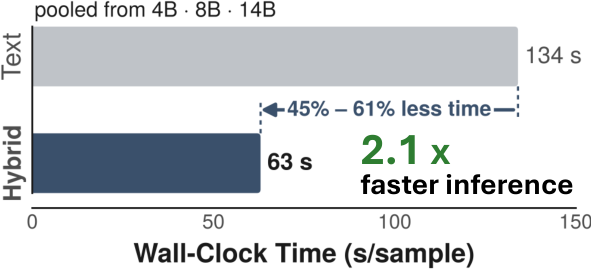 Figure: End-to-end inference speedup across three model scales for HybridAgent. Source: arXiv 2610.18861
Residual Mapping Bridges Two Contexts: KV Cache Eliminates Re-encoding
Interleaving continuous vector states with discrete tokens inside a unified neural network requires bridging representation spaces. The researchers developed HybridLink, a lightweight residual adapter that maps hidden representations from the model’s final layer directly back into the input embedding space. Latent states can thus feed straight into the next computation step without inverted text decoding.
This architecture preserves continuous working memory across multi-turn interactions. Input prompts, latent reasoning vectors, and tool observation outputs are jointly stored in a single continuous Key-Value (KV) cache. Once a tool execution completes, the model resumes deliberation directly atop existing memory buffers, eliminating the need to flush context and run costly re-encoding passes.
Training this hybrid system relies on a dedicated two-stage recipe. Stage one, HybridSFT, uses a self-conditioned two-pass training mechanism. The first pass employs teacher forcing to produce target latent inputs, while the second pass replaces ground-truth embeddings with the model’s own predictions. Cross-entropy loss is computed on text tokens and regression loss on latent positions, jointly optimizing the backbone and HybridLink. Stage two, HybridRL, applies reinforcement learning atop this foundation, teaching the agent when to ponder in latent space and when to emit concrete actions.
The implementation builds atop verl and vLLM, with large-scale training executed across 32 NVIDIA H100 GPUs. By confining intermediate reasoning directly within Tensor Cores, memory controllers are freed from relentless vocabulary lookups, reserving precious memory bandwidth for real-world interactions.
Inspectable Latent Vectors: Internal Hidden States Maintain Semantic Clarity
A primary skepticism surrounding latent reasoning is opacity: if internal thinking is reduced to floating-point vectors, debugging and safety auditing become challenging. The authors show that interpreting latent thoughts requires no specialized decoders. By comparing the HybridLink-projected latent vector against token embeddings in the vocabulary using cosine similarity, the nearest neighbor yields a human-readable pseudo-token. Equation 5 formalizes this mapping as an argmax over the vocabulary, which also determines the exit anchor </latent>.
Readability is measured by the average cosine similarity between latent vectors and their nearest token embeddings. A value of 1 indicates an exact alignment with a dictionary token. The researchers established a noise threshold using 2,000 Gaussian random vectors, benchmarking 200 downstream tasks. Context specificity evaluates token overlap between pseudo-text and the prompt relative to unrelated tasks; a ratio exceeding 1 indicates the latent reasoning genuinely targets the problem at hand. Probing vectors that surpass the noise baseline and exhibit specificity greater than 1 yields a reliable, auditable trace of internal thought.
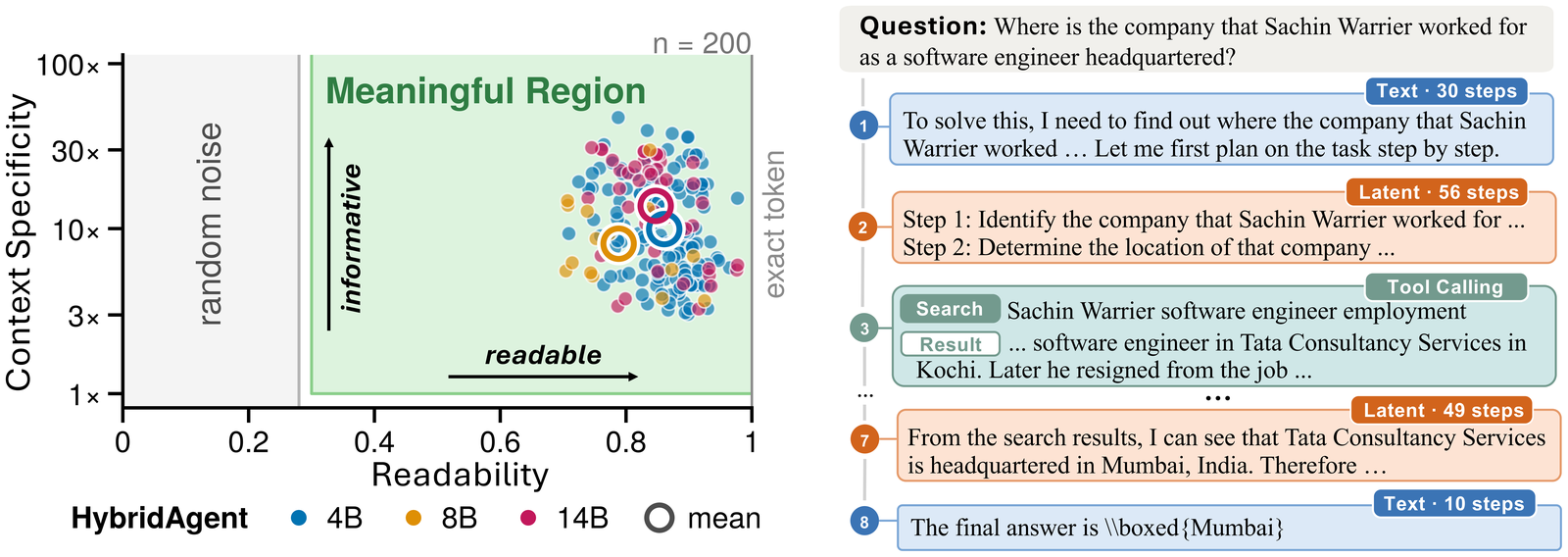 Figure: Semantic probing distribution of latent vectors and an example multi-step tool-use trajectory. Source: arXiv 2610.18861
The impact of self-conditioned training is particularly evident here. Using a shared Qwen3-14B-Base backbone, format-only prompting achieves scores of 20.6, 19.8, and 62.4 on AIME25, AIME26, and MATH500. Enabling HybridLink lifts these to 23.8, 22.5, and 73.8; adding self-conditioned training boosts them to 32.5, 31.7, and 84.2. Readability of the probed latent thoughts rises synchronously across training stages.
Latent reasoning preserves structured directions aligned with token embedding space rather than arbitrary geometric noise. Training regimes without self-conditioning often degenerate into uninterpretable fragments. Whether latent representations remain transparent depends fundamentally on the optimization objective, not an inherent flaw in latent pathways.
Tested Across 11 Complex Benchmarks: 3x Reduction in Multi-turn Cost
The evaluation environment targets demanding, interactive scenarios, integrating a Python sandbox alongside Tavily web search. Each execution trajectory allows up to 10 tool calls, retrieving top 10 search snippets per query. GPT-5.6-Luna serves as both judge model and summarizer.
The benchmark suite encompasses 11 diverse tasks, including GAIA, WebWalker, HLE, SealQA, and AIME mathematics competitions. Across 5 independent runs, accuracy exhibited a tight standard deviation of ±0.014 and a 95% confidence interval of ±0.017 (breaking down to ±0.031 on mathematics and ±0.018 on knowledge retrieval). At 8B and 14B scales, the architecture surpassed leading LLM agents and specialized frameworks, with 14B outperforming the strongest baseline by 17.4%. Under identical model scales and training budgets, HybridSFT and HybridRL exceeded text and latent baselines by 18.5% and 10.4%, respectively.
Billable text tokens decline sharply as the proportion of latent reasoning grows. Because multi-turn agents regularly execute dozens of tool interactions, per-step savings compound over long horizons, delivering substantial real-world cost benefits.
Hybrid Reasoning Reshapes Engineering Frontiers: Training and Migration Trade-offs
Latent-space reasoning remains a polarizing paradigm. Proponents argue that text-based autoregression is nearing an architectural ceiling. High-frequency multi-agent collaboration and long-horizon planning rapidly bloat context windows in text-only systems. Offloading intermediate logic directly to Tensor Cores while sharply decreasing memory bandwidth pressure is an essential path to sustainable scale.
Skeptical engineers point to high migration hurdles. Modern commercial ecosystems rely heavily on standardized text-based APIs, with telemetry, debugging suites, and safety guardrails all centered on text parsing. HybridAgent requires specialized fine-tuning and custom inference runtimes, making direct drop-in integration with proprietary black-box models impossible today. The cost of overhauling foundational infrastructure could partially offset inference-time hardware savings.
Test-time compute scaling further enriches the debate. On 100 challenging math and science questions evaluated across sampling budgets from k=4 to k=64, pass@k curves for the hybrid architecture climb continuously, demonstrating superior compute efficiency over pure RL text agents. Continuous latent states offer rich capacity for complex exploration, widening the performance gap as test-time budgets scale.
The computational bottleneck of autonomous agents fundamentally stems from the encoding medium of internal reasoning. Forcing intermediate deduction into discrete tokens wastes memory bandwidth. Continuous latent spaces capably shoulder internal deliberation while retaining standardized text interfaces for external actions. In compute-constrained long-horizon environments, eliminating redundant self-talk remains the most effective lever for maximizing serving throughput.
Reference Links:
- arXiv Paper: Hybrid Reasoning Agents (2610.18861)
- Stanford University & Together AI Joint Research Project