On October 12, 2026, engineer Eddie Abbondanzio showcased his latest paddock pit vehicle: a kick scooter powered entirely by an ordinary 20V household cordless drill, capable of hauling an adult at speeds up to 10 mph (roughly 16 km/h). Working paddock duties at local autocross events, Abbondanzio grew tired of walking while watching fellow racers zip around on commercial electric scooters. He already owned an old, purely manual Razor A5 Lux. Buying a cheap turnkey e-scooter would have cost a few hundred bucks, but it would have left the Razor to collect dust in his garage. Instead, he decided to treat the old scooter, a power drill, and a 3D printer as raw construction materials—even if it ended up saving him zero dollars.
Dropping in a 20V Cordless Drill to Skip EV Powertrain R&D
Building an electric vehicle traditionally runs into the hurdle of the “powertrain trifecta”: electric motor, electronic speed controller (ESC), and a custom lithium battery pack. Commercial products seal all three inside the chassis, turning a single failing component into a costly total replacement. Abbondanzio bypassed the headache entirely by grabbing a Hercules 20V cordless drill from Harbor Freight. In one compact package, he got a motor, reduction gearbox, variable-speed trigger, and an interchangeable battery pack. Off-the-shelf power tools sitting on hardware store shelves are essentially self-contained, highly integrated micro-powertrains ready to be repurposed.
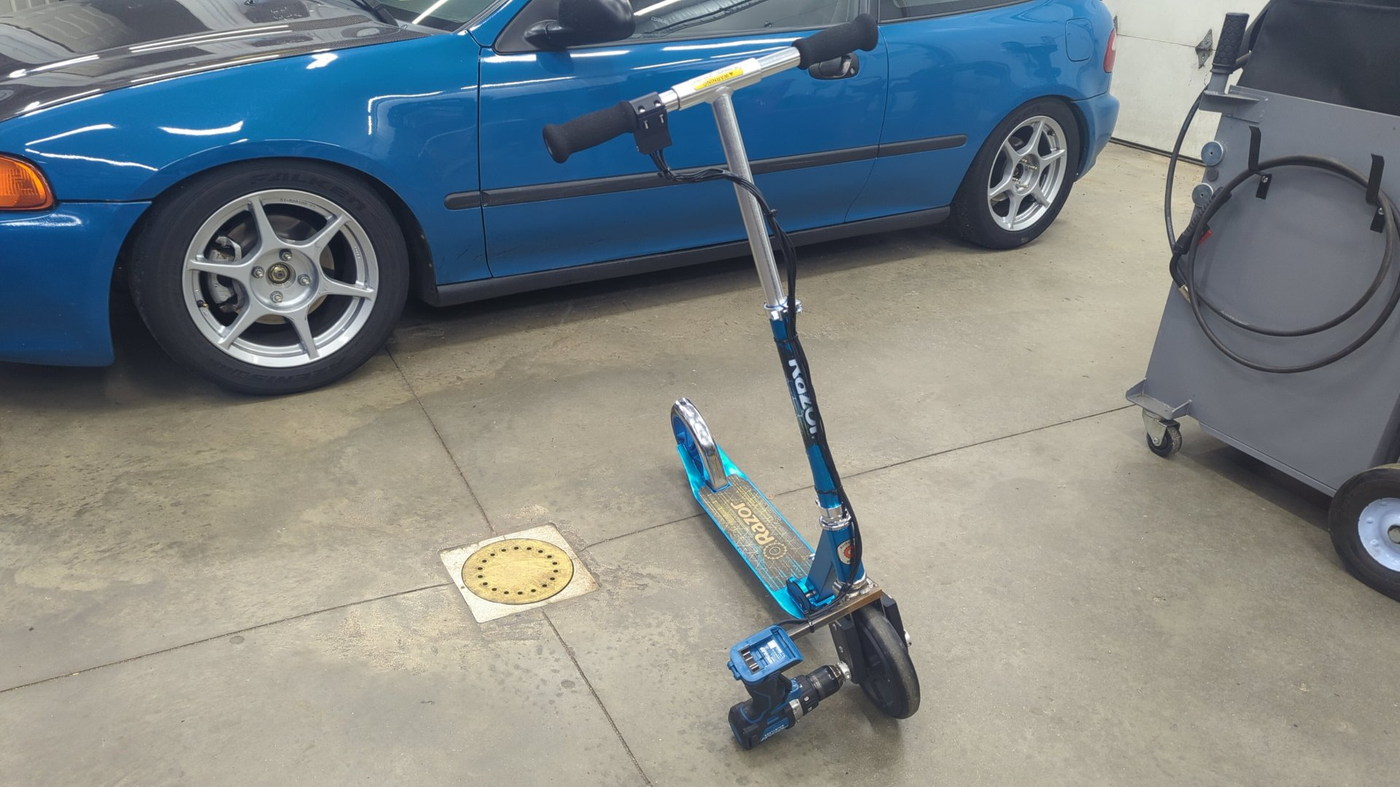 Figure: The completed scooter and front-drive assembly, transferring drill torque to the front wheel via a keyed shaft and one-way bearing. Credit: Eddie Abbondanzio
He welded mounting brackets directly onto the front fork, creating a front-wheel-drive layout reminiscent of his own Honda Civic. The drill delivered massive low-end torque, accompanied by a healthy dose of mechanical gear noise. High gear placed too much strain on the battery, but low gear reliably hauled a full-grown adult at 10 mph, powering through inclines without bogging down. A 5Ah battery provided about 2 miles (3.2 km) of range. With the drill spinning at full load, a 2-mile range proved more than sufficient for buzzing around an autocross paddock.
A 200mm Keyed Shaft and One-Way Bearings Eliminate Freewheeling Lockup
Mating a drill chuck directly to a wheel introduces a major mechanical snag: back-drive lockup. Power drills rely on high-ratio planetary reduction gearboxes with heavy internal drag. If you rigidly weld the drill chuck to the front axle, releasing the throttle trigger instantly locks the front wheel, pitching the rider over the handlebars. Furthermore, the scooter still needed to retain its original manual kick-scooter functionality.
To decouple driving torque from freewheeling glide, Abbondanzio sourced standard transmission hardware from McMaster-Carr. The core assembly relied on a 200mm-long, 12mm-diameter keyed rotary shaft, supported by two 6201-2RS deep groove ball bearings and two CSK12PP one-way dual-keyway bearings. The one-way bearing operates much like a bicycle freewheel ratchet: when the drill delivers power, the bearing wedges shut, locking into the hub via 4×4×12mm machine keys to propel the scooter forward. When the drill cuts out and the wheel outspins the shaft, the bearing instantly disengages and freewheels. For a few dozen dollars, a pair of off-the-shelf one-way bearings replaced a complicated clutch assembly with an elegant, maintenance-free mechanical solution.
Ten M6 Bolts Secure 3D-Printed Wheels Against Torquey Launches
The stock Razor A5 Lux plastic wheels were too narrow for a 12mm steel shaft and far too brittle to withstand sudden drill torque spikes. Abbondanzio brought out a 3D scanner, mapped the front end of the scooter, and designed a custom three-piece wheel assembly in CAD. Deploying industrial metrology on a toy push scooter might look like classic over-engineering, but it yielded an airtight, slop-free fit.
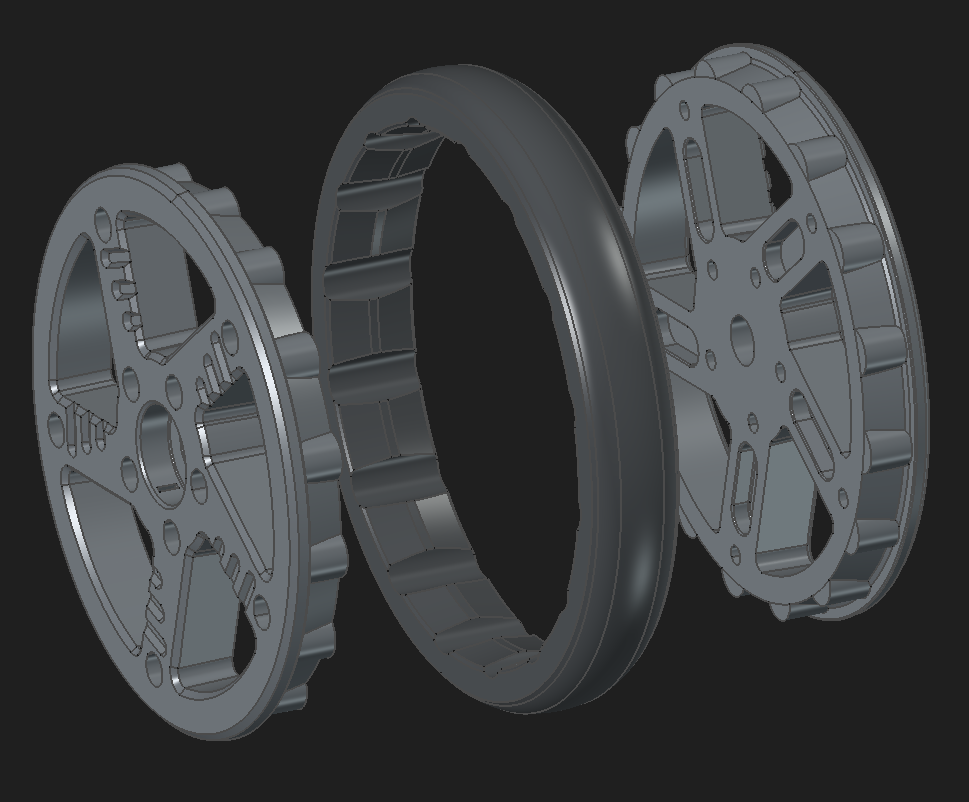 Figure: Exploded view of the 3D-printed wheel assembly, showing keyed shaft slots, press-fit bearings, and split hub halves. Credit: Eddie Abbondanzio
With printed plastic handling drive torque, the main failure modes were hub layer delamination and tire slip on the rim. Abbondanzio printed the two-piece split hubs out of tough, weather-resistant ASA, while printing the tire itself from flexible thermoplastic polyurethane (TPU). Ten M6×30mm bolts with nylon locknuts clamped the hub halves together. To prevent rotational shear between the halves, 1/16-inch steel key stock was embedded into the mating faces of each of the five spokes. The hub rim gripped the TPU tire with a deliberate squish fit, backed by interlocking ridges on the mounting surface. Letting standard metal fasteners take the brutal shear loads while 3D printing handled intricate geometry allowed desktop-printed parts to endure real-world riding.
Moving the Trigger to the Handlebars Brings Instant Burnouts
Once the mechanical drivetrain proved viable, the real ergonomic frustration surfaced in the controls. To maintain a natural riding posture, Abbondanzio needed to relocate the drill trigger switch up to the handlebars. Cracking open the drill housing required removing a left-hand reverse-thread retaining screw inside the chuck. Inside, however, lay a tangled rat’s nest of wiring behind the trigger assembly. He ended up snipping every lead, splicing in whatever 12 AWG and 18 AWG wiring he had on hand, and running the bare, unsleeved harness straight down the steering column.
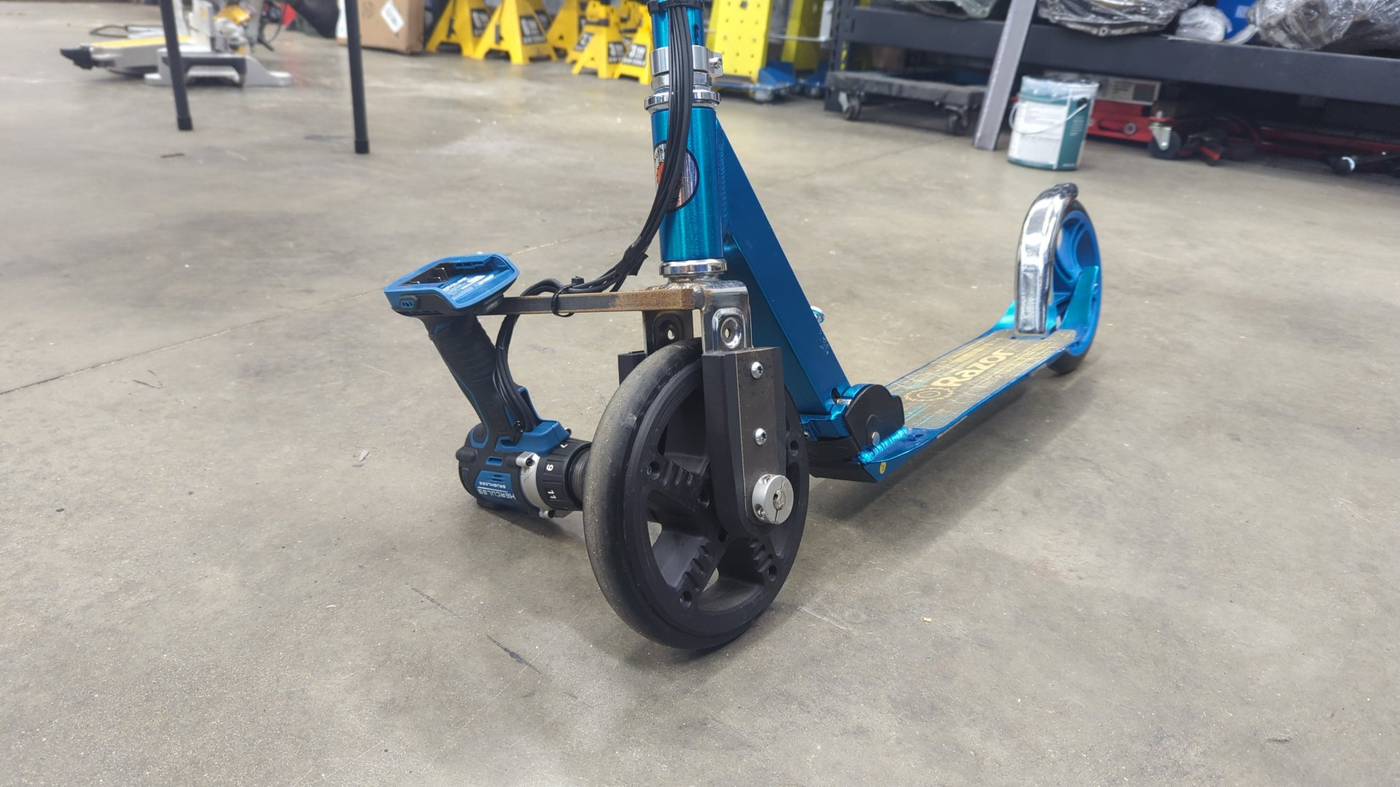 Figure: The relocated drill trigger switch mounted to the handlebars, extended by hand-soldered 12 AWG and 18 AWG wires. Credit: Eddie Abbondanzio
Control ergonomics proved even rougher. Cordless drill triggers are tuned for driving screws and drilling pilot holes—they have a short throw, aggressive ramp-up, and none of the smooth linear modulation of an electric scooter throttle. Squeeze a millimeter too far, and the full 20V torque curve slams into the front wheel instantly, spinning the TPU tire in place before the scooter lurches forward. Abbondanzio settled on a practical riding routine: kick off manually to build forward momentum, then pull the trigger to engage motorized assist. Adapting a hand tool’s switchgear into a vehicle throttle inevitably demands a compromise in control finesse.
Saving Zero Dollars to Reclaim the Agency of Building
Garage builds like this always divide opinion into two camps. Pragmatists argue that cheap commercial electric scooters already come with silky sine-wave motor controllers, compliant integrated brakes, and waterproof harnesses. Sinking countless hours into sourcing bearings, printing hubs, and welding steel brackets just to produce a burnout-prone machine with a 2-mile range makes no financial or practical sense.
Makers keep a completely different ledger. The convenience of off-the-shelf consumer gadgets rests upon sealed black boxes; consumers buy user licenses for hardware while forfeiting the freedom to dismantle, understand, and recombine it. Tallying up the final bill from Harbor Freight, Amazon, McMaster-Carr, welding wire, and spools of filament, Abbondanzio candidly admitted that he didn’t save a single dime.
Yet that seeming financial loss captures the true dividend of garage engineering. When an engineer can redefine a kick scooter, a cordless drill, and a handful of standardized bearings as raw materials, hardware prototyping drops from industrial assembly lines back onto the maker’s workbench. Cost reduction has always been the domain of factory economies of scale; cobbling disparate hardware into a functioning machine reclaims our agency over the manufactured world.
Reference links:
- Eddie Abbondanzio’s blog: “I Electrified My Push Scooter With A Power Drill”
- HN Discussion