
On September 11, 2026, twenty-five Fields Medallists published an open letter accusing artificial intelligence companies of treating mathematical problem-solving as a mere yardstick for compute capacity—a practice they argued stands in severe conflict with the long-term mission of academia. Six days later, fellow Fields Medallist Tim Gowers stepped forward to explain why he refused to sign. In doing so, he brought deep divisions within the mathematical community out into the open.
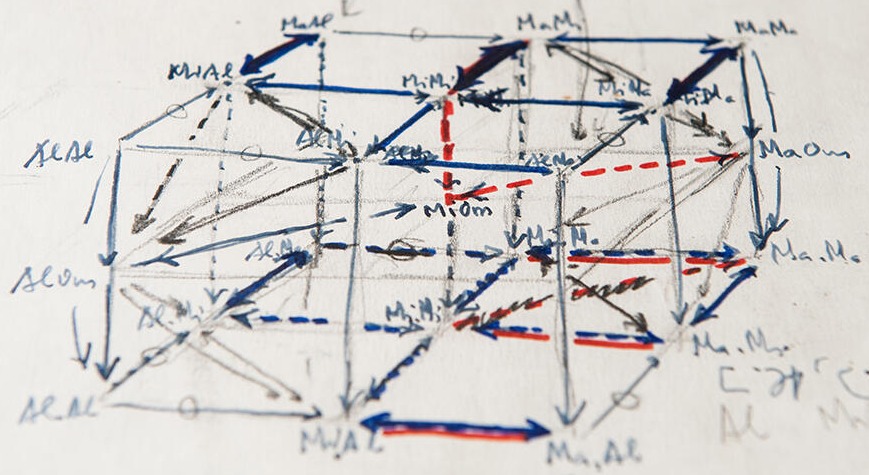 Image: The archival manuscripts of Alexandre Grothendieck, preserved in the basement of a bookstore in Paris’s 6th arrondissement. Source: David Bessis, “The Fall of the Theorem Economy”
$40 Million to Buy Out a Century-Old Counterexample
Under the computational dumping tactics of commercial tech firms, solving open mathematical problems has turned into a commodified transaction with an explicit price tag. Members of the MathOverflow community recently tallied the bill: securing the recently unveiled Navier–Stokes counterexample required staggering investments in raw compute. Capital&Compute estimated the compute cost at $6.5 million. TensorFeed placed the range between $10 million and $15 million. A leak reported by Business Insider put the expenditure as high as $40 million. Spending tens of millions of dollars to buy the first-to-publish rights for a century-old counterexample demonstrates how capital’s sweeping buyout of discovery rights has rewritten the rules of the discipline.
Unsolved conjectures are not unowned commodities falling freely from the sky. They represent the intellectual crystallization distilled, simplified, and generously shared by generations of brilliant minds. AI companies treat these foundational questions just as they treat open-source code on GitHub: as cheap raw material for stress-testing proprietary models. Foundation models claim the conspicuous glory of finding solutions, leaving behind a barren landscape where academia is stripped of its primary goals.
AI has turned proof generation into something wholesaled by compute hours. As a result, the true scarce resource in mathematics has migrated away from raw theorem-proving ability. What matters now are two distinct capabilities: formulating the right questions, and truly understanding the answers once they are found. The core dilemma is that within our existing academic and economic systems, conceptual understanding and question formulation cannot be easily quantified or compensated.
A Dissenting Peer Exposes the Divide in Mathematical Values
The open letter, titled A Severe Misalignment of AI in Mathematics, triggered wide-reaching tremors upon its release. The core thesis argued that solving problems is merely an instrument to attain deep conceptual understanding. In an AI-dominated landscape where that distinction is lost, machine capability threatens to backfire on humanity’s ultimate intellectual aspirations. Yet this absolute elevation of conceptual theory over problem-solving sparked pushback from different traditions within the mathematical world.
Tim Gowers publicly explained his decision not to sign on his blog, and the essay was quickly crossposted to Terence Tao’s homepage. The post sparked an intense discussion on Hacker News, racking up 242 comments against 186 upvotes—a comment-to-score ratio of over 1.3 that reflected fierce debate. While Gowers conceded that the discipline faces a genuine crisis, he firmly rejected the notion that conceptual understanding should be canonized as the sole legitimate pursuit of mathematics.
Citing his influential essay from twenty-five years ago, The Two Cultures of Mathematics, Gowers countered that mathematics has always harbored two distinct temperaments: those driven primarily by problem-solving, and those motivated by structural theory and deep conceptual insight. The wording of the open letter, he argued, unilaterally branded the sheer joy of problem-solving as an inferior orientation. Once raw compute vastly compresses the market value of human problem-solving, what started as a defensive reaction quickly devolved into an ideological struggle over cultural authority.
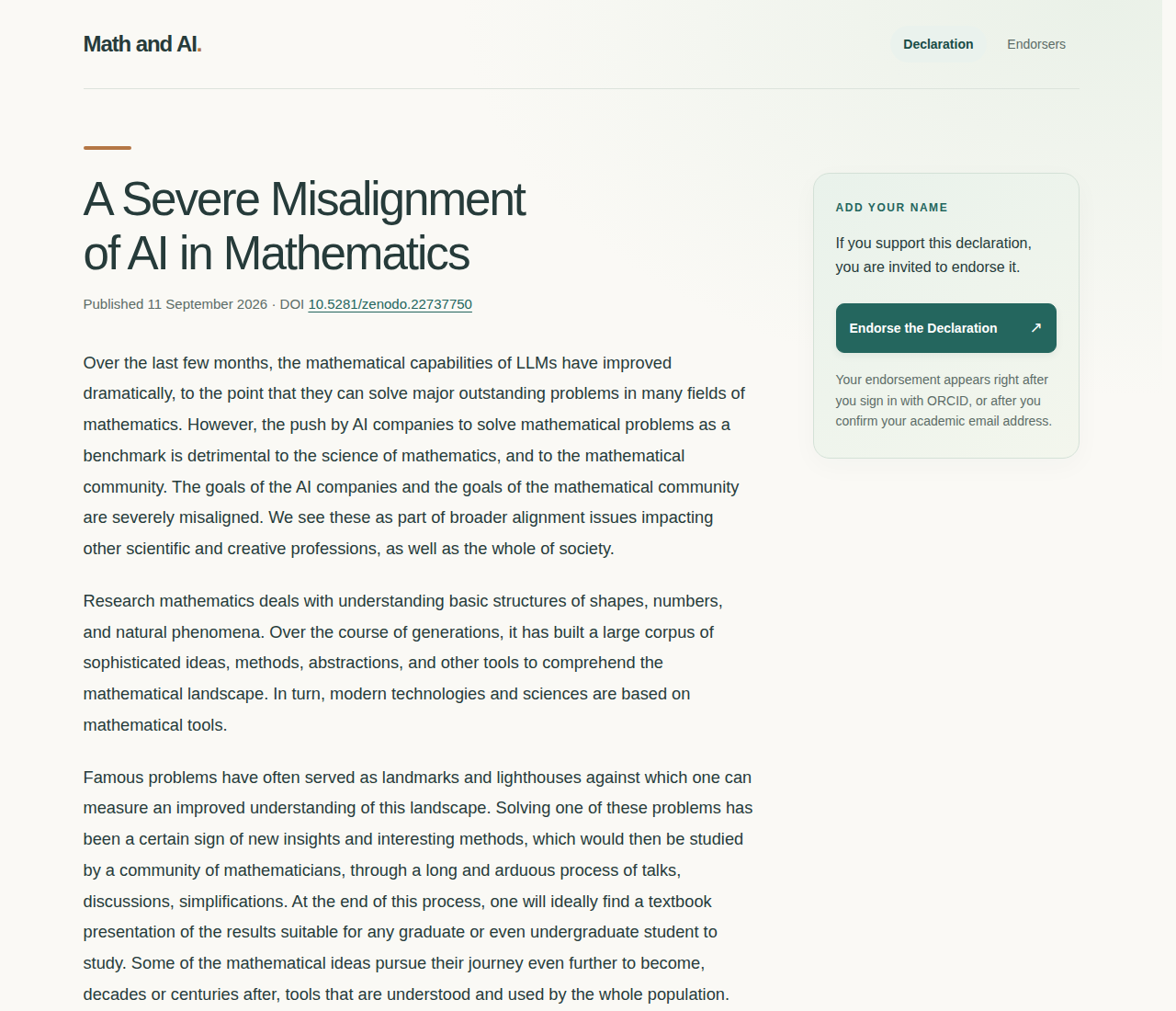 Image: Screenshot of the open letter “A Severe Misalignment of AI in Mathematics”, signed by 25 Fields Medallists. Source: mathandai.org
A Cambridge Research Group Learns a Brutal Lesson
Gowers’s perspective is not merely theoretical; it is grounded in practical engagement. He openly disclosed his relationship with OpenAI, noting that as an external expert, he enjoys early access to OpenAI models and a complimentary Pro subscription, though he stressed that he has never accepted research funding from the company. Even a few days of advance access proved sufficient for him to witness the sheer destructive velocity of technological progress firsthand.
At the University of Cambridge, Gowers leads a research group dedicated to automated theorem proving. Their original ambition was to build machine systems that would assist human mathematicians in uncovering new mathematical structures. Yet today’s foundation models routinely bypass those meticulously designed theoretical frameworks, producing valid proofs through brute-force computational power. Gowers candidly acknowledged that his group’s core rationale for existence had evaporated, leaving them no choice but to swallow this bitter pill.
Publicly available models are already more powerful than virtually any individual human mathematician at discrete problem-solving. Dense, pages-long mathematical arguments pour onto screens faster than human minds can digest them. In the face of this deluge, the exchange of mathematical insight often degenerates into nothing more than a human user typing back a cursory “thank you.” The biological bandwidth limit of human comprehension has become a physical wall blocking the genuine diffusion of mathematical insight.
Nobody Wants to Fund Pure Understanding
The open letter contains a notably fragile argument: it asserts that even if finding proofs is no longer the exclusive preserve of human mathematicians, society must still devise mechanisms to sustain and value a dedicated corps of human experts. That defensive perimeter was swiftly dismantled in the Hacker News comments. Critics posed two unavoidable questions: Why should society continue to allocate public funding to a group that no longer produces concrete solutions? And how will tenure-track career ladders for junior researchers be evaluated?
The traditional academic apparatus is built entirely around publishing papers and resolving open problems. When a doctoral candidate spends five years grinding through a minor theorem only to discover that a commercial model can produce the same result in five minutes, classical scholarly training loses its real-world footing. This is not merely an employment crisis for individual researchers; it is a structural destabilization of the entire talent pipeline.
Without an established institutional framework to quantify pure conceptual understanding into performance metrics, the grant allocation system loses its operational baseline. Gowers sketched a hyperbolic thought experiment: an international treaty mandating a moratorium on the release of stronger reasoning models, with academic bodies deciding which problems machines are permitted to tackle. Such detached regulatory fantasies only underscore the profound sense of helplessness academia feels when confronted by the steamroller of private capital.
Hoarding Problems Becomes Safer Than Solving Them
The pressure of institutional unraveling is driving researchers toward their most basic defensive instincts. A thread on MathOverflow garnered nearly 5,000 views, with the author voicing deep concern that mathematical research may devolve into a medieval era of secrecy. Stripped of professional security, researchers are instinctively cutting themselves off from open collaborative networks.
History provides direct precedents for this kind of closed-door retreat. In 1510, Italian mathematician Scipione del Ferro discovered an algebraic formula for solving cubic equations and kept his breakthrough secret for twenty years, revealing it only on his deathbed to his pupil Antonio Maria Fior. In that era, hoarding a proprietary method was the only way to safeguard professional livelihoods. Centuries later, Isaac Newton delayed publishing his work on calculus, sparking a bitter, protracted priority dispute with Gottfried Wilhelm Leibniz. When sharing insight invites vulnerability, information blackouts become armor.
Terence Tao offered an incisive breakdown of the current dynamic on social media: today, the truly scarce talent is identifying a promising, tractable unsolved problem. Yet under current incentives, the moment word leaks that a human team is making progress on a conjecture, commercial AI labs redirect massive compute clusters to solve it first, extinguishing human research projects before they can bear fruit.
 Image: Screenshot of the MathOverflow question “How do we prevent mathematics from devolving into the medieval era of secrecy?”. Source: MathOverflow
The Community Fights to Reclaim the Value of Intellectual Labor
Technological intrusion has completely inverted academic incentives. If formulating an insightful problem merely serves as an invitation for machines to capture the solution rights, the motivation to openly share research directions evaporates entirely. Locking promising ideas inside desk drawers has become the only way to safeguard intellectual investment—a retreat that threatens to dismantle centuries of open scientific tradition.
Faced with this ongoing computational sweep, discussions across the community have put forward two concrete, practical defense mechanisms. The first proposal borrows from copyright law, advocating that only human authors may be formally credited on academic papers. For publications that lack identifiable human intellectual contributions, the use of generative systems must be explicitly designated. This rule aims to cut off the shortcut that allows tech companies to convert raw compute directly into academic prestige.
The second proposal mandates that any co-authored paper must disclose its complete methodology, including system prompts, pipeline scaffolding, and orchestration modules. Because these infrastructural architectures are treated as core trade secrets by major tech labs, compulsory disclosure would dramatically increase the hidden costs of claiming priority, discouraging corporate labs from encroaching on academic terrain.
The collective protest by twenty-five Fields Medallists and the defensive retreat of researchers choosing secrecy are two sides of the same coin: an urgent attempt to reprice human intellectual labor. The debate is no longer about how capable models are at solving equations, but about what new institutional rules must be forged to curb the unchecked expansion of commercial capital. Without protective guardrails, allowing computational dumping to obliterate human research pathways will pull the ladder out from beneath an entire generation of scholars.
References:
- MathAndAI Open Letter
- Tim Gowers’ Blog Post
- MathOverflow Discussion Thread