“This Engine Isn’t Finished” — And Then It Fired
When United Launch Alliance (ULA) then-CEO Tory Bruno saw the initial photographs of Raptor 3, he famously tweeted that there was no need to show a partially assembled engine to exaggerate. His reaction was understandable: compared to its two predecessors, Raptor 3 looked completely stripped down, as if a crew had unbolted the external shell and left only the bare skeleton. SpaceX President and COO Gwynne Shotwell offered no verbal explanation in response, simply posting a photograph of Raptor 3 firing up in a flawless hot test.
That single photograph settled the matter: the engine was not missing its pieces; those pieces had been routed inside.
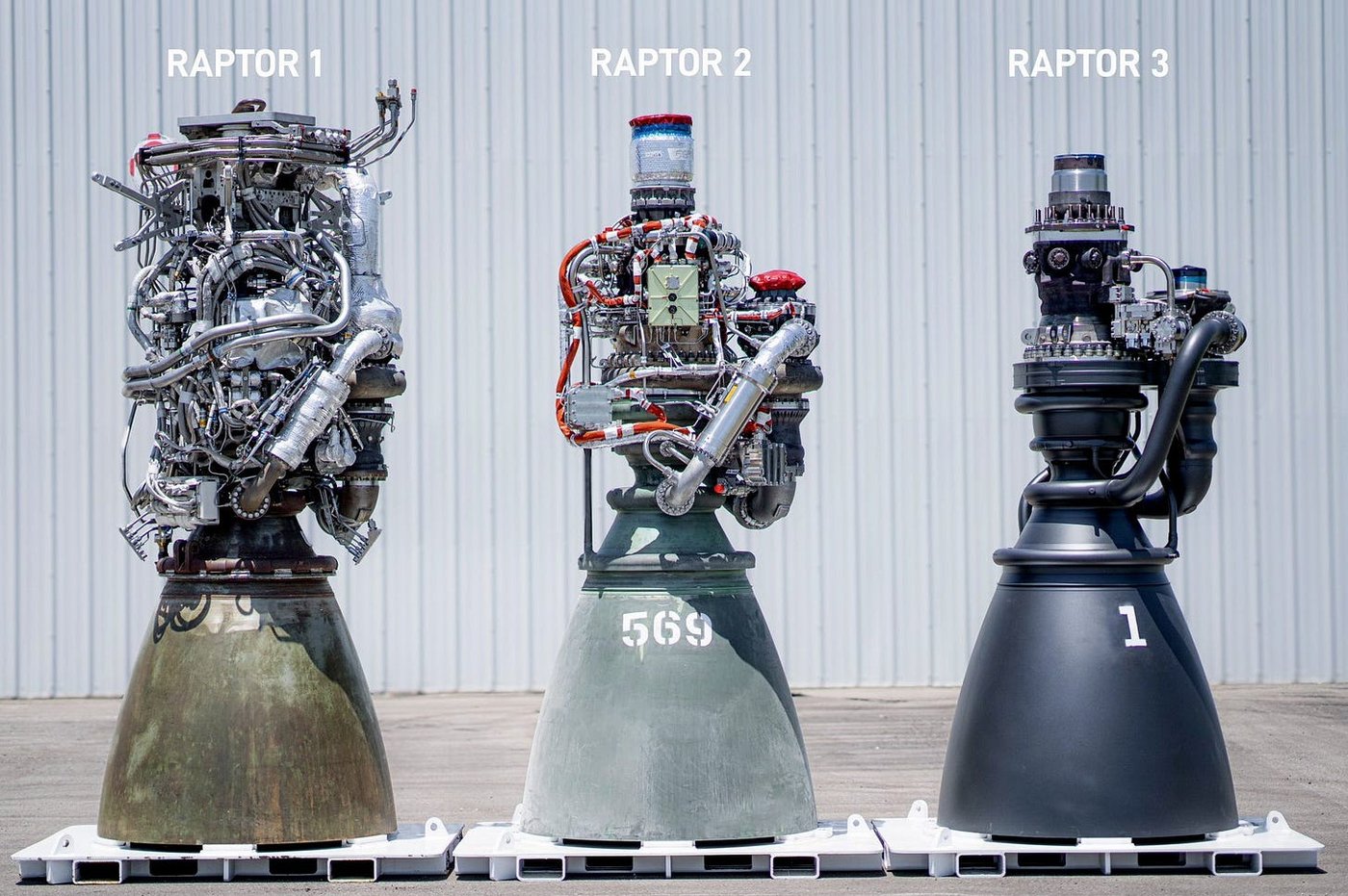
Figure: Side-by-side comparison of the three Raptor generations (from left to right: Raptor 1, Raptor 2, Raptor 3). External plumbing and wire harnesses diminish with each iteration, vanishing almost entirely on Raptor 3. Source: SpaceX, via Construction Physics
From Development Testbed to Mass Production: 35% More Thrust with Less Mass
Raptor was developed by SpaceX specifically for Starship, unlike the Merlin engine powering Falcon 9. Its development spanned a full decade: initial hot firing in 2016, flight on Starhopper in 2019, integration onto the full Starship stack in 2023, and culminating in Raptor 3’s flight in May 2026. Raptor 3 produces roughly 35% more thrust than Raptor 1, yet appears noticeably more compact, smaller, and lighter.
This apparent paradox—gaining thrust while shedding volume—reflects a deliberate core strategy. Raptor 1 was fundamentally an experimental development engine, wrapped in layers of diagnostic sensors, pressure taps, thermocouples, and wire harnesses designed to monitor every node and map out exactly what the machine was doing across every operating regime. Over ten years, as empirical telemetry accumulated, engineers learned which sensors could be deleted, which propellant lines could be merged, and which flanged fittings could be permanently welded shut. Only with that deep empirical baseline could SpaceX begin aggressively subtracting.
Anyone in engineering can add complexity; subtraction requires truly understanding the machine.
Betting on the Hardest Propulsion Cycle Ever Built
Raptor employs a full-flow staged combustion (FFSC) cycle. In plain terms: the engine incorporates two preburners—one running fuel-rich to drive the methane turbopump, the other oxygen-rich to drive the liquid oxygen turbopump. The entire propellant flow passes through the preburners, heating and pressurizing before the two gaseous streams enter the main combustion chamber to burn completely. The payoff is immense: a higher mass flow through the turbines enables them to operate at significantly lower temperatures and pressures for a given power level, drastically improving turbine lifespan and hardware longevity—a mandatory requirement for a company betting its entire economic model on rapid rocket reusability.
Prior to Raptor, only two full-flow staged combustion engines had ever reached testing: the Soviet RD-270 in the 1960s and the American Integrated Powerhead Demonstrator (IPD) in the 1990s and 2000s. Neither ever flew. When SpaceX initiated the Raptor program in 2012, it acquired surplus equipment and test articles from the IPD program. The price of this cycle, however, is staggering complexity. To grasp the scale of the turbomachinery required: the turbopump on the Saturn V’s F-1 engine demanded approximately 41 megawatts of shaft power—roughly comparable to the entire shaft power delivered by the nuclear reactor of an Ohio-class submarine.
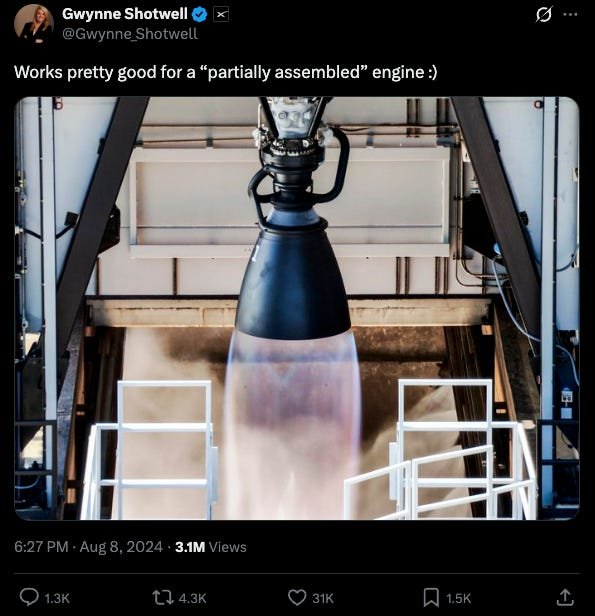
Figure: Successful hot fire of Raptor 3. Source: SpaceX President Gwynne Shotwell
Lines Didn’t Disappear — They Were Swallowed Inside
The most striking visual difference in the three-generation comparison is how clean Raptor 3 appears on the outside. But those fluid lines and electrical conduits did not simply vanish into thin air; they were migrated into the engine structure itself through additive manufacturing. SpaceX licensed advanced metal 3D printing technology from Velo3D in 2024, with Elon Musk declaring that SpaceX possesses the most advanced metal 3D printing capability on Earth. Close-up photos of Raptor 3 clearly reveal the distinctive print layers across the engine body.
Key architectural simplifications include:
- Countless bolted flanges were replaced with direct welds, shedding weight and eliminating potential leak paths, though trading away modular serviceability—once welded shut, components cannot be disassembled in the field.
- Helium spin-up and actuation circuits were completely excised. Raptor 1 relied on helium to spool up turbines and actuate select valves; Raptor 3 switched entirely to nitrogen, deleting the dedicated helium plumbing and storage subsystem.
- Main combustion chamber spark igniters were already eliminated in Raptor 2, as the hot exhaust gases entering from the preburners provide more than enough thermal energy for auto-ignition.
- In Raptor 3, engineers removed a gaseous oxygen heat exchanger adjacent to a preburner and cut out an auxiliary fuel line feeding the preburner.
- The turbopumps were compacted, preburner controllers transitioned from decentralized assemblies scattered around the powerhead into consolidated control modules, and discrete valves were merged into integrated valve manifolds.
- The single largest weight reduction came from discarding the external heat shield and fire suppression shroud. Raptor 1 and 2 were encircled by vulnerable exposed plumbing and wiring that required heavy thermal blankets to withstand the radiative heat of the rocket plume. By embedding lines internally and integrating active regenerative cooling, the external heat shield and fire suppression gear were eliminated entirely.
The engine looks clean on the outside, but its internal integration density has skyrocketed. Musk himself acknowledged that this was engineering of extraordinary complexity.
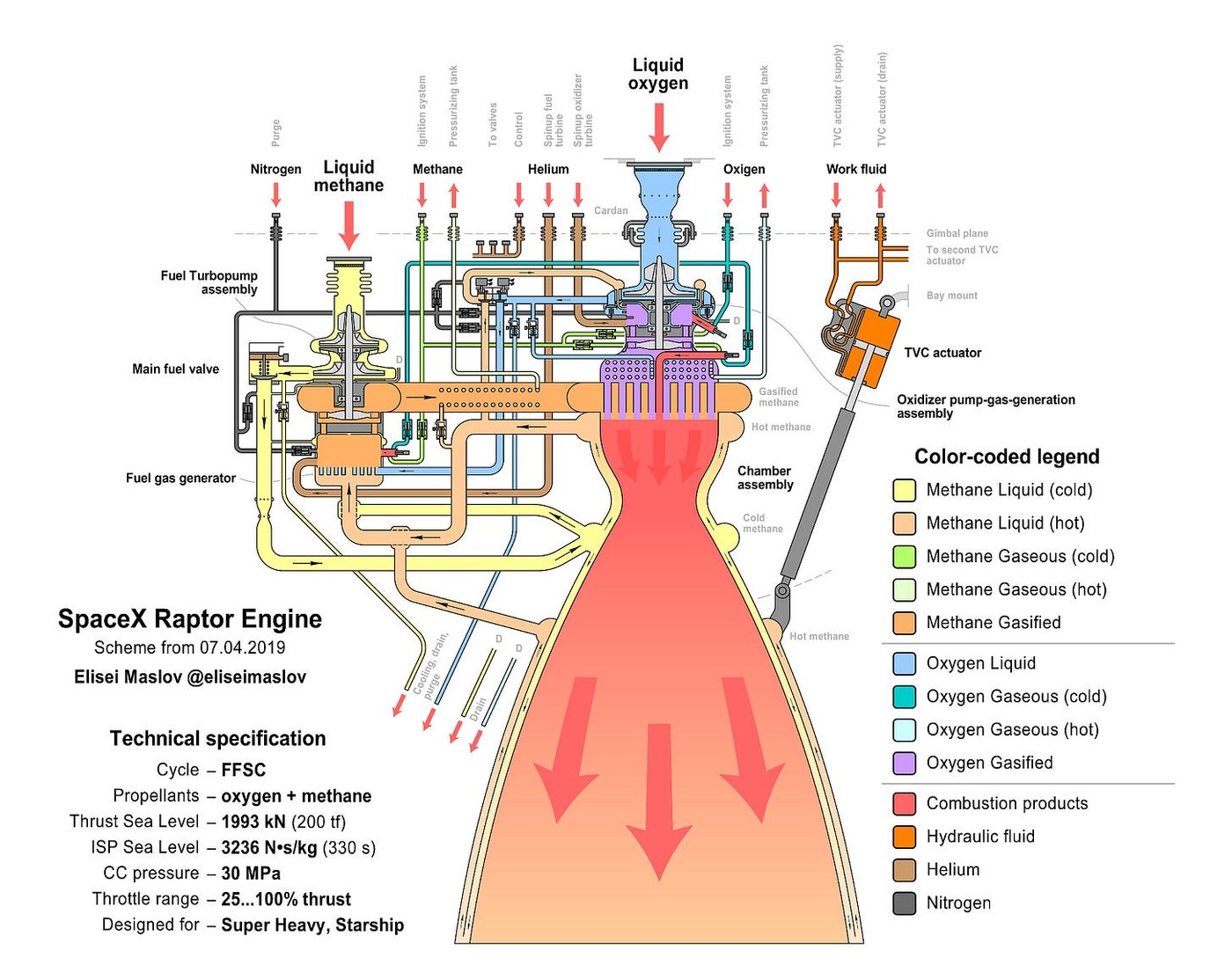
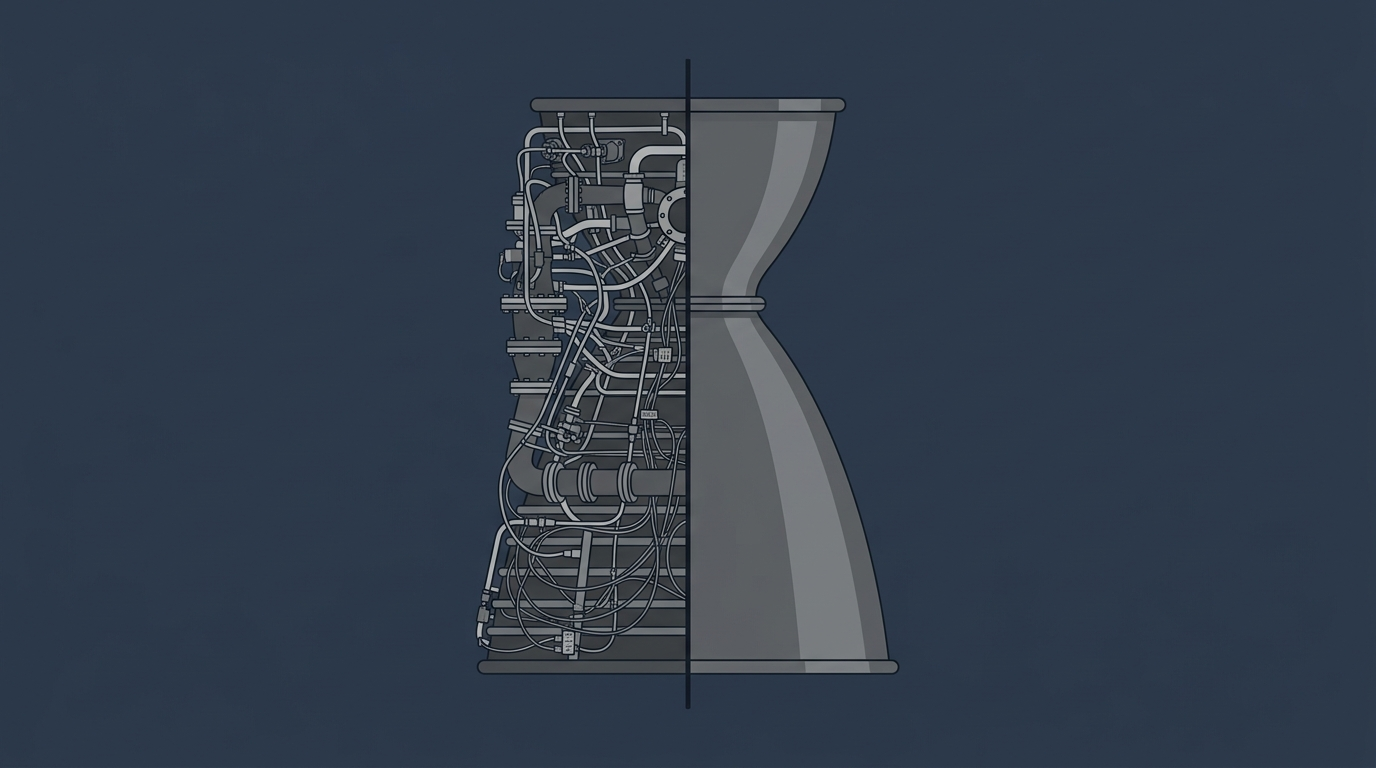
Figure: Fan-made schematic of Raptor 1 illustrating the dense tangle of external lines and sensors. Source: Elisei Maslov, via Construction Physics
The Flight 13 T-0 Abort: Simplification Brings New Vulnerabilities
In July 2026, during the initial launch attempt of Starship’s 13th Integrated Flight Test (IFT-13), the flight software triggered an automatic abort at T-0 after multiple Raptor 3 engines failed to ignite properly. Stripping out diagnostic sensors inherently reduces observability; welding joints together makes anomalies significantly harder to isolate and troubleshoot; deleting redundant fluid paths narrows operational tolerances. The undeniable benefits of simplification—lower mass, fewer leak points, streamlined mass production—come hand in hand with heightened operational fragility.
This is not a debate over who is right and who is wrong. The underlying logic of Raptor 3 holds only if SpaceX’s grasp of the hardware is truly profound enough to discern which redundancies can be safely discarded. The IFT-13 launch abort proved that this engineering confidence had not yet completely aligned with reality.
What the Comparison Photo Really Shows: Systematically Eliminating Uncertainty
One crucial detail is often overlooked: SpaceX does not publish engineering blueprints, and no public teardown of a Raptor exists. Nearly everything known about its internal layout stems from occasional remarks by Elon Musk on social media, reporting from NASASpaceFlight and Everyday Astronaut, and community schematics created by space enthusiasts. These secondary accounts must be taken with healthy skepticism.
Yet the three-generation comparison photograph itself is unequivocal. It captures an elemental rule of engineering: radical subtraction is only earned through a prior decade of addition—adding sensors, running hundreds of hot tests, amassing telemetry, and diagnosing failures. Every removed flange, deleted transducer, and consolidated line represents an engineering question that shifted from “uncertain” to “settled.” By 2026, that learning loop is still in full swing. Raptor 3 stands as proof both of how far SpaceX has traveled, and of just how formidable the remaining road truly is.
References:
- Construction Physics Article
- Hacker News Discussion
- NASASpaceFlight Reporting
- Everyday Astronaut Coverage
- NASA Spaceflight Forum Discussion
- Elon Musk’s Reply to Yishan Wong on X