Some 225 million kilometers from Earth, across the dusty expanse of Jezero Crater, dozens of titanium tubes packed with core drillings lie quietly on the Martian surface. Since 2021, NASA’s Perseverance rover has been prospecting this ancient lake delta, using its robotic arm to extract core samples that may harbor evidence of ancient Martian life. Sealed into ultra-clean titanium alloy tubes, they were carefully deposited across the desert floor, awaiting a shuttle that was supposed to bring them home. The samples are packed and waiting, but the bus has been permanently canceled.
An $11 Billion Bill Sinks the Return Shuttle
In early January 2026, the text of a bipartisan congressional compromise spending bill delivered the final verdict: “the agreement does not support the current Mars Sample Return program.” With that single sentence, lawmakers legislated an end to NASA’s most ambitious interplanetary logistics network. While the final bill allocated $7.25 billion to NASA’s science directorate—well above the White House’s initial proposal to slash the budget in half—it still left a yawning chasm between available funds and the colossal cost of retrieving the Martian cache.
The project’s demise was triggered directly by a budget spiral. By 2024, projected costs for Mars Sample Return (MSR) had ballooned to an eye-watering $11 billion, threatening to starve virtually every other planetary exploration effort at the agency. In January 2025, NASA submitted an emergency redesign aimed at shaving costs down to roughly $7 billion, but congressional appropriators remained unmoved. Under current fiscal realities, spending double-digit billions to bring back a handful of rocks was simply a non-starter.
Returning Martian Rocks Requires a Multi-Spacecraft Relay
Hauling physical samples back from the surface of Mars is exponentially more challenging than sending a one-way rover. As originally architected, MSR was not a single mission, but a high-wire relay involving multiple independent spacecraft operating in perfect lockstep across two planets. NASA would first deploy a Sample Retrieval Lander carrying the Mars Ascent Vehicle (MAV). Once down on the surface, robotic arms would transfer the sample tubes into an orbiting sample canister atop the rocket, which would then launch into low Martian orbit.
Waiting in orbit would be the European Space Agency’s (ESA) Earth Return Orbiter (ERO). This spacecraft had to track and autonomously capture the basketball-sized sample canister at orbital speeds, seal it inside a multi-layered biocontainment barrier to meet stringent planetary protection rules, ignite its main engines to journey back toward Earth, and finally drop the return capsule into the Utah desert. A single mechanical failure anywhere along this interplanetary assembly line would instantly reduce an $11 billion investment to cosmic debris.
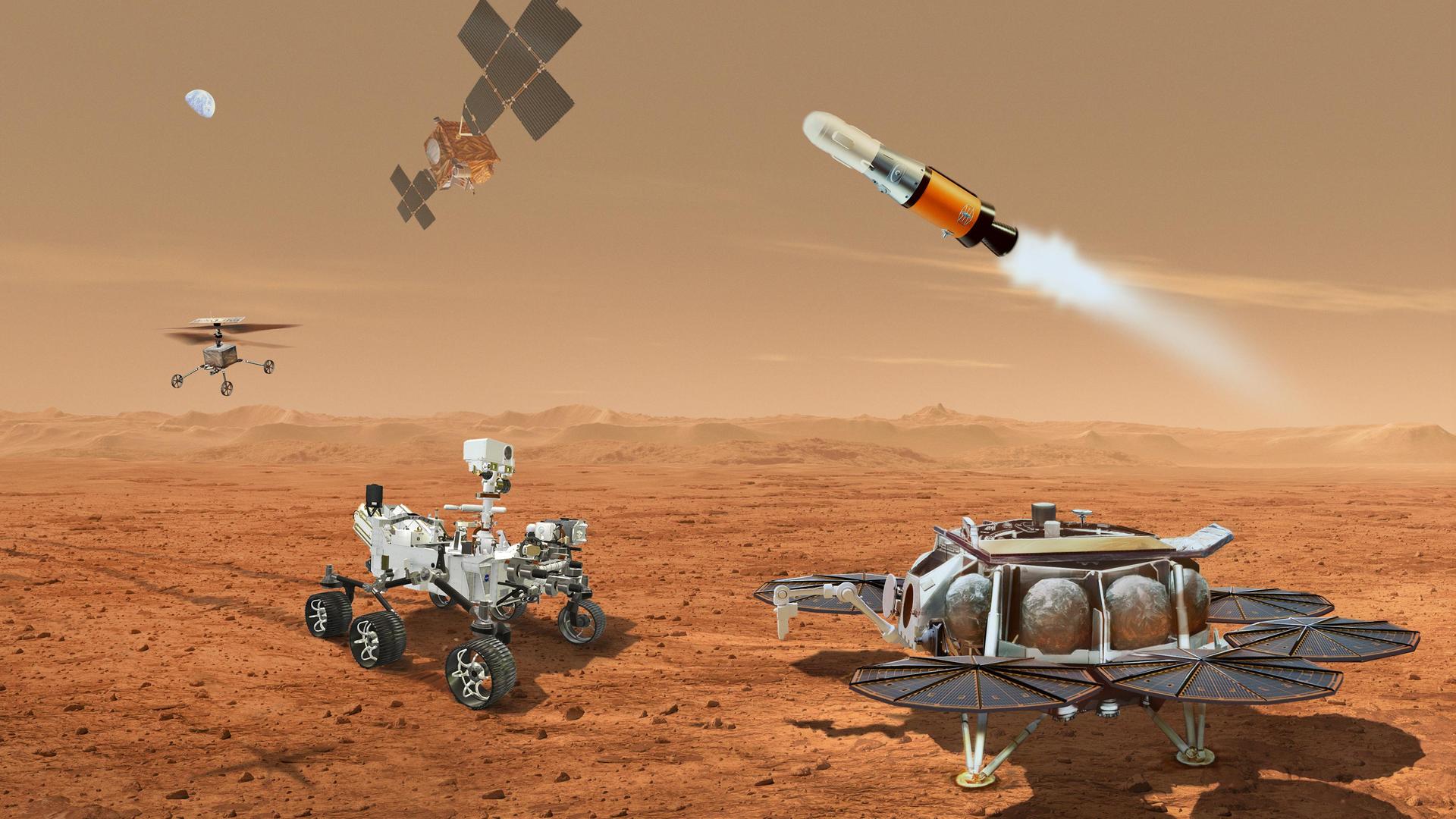 Figure: The overall mission architecture of Mars Sample Return, showing a coordinated fleet of spacecraft working together to return rock samples to Earth. Source: NASA/ESA/JPL-Caltech
Mega-scale international space projects are acutely vulnerable to mid-course cancellations. ESA had already sunk substantial capital and engineering into the Earth Return Orbiter. As MSR hovered on the brink of termination late last year, ESA officials indicated they might repurpose the orbiter into a standalone Mars science mission. If Europe’s hardware is diverted, NASA loses more than just a ride: even if funding rebounds down the line, re-engineering an orbital rendezvous system from scratch will cost multiples of the original design.
Confirming Ancient Life Demands Earthbound Laboratories
Behind the bureaucratic cancellation lies the loss of a critical physical evidentiary chain for extraterrestrial life. In 2024, while exploring a rock formation named Cheyava Falls, Perseverance cored into mineral deposits bearing distinct “leopard spots.” On Earth, these vivid millimetric halos of iron and phosphate are classic chemical fingerprints left behind by ancient microbial metabolic activity.
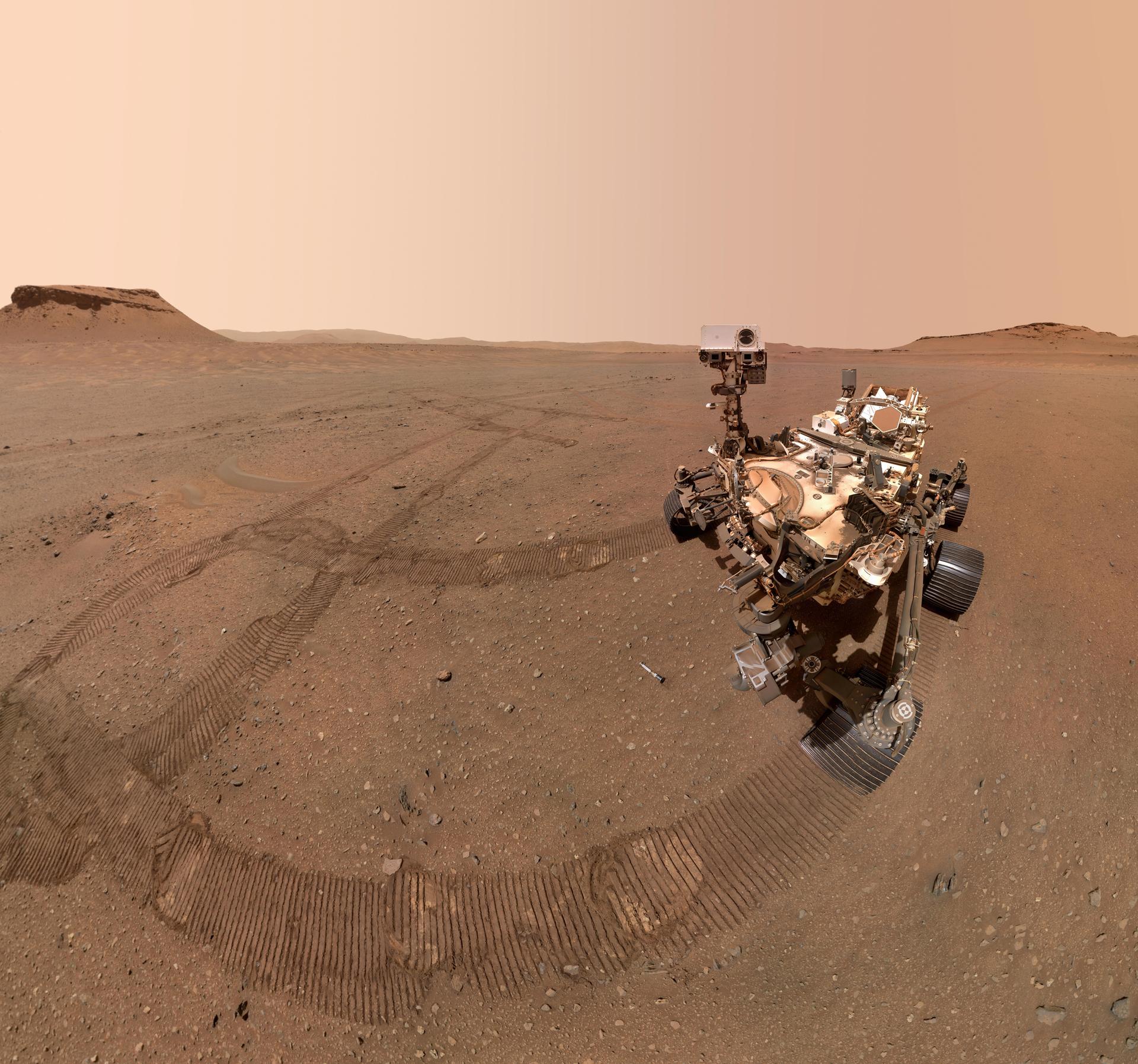 Figure: The Three Forks sample depot placed by the Perseverance rover in Jezero Crater, with sample tubes neatly arranged on the Martian surface awaiting retrieval. Source: NASA/JPL-Caltech
This discovery represented the core scientific justification for MSR. Even the most sophisticated onboard spectrometers cannot deliver a conclusive verdict in situ. To definitively prove whether those leopard spots represent fossilized life or merely abiotic chemistry, scientists must subject the samples to terrestrial synchrotron radiation facilities to map their crystalline lattice, and run isotope ratio mass spectrometers to analyze fractional carbon variations. These multi-ton instruments cannot be miniaturized onto a rover. The final test can only happen on Earth.
Abandoning sample recovery imposes an immediate and permanent scientific penalty. As planetary scientist Bethany Ehlmann emphasized, a rock with potential biosignatures is sitting on Mars waiting for pickup, alongside dozens of other cached samples that likely hold unexpected breakthroughs. Without returning them to Earth’s laboratories, humanity has voluntarily shuttered its best opportunity to answer whether life ever existed on Mars.
A Budget Civil War Grips Planetary Science
The runaway budget of a single flagship mission had triggered a bitter resource war inside the planetary science community. Consuming $11 billion would have drained the coffers of nearly every other interplanetary initiative. With MSR removed from the budget ledger, NASA was finally able to free development capital for two long-delayed Venus probes (VERITAS and DAVINCI) and restart formal planning for a flagship Uranus Orbiter and Probe. It was a forced trade-off dictated by balance sheets.
In tech discussions on Hacker News, the financial contrast was impossible to ignore. Several commenters noted that SpaceX’s entire Starship program—spanning iterative design, manufacturing infrastructure, and frequent test launches—has cost around $15 billion, and is approaching regular orbital operations. Pouring upwards of $10 billion into a bespoke, single-use sample recovery pipeline strikes many engineers as deeply obsolete in an era defined by commoditized, reusable heavy lift.
Compounding the controversy is an accelerating geopolitical timeline. China plans to launch its Tianwen-3 mission around 2028, aiming to bring Martian samples home following its historic far-side lunar sample return. The American withdrawal has provoked sharp criticism within the scientific establishment. Victoria Hamilton of the Southwest Research Institute remarked that the decision is hard to interpret as anything other than an admission that returning samples from Mars is “too hard for the United States,” surrendering leadership mid-race. Philip Christensen similarly lamented the mission’s death as an abandonment of U.S. primacy in deep space exploration.
A $110 Million Lifeline for Heavy Landing Technology
While Congress pulled the plug on the baseline mission, it left a modest $110 million appropriation in a new account designated “Mars Future Missions.” This funding is designed to preserve key intellectual property and technological assets developed during MSR’s early phases—most notably the heavy entry, descent, and landing (EDL) systems needed to deliver massive payloads through Mars’ razor-thin atmosphere.
Mars’ tenuous atmosphere offers notoriously little braking drag for multi-ton spacecraft. The preserved budget protects the specialized engineering teams developing the supersonic parachutes and retrorocket clusters required for high-mass planetary landings. Should reusable commercial heavy-lift vehicles eventually slash round-trip launch costs, or should NASA transition toward a commercial services procurement model, this technological reservoir will form the engineering bedrock for a future sample return.
For now, an $11 billion logistical price tag has severed the route home for Perseverance’s precious cargo. Dozens of titanium tubes holding ancient sediments will weather in Jezero Crater as monuments to human ambition and fiscal reality. The rules of planetary exploration have shifted: pouring unbounded resources into a single custom mission no longer survives contact with modern aerospace economics.
References:
- Hacker News Discussion (item?id=49791939)
- Congressional Compromise Spending Bill and NASA Planetary Science Budget Reports