
100 Kilotons of TNT Detonated, but the Aftershocks Never Came
In September 2017, North Korea conducted its sixth underground nuclear test beneath Mount Mantap at the Punggye-ri nuclear test site. The explosive yield was estimated between 100 and 250 kilotons of TNT, and the U.S. Geological Survey (USGS) recorded it as a magnitude 6.3 seismic event. Roughly eight minutes later, a magnitude 4.1 event was registered, identified as the collapse of an underground detonation cavity.
Under normal circumstances, an underground explosion of that magnitude shatters the surrounding rock mass, unleashing an immediate, dense sequence of small aftershocks that gradually fades over several weeks as the crust readjusts. Yet at Punggye-ri, virtually nothing happened at first. Apart from an isolated small tremor, there was no pronounced aftershock sequence. Persistent seismic activity only began to surface approximately three weeks later.
Eight years later, the earthquakes in that region have not ceased. In fact, they are multiplying.
Unearthing 1,399 Microearthquakes from Seismic Noise
A study published in Science on September 17, 2026, has brought the full picture to light. A research team co-led by Kwang-Hee Kim of Pusan National University and geophysicist Xingli Fan of Chengdu University of Technology searched continuous seismic records collected in China and South Korea between 2008 and 2025. They identified a total of 1,399 earthquakes in the vicinity of Punggye-ri, precisely locating 955 of them. The overwhelming majority were microearthquakes below magnitude 2.0 — signals completely invisible to the naked eye on standard seismograms.
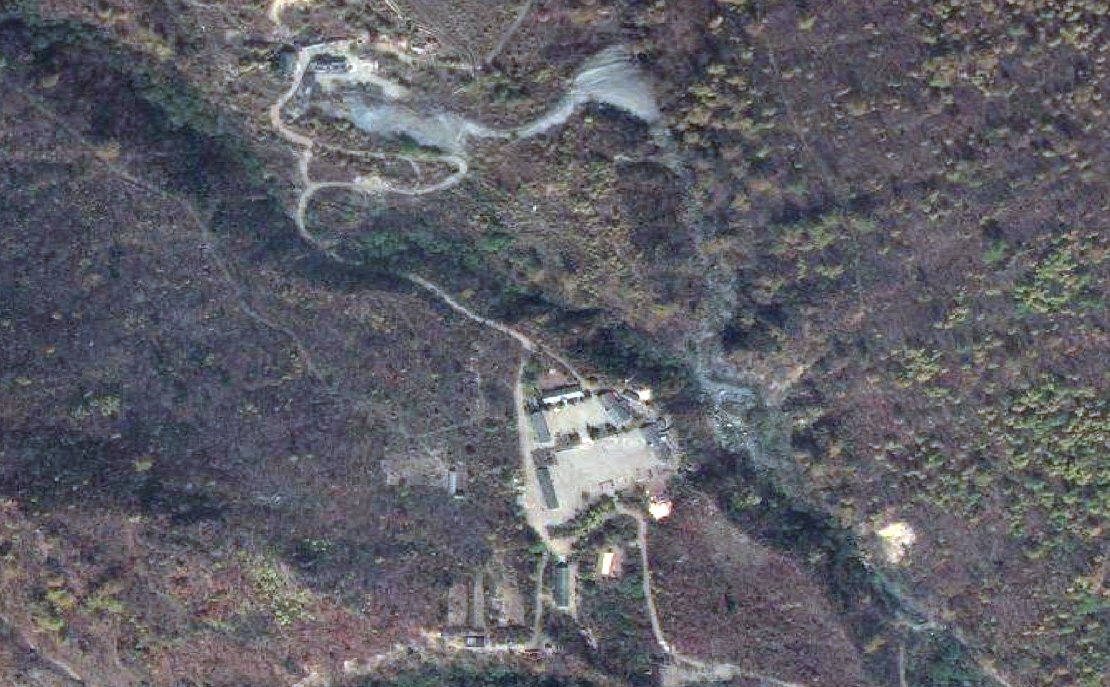 Figure: ShakeMap of North Korea’s 2013 nuclear test released by the U.S. Geological Survey (USGS). Source: USGS
Uncovering them required a computational technique known as “template matching.” The principle is straightforward: seismologists take known earthquake waveforms as reference templates, then scan continuous historical recordings to extract low-amplitude events buried beneath ambient noise. It resembles taking a short musical snippet to search through an entire day’s audio recording, identifying every moment someone hummed that tune — even when largely drowned out by background noise.
The data pointed to an anomalous conclusion: following the 2017 nuclear test, earthquake frequency did not decay; instead, it climbed steadily through 2025, while the total cumulative energy released (measured in seismology as seismic moment) rose in lockstep. Spatially, these events delineate two roughly parallel north-northwest-trending lineaments. One corresponds to the southern extension of a known fault mapped decades ago south of Mount Mantap; the other displays no surface expression whatsoever. Because researchers cannot access North Korea for on-site field surveys, they had to sift through archival geological maps dating back decades to reconcile the two.
Storing Blast Stress in the Crust: Faults Paying in Installments
The prevailing explanation for this pattern is that the six successive underground tests progressively fractured the shallow rock mass of Mount Mantap, transferring mechanical stress onto pre-existing faults that were already hovering near critical failure. The overburden of the mountain and its rugged topography likely dictated which faults were most vulnerable. Numerical modeling confirms that the densest clusters of earthquakes coincide with zones of anomalously high stress changes.
Zhigang Peng, a seismologist at the Georgia Institute of Technology, notes that faults can persist in a critically stressed state, primed to slip at any moment even when appearing dormant. Human activities such as deep fluid injection are well known to push such faults over the edge. A nuclear detonation does something similar: applying an additional push to an already tightly coiled spring. In this case, however, that extra load was partitioned across multiple faults over dozens of square kilometers, each releasing strain at its own tempo.
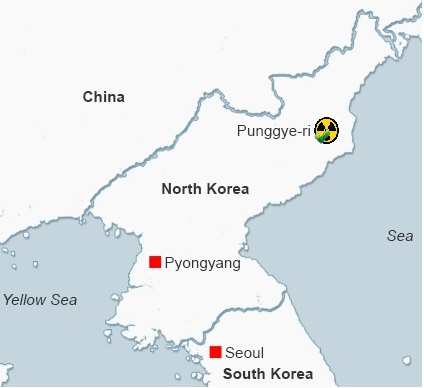 Figure: Location map of the Punggye-ri nuclear test site. Source: VOA / Wikimedia Commons
Back in 2018, Columbia University seismologist Won-Young Kim and his colleagues located 13 post-test earthquakes along a roughly 700-meter-long fault near the test site, anticipating that stress readjustments would continue. Yet the actual timeline has vastly outstripped their forecasts. Eight years on, seismic activity has not abated; rather, the event rate continues to climb.
Quakes 20 Kilometers Away: Neither Classical Mechanism Fits
What genuinely puzzles seismologists is the spatial distance. The shockwave of a nuclear detonation is a transient dynamic stress pulse that theoretically should trigger slip on neighboring faults almost instantaneously; it cannot account for persistent activity eight years later. Conversely, the permanent static stress changes induced by the blast decay sharply with distance, making it difficult to justify earthquakes occurring 20 to 30 kilometers away. Neither classical triggering mechanism fits the observations.
USGS geophysicist Walter Mooney proposed an alternative mechanism: slow-migrating subsurface fluids may play a decisive role. The detonation tore open pervasive fracture networks throughout the rock volume. Groundwater seeping along these newly formed pathways onto fault planes can act as a lubricant, reducing frictional resistance. Because fluid migration is slow, it accounts for the multi-year delay; because fluids diffuse through fracture networks, it explains the spatial reach. The authors considered this hypothesis but noted that direct empirical proof remains absent. In Mooney’s words: “The jury’s still out.”
In June 2026, seismologist Mengyi Ren and colleagues at the China Earthquake Administration reported parallel findings in Seismological Research Letters. Between 2016 and 2024, they detected 647 previously uncataloged earthquake-like events, with monthly counts surpassing 30 during several months in 2021 and 2022. However, discrepancies exist between the two investigations: Ren’s team observed seismicity migrating back toward the test site, whereas the latest Science study identified no clear spatial migration. While both studies confirm enduring activity, they diverge on key kinematic details.
Disturbing the Earth’s Crust: A Bill Far Longer Than the Textbooks Describe
Precedents for human-induced seismicity are abundant: wastewater injection, mining, reservoir impoundment, and geothermal energy exploitation have all been shown to trigger fault slip. Kwang-Hee Kim himself linked South Korea’s 2017 magnitude 5.5 Pohang earthquake to hydraulic stimulation at an enhanced geothermal project, which reactivated a critically stressed pre-existing fault. Mount Mantap, he noted, demonstrates that an entirely different form of anthropogenic perturbation — underground nuclear explosions — can also leave an exceptionally long seismic legacy.
What distinguishes Punggye-ri is its extraordinary temporal footprint: the nuclear tests appear to have set off continuous fault ruptures across an already stressed crust for over eight years, accelerating through 2025. That timescale fundamentally diverges from textbook models of Omori-type aftershock decay. As Kwang-Hee Kim remarked: “There are so many things that I cannot explain,” adding, “This is completely different from our expectation or textbook cases,” and “Normally, seismic activity decays over time.”
The seismic debt incurred by nuclear testing is proving far more protracted than anyone assumed. Its true dimensions are only visible now because detection algorithms — notably template matching — are finally sensitive enough to fish microearthquakes out of ambient noise. The ledger continues to expand, its expiration date is unknown, and even the scientists deciphering it admit they cannot foresee what is written on the pages ahead.
Reference Links:
- Science Research Paper
- Seismological Research Letters (Ren et al. Study)
- Hacker News Discussion