
Over a 24-hour span between November 4 and 5, 2026, China’s AI landscape witnessed a rare coordinated move. Tencent and Baidu announced the open-sourcing of their latest flagship foundation models back-to-back. Instead of keeping their top-tier checkpoints locked behind proprietary cloud APIs and metered token billing, both giants chose to release compute outputs worth tens of millions of dollars—effectively footing the industry’s most prohibitive bill.
Their release pipelines differ significantly. Baidu’s weights are immediately downloadable, whereas Tencent’s statement noted their weights would arrive “in the coming days.” Despite announcing on the same day, one has already shipped while the other is en route.
In large language model development, the heaviest financial burden has always centered on massive, early-stage pre-training. Instilling general linguistic and algorithmic reasoning into a foundation model requires engineering teams to cluster tens of thousands of accelerator cards for months on end. Astronomical electricity bills and hardware depreciation quickly price out small-to-midsize startups. Many ventures burn through their seed capital before ever producing a foundation model capable of general-purpose reasoning.
Two Foundation Models in 24 Hours: Turn-Key Agent vs. Raw Base Checkpoint
Facing the same compute dilemma, the two giants took opposite philosophical routes. Tencent’s Hunyuan Hy4 arrives fully loaded, featuring out-of-the-box visual reasoning and direct computer use capabilities. Baidu’s ERNIE 5.5 Flash Base, by contrast, is a blank slate: it captures the raw base model at the exact moment pre-training finished, deliberately leaving all post-training and downstream alignment untouched.
Building a modern foundation model is much like constructing a skyscraper. Pre-training drives the pilings and pours the concrete foundation, while post-training handles the interior fit and finish. Baidu candidly noted in its technical report that this release is specifically designed to spare developers the crippling cost of pre-training. Tech giants shoulder the civil engineering; downstream developers craft targeted applications. The division of labor across the ecosystem is becoming sharper.
Tencent Integrates Desktop Workflows: The 3.04 Evaluation Benchmark
Tencent’s Hy4 focuses its core advancements on multimodal inputs and professional industrial workflows. The architecture incorporates fine-grained image parsing, complex chart analysis, and visual mathematical reasoning. On the software interaction front, researchers equipped the model with direct command-line and GUI operating capabilities. It interfaces directly with desktop displays, keyboards, and mice, orchestrating sequential operations across disparate software environments.
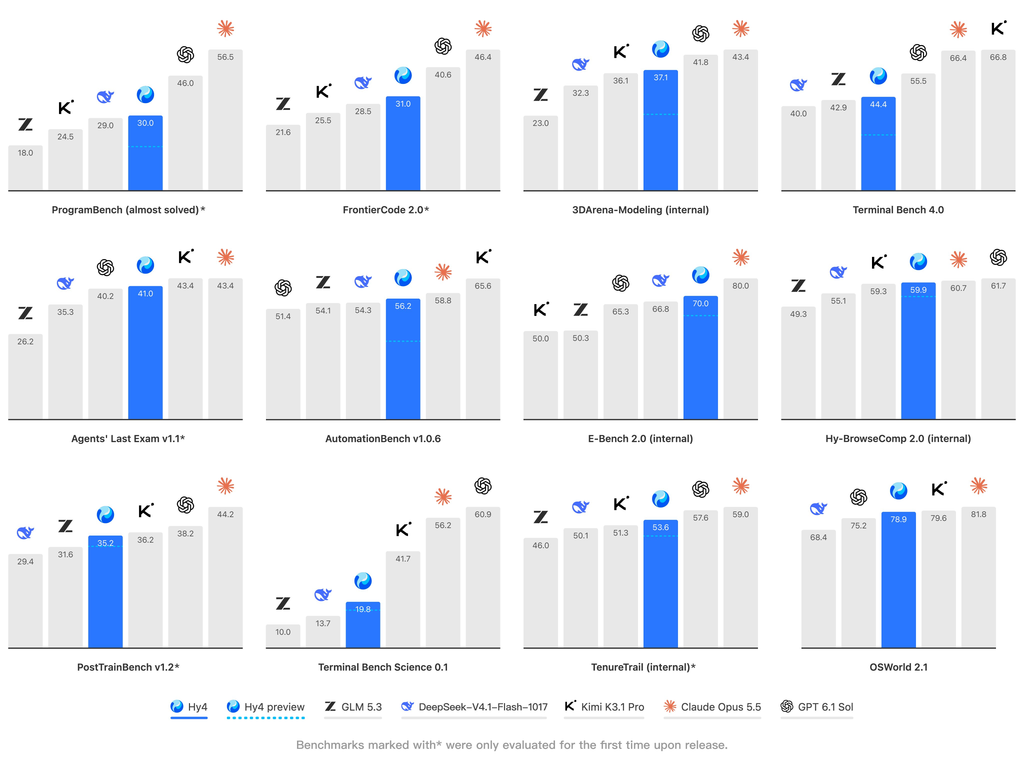 Figure: Tencent demonstrates Hy4’s execution pipeline across visual comprehension and complex engineering CAD workflows. Source: tencent.com
The engineering team focused extensive training on professional software suites such as Blender and CAD. On the WorkBuddy desktop automation benchmark, Hy4 posted an average score of 83.18, leading 9 out of 12 workflow scenarios. Interaction telemetry from production-grade software stabilized the model’s spatial reasoning chain across multi-step execution paths. In unforgiving industrial runtime environments, strict exception handling forces the agent to keep error rates low throughout long-horizon tasks.
The official financial benchmark evaluation also drew attention. Conducted with 213 financial professionals across 579 real-world tasks, Hy4 scored an aggregate 3.04, edging out DeepSeek-V4.1-Flash-1017 (2.97) and widening the gap against Kimi K3.1 Pro and GLM-5.3 (both at 2.68). On the iRaB investment research benchmark, it improved by 12.03 percentage points over its preview release. Its unsupported assumption error rate dropped from 23.1% to 5.6%, while its overall hallucination rate was reined in to 7.2%.
These benchmark figures warrant a measured perspective. The evaluation was co-organized by Tencent’s Hunyuan team and internal fintech divisions, despite including 153 external industry evaluators. When a provider designs the benchmark and claims the top spot, the metrics carry inherent caveats. The true endurance and robustness of the model will depend on independent verification by third-party developers on demanding production workloads.
Baidu Redesigns 43-Layer Attention: Making 33.5 Trillion Tokens Count
In stark contrast to Tencent’s integrated product philosophy, Baidu’s ERNIE 5.5 Flash Base positions itself as a pure foundation checkpoint, free of downstream fine-tuning. The model features 280 billion total parameters while activating only 14 billion parameters per token. Baidu invested 33.5 trillion tokens to train the checkpoint from scratch, establishing a turnkey starting line for the open-source community.
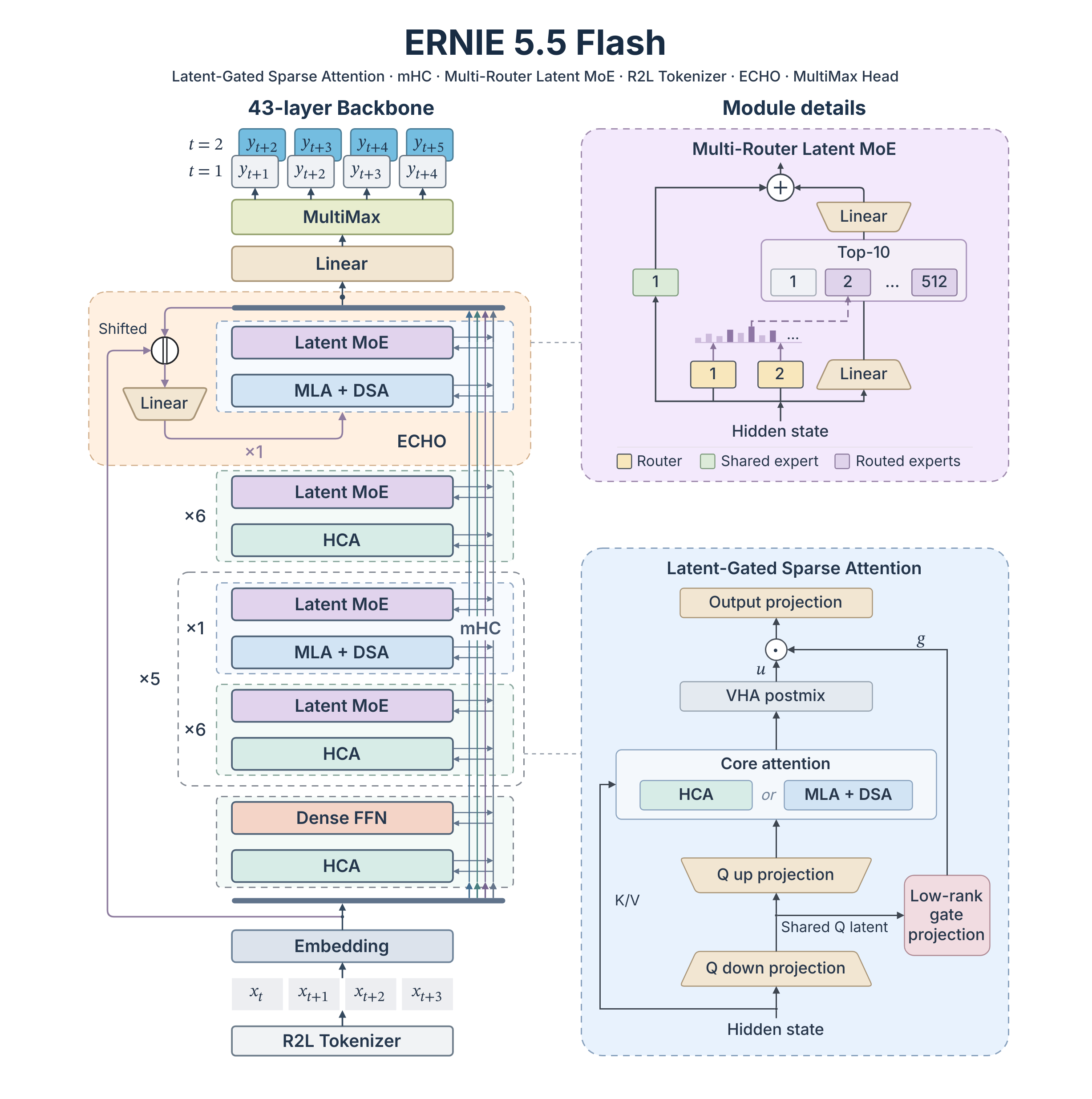 Figure: Structural breakdown of ERNIE 5.5 Flash, highlighting its 43-layer backbone and hybrid sparse attention mechanics. Source: ernie.baidu.com
The brilliance of this architecture lies in aggressive memory optimization for long-context inference. In conventional 43-layer transformer backbones, every layer maintains a full Key-Value cache across the entire context window. Baidu adopted a tiered ratio: out of every 7 consecutive layers, only 1 layer preserves full dense attention, while the remaining 6 layers compress every 128 tokens into a single feature representation.
The VRAM saved by the compressed layers is reallocated to critical full-attention layers. The cheaper compressed layers adopt wide 512-dimension heads, while the expensive full-attention layers rely on compact 256-dimension heads. Concentrating KV cache memory budgets exclusively on core layers delivers superior throughput compared to standard sparse attention designs. This low-level structural overhaul ensures smooth, stable execution across 1-million-token context windows.
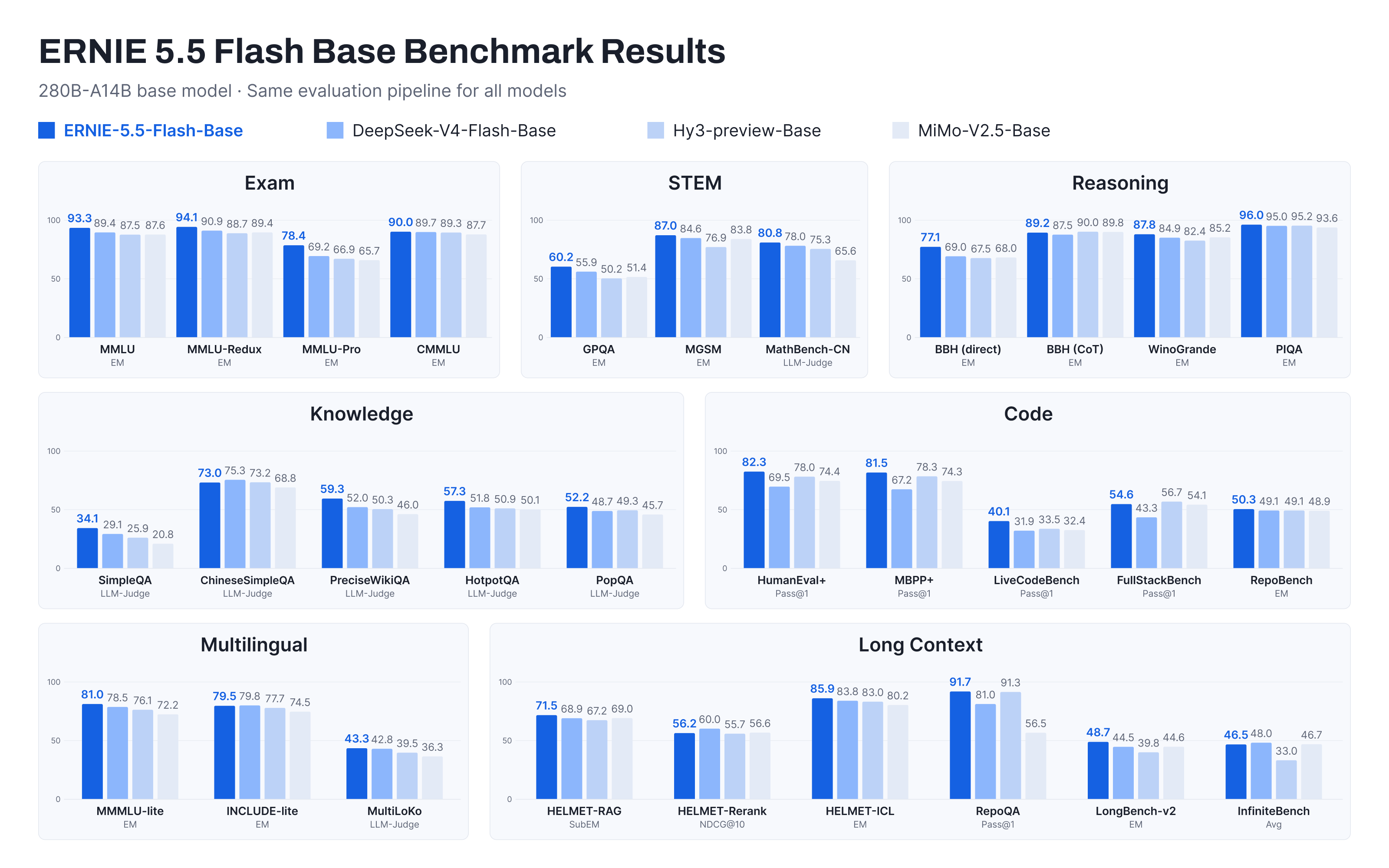 Figure: Side-by-side performance benchmarks comparing ERNIE 5.5 Flash Base with models such as DeepSeek V4 Flash. Source: ernie.baidu.com
In data curation, Baidu applied an “irreversible priority” rule, heavily biasing pre-training corpora toward repository-level codebases and rigorous long-form technical reasoning. Without native cross-file comprehension baked into the weights, downstream fine-tuning can rarely patch the deficit. Putting the most compute-heavy labor into the foundational phase reflects the true value of an open base model.
Reclaiming Pre-Training as Infrastructure: Saving Startups Millions in Compute
Across the life cycle of large language models, pre-training is the single most capital-intensive and irrevocable phase. It is the heavy-machinery sector of machine learning, where financial risks run highest. Pre-training a 30-trillion-token architecture from scratch requires tens of millions of dollars in upfront capital even with optimal hardware allocations. Should the run encounter loss divergence or hardware node failures, millions in electricity transform instantly into wasted datacenter heat.
A recent discussion in the developer community reinforces the weight of these compute invoices. The open-source image generation project Pjit-21K detailed a modest $20,000 budget run. Even for lightweight exploratory validation, upfront compute drains an indie developer’s runway almost overnight. By taking the initiative to release high-caliber foundation weights, tech giants eliminate the need for downstream teams to reinvent the base model.
Redirecting compute expenditure is fundamentally restructuring developer resource allocation. Relieved of multi-million-dollar foundation costs, teams can concentrate limited capital on domain-specific execution. Whether fine-tuning for specialized industrial pipelines or engineering complex multi-step tool use, return on investment timelines shrink dramatically. As tech giants build out the roads and bridges, domain verticals can focus on deep deployment, solidifying industry specialization.
Beyond the Compute Subsidy: The Battleground Moves to Domain Deep Waters
The simultaneous releases by Tencent and Baidu illustrate a broader trend in machine learning industrialization. As parameter scales pass the hundred-billion threshold, general linguistic reasoning has evolved into a public utility. Centralizing the upfront compute burden within tech giants equipped with massive hardware reserves dramatically curtails duplicate waste across the industry. The era of fragmented, redundant base model burn rates is drawing to a close.
Tencent presented a turn-key solution; Baidu delivered a bare-metal scaffold. Both strategies accelerate a profound shift in how AI engineering is divided. The most expensive hurdle—foundation pre-training—has been internalized as public infrastructure. With the largest invoice settled, the decisive battle now moves to real-world industrial implementation.
References:
- Tencent Hunyuan Hy4 Official Announcement & System Technical Report
- Baidu ERNIE 5.5 Flash Base Architecture Technical Report
- Hacker News Community Discussions (Pjit-21K Training Costs & Open Weights)