This year, Apple officially dropped all x86 architecture code with the release of macOS 27. On paper, the twenty-year-old Hackintosh tradition had just received its death sentence. Yet within less than a month, the tightly locked-down operating system booted up on third-party hardware once again. Qualcomm Snapdragon laptops and Nintendo Switch handhelds were both forcefully made to run Apple’s OS by determined tinkerers.
Apple Cut the Legacy Architecture, Building a Five-Year Hardware Moat
Apple spent five years carefully constructing this hardware wall. Back in 2021 when the M1 chip debuted, Intel was stuck at 14nm. Apple took that opening to transition its entire computer lineup to in-house Apple Silicon ARM designs. Superior battery life and thermal efficiency won the market—and seamlessly bound the software ecosystem directly to Apple’s own assembly lines.
Once the official system stopped leaving backdoors for generic processors, non-Apple hardware could no longer boot. Over the past decade, enthusiasts could still run macOS inside virtual machines with PCI passthrough on standard PCs, utilizing dedicated GPUs at near-native speeds. But when macOS 27 excised legacy architectures entirely, the foundation for that workaround collapsed. Open-source bootloaders maintained by the community for years became virtually obsolete overnight.
The logic behind this lockdown was blunt and ruthless. Apple controls every layer from silicon to kernel, methodically squeezing out third-party hardware. As long as hardware interfaces remain proprietary and undocumented, outsiders have no way to decipher hardware specifications. For ordinary users eager to run the latest OS, buying genuine Apple hardware seemed like the only remaining route.
Two Decades of Porting Ground to a Halt at Human Limits
Getting a proprietary operating system to run on unfamiliar silicon requires monumental engineering effort. Teams must decompile the kernel line by line. They have to map proprietary Apple driver protocols onto generic motherboards. Engineers are forced to navigate undocumented binary mazes, hunting down and manually patching hundreds of runtime errors.
Such punishing technical barriers confined the entire ecosystem to the spare time of a handful of elite specialists. The group capable of writing kernel extensions has always been tiny. With every major macOS upgrade, these developers spent months reverse-engineering register traces. Faced with the sprawling bespoke interfaces of proprietary chips, manual porting quickly hit an insurmountable ceiling.
Without official chip datasheets, fragmented hobbyist contributions could never keep pace with corporate lockdown schedules. Adapting a single peripheral driver could burn months of engineer time just to achieve basic responsiveness. When low-level maintenance depends entirely on raw human stamina, ecosystem collapse is only a matter of time.
The community had fallen quiet on the eve of macOS 27’s launch. Mobile ARM hardware lacked unified bus standards, with fragmented system topologies across manufacturers. Every SoC’s GPU core demanded custom drivers from scratch. Hobbyist goodwill alone could no longer bridge this massive engineering gulf.
Zero Lines Written: An Aging Laptop Runs New Apps in One Day
The stalemate finally broke during an impromptu experiment. Yoon, an experienced developer, needed to build a mobile application but didn’t have a modern Mac on hand. He dusted off an idle ThinkPad T490 running an older OS release. Powered by an early Intel CPU, the machine traditionally required extensive manual patching to configure hardware compatibility.
Apple had deeply integrated Claude Code and Codex into Xcode 26. Turning to these models to diagnose compatibility build errors, Yoon watched the AI generate functional patch scripts within seconds. Without manually authoring a single line of code, he had the entire workflow running within twenty-four hours.
That single day of tinkering opened up unexpected possibilities. Large language models demonstrated remarkable reasoning speed when parsing low-level system crashes. Symbol conflicts that once took specialists weeks to unravel could now be patched in minutes. Developers no longer needed to master every register detail before deploying algorithms to clear porting hurdles.
Once compilation succeeded, deeper reverse-engineering efforts followed a similar cadence. Decompiling machine instructions no longer required grueling manual inspection. Given rich contextual cues, models could perform high-level pattern matching across architectures. Algorithms formed an automated bridge connecting known working drivers to obscure error logs.
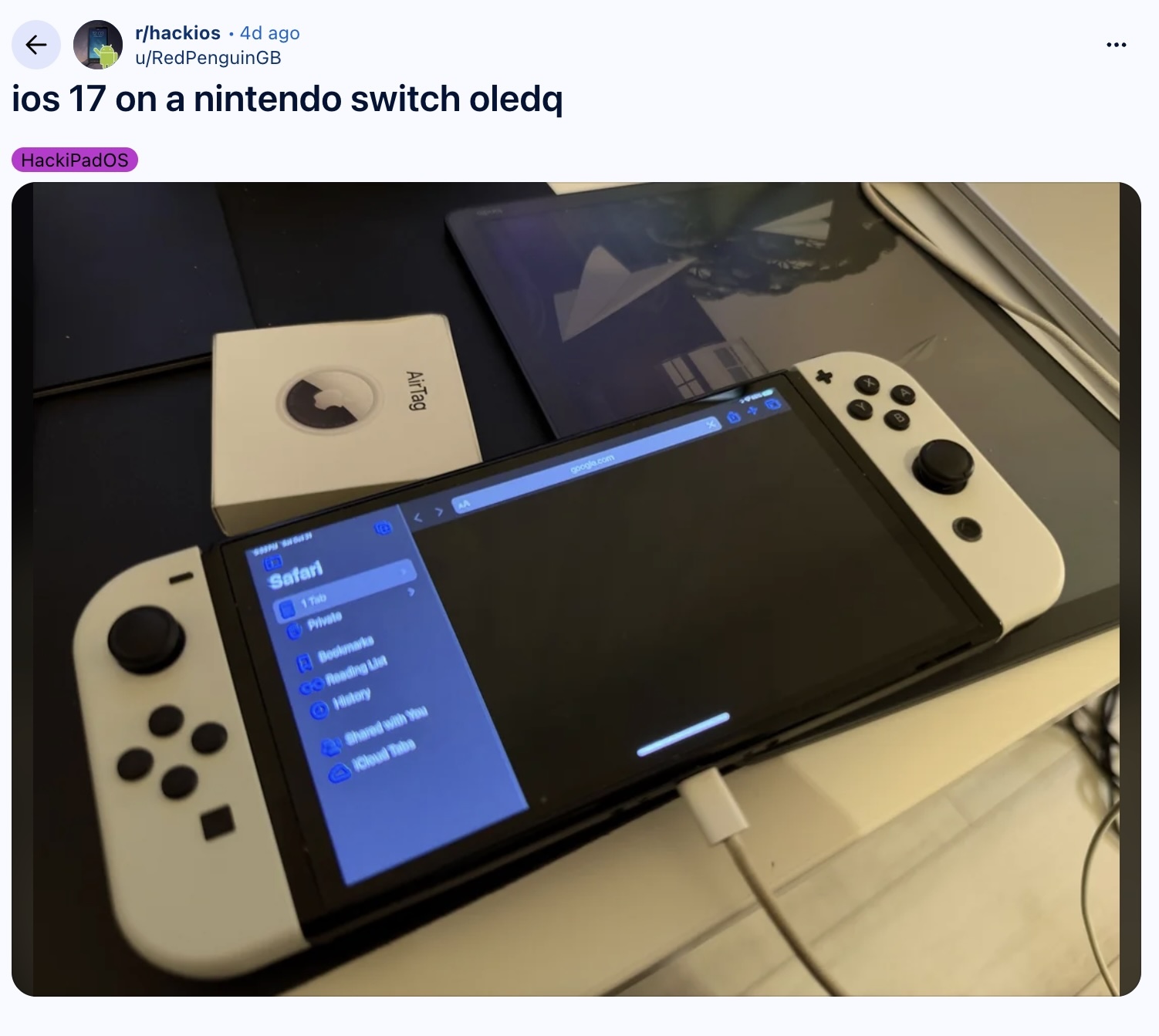 Figure: macOS 27.2 Beta running on an RK3588 ARM board with custom Mali drivers. Source: naut.ca
Reverse Engineering Meets LLMs: Handhelds Boot Apple OS in Weeks
What began as an isolated breakthrough swiftly turned into a collective community surge. Developers chained the reverse-engineering framework Ghidra directly into Claude Code pipelines. The tedious chore of manual disassembly analysis transformed into automated patch pipelines that spit out hardware drivers on demand. The community aptly described the workflow as software engineering on steroids.
The results delivered over the following weeks shattered industry assumptions. macOS 27 was successfully booted on lightweight Qualcomm Snapdragon laptops. The latest macOS 27.2 beta went a step further, running directly on RK3588 development boards. Even the Nvidia-powered Nintendo Switch was coaxed into booting iOS 17.
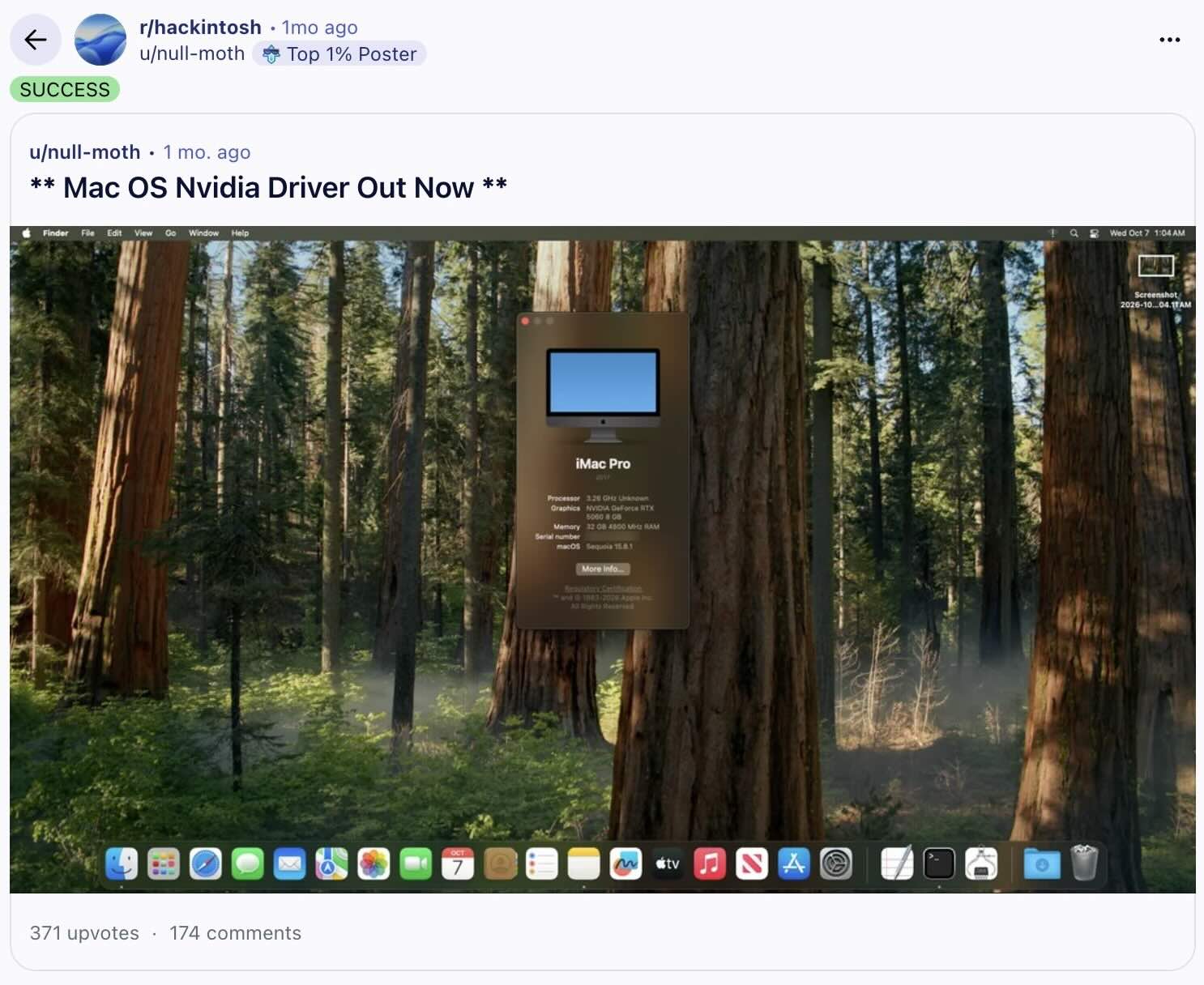 Figure: iOS 17 running on a Nintendo Switch OLED. Source: naut.ca
Hardware compatibility expanded at a blistering pace. Leveraging the open-source nullmoth project, Nvidia 50-series graphics cards achieved native OS-level acceleration for the first time. Proprietary protocols like AirDrop and hardware-accelerated video decode were methodically unlocked with algorithmic assistance. The technical cliff erected by a trillion-dollar corporation is being systematically leveled by low-friction reverse-engineering pipelines.
Driver adaptations that previously demanded months of grueling labor have collapsed into a few iterative prompt exchanges. The model breaks down register mappings of target silicon, cross-references open-source driver implementations, and synthesizes missing kernel routines. Proprietary graphics interfaces are peeled open layer by layer through relentless algorithmic deduction.
When Porting Costs Collapse, Hardware Ownership Returns to Users
This wave of revival exposes a fundamental reality: OS porting has always been an economic equation. Historically, the obstacle preventing alternative hardware adoption was the sheer labor cost of driver translation. When AI drives reverse-engineering costs toward zero, proprietary hardware defenses lose their holding power.
Apple attempted to consolidate control by phasing out legacy architectures, pushing consumers to swallow steep hardware premiums. But reverse-engineering models have rewritten the rules of this cat-and-mouse game. What reached its demise was not the Hackintosh, but the manual cottage-industry workflow that supported it. Facing rapidly iterating automated code generation, proprietary moats are showing undeniable fractures.
Critics have long questioned the enormous energy and compute poured into training frontier LLMs. The resurrection of Apple’s locked-down operating systems on rogue silicon offers an unmistakable rejoinder. Once low-level kernel reverse engineering becomes an accessible commodity, artificial hardware locks cannot hold. The physical hardware you paid for will ultimately belong to you.
References:
- naut.ca: Yoon’s technical blog
- Hacker News community discussions