
A Toy That Shatters the Price Floor
On August 26, 2026, Pollen Robotics released Microduck, a bipedal robot priced at just $399. This pricing directly shatters the industry floor of tens of thousands of dollars. It demonstrates that open-source momentum is transforming bipedal robots from expensive lab exhibits into accessible consumer hardware. With a budget equivalent to a basic smartphone, developers can now acquire a physical bipedal platform with full dynamic response.
For a long time, the bipedal robotics field has been dominated by million-dollar machines from giants like Boston Dynamics. These traditional “aristocrats” rely on extremely expensive precision motors, harmonic reducers, and high-precision LiDAR sensors. Microduck’s ability to compress the price to $399 relies on a dimensionality reduction strategy of “wrestling in the digital world first.” This strategy transforms the high costs of physical damage into cheap GPU computational resource consumption.
The Life-and-Death Arena in the Simulator
Microduck’s core trump card is its extremely thorough sim2real (simulation-to-reality) pipeline. It is a robotic duck born in the MuJoCo simulator. The research and development team put it through tens of thousands of falls and recoveries in a virtual environment, continuously using reinforcement learning for trial and error. This shows that the cost of algorithmic iteration is now far lower than hardware trial and error, and computational power is rapidly replacing the tolerance requirements of precision machinery.
This little duck has already mastered sitting, standing, walking, and even kicking a ball and recovering from a fall. Even roller skating, which requires extreme balance, and complex fine grasping can be directly previewed and debugged in a browser-based simulator. Its deep collaboration with Hugging Face further confirms the AI community’s high expectations for this low-cost route. The open-source community is completely restructuring the once-insurmountable moat of hardware development with a software-defined mindset.
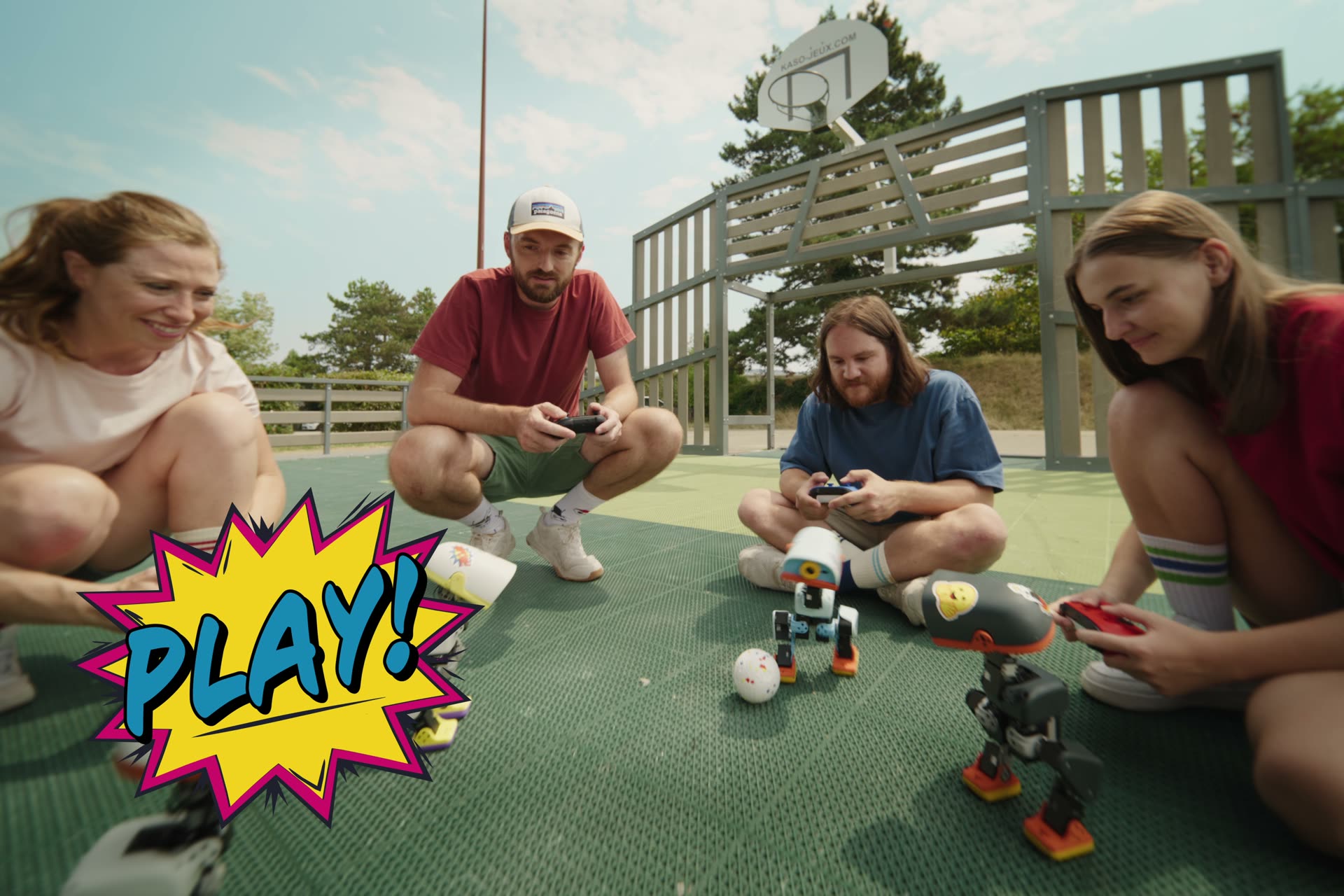 Image: Microduck Product Key Visual. Source: Pollen Robotics Official Website
The Chaotic Test of the Real World
Bringing the price down is only winning the first round. Robots in laboratories face flat floors and preset obstacles, whereas consumer robots deal with randomly scattered Lego bricks, tangled charging cables, and pets that might charge at any moment. This is Microduck’s true life-and-death battlefield. The long-tail edge cases of the real physical world are far more complex and fatal than parameter jitters in a simulator.
When this $399 robotic duck enters a home, it must cope with friction that cannot be perfectly modeled and unexpected physical collisions. In a simulator, gravity fields and collision volumes are flawless mathematical formulas, but on a living room carpet, the resistance of every single fiber challenges the generalization boundaries of reinforcement learning models. Paradoxically, the low-cost physical hardware has become the most rigorous test paper for cutting-edge algorithms.
 Image: User interaction scene with Microduck. Source: Pollen Robotics Official Website
The Chain Reaction of Hardware Open Source
Currently, Pollen Robotics has open-sourced all hardware designs, firmware, and training code. This completely open approach can vastly accelerate the robotic duck’s evolutionary speed in the real world. The real physical test data from countless developers in their self-built environments will continuously feed back into the robustness of the entire simulation system. Once this data flywheel starts spinning, the defense lines built by closed-source manufacturers through hardware stacking will rapidly collapse.
Open-source hardware inevitably faces the risks of inconsistent quality control and an extremely high early failure rate. Different developers using 3D-printed parts of different materials will introduce completely different physical rigidities and deformations, which in turn affect the execution effectiveness of pre-trained algorithm policies. The author observes that some in the community believe this low-priced toy will quickly gather dust due to frequent breakage, while others firmly believe it is the “Apple moment” for home robots—an unavoidable growing pain on the path to popularization.
The Final Step Toward the Singularity
With a $399 entry ticket, Microduck pushes bipedal robots into the vast scenario of home environments. This proves that the core of competition in the robotics industry has shifted, and the battle of algorithms and data has completely replaced the capital stacking of expensive hardware. The singularity for consumer robots will only arrive when algorithms trained in simulations can truly handle a messy, real-world living room. The author’s analysis above is based on the limited information available at this stage; how the technology will ultimately evolve still requires brutal long-term testing by the market.
Reference Links:
- Pollen Robotics Official Website
- GitHub Open Source Repository
- Hugging Face Community Discussions\n


