An email claiming to come from a Singapore venture capital fund, an interviewer with a German accent who refused to turn on his camera citing “traveling,” and an unassuming TypeScript coding assignment. This was the opening salvo in a coordinated kill chain targeting maintainers of premier open-source projects.
On September 17, 2026, the official Rust security team issued an urgent advisory: malicious actors are leveraging fake job opportunities combined with video interviews as an entry vector, specifically hunting core rust-lang team members and maintainers of high-download crates (Rust’s package unit). The attackers are not looking to spend months discovering zero-day vulnerabilities. Instead, they aim to seize direct control of developer machines through social engineering, enabling them to publish malicious releases directly to the official package registry.
Video Calls Used to Hijack Package Publishing Rights
Targeting individual developers via social engineering is dramatically more cost-effective than attempting to brute-force corporate firewalls. The attackers first dangle an enticing hook—either a lucrative full-time job offer or a highly paid advisory contract. To lend the scam credibility, they craft professional-looking corporate websites and fabricate detailed LinkedIn profiles boasting impressive credentials.
Once the developer takes the bait and joins the video call, the real attack unfolds mid-conversation. The interviewer concocts an excuse requiring the target to install software locally. They might claim the conferencing app lacks a specific audio codec and send an installer disguised as a plugin. Alternatively, they display simulated connection errors over screen share and prompt the victim to execute an arbitrary command in their terminal. According to the Rust security team, several prominent Rust developers were targeted using similar techniques as early as June. Just last month, arrayref—a foundational low-level crate with massive download numbers—was briefly poisoned through similar means. When a low-level dependency like this is backdoored, downstream enterprises are silently compromised during routine automated builds.
The Rust team stated explicitly that the sophistication of these targeted campaigns links them to threat actors affiliated with the Democratic People’s Republic of Korea (DPRK). An enterprise-grade transnational deception apparatus—complete with fake websites, customer service channels, and custom tooling—was mobilized against individual programmers. The open-source ecosystem’s single point of failure has shifted from server infrastructure to the identity of defenseless maintainers themselves.
A 1.68 MB Remote Access Trojan Hidden in Image Footers
Developer Matt Mastracci (grack.com) published a detailed account of how he narrowly avoided becoming a victim. He received an email invitation from a firm claiming to be “Lua Ventures,” an actual DeFi VC that had quietly ceased operations. The attackers provided a repository for a ferry-ticketing application named “Ticket Harbor” and requested that he run static checks and build commands.
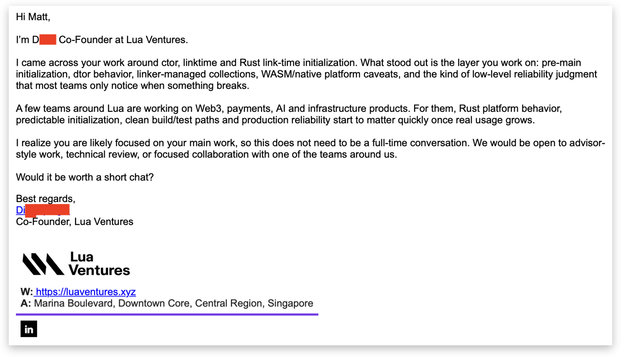 Image: The initial phishing email sent by the attacker. Source: grack.com, “Anatomy of a Failed (Nation-State?) Attack”
On the surface, the repository appeared to be a standard TypeScript project, but hidden within were four deceptive postinstall hooks. One of these hooks silently executed git update-index --skip-worktree. This command forced Git to ignore local modifications to specific files, ensuring that even if the developer ran git status in their terminal, the altered patch files remained entirely invisible.
The actual malicious payload was tucked away inside a patch file named typescript+5.9.2.patch. It injected an obfuscated script right at the top of the compiler’s primary files. This script deliberately avoided standard eval calls, relying instead on new Function(...) to dynamically instantiate execution logic in memory and bypass signature-based antivirus scanning.
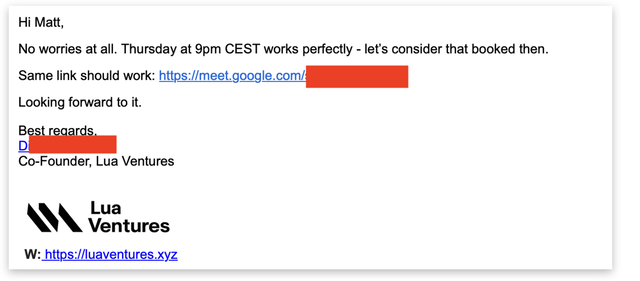 Image: Follow-up email presenting the “test assignment” invitation. Source: grack.com
Standard image parsers stop reading when they reach the end-of-file marker. But this loader script jumped directly past the end of operators/3.png, extracting an appended data block to execute an embedded WebAssembly stub. This stub then spawned a detached, silent Node process that injected a 1.68 MB second-stage payload into the victim’s operating system. When malware can orchestrate its relay through benign static images and raw memory buffers, traditional static analysis mechanisms fail instantly.
A Three-Tier Erasure Mechanism Leaves Zero Forensic Trails
Dubbed “PinpinRAT,” this remote-access trojan displayed rigorous operational discipline throughout its persistence and execution phases.
Upon launch, the trojan immediately generated an RSA-2048 keypair locally along with a random AES-256 session key. All subsequent command-and-control communications were encrypted using AES-256-CBC, authenticated with an HMAC-SHA256 integrity tag. Network monitoring appliances captured only high-entropy noise, leaving enterprise firewalls completely unable to inspect the outbound command stream.
The trojan came fully equipped for total host takeover. It could harvest and exfiltrate all system environment variables in a single sweep—where cloud credentials and package registry tokens typically reside. It supported arbitrary file reads and writes, system process spawning, and DNS query tunneling to bypass restricted corporate networks by encapsulating encrypted payloads inside DNS lookups.
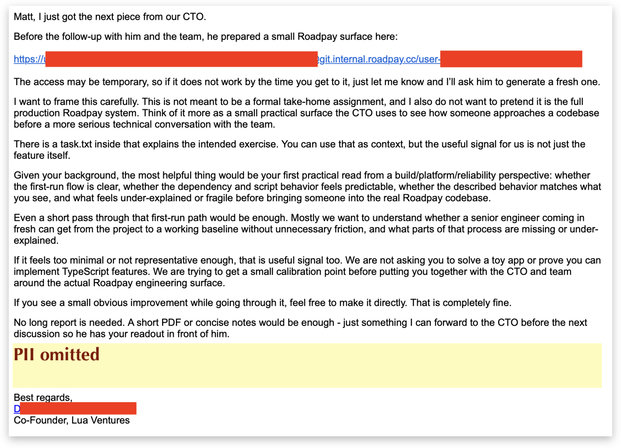 Image: The bait repository and test task description. Source: grack.com
On Windows, PinpinRAT established persistence by registering a hidden scheduled task. On macOS, it disguised itself as a core system networking process (com.apple.WebKit.Networking).
Most alarming of all was its self-cleaning mechanism. The attack chain systematically erased its tracks across three distinct layers: the Git skip-worktree concealment was merely step one. Upon initial execution, the dropper rewrote the patch files to strip out the injected malware. Once the second-stage payload executed from the temporary directory, it triggered a local self-destruction routine. After breaching primary perimeter defenses, this trojan was designed to maintain persistent access on the victim’s machine, transforming it into a staging ground for ongoing software supply-chain poisoning.
How AI Inadvertently Uncovered the Fake Interview
Faced with this intricately layered trap, the author of grack.com escaped compromise largely through instinctive skepticism and a stroke of luck.
He felt the role—architectural evaluation—did not logically align with such an elementary repository. Exercising caution, he refrained from executing build commands locally. Instead, he zipped up the codebase and ran it through Claude for a quick audit. Claude quickly flagged an anomaly: the root configuration defined no lifecycle scripts, yet the repository relied on patch-package to apply modifications. Tracing that discrepancy led directly to the sophisticated trojan hidden inside the patch directory.
Reflecting on the incident afterward, the author noted a chilling realization: had the attackers buried the payload inside a routine build.rs script—executed automatically during any Rust build—he almost certainly would have been infected.
A post-mortem analysis revealed numerous red flags throughout the interaction. The initial outreach bore subtle markers of structured LLM generation. While the interviewer’s LinkedIn profile appeared extensive, it consisted entirely of vacuous titles devoid of substantive industry contributions. The affiliated social media account had an authentic history, but its display name had been changed as recently as November 2025. None of the referenced portfolio companies maintained a genuine online footprint beyond superficial landing pages.
The interview logistics were equally suspicious. Reputable venture capital firms do not simply drop a meeting time and link without sending a calendar invite. The interviewer adamantly kept his camera off throughout the call. Furthermore, geographic markers were scattered across incongruous jurisdictions: a Singapore fund, personnel operating in European time zones, a candidate based in Canada, and an outreach campaign referencing American clients from websites registered with .cc top-level domains. The wider attackers scatter their identity anchors and physical coordinates, the harder it is for targets to verify discrepancies.
Spare-Time Maintainers Cannot Withstand Nation-State Cyberwarfare
At the conclusion of the security audit, the image file harboring the malicious payload still failed to trigger a single detection flag across mainstream antivirus engines on VirusTotal.
The remediation advice provided in the official Rust security alert remains inherently limited: maintainers are urged to remain skeptical of unsolicited outreach, initiate their own video calls, enforce multi-factor authentication, and monitor historical login sessions.
Yet relying solely on individual vigilance creates a severely asymmetrical defensive posture. Launching an attack costs little more than a fabricated CV and an hour on a video call, but the prize is access to hundreds of millions of downstream machines. For maintainers volunteering their free time to support critical software ecosystems, a single errant click can result in complete host compromise. The publishing keys in their possession have become vastly more valuable than the code repositories themselves. A digital world built on the goodwill of open-source hobbyists is now directly confronting the industrialized, sustained infiltration campaigns of nation-state threat actors.
References:
- Targeted attacks on rust-lang members and crate authors
- Dissecting a failed nation-state attack
- Supply-chain attack on arrayref