
A German military radio cipher transmitted on November 27, 1918, spent over a century resting quietly on the famous list of the “Top 50 Unsolved Encrypted Messages” maintained by scienceblogs.de. Sharing that catalog were some of history’s most notorious cryptographic enigmas, from the cryptograms of the Zodiac Killer to the indecipherable Voynich manuscript. A few days ago, this century-old mystery—one that had defeated generations of codebreaking experts—was broken cleanly by GPT-6 Astra, an AI model that has never laid hands on a telegraph key.
On Hacker News, the breakthrough quickly garnered 349 points and 160 in-depth technical comments, with an additional 11 upvotes on Lobsters. For large language models, cryptography represents an uncompromising, zero-hallucination benchmark. The model cannot disguise shortcomings behind plausible prose; its output must reconstruct historical ground truth strictly within the rigid boundaries of mathematical cipher structure.
Six Letters to Defeat Noise: The Physical Constraint of ADFGVX
Introduced during the final year of World War I, the German ADFGVX cipher was remarkably disciplined in its architectural design. Instead of utilizing the full Latin alphabet, the cipher restricted its transmitted vocabulary to just six letters: A, D, F, G, V, and X. In Morse code, these six characters were chosen specifically because their dot-dash acoustic patterns are widely separated and exceptionally distinct, minimizing transcription errors for exhausted radio operators amid deafening artillery fire. From a systems engineering perspective, this was the early 20th-century equivalent of bypassing fragile wideband links in favor of low-bandwidth, high-fault-tolerant baseband signals, systematically filtering out transmission noise at the physical layer.
The core of the system was a 6×6 Polybius grid. Its 36 cells accommodated the 26 letters of the alphabet alongside the 10 Arabic numerals (0–9). A sender used a pre-arranged secret keyword to shuffle the layout of plaintext characters within the grid. To encrypt, the sender mapped each original character to a two-letter coordinate pair based on row and column letters.
Using the word “HOUSE” as an illustrative key, the cell at row A and column A might map to the letter H, row A and column D to O, and row D and column A to B. Under such a grid, a word like “PRINZ” would be converted into an initial coordinate stream such as FX GD DX FV VD. This two-dimensional coordinate mapping acted as a dynamic cryptographic hash at the application layer: altering a single configuration parameter downstream produced an avalanche of divergence in the resulting ciphertext.
Over the ensuing century, human cryptanalysts equipped with statistical heuristics and mathematical intuition gradually dismantled hundreds of similar German radio messages. Renowned codebreaker George Lasry successfully deciphered several entries from the scienceblogs.de roster during his career. Yet roughly a dozen short intercepted messages remained impenetrable black boxes, stubbornly defying conventional reverse engineering.
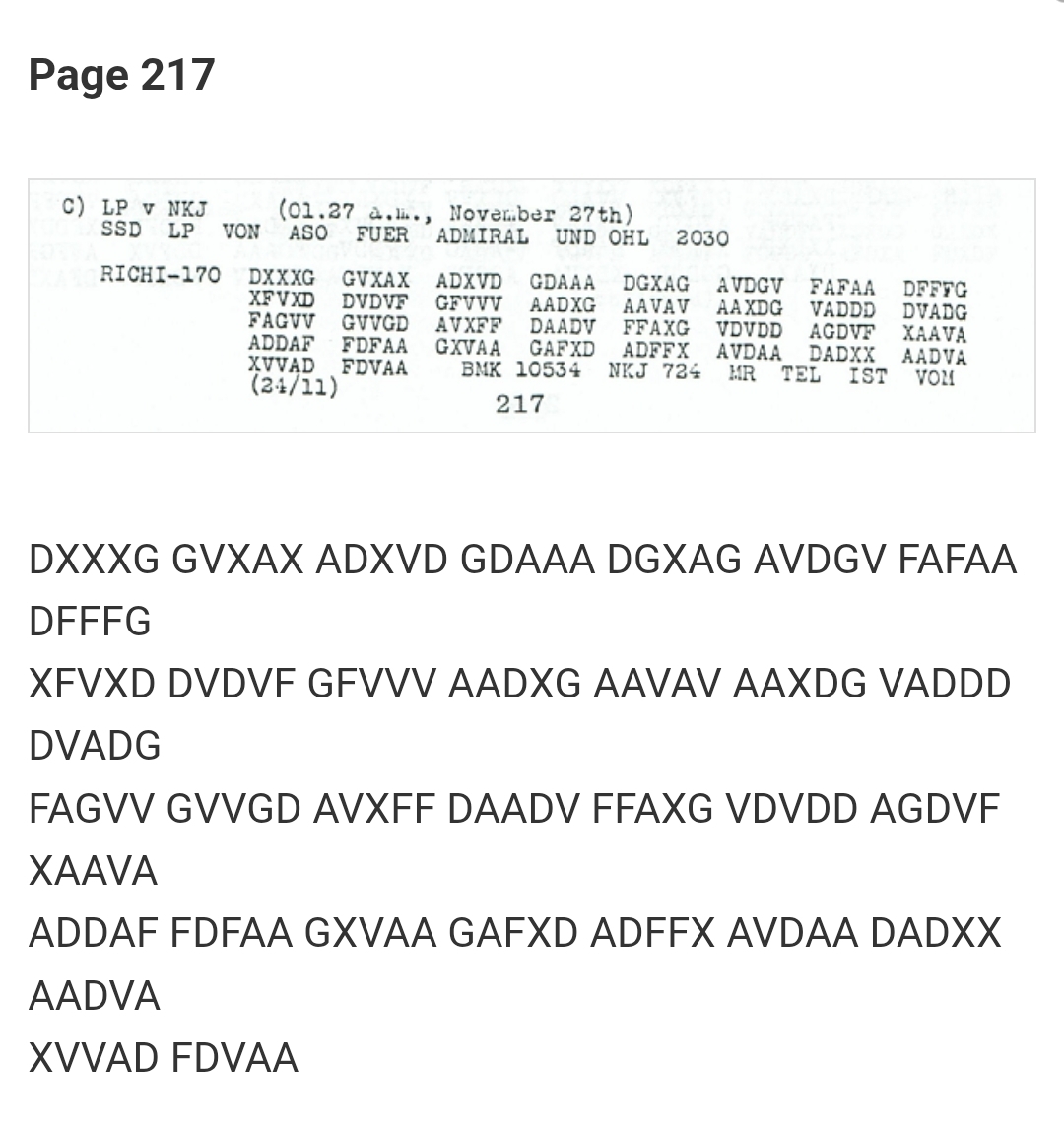 Figure: The unsolved German radio telegram from November 27, 1918. Source: prinz / Klausis Krypto Kolumne
Slicing an Asymmetric 170-Character Matrix: Compute Over Classical Cryptanalysis
When presented with this deadlock message composed of exactly 170 symbols, Astra extracted the German word TRUPPENVERSCHIEBUNG as the candidate encryption key. This 19-letter word—meaning “troop movement”—was meticulously documented on pages 214–215 of J. Rives Childs’s foundational work, The History and Principles of German Military Ciphers, 1914–1918. In ADFGVX, coordinate substitution was only the preliminary stage; it was immediately followed by a columnar transposition governed by the keyword. To begin decryption, Astra needed to arrange the letters of this keyword in alphabetical order.
Within this 19-character key, T ranks 16th alphabetically, while R ranks 13th. This lexicographical reordering operated essentially like an out-of-order scheduling mechanism prior to data write, effectively severing the continuous n-gram frequency correlations that an attacker would otherwise exploit for brute-force frequency analysis.
Writing the keyword horizontally, the model populated the 170 ciphertext symbols across a 19-column grid row by row. This produced 8 full rows of 19 symbols each, followed by a final row containing 18 symbols. After column transposition, 18 of the columns held exactly 9 symbols, while column “G” alone held only 8 symbols.
The core computational hurdle lay in determining the precise data offset for each transposed column. Consider the letter T: ranked 16th in alphabetical sequence, it was preceded by 14 full columns of 9 symbols and the single short column of 8 symbols (column G).
Calculating (9 × 14) + (1 × 8) = 134, the column segment governed by letter T began at exactly the 135th symbol of the ciphertext array. For modern software systems, slicing into such an asymmetric matrix is equivalent to calculating exact memory page offsets—a discrepancy of even a single bit triggers a segmentation fault in the decryption stack.
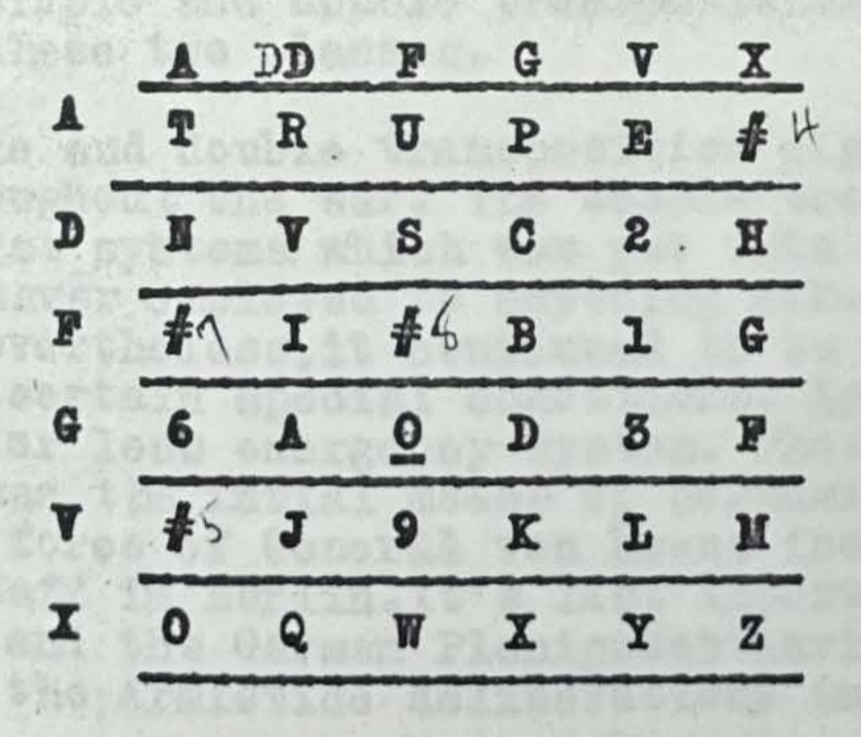 Figure: ADFGVX grid generated with the key TRUPPENVERSCHIEBUNG. Source: prinz
Through rigorous mathematical reconstruction, Astra assembled the permutation matrix and deciphered the concealed German plaintext: EIN ENGLISCHER KREUZER EINLIEG X SEWASTOPOL X S4STEN X EIN GESCHWADER DER X ALLIIERTEN FOLGT 26STEN X. Translated into English, the dispatch read: AN ENGLISH CRUISER ARRIVED AT SEVASTOPOL ON THE ?4TH AN ALLIED SQUADRON FOLLOWS ON THE 26TH. The message confirmed that German forces were reporting the arrival of an English cruiser in Sevastopol, with an Allied squadron scheduled to follow on the 26th (with only the tens digit of the cruiser’s arrival date uncertain, though Royal Navy logs of HMS Canterbury later verified it was the 24th). A hundred-year cold case collapsed inside the forward pass of a multi-layer neural network into an unconstrained pattern-matching convergence, erasing years of human brute-force logic in a matter of compute cycles.
Bridging a 12-Day Temporal Gap: A Model Without Causal Baggage
Beyond extracting the plaintext, Astra diagnosed why human experts had collectively failed on this cryptogram for more than a century. According to the precise historical logs in Klausis Krypto Kolumne (page 217), the message was transmitted on November 27, 1918. Yet the key TRUPPENVERSCHIEBUNG was officially scheduled in Imperial German army records to enter service on December 9, 1918. That 12-day temporal discrepancy had erected an invisible cognitive barrier that held cryptanalysts at bay for nearly a hundred years.
The key dynamics of this historical cold case can be summarized as follows:
| Cryptographic Parameter | Ciphertext Characteristics | Solution Matching Parameters |
|---|---|---|
| Time baseline | November 27, 1918 | December 9, 1918 |
| Total message length | 170 symbols | Matched to 19-column matrix |
| Matrix configuration | 8 full rows + 1 incomplete row | - |
| Column anomaly | Column G holds only 8 symbols | - |
| Polybius / transposition keys | A/D/F/G/V/X | TRUPPENVERSCHIEBUNG |
When human experts triage historical ciphers, they unconsciously enforce the physical arrow of time. No rigorous cryptanalyst testing an intercepted late-November message would think to apply a codebook slated for distribution two weeks in the future. This commonsense premise acted like a rigid implicit assertion in defensive programming; once the search logic branched down the wrong conditional path, all subsequent compute and effort were rendered completely futile.
Large language models, when traversing parameter spaces and historical corpora, carry no such human narrative bias or causal baggage. They do not care about chronological propriety; they simply evaluate whether mathematical keys mesh against data patterns across multi-dimensional state spaces. By discarding rigid assumptions about chronological causality, the AI effortlessly bypassed a blind spot that had stood firm against human expertise for a century.
Cryptography as AI’s Ground Truth: A Benchmark Where Rhetoric Fails
Cryptography remains an ultimate litmus test for artificial intelligence. The ground rules are unforgiving and deterministic: a decryption is either mathematically correct or wrong. A model cannot bluff with evocative prose, nor can it hide mathematical failure behind conversational eloquence. A century ago, a wartime operational error—using a cipher key twelve days ahead of schedule—fooled generations of cryptanalysts who relied on logical temporal deductions. It was finally cracked by a system that has never operated a telegraph, but knows how to search across unconstrained parameter spaces.
Astra’s decryption recovered a lost sliver of naval history, while piercing an invisible cognitive ceiling in human problem-solving. By ignoring the supposed business logic of human military schedules and letting pure mathematical structures dictate the search, the model demonstrated how compute-driven exploration can pierce through historical deadlocks far beyond the reach of human intuition.
References:
- prinz Blog Post
- Hacker News Discussion
- Lobsters Discussion


