He Learned PCB Design, 3D Printing, and Embedded C — Just to Listen to Music with Album Art
“I always loved seeing and touching the cover art of CDs and LPs I bought, but ultimately the convenience of digital streaming won out — and I accepted having no cover art (or postage stamp-sized art). Recently I missed this more and more and finally decided to do something about it. So I built a streaming music player.”
— Marton, Creator of Pentaton LP
These words came straight from the heart of a software developer. He is not an electronics engineer, not a hardware geek, and not an industrial designer. He is simply someone who missed physical album artwork. But what came after that sentence led him down a path very few software developers ever take: he decided to build a piece of hardware himself.
Not for a startup, not for monetization, and not to publish a paper — simply because when he listened to a song, he wanted to see its album cover, just like holding a vinyl record in the past.
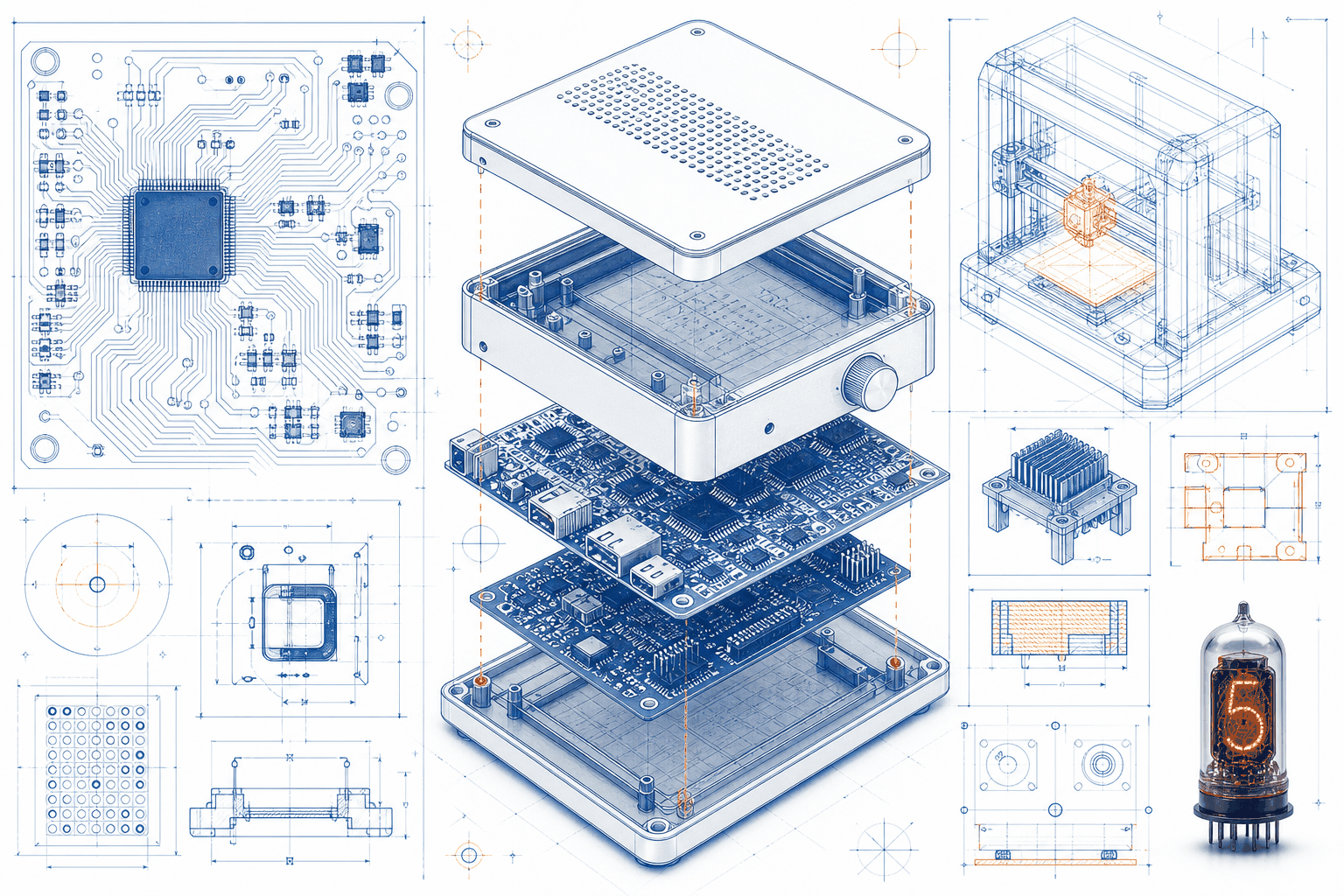
It took him months to learn PCB design, 3D modeling and printing, embedded Linux kernel compilation, and GPU-accelerated programming from scratch. The circuit board went through 4 revisions. The enclosure was printed over and over again, with the initial attempts resulting in complete scrap. In the end, a wall-mounted streaming music player that looks like a vinyl record sleeve — Pentaton LP — was born.
This story garnered 166 points and 35 comments on Hacker News, but numbers hardly capture its true charm. At its core, this is a story about caring.
The Core Conflict: He Wanted a Product That Didn’t Exist
Marton’s requirement sounded simple: a wall-mounted streaming music player with a square screen of roughly 12 inches (the size of a vinyl album sleeve), capable of displaying album artwork and playing music via AirPlay — and doing nothing else.
However, he quickly realized that no such product existed on the market. AirPlay-compatible streaming receivers rarely come with decent screens, while smart photo frames with screens generally lack support for streaming audio protocols. A product that combines both? Nobody makes one. The market is just too small. People willing to pay hundreds of dollars just to view album art probably wouldn’t meet the minimum order quantity for a factory production line.
So Marton faced a choice: either accept reality and keep listening to music on his phone with postage-stamp-sized covers, or — do it himself. He chose the latter.
Learning Curve Step 1: PCB Design
Marton’s first challenge was finding an appropriate hardware platform. He needed a small, low-power computer capable of driving a high-resolution display and supporting the AirPlay protocol. Eventually, he settled on the Radxa CM3 — a single-board computer in a compute module form factor with an embedded DisplayPort (eDP) interface that could directly drive a screen.
However, the Radxa CM3 required a carrier board to provide power, USB, network interfaces, and other connections. None of the off-the-shelf carrier boards met his strict thickness requirements — he wanted the entire device to mount flush against the wall like a vinyl sleeve. So he decided to design a custom carrier board himself. “I’ve never done this before,” he wrote, “so there was a lot to learn, from basic electronics and magnetism to high-speed signal routing.”
A software developer learning PCB design from scratch had to tackle high-speed differential signals, power integrity, and electromagnetic compatibility — topics that even seasoned embedded engineers find daunting. The carrier board needed to integrate the compute module, power supply circuitry, USB-C port, Gigabit Ethernet, and an audio trigger interface, all while keeping thickness to an absolute minimum.
The result? It took four revisions to reach a fully functional state. Each revision meant a complete manufacturing cycle: design, layout, prototyping, soldering, testing, finding bugs, and going back to the design software. Yet Marton described it casually: “It took me four revisions to get everything working.”
Learning Curve Step 2: 3D Printing & Curved Surface Modeling
Once the circuit board was sorted out, the enclosure presented a brand-new challenge.
Marton wanted a sleek enclosure with smooth, aesthetically pleasing curves. He chose FreeCAD for parametric modeling, but found that parametric CAD does not naturally excel at generating smooth, complex surfaces. His solution was classic software developer style: he wrote a custom FreeCAD macro to generate the exact surface geometry he wanted.
With the design ready, he bought a brand-new 3D printer to fabricate it — and immediately hit a wall. “Designing for manufacturing, especially for 3D printing, takes a lot of experience,” he reflected modestly. Everyone who enters the 3D printing world experiences the frustration of warping, stringing, and layer separation. The difference was that while most beginners print small trinkets, he was printing the main enclosure for a wall-mounted music player.
He spent additional time mastering design rules: wall thickness, overhang angles, and thermal shrinkage compensation. The first batch of enclosures was completely scrapped, but he ultimately produced a finished piece he was satisfied with.
Learning Curve Step 3: Embedded Linux & GPU Programming
With the physical hardware ready, it was time for the software. As a software developer, this should have been Marton’s comfort zone. However, embedded Linux development is far more involved than writing application code.
He selected Alpine Linux — an ultra-lightweight distribution. Running it on a single-board computer required extensive low-level configuration: bootloader setup, device trees, custom kernel compilation (configuring drivers, enabling GPU support), display backlight PWM control, power management (achieving standby power under 2W), and getting shairport-sync (an open-source AirPlay implementation) to run on this minimal system. Every step meant digging through documentation, debugging kernel panics, and monitoring raw serial boot logs.
Then came the centerpiece: displaying album artwork.
“It turns out that cross-fading between two 4-megapixel images at 60 frames per second is not easy on a modest single-board computer.” Driving a 17-inch display at 1920×1920 resolution required roughly 620 MB/s of raw memory bandwidth just to push pixels, before accounting for image decoding or transition math.
Marton’s solution was GPU acceleration. He configured GPU drivers on Alpine Linux and wrote hardware-accelerated rendering logic to achieve buttery-smooth album cover transitions. A software developer learned embedded GPU programming — all for the feature of displaying album covers.
Furthermore, the AirPlay protocol itself only transmits low-resolution album art around 500×500 pixels. To overcome this, he implemented an out-of-band protocol extension in the music player client, allowing full-resolution cover art to be sent and rendered over a separate channel. He literally extended the protocol itself.
The Final Product: Pentaton LP
After overcoming all these hurdles, Pentaton LP was born. Core specifications:
- 17-inch IPS LCD display, 1920×1920 resolution with 1:1 pixel mapping
- Powered by Radxa CM3 compute module, mounted on a custom carrier board
- Runs Alpine Linux, utilizing shairport-sync to receive AirPlay audio streams
- Standby power under 2 Watts, around 24 Watts during active streaming
- USB-C PD power supply, featuring a 12V trigger output to automatically switch external amplifiers
- Supports external DACs (he uses a FiiO KA17 connected to a Pro-Ject Amp Box SE)
The device stays always online. When the display is off, standby power stays below 2W. Upon detecting an incoming music stream, it wakes up instantly, turns on the screen, and triggers the amplifier via the 12V signal. The entire experience feels like having a living, singing album cover hanging on your wall.
Why This Story Is Worth Reading
We live in an age where almost anything can be bought off the shelf. The sheer convenience of consumption has made us forget the intrinsic value of “making.” Marton’s story is compelling precisely because it highlights something rare in our modern world: caring.
He didn’t care about technology for technology’s sake. He cared about seeing that album cover when playing music. For something almost abandoned in the streaming era — where most people don’t even glance at the cover before clicking play — he felt it was worth spending months, mastering four completely unfamiliar domains, and burning through multiple circuit boards and rolls of filament.
One Hacker News comment captured this sentiment perfectly:
“This reminds me of buying CDs and vinyl back in the day, holding the cover, turning it over, reading the liner notes and lyric booklets. Streaming is convenient, but we lost something along the way.”
Marton answered that sentiment with action: if no one is willing to build what was lost, you build it yourself.
This is not a story about how technology changes the world. It is a story about how a person changed himself by caring deeply about a small detail. He may not alter the course of the music industry, and Pentaton LP might not become a massive commercial blockbuster. But he spent months learning a array of skills from scratch and created a device he loves — and that in itself is beautiful.
Epilogue
Marton is currently considering launching a Kickstarter campaign. Interested readers can visit pentaton.app for further details.
Regardless of whether this device enters mass production, one image lingers in the author’s mind: a software developer late at night, under a desk lamp, plugging power into a freshly soldered circuit board to see if his fifth revision finally works properly. He didn’t set out to change the world; he just wanted to see the album art while listening to his favorite songs.
Reference links:
- Pentaton LP Announcement Article (pentaton.app)
- HN Discussion (item?id=49022355)
- Radxa CM3 Single Board Computer
- shairport-sync AirPlay Implementation
 Figure: Marton’s custom PCB carrier board for Radxa CM3, which went through 4 revisions to achieve full stability.
 Figure: Rear view of the finished Pentaton LP, showing the USB-C power input, Gigabit Ethernet port, and 3.5mm audio trigger jack.
 Figure: CAD wireframe model of the enclosure designed in FreeCAD, featuring a custom macro written to generate smooth curved surfaces.