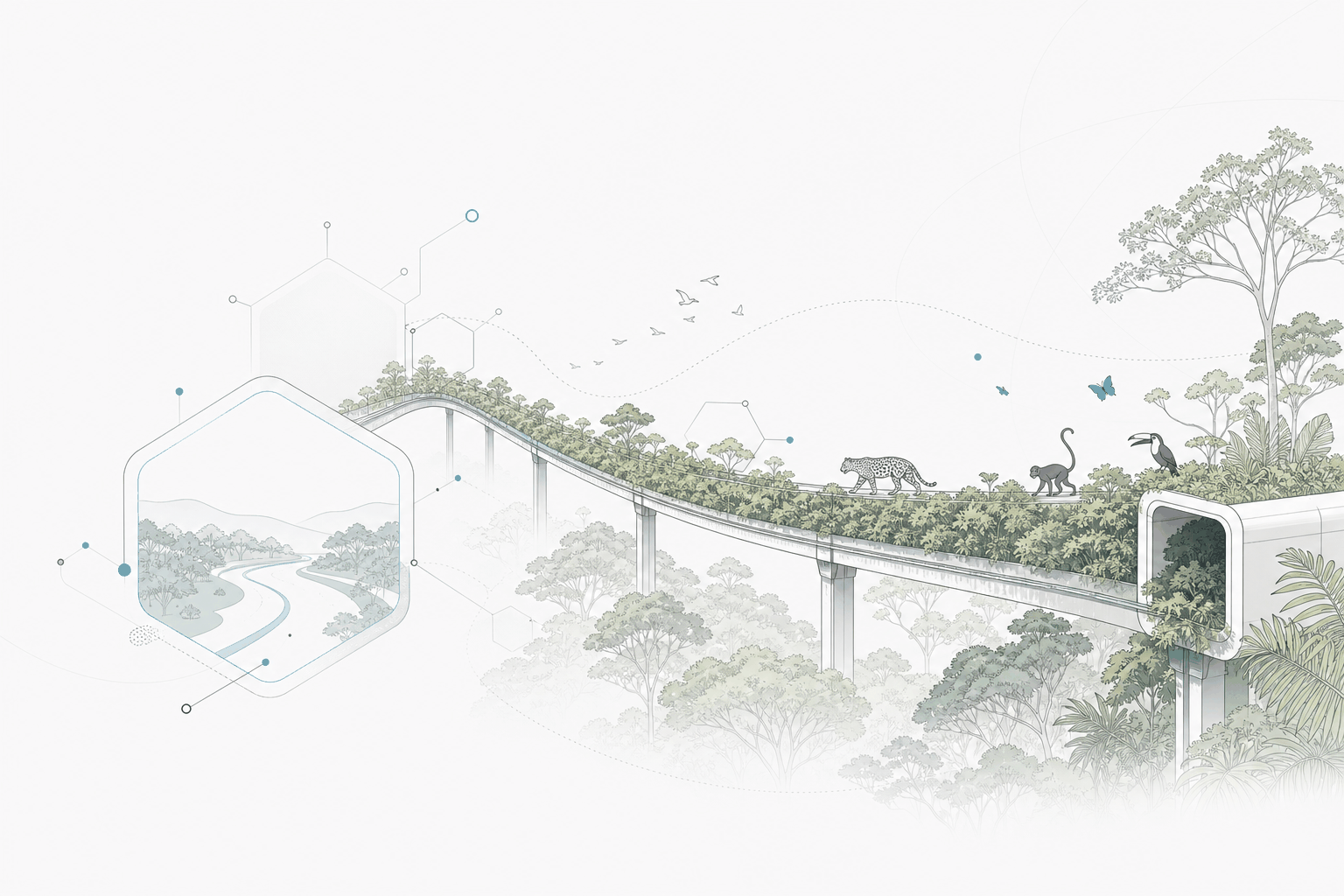
In 2024, eight modest bridges made of rope and wooden slats were suspended between tree canopies across a highway in Alta Floresta, a town in the northern reaches of Mato Grosso in the Brazilian Amazon. Fifteen months later, camera traps recorded 15,000 safe wildlife crossings, while zero roadkill occurred along that stretch of road during the same period.
No high-tech gadgetry, no massive budgets—just rope, piping, steel cables, and concrete pillars.
One Highway, Two Worlds
The story begins with roads. The Amazon rainforest harbours the world’s dense biodiversity and Brazil’s richest array of primates. At the same time, Brazil boasts the world’s fourth-largest road network. Combined, these two facts spell disaster for arboreal animals.
When a highway cuts through the rainforest, the forest canopy is abruptly severed. Monkeys, sloths, and opossums—creatures that normally spend their entire lives high above the ground—are forced to descend to the forest floor, trudge across scorching asphalt, and climb back up on the other side. The outcome is predictable: getting struck by vehicles.
A 2022 study estimated that nearly 9 million mammals are killed on Brazilian roads every year. Data published in Nature in 2025 confirmed that Brazil ranks among the countries with the highest terrestrial vertebrate roadkill rates globally.
In Alta Floresta, residents and conservationists witness this reality daily. Fernanda Abra, founder of Projeto Reconecta and a conservation biologist at the Smithsonian’s National Zoo, recalled finding two dead Schneider’s marmosets—an endangered monkey species endemic to the Brazilian Amazon—on the highway just hours before installing the first canopy bridges.
This is far from an isolated incident. Along highway ES-164 in the Atlantic Forest state of Espírito Santo, biologist Gabriel Falchetto encounters roadkilled animals in the morning fog nearly every day. On one occasion, he found a critically endangered buffy-headed marmoset—a species with only about 2,500 individuals remaining on Earth. Standing over its body, Falchetto remarked, “Beyond losing this individual, it serves as a stark reminder of what human activity is doing to biodiversity.”
Canopy Bridges: Engineering Wisdom Over High Tech
The structures in Alta Floresta are not multi-million-dollar, dozens-of-meters-wide eco-overpasses. They are artificial canopy bridges—aerial pathways suspended between disconnected treetops specifically designed for tree-dwelling wildlife.
The engineering is remarkably simple. Each bridge relies on concrete pillars as anchor points. The main body consists of either a linear structure of braided rope and steel cable or a grid-like mesh combining rope netting, high-density polymer piping, and steel cables. The two designs are installed side-by-side, less than a meter apart, allowing animals to choose their preferred crossing method. During installation, the team anchors the bridges to concrete pillars on opposite sides of the road at canopy height.
Each bridge costs approximately $3,000 in materials, with an expected lifespan of over 20 years and virtually no maintenance required.
By contrast, traditional concrete wildlife overpasses frequently cost hundreds of thousands or even millions of dollars. Canopy bridges cost a tiny fraction of that amount.
Every bridge is monitored by two infrared camera traps: one pointed along the bridge deck to record which species cross, and another facing the forest canopy to track animals that approach the bridge head but decide against using it. This data provides crucial insights into which species utilize the bridges, which do not, and which designs prove most popular.
How Animals Learned to Cross
Animals do not intuitively recognize an artificial bridge on day one.
In Alta Floresta, tufted capuchins took seven months before making their first crossing on one of the bridges. Every species adapts at its own pace.
“In conservation, we often feel immense urgency, but we fail to consider the timeline of the affected species,” Abra explained. Highway BR-174 was constructed in the 1970s; animals had decades to adapt to the road’s presence. Offering them a new way across requires patience.
Once learned, however, the results were astounding. By late 2025, camera traps had documented at least six primate species using the bridges: black-faced black spider monkeys, Purus red howler monkeys, northern night monkeys, tufted capuchins, Schneider’s marmosets, and the Alta Floresta titi monkey. The latter was only scientifically described in 2019, immediately listed as critically endangered, and has now become the flagship symbol of the entire project.
Beyond primates, small mammals including opossums, sloths, and mouse opossums were also captured on camera crossing the highway.
In an earlier project along BR-174—where Abra collaborated with the Waimiri-Atroari Indigenous people to erect 32 canopy bridges across Indigenous territory—roughly 1,250 safe primate crossings were recorded over five years. Indigenous community members were instrumental in determining optimal bridge placement based on their daily observations of wildlife movement corridors.
What 15,000 Crossings Really Mean
The ecological logic behind these figures extends far beyond “a monkey avoided getting run over.”
When highways fragment forest habitats, animal populations are divided into isolated pockets. Isolated populations shrink, becoming vulnerable to inbreeding and declining genetic diversity—academic terms that translate in plain language to: the population slowly moves toward extinction.
Primates, particularly frugivores, act as vital seed dispersers in the rainforest. A single howler monkey consumes vast quantities of fruit daily and deposits seeds far from the parent trees. Without them, forest tree species composition shifts, triggering a chain reaction across the ecological network—a process biologists refer to as a “domino effect.”
Thus, the significance of these bridges goes well beyond 15,000 animals surviving a road crossing. These animals continue to move, forage, mate, and disperse seeds between both sides of the forest. Gene flow is restored, and forest ecosystem functionality is preserved.
Abra frames it concisely: “Canopy bridges serve two purposes. First, to improve wildlife connectivity by enabling animals to move between fragmented forest patches. Second, naturally, to reduce roadkill.”
From Grassroots Action to National Policy
In 2026, Brazil’s National Department of Transport Infrastructure (DNIT) officially adopted this rope bridge design as a recommended national highway standard. This marks a transition where a grassroots solution rooted in Indigenous knowledge and civic conservation is being integrated into national infrastructure policy.
A bill currently under consideration in the Brazilian Congress (already passed by the Chamber of Deputies and awaiting a Senate vote) would establish a “National Wildlife Road Safety Program,” mandating wildlife warning signs, speed reduction measures, overpasses, canopy bridges, and underpasses along federal highways.
Abra’s organization, Projeto Reconecta, is also expanding its reach. Next steps include “Reconecta Suriname,” 10 new bridges in Lucas do Rio Verde (Brazil), and “Reconecta Habitats” across the Pantanal wetlands and the Atlantic Forest.
Highway BR-262 in the Pantanal, known as the “Highway of Death,” sees approximately 2,000 animals killed each year—and it stands as Reconecta’s next major target.
A Final Observation
Writing this article, one image comes to mind: a rope bridge costing under $3,000, suspended above an ordinary highway in the Brazilian Amazon, its branch-like structure almost blending into the surrounding canopy. Drivers passing beneath might never notice it.
Yet camera traps recorded 15,000 safe journeys across that span.
The most fundamental and compelling aspect of this story is not a technological breakthrough. Rather, it is a reminder: human infrastructure—that asphalt highway—was originally engineered for only one category of “user” (humans and vehicles), completely ignoring another category of “user” (the voiceless inhabitants of the rainforest). It was never that we lacked the capability to accommodate both; rather, at the moment of engineering design, no one spoke up for them.
A rope bridge costs less than a flagship smartphone. Yet it allowed 15,000 lives to return safely to the other side of the canopy.
References
- Mongabay: Zero roadkill as Amazon canopy bridges secure 15,000 crossings (2026.07.21)
- Mongabay: Endangered primates use new canopy bridges in a Brazilian Amazon city (2025.07)
- Smithsonian’s National Zoo: How Brazil’s Unique Canopy Bridges Are Saving Species (2025.07)
- Good News Network: In the Amazon, One Woman’s Ingenious Canopy Bridges Are Helping Monkeys Cross the Road Safely (2025.02)
- Projeto Reconecta: Design and Installation of Artificial Canopy Bridges
- Discover Wildlife: Canopy bridges are saving endangered wildlife in the Amazon (2024.05)
Image Captions
 Installation site of the first canopy bridges in Alta Floresta in 2024. Concrete pillars and rope structures are visible. Photo credit: Programa Alta Floresta Não Atropela
 A Schneider’s marmoset (Schneider’s marmoset) using a rope bridge to cross the highway. Captured by camera trap. Photo credit: Maelle Lima de Freitas / Projeto Reconecta
 Aerial view showing a canopy bridge spanning the highway and connecting tree canopies on both sides. Photo credit: Programa Alta Floresta Não Atropela