Twenty-Six Years Without Endemic Measles: The Streak Snapped on November 17
On November 17, 2026, the Pan American Health Organization (PAHO, the regional public health authority for the Americas) officially announced that the United States has lost its measles elimination status. Measles—an acute, highly contagious viral respiratory disease typically characterized by high fever followed by a full-body rash—was eliminated in the U.S. in 2000. That 26-year public health milestone is now gone. Mexico and Bolivia lost their status on the same day; Canada lost its elimination status a year earlier in 2025.
“Elimination” carries a rigorous epidemiological definition: no sustained, local viral transmission within a country for 12 consecutive months. Occasional importations by returning travelers do not disqualify a country, provided the transmission chains remain brief and quickly fizzle out. However, an outbreak ignited in West Texas in January 2025 never ceased. Persisting for well over twelve months, it allowed measles to re-establish itself domestically. The official term is endemic: the virus has made itself at home, and new clusters can no longer be explained away as sporadic international travel cases.
For ordinary people, measles is deceptively hazardous from the start. Its onset mimics a standard cold—fever, persistent coughing, runny nose, and red, watery eyes. Only after two or three days does a hallmark rash erupt behind the ears and spread across the body. By the time clinicians recognize it as measles, the patient has typically spent several days circulating in public and passing the virus to those nearby.
One Measles Patient Infects 12 to 18 Others; Influenza Averages 1.5
In epidemiology, transmissibility is gauged by the basic reproduction number ($R_0$): the average number of secondary infections generated by a single contagious individual in a completely non-immune population. For measles, $R_0$ sits between 12 and 18; for seasonal influenza, it hovers around 1.5. Translated into everyday settings: while flu spreads in slow, link-by-link chains, a single individual with measles can easily infect an entire crowded classroom.
Measles transmits via respiratory droplets and airborne aerosols. After an infectious person exits a room, the virus remains suspended in the air and viable for up to two hours. Sharing the same supermarket aisle or clinical waiting room is more than enough to contract the disease, even without face-to-face contact. When an infection spreads this rapidly, tracing and isolating exposed individuals after the fact is always a step behind; robust pre-emptive defense is the only strategy that works.
That pre-emptive defense is herd immunity: having enough immune individuals in a population that the virus cannot find its next susceptible host, causing transmission chains to stall out naturally. The more contagious a pathogen, the higher the threshold required. While a 30% to 40% vaccination rate might slow down influenza, the threshold for measles is strictly anchored at 95%—no more than 1 in 20 people can lack protection.
From 95% to 92%: The Missing 3% Is Far from Evenly Spread
Among kindergarteners across the United States, coverage for the two-dose MMR (measles, mumps, and rubella) vaccine stood at 95% in 2019. By 2025, that figure had slipped to 92%. A 3-percentage-point decrease might sound modest on paper, but translate it to a classroom: in a class of 20 young children, the count of unprotected students shifts from at most one to nearly two.
The real crisis lies in how unevenly that 3-point gap is distributed. A study published in Nature Medicine in August 2026 modeled school-level vaccination data across 50,000 U.S. schools. Its central finding: even when county-wide average coverage hovers close to 95%, it routinely conceals hyper-localized pockets of severely under-vaccinated schools. These clusters serve as the ground zero where the virus takes root. Outbreaks in regions with adjacent low-uptake communities persist significantly longer. Stanford University epidemiologist Nathan Lo characterized the dissemination pattern as resembling “popcorn”—flashes of infection that once stayed contained in isolated pockets are now spilling over into neighboring communities.
Behind the drop in vaccination rates lies an erosion of institutional trust. A survey by the Annenberg Public Policy Center at the University of Pennsylvania found that the share of American adults who view vaccines as safe fell to 83% in 2025, dropping another 3 percentage points from 2024. Public attitudes shift first, and vaccination rates follow. Given current trends, 92% may not even represent the bottom.
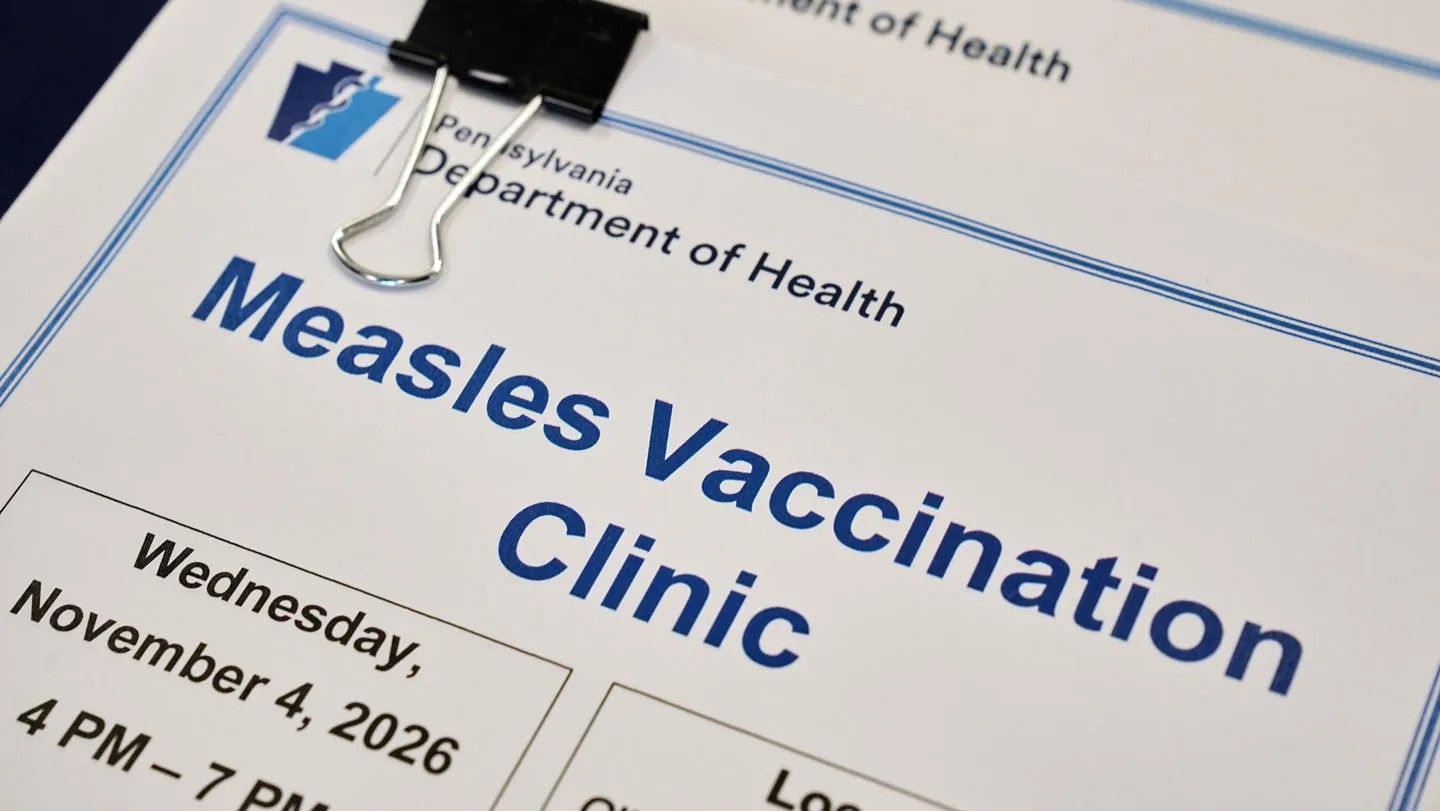 Photo: A sign posted outside a vaccination clinic on November 4, 2026. Following the loss of elimination status, walk-in vaccine sites have returned to daily street life. Source: Science News
From West Texas to Over 7,000 Cases: Nine Out of Ten Were Unvaccinated
The timeline is now clear: an outbreak sparked in West Texas in January 2025 formed a continuous chain of transmission that was never broken, culminating in the revocation of the status on November 17, 2026. Over this two-year span, the country recorded nearly 100 separate outbreaks and over 7,000 confirmed cases—approximately 2,300 in 2025, and 5,412 in 2026 as of November 12. This marks the most severe measles resurgence in the United States since 1991: a disease once virtually erased from daily American life under elimination status has returned to emergency rooms and school warning letters.
More than 90% of cases occurred in individuals who were unvaccinated or had an unknown vaccination status. The virus travels almost exclusively along unprotected routes. The clinical consequences have been severe: roughly one in five infected individuals required hospitalization for serious complications such as pneumonia or encephalitis (brain swelling). Children under five, adults over twenty, and pregnant women face the highest risk. State health departments have reported 13 deaths, with the CDC currently verifying nine.
Among the grimmest statistics is congenital measles, where infants contract the virus from their mothers in utero or around delivery: at least 13 cases have been recorded since 2025. A study published in NEJM Evidence on November 16 noted that newborns infected this early face an alarmingly high risk of fatal neurological complications, including subacute sclerosing panencephalitis (SSPE) later in life. Newborns cannot protect themselves with vaccines—the standard first MMR dose is administered only after age one. Whether a child safely navigates their first year depends entirely on the immunity of the community around them.
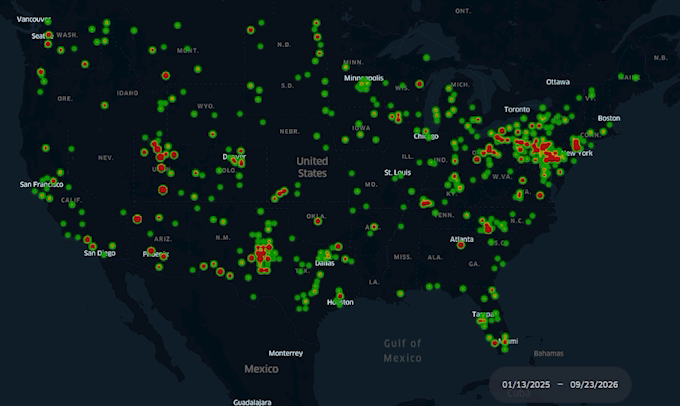 Map: Distribution of cumulative measles cases across U.S. counties since mid-2025, ranging from green (few) to red (many). Note how cases cluster heavily in a handful of counties rather than dispersing evenly—low-vaccination pockets act as persistent tinderboxes. Source: Michael Mitchell and Andrea Uhlig / Brown University School of Public Health
For Every 1,000 Reported Cases, the Real Burden May Be 3 to 5 Times Higher
In Arizona and Utah, official tallies documented around 1,000 confirmed infections. Yet an epidemiological study hosted on the medRxiv preprint server estimates that confirmed figures account for merely 20% to 30% of actual infections. Reported case counts represent only the absolute floor. The undercount stems from both ends: mild symptoms are easily dismissed as ordinary colds and never tested, while laboratory reporting systems miss additional cases. The larger the volume of undetected transmission, the harder containment becomes.
The financial arithmetic is equally sobering. New Mexico spent approximately $5.4 million responding to a single linked outbreak in 2025, working out to over $53,000 per confirmed case—quarantines, extensive contact tracing, specialized lab tests, and hospital care cost far more than preventive immunizations. The CDC has allocated an additional $100 million in emergency funds to states. Had that same funding gone into proactive, catch-up vaccination campaigns, it could have prevented vastly more cases before they ever began.
Reclaiming Elimination Requires a Full Year of Zero Transmission: Catch-Up First
Elimination status can be regained, and the benchmark remains unchanged: achieve 12 consecutive months without sustained local transmission, and a country can reapply. Precedents exist—Venezuela lost status in 2017 and Brazil in 2019, yet both reclaimed certification through rigorous nationwide catch-up vaccination drives. Canada’s multi-year outbreak was declared over in October 2026. PAHO Director Jarbas Barbosa noted that measles is resurging globally precisely because persistent gaps in vaccination coverage leave windows of vulnerability open.
The public health toolkit contains ready solutions: the first dose can be moved up to six months of age during community outbreaks (instead of waiting for the routine 12-month mark), and the second dose can similarly be accelerated, provided health guidance adapts quickly. Above all, kindergarten vaccination rates must be pushed back up past the 95% line. Brown University epidemiologist Jennifer Nuzzo warned: “Losing it means we are going backward… undoing decades of progress.” Cornell University’s Ana Bento added: “This announcement is not a punishment. It’s a reminder of what must change.”
There is still no antiviral cure for measles; clinical management relies on antipyretics, hydration, and monitoring for organ damage. For 26 years, what truly kept the virus at bay was nothing more than two MMR shots and a 95% coverage wall. That defensive shield was worn down gradually; the pathogen itself has not changed. Loss of elimination status was driven by coverage numbers, and recovery will be too. Under international rules, breaking transmission for a full year opens the door to recertification. The mathematics of epidemiology are completely indifferent: restore the numbers, and the virus has nowhere left to go.
References:
- PAHO Declaration Revoking U.S. Measles Elimination Status
- Science News: Coverage Analysis and Public Health Implications
- Brown University School of Public Health: County-Level Case Distribution Map
- Nature Medicine: School-Level Vaccination Coverage Simulation Study
- NEJM Evidence: Study on Congenital Measles and Infant Outcomes
- medRxiv: Outbreak Size Underreporting Estimation in Arizona and Utah
- Annenberg Public Policy Center (UPenn): Vaccine Confidence and Safety Survey
- CDC: Measles Outbreak Surveillance and Epidemiological Data