Open the sleek delivery box, and you will find neatly arranged collection swabs, preservation tubes, and biohazard zip bags. Following the instructions, you collect a small stool sample in the bathroom, seal it, and mail it back. A few weeks later, an elaborate health dashboard with colorful charts pops up on your smartphone. Many consumers turn to these tests hoping to uncover the root causes of chronic bloating, lethargy, or stubborn weight fluctuations.
In November 2026, a reporter for the journal Nature put these promises to the test. The reporter took a single bowel movement, split it into two identical subsamples, and shipped them to two commercial testing companies. Despite originating from the exact same person at the exact same moment, the samples yielded completely contradictory evaluations.
NirvanaBiome detected 133 microbial species and rated the reporter’s microbial diversity as “excellent.” Meanwhile, Washington-based Viome identified only 61 active microbes and warned that the user was in a suboptimal, sub-healthy state. Without any physical change in the subject, the two reports arrived at wildly diverging conclusions.
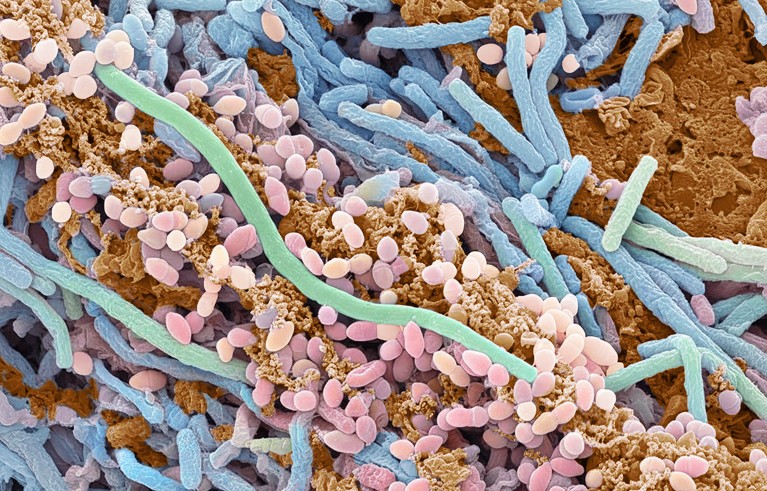 Figure: Gut microbiota in healthy human stool under an electron microscope. Source: Steve Gschmeissner/Science Photo Library (via Nature).
Tested by a Reporter: One Lab Praised Diversity While the Other Sold Supplements
Trillions of microorganisms reside within the human intestinal tract. Medical science collectively refers to this community as the gut microbiota (the collection of bacteria and other microbes inhabiting the digestive tract). Many commercial vendors claim that sequencing your microecology allows them to formulate a personalized nutrition plan. The reporter’s firsthand experience, however, exposed a glaring rift between marketing claims and scientific reality.
Viome provided a detailed list of dietary recommendations. The algorithm instructed the subject to avoid broccoli and instead eat more pecans. The report immediately followed up by pitching personalized supplements priced at over $150 per month. The company even recommended repeating the paid test every four to six months.
One company declared the gut ecosystem “excellent,” while the other aggressively pushed expensive monthly supplements. Faced with identical stool samples, two providers returned fundamentally incompatible conclusions. When the diagnostic outcome depends entirely on which lab receives the vial, commercial testing ceases to serve as a meaningful health baseline.
Seven Companies Blind-Tested: Genera Counts Diverge by 26-Fold
The reporter’s experience was far from an isolated fluke. The National Institute of Standards and Technology (NIST) conducted a rigorous comparative study on commercial gut microbiome tests. Researchers collected a stool sample from a single healthy volunteer and utilized specialized laboratory equipment to thoroughly homogenize it into a uniform mixture.
The homogenized liquid was aliquoted into multiple identical vials and shipped anonymously to seven leading commercial testing firms. None of the companies knew they were participating in a scientific evaluation. When the data was compiled, the research team was astonished: the number of microbial genera (a taxonomic rank above species, akin to how cats and tigers share the genus Panthera) reported across the seven companies diverged wildly.
The lowest count was a mere 34 genera, while the highest reported an astonishing 906 genera—a 26-fold difference. It was the biological equivalent of showing seven people the same group photo, with one person counting 34 individuals and another spotting 906. Across all seven professional reports, only three genera were identified in common.
NIST researchers also submitted replicate samples from the same individual to the same commercial lab. One company evaluated the first two identical replicates as “healthy,” but flagged the third replicate as “unhealthy.” In statistical terms, the analytical variance between different commercial providers matched or exceeded the biological variance seen across eight entirely distinct human donors. Scott Jackson, former director of the microbial genomics program at NIST, voiced deep frustration, noting that commercial services cannot even agree on a baseline definition of what “healthy” looks like.
Similar cross-validation studies conducted by European and Canadian research teams observed the same phenomenon. When identical samples were sent to six testing providers, ratings swung unpredictably across “excellent,” “good,” “average,” and “poor.” The health profiles generated by commercial labs differ so dramatically that they appear to describe completely unrelated strangers.
 Figure: Fermented foods like kombucha are frequently recommended by testing companies. Source: Deb Lindsey/The Washington Post via Getty (via Nature).
From Swabs to Algorithms: Divergence at Every Step of the Pipeline
Why does identical biological material yield night-and-day results? From sample collection to the final algorithmic report, the entire testing pipeline suffers from a total absence of standardized protocols. The manual collection step performed by everyday consumers at home is often where discrepancies begin: some scoop with a spoon, others swab lightly with cotton, and some wipe with toilet paper.
The choice of preservation buffer directly dictates microbial survival. Tubes containing chemical preservatives prevent post-collection bacterial growth, whereas dry collection tubes leave the sample’s fate to chance. Over days of ambient transit through postal networks, shifts between aerotolerant and obligate anaerobic species can reshape the community structure. By the time a vial arrives at the facility, its microbial makeup has already drifted from its composition at the moment of excretion.
DNA and RNA extraction methods are equally fragmented. Bacterial cell walls vary tremendously in physical durability. Gentle chemical lysis only breaks open fragile, thin-walled species, whereas vigorous mechanical bead beating is required to rupture tough, thick-walled bacteria. Depending on the extraction protocol chosen by a given laboratory, the observed relative abundances of different bacterial phyla can invert entirely.
Furthermore, different companies target entirely different biomolecules. Most commercial services sequence deoxyribonucleic acid (DNA, the stable long-chain molecule storing a cell’s permanent genetic blueprint, detectable regardless of whether the cell is dead or alive). Viome, in contrast, focuses on ribonucleic acid (RNA, molecules expressing active genetic instructions that reflect real-time cellular activity). DNA reveals who is present, whereas RNA attempts to capture who is actively working.
The final divergence occurs during computational analysis. Every firm relies on proprietary bioinformatics pipelines—software workflows that match raw sequencing reads against taxonomic reference databases. As Rob Knight, a renowned microbiome researcher at the University of California, San Diego, pointed out, algorithmic decisions introduce exponential divergence once sequencing data enters computational processing.
The Microbiome as a Fingerprint: Medicine Has No Universal Normal
Behind these procedural fractures lies a deeper scientific reality: human gut microbiomes lack a universal template for health. In routine clinical medicine, fasting blood glucose has well-established diagnostic intervals; if an indicator strays beyond clinical thresholds, physicians can make definitive diagnoses.
Blood glucose meters can be repeatedly calibrated against reference solutions with certified concentrations. Natural gut microbiota samples, by contrast, possess no known gold-standard reference ground truth. A person’s gut ecosystem is as distinct as a fingerprint. Ethnicity, geographic environment, age, diet, and even birth delivery method leave lasting imprints on the microbiome.
Whether an individual was delivered via Cesarean section or recent exposure to broad-spectrum antibiotics can persistently alter the microbial landscape. A commensal microbe living harmoniously inside one person might trigger low-grade inflammatory responses in another. At present, microbial genomics has not established an absolute baseline for a “healthy” gut. Yet commercial services leap across this foundational scientific void, repackaging weak statistical correlations into definitive health prescriptions.
Uncritical Dietary Restrictions Risk Real Nutritional Deficiencies
Facing patients clutching colorful commercial microbiome dashboards, gastroenterologists frequently express exasperation. Fergus Shanahan, a gastroenterologist at University College Cork in Ireland, notes that he invariably sighs when patients walk in with commercial reports. Jacques Ravel, a microbiologist and genomicist at the University of Maryland, puts it even more bluntly: the direct-to-consumer industry suffers from an utter lack of standardized technical benchmarks.
In 2024, an international consensus panel of microbiome experts from 18 countries published a statement in a leading medical journal, concluding that commercial microbiome testing is not suitable for routine clinical screening. Physicians only order microbiome-related tests in narrow, well-defined clinical scenarios, such as recurrent Clostridioides difficile infections. Unsupervised home testing outside clinical indications predominantly generates actionable health anxiety rather than actionable insight.
Blindly adhering to commercial dietary directives can introduce secondary health risks. Prompted by red warning labels on a smartphone report, consumers have severely eliminated legumes or cruciferous vegetables from their diets, leading to chronic nutritional imbalances. An even more perilous hazard is the delay of evidence-based medical care: when organic gastrointestinal pathology is present, relying on direct-to-consumer stool kits delays vital diagnostic procedures such as colonoscopies.
Commercial vendors excel at dressing their offerings in high-tech jargon, promising an end to dietary guesswork and tailor-made wellness regimens. Yet empirical scientific assessments demonstrate that sending identical samples to two labs yields diametrically opposed assessments. Paying one or two hundred dollars for a home microbiome test yields results with margins of error so large that they might as well belong to two completely different human beings.
Until the scientific community establishes universal diagnostic baselines and standardized analytical pipelines, mail-in gut kits fall far short of medical-grade testing. Everyday consumers do not need to be held hostage by dizzying microbiome charts. A well-balanced diet and regular sleep patterns remain vastly more dependable than a $150-a-month subscription to customized supplements.
Reference Links:
- Nature Feature Article
- Communications Biology Research Article
- NIST Research Blog