Twenty Kilograms Down on the Scale, but Hands Begin to Shake
Stepping onto the scale in the early morning, the needle rests a full twenty kilograms lower than it did several months ago. In the mirror, waistbands that were once uncomfortably tight now gap generously. For many, this looks like the textbook definition of weight-loss success.
Daily life, however, soon sends a conflicting message. Carrying grocery bags filled with fresh produce up a flight of stairs leaves calves trembling after just a few steps. Lifting a heavy cast-iron skillet with one hand reveals a sudden loss of wrist strength.
Many assume this is merely temporary fatigue from eating less. The reality is far more concerning: a substantial portion of the weight shedding off the scale consists of muscle tissue essential for maintaining functional independence.
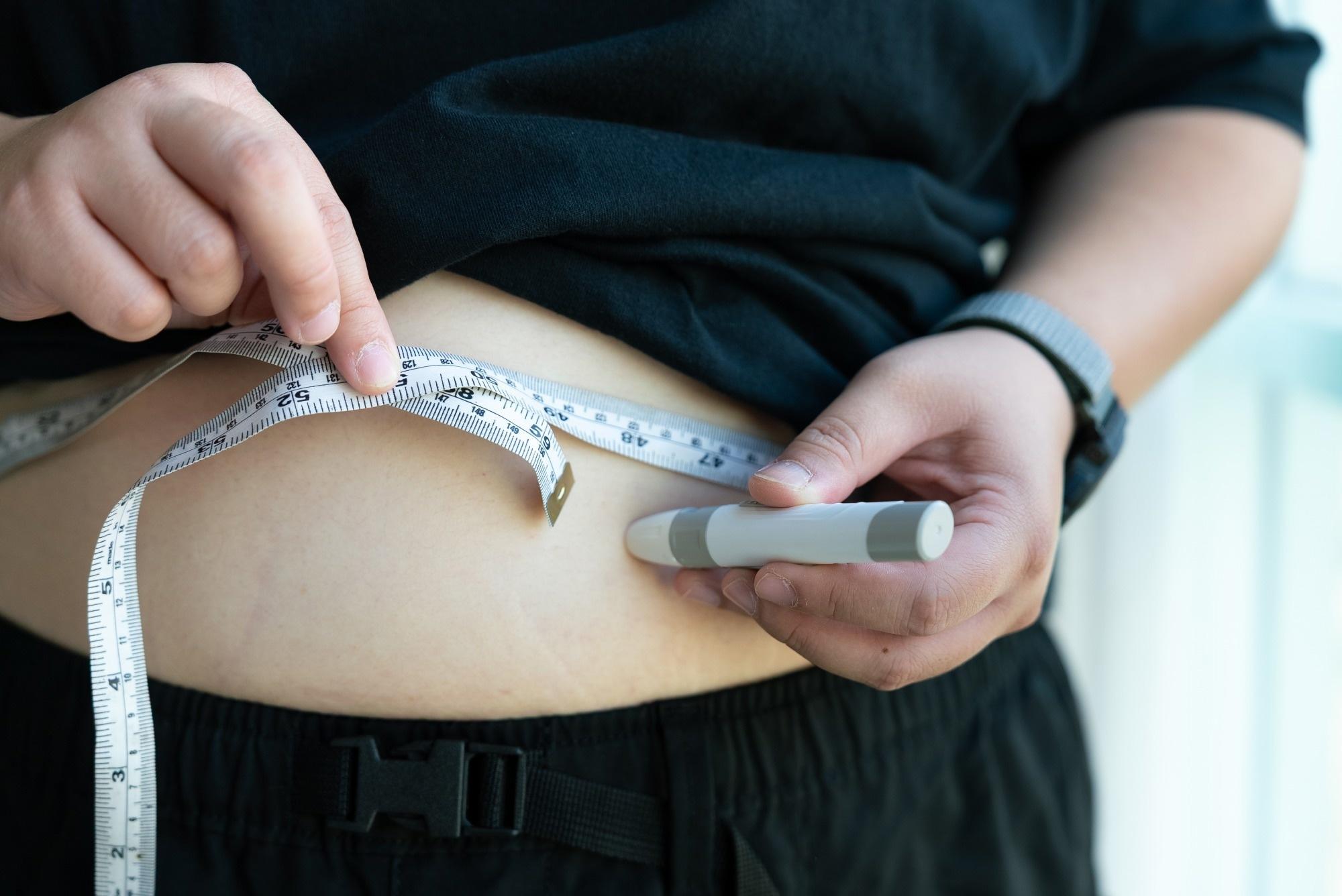 Figure: Weight-loss injection treatment setting with pen injector and tape measure. Source: News-Medical (Shutterstock)
A new generation of injectable weight-loss therapies, headlined by tirzepatide—which mimics gut hormones to suppress appetite—has surged in popularity worldwide. These medications help overweight individuals shed an average of 20% of their body weight. Yet as body volume shrinks, the skeletal muscle responsible for mobility quietly wastes away.
Downsizing the body through dieting or injections alone often comes at the expense of functional strength. Losing core bodily support during weight loss risks leaving behind a frail, hollow frame.
A 40-Week Rigorous Trial: 120 Participants in Body Composition Scans
A research team led by Danny Green at the University of Western Australia set out to investigate this hidden vulnerability. They launched the T-REx randomized controlled clinical trial. Spanning 40 weeks, the study was published on November 9, 2026, in the medical journal Nature Medicine.
The team recruited 120 sedentary adults aged 50 to 70. All participants were overweight or obese, had at least one weight-related chronic health condition, and all female participants were postmenopausal.
Throughout the trial, every participant received weekly injections of tirzepatide, starting at 2.5 mg per week and gradually titrating up to a maximum dose of 15 mg per week.
Researchers randomized participants into two groups. One received medication alone. The other paired regular injections with guided resistance exercise. The exercise group completed supervised, one-hour strength training sessions using dumbbells and resistance machines three times per week.
Using dual-energy X-ray absorptiometry (DXA)—a low-radiation imaging method that precisely measures body composition—researchers tracked whole-body tissue changes. The resistance training group demonstrated remarkable discipline, achieving a 91% adherence rate over the 40 weeks.
The final weight-loss figures caught many by surprise. The exercise group lost an average of 22.28 kg, while the medication-only group lost 22.61 kg—virtually identical drops of around 22 kg. Fat mass loss was also neck-and-neck, at 17.98 kg and 17.19 kg, respectively.
Resistance exercise did not hinder the medication’s fat-burning efficacy, nor did it slow progress on the scale. The true divergence lay hidden beneath the skin, within the muscle tissue.
Lifting Three Times a Week Preserves a Quarter of Lean Mass
Whole-body DXA scans unveiled what was happening inside. In the medication-only group, participants lost an average of 4.67 kg of lean mass—the non-fat soft tissue of the body, composed primarily of skeletal muscle.
What does losing 4.67 kg of muscle mean in practical terms? It is the equivalent of stripping away roughly ten one-pound prime steaks of tissue from the frame. Older adults already experience natural age-related functional decline; shedding this much muscle in a short window directly empties out essential physical reserves.
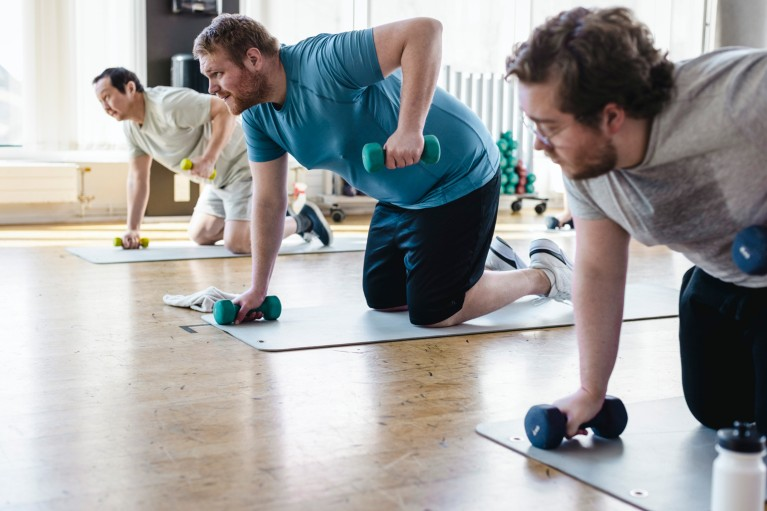 Figure: Three participants performing kneeling dumbbell exercises in a fitness class. Source: Nature (Getty)
For participants who lifted weights three times a week, lean mass loss was held down to 3.57 kg. Compared to the medication-only cohort, the exercise group spared 1.09 kg of lean mass—saving nearly a quarter of the muscle that would otherwise have been lost.
This protective effect was equally pronounced in the limbs, where everyday mobility originates. Appendicular lean mass dropped by 3.55 kg in the medication-only group, compared to just 2.92 kg in the lifting group.
Muscle loss driven by pharmacotherapy cannot be restored simply by sitting and resting. Three resistance sessions a week preserved one-fourth of lost lean tissue. That extra kilogram of conserved muscle represents a critical barrier for joint stability, bone health, and independent living.
Functional Decline Strikes Without Warning
Even more striking than the body composition numbers were the objective muscle strength tests. Researchers evaluated participants across three core movements: chest press, lat pulldown, and knee extension.
In the medication-only group, strength plummeted across the board. Chest press strength dropped by 4.09 kg, lat pulldown strength declined by 4.42 kg, and leg extension strength fell by 4.42 kg.
By contrast, the group that committed to lifting saw their strength rebound comprehensively. Chest press strength improved by 4.68 kg, lat pulldowns surged by 8.58 kg, and knee extension strength grew by 5.88 kg. After 40 weeks, a performance gap of roughly 10% separated the two groups.
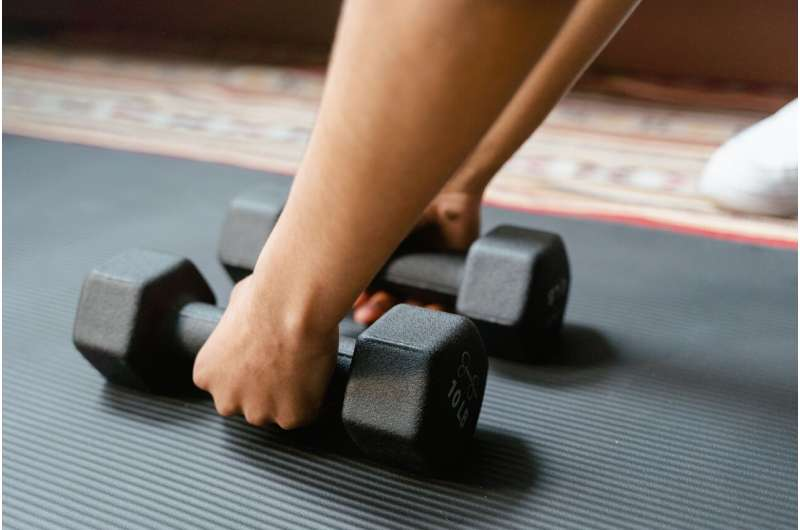 Figure: Close-up of hands gripping dumbbells during resistance training. Source: Medical Xpress (Pexels)
The most insidious finding of the trial surfaced in subjective symptom questionnaires. When asked whether they felt lethargic, weak, or physically fatigued, both groups reported virtually identical self-assessment scores.
Sedentary daily routines mask physical deterioration. When everyday tasks do not involve heavy exertion, losing 10% of muscle capacity easily escapes notice.
This silent decline poses severe risks, particularly for middle-aged and older adults. Rapid muscle loss accelerates sarcopenia—the progressive loss of skeletal muscle mass and strength—dramatically elevating the risk of falls, fractures, and disability.
Not feeling exhausted does not mean strength is intact. Sensory habituation makes muscle loss during pharmacological weight reduction exceptionally deceptive.
Dumbbells Belong on Every Weight-Loss Prescription
The trial also tracked cardiovascular and metabolic biomarkers. Both groups saw systolic blood pressure decline by 15 to 17 mmHg. Fasting blood glucose, insulin levels, HbA1c, and lipid panels improved to the same degree across both cohorts.
Metabolic improvements stem largely from systemic weight reduction and visceral fat clearance. Laboratory panels, however, capture only chemistry. The true determinant of quality of life is whether an individual can walk upstairs unaided or lift their grandchildren.
Lead researcher Danny Green emphasized that rapid weight loss inevitably exacts a toll on lean mass. The overarching objective of weight management must be preserving functional capability, not merely watching numbers tick down on a bathroom scale.
An injection can melt away fat at unprecedented speed, but it cannot build or preserve muscle tissue. Relying solely on medication for a slimmer physique often exacts a steep price in physical strength.
Three structured resistance training sessions per week defend the functional baseline of everyday life. Whenever a physician prescribes a GLP-1 or dual-agonist injection in the clinic, a set of dumbbells in the gym belongs right alongside it on the script.
References:
- Nature News: Weight-loss drugs cause muscle loss, but lifting weights can salvage it
- Nature Medicine Paper: Tirzepatide combined with resistance exercise randomized controlled trial
- Medical Xpress Coverage: Resistance exercise is key to preserving muscle function on GLP-1 therapies