End-to-end encryption has safeguarded human communication for twelve years. Yet the moment a smartphone screen lights up, this line of defense collapses. In November 2026, encrypted messaging service Signal rolled out a critical update for Apple’s iOS 27, outright revoking interface capture permissions. When a user presses the side and volume buttons inside Signal, the operating system blocks the screenshot entirely. This seemingly retrogressive move directly targets the native AI agents Apple and Google are baking into their operating systems.
In traditional security mental models, a private exchange between two phones behaves like an armored transport truck. Communications data undergoes heavy encryption before ever leaving the keyboard. Traversing cell towers and cloud servers as garbled ciphertext, only the intended recipient’s device holds the key. But now the operating system itself has stepped in as the collector. The roof of the armored transport is being torn off right at the delivery bay.
Apple’s Siri AI, Google’s Gemini, and Microsoft’s Recall are recasting the entire handset display into a real-time perceptual feed for neural models. Signal’s screenshot shutdown exposes the simmering proxy war between third-party developers and platform gatekeepers. End-to-end encryption defended data across ten thousand kilometers of fiber, only to surrender at the final thirty centimeters before human eyes.
Screenshots Are Just a Stopgap: E2EE Fails at the Last Mile
Signal’s fight against system-level AI began on desktop platforms. When Microsoft launched its Windows 11 Recall visual snapshot mechanism, Signal was among the first to introduce anti-screenshot countermeasures on PC. This mobile escalation brings the front line straight to the device users keep closest to their persons.
Siri AI on iOS 27 introduces native Onscreen Awareness. The system assistant periodically captures visual frames from the active foreground app, piping raw pixels directly into neural networks to interpret user context and intent. Every line of dialogue inside a chat bubble—even as human eyes scan it—simultaneously feeds the persistent context memory of a foundation model.
The core premise of end-to-end encryption hinges on the client device being fundamentally trustworthy. Cryptographic protocols ensure zero intermediate transit nodes ever witness plaintext. But when the underlying OS pulls data directly from the rendered graphics layer, protocol-level protections are rendered moot. The cryptographic primitives hold firm, yet the physical output gateway stands wide open.
Faced with habitual system-level monitoring, Signal has had to rely on the few residual resistance levers remaining in mobile operating systems. The iOS build now forcibly enables screen-recording prevention flags. By masking its window directly within the system display pipeline, the app severs visual capture. Normal screenshot sharing functionality is disabled as collateral damage.
 Figure: Signal publishes an in-depth post addressing system AI screen scanning, warning that mobile platforms are unilaterally rewriting privacy contracts. Source: signal.org
Compromise on Android: Raising the Shield Only When AI Probes Strike
On the Android side, architectural fragmentation doubles the engineering friction. Varied hardware ecosystems and divergent OEM implementations of screenshot broadcast mechanics mean an indiscriminate lockout would fail to provide coherent feedback on many devices, leading users to assume their display hardware is malfunctioning.
Following months of reverse-engineering and tuning, Signal chose an adaptive defense pathway on Android. A background service monitors low-level system events and agent telemetry calls. Under normal circumstances, users can freely capture chat history. The moment the app detects a system agent such as Gemini attempting to index the current view, it toggles “Screen security” within milliseconds, instantly replacing the rendered display buffer with blank frames.
To respect individual user autonomy, Signal maintains a preference toggle to disable this protection. But the toggle arrives with explicit trade-offs. Should a user turn off the safeguard, their messaging records are surrendered to system AI models. Furthermore, confidential replies sent by friends across the conversation are ingested into the training pool as well, dismantling Signal’s cryptographic guarantees.
Offloading this dilemma onto end users underscores the vulnerable position third-party developers occupy. Lacking standardized platform APIs, software teams are forced into guessing undocumented screen-reading behavior, maintaining brittle defensive patches against core operating system functions.
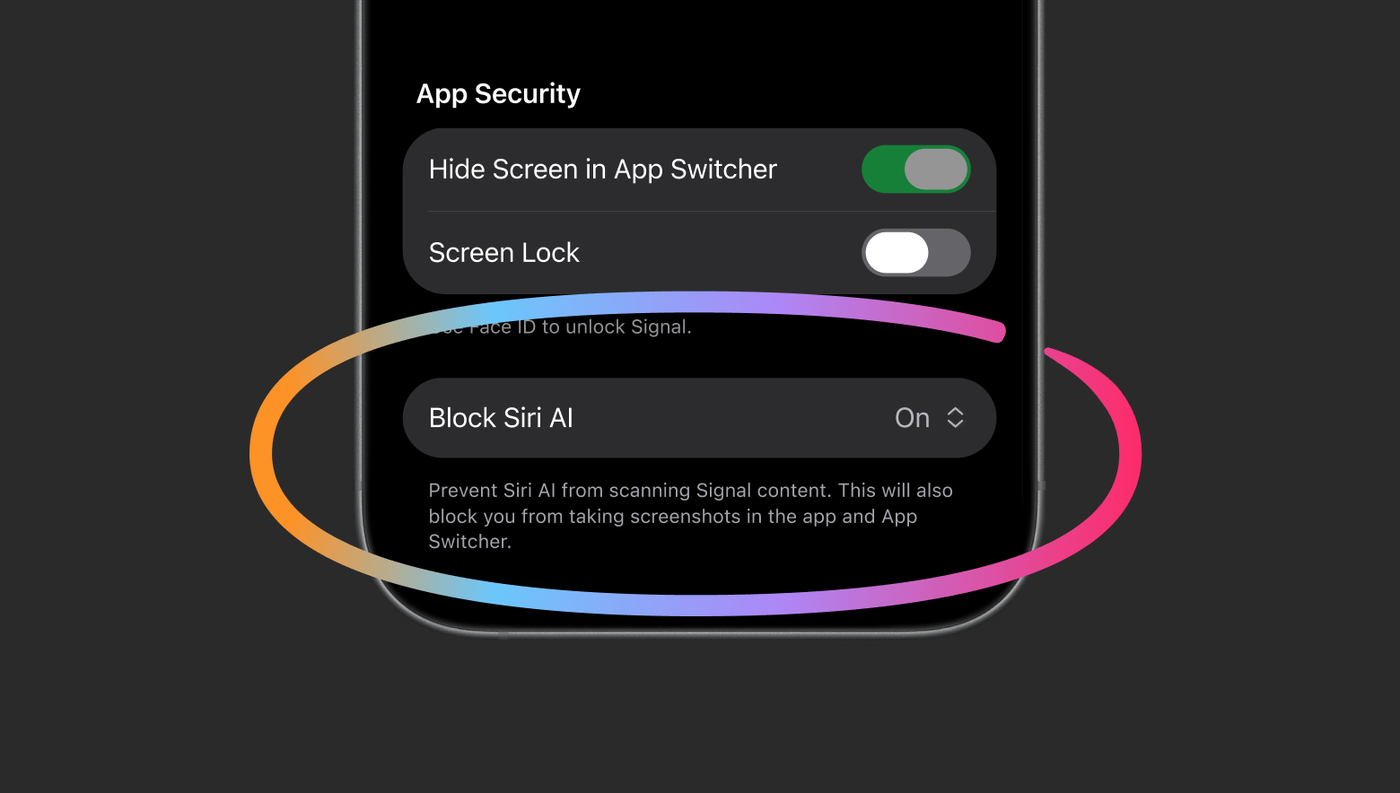 Figure: Signal for iOS adds dedicated defensive toggles to block system AI inspection. Source: signal.org
Pixels Can Be Masked, but the File System Remains Exposed
A grimmer engineering reality remains: blocking visual output merely plugs the most conspicuous exfiltration route. In its accompanying technical whitepaper, Signal’s engineering team candidly admitted that restricting screenshots does not form a comprehensive perimeter. System-level agents operate with root privileges, granting them carte blanche to bypass graphical layers and inspect underlying files directly.
High-resolution media, voice memos, and local databases generated by messaging apps sit inside application sandboxes. Mobile operating systems hold native, unfettered access to these files. System agents can traverse the file system under the guise of background indexing. While a phone charges overnight, offline assets are routinely parsed for multimodal feature embeddings. End-to-end encryption shields the network packet; cached files on disk remain completely exposed to platform analysis.
Desktop operating systems provide even flimsier bulwarks. On Apple’s latest macOS 27, developers found zero official APIs for third-party screenshot suppression. Apple’s existing display protection primitives remain strictly reserved for DRM-protected streaming media. Commercial video copyright receives rigorous platform defense, while private human conversations are denied access to the same safeguards.
For macOS users, the sole recourse is manually adding Signal to Siri’s global exclusion list in System Settings. Shifting this burden onto consumers leaves the vast majority silently exposed. Third-party agents exacerbate the crisis: Meta’s Muse assistant was recently discovered abusing accessibility APIs to scrape data from adjacent applications. Channels originally designed to assist visually impaired individuals have been co-opted into automated pipelines for harvesting private text.
Big Tech Rewrites the Environment: Developers Need an Opt-Out Switch
Apple, Google, and Microsoft form the foundational operating environment of modern consumer computing. For millions of independent applications, the operating system is the ocean in which they swim. Today, these three platform gatekeepers have unilaterally altered the salinity and temperature of the water without consulting the broader ecosystem.
Over recent months, Signal’s security team conducted extensive forensic audits across iOS and Android. Engineers sought to trace the memory pipelines and intermediate caches used when system AI harvests onscreen data. Yet within official developer portals, comprehensive technical documentation is nowhere to be found. Screen ingestion occurs entirely inside proprietary black boxes, leaving security auditors with little more than fragmentary system call traces.
In response, Signal has issued two core demands to the three platform giants. First, operating systems must provide a standardized, programmatic opt-out mechanism. This switch must cleanly cover screen capture, disk indexing, push notifications, and clipboard pipelines without degrading baseline app features as a penalty. Second, platforms must publish transparent architecture whitepapers detailing agent data lifecycles—explicitly delineating what is processed on-device versus what is offloaded to remote data centers.
While platform vendors argue that hardware-isolated confidential computing addresses these privacy concerns, Signal firmly rejects the claim. Confidential computing leaves auditing authority and governance solely in the hands of silicon and OS providers. Unless the foundation provides transparent, enforceable opt-outs, hardware security enclaves remain unaccountable black boxes. Both users and developers remain trapped in non-consensual trade-offs.
The Canary in the Coal Mine: Privacy Cannot Be Defended by a Single App
In October 2026, the Electronic Frontier Foundation (EFF) secured an initial concession: Apple agreed to allow per-application exclusion toggles in system settings. Yet this falls far short of structural reform. When privacy requires users to hunt through dozens of nested system menus, defense in depth ceases to exist in practice.
Signal views its stance as a canary in the coal mine. When toxic fumes spread through the tunnels, the most sensitive creature reacts first. Signal’s screenshot lockout is an urgent alert: applications handling banking, healthcare, legal counsel, and proprietary corporate intelligence are all careening toward platform-enforced AI perimeters.
Developer communities spent two decades standardizing and deploying end-to-end encryption. Against system-level AI, that entire architecture faces structural obsolescence. If operating system vendors treat every display pixel as free training fodder, no independent software team can defend user sovereignty with application code alone. The boundaries of digital privacy require wholesale renegotiation across the industry. The canary’s alarm is ringing, and the window to rebuild an enforceable social contract is closing fast.
References:
- Signal Official Technical Statement
- EFF Digital Privacy Exclusion Evaluation Report
- Apple iOS Developer Security & Screen Access Guidelines
- Google Android Agent Permission Architecture Overview
- Microsoft Recall Architecture Evolution and Data Isolation Specifications