Exhausted Patients Flood the Clinic: Appointments Driven by Testosterone
A professional woman in her thirties returns home after working overtime, gets washed up, and collapses into bed, completely depleted. When her partner reaches out for intimacy, all she feels is reluctance and guilt.
Long work hours have drained her physical stamina, leaving her body’s response to affection on mute. Routine medical checkups show everything within normal ranges, yet her libido and sexual desire have persistently flatlined.
Dr. Jessica Yih, a urologist at UC Irvine Health, has been fielding an influx of inquiries. Requests for solutions to restore sexual desire are coming from “every single corner,” spanning women across virtually every age bracket.
Under physician guidance, many patients have turned to testosterone—the steroid hormone that governs vitality and desire. Following regular micro-dosing of topical gel or scheduled injections, their sensory responsiveness gradually returns. Physical intimacy, once actively avoided, regains its long-lost warmth.
 Fig: Overlapping silhouettes of four women: female bodily and emotional experiences vary widely. Source: Science News (Getty)
Yet every single patient is relying on off-label use—prescribing medication for an indication not officially sanctioned by regulatory agencies. Because formulations are designed strictly for men, women are forced to manually dilute creams or split doses themselves.
The Overlooked Biological Mainstay: Women Naturally Have More Testosterone
In popular culture, testosterone is almost universally associated with facial hair, deep voices, and muscular physiques. Many assume women rely exclusively on estrogen, regarding androgens as biological taboo.
Biological reality contradicts this persistent stereotype. Throughout a woman’s reproductive years, testosterone is a vital, dominant active hormone. Secreted jointly by the ovaries and adrenal glands, circulating levels of bioactive testosterone consistently exceed those of estrogen.
Research published in The Lancet Diabetes & Endocrinology unpacks the underlying mechanism: testosterone acts directly on the central nervous system, lowering the brain’s threshold for recognizing sexual cues.
It simultaneously promotes vascular engorgement across pelvic tissues, elevating blood flow perfusion and nerve ending sensitivity throughout the region.
When women transition into perimenopause or navigate chronic psychological stress, hormone levels can plummet. This frequently triggers Hypoactive Sexual Desire Disorder (HSDD)—a formal clinical diagnosis defined by a persistent lack of sexual desire that causes marked personal distress.
Entrenched gender biases in medical research have long trivialized testosterone’s broad utility. Countless women have silently endured the loss of intimacy during midlife, rarely offered targeted physiological interventions.
Prescriptions Surge Nearly Fourfold: Young Adults Lead the Rapid Climb
Faced with a complete absence of officially approved treatments, grassroots demand has manifested in explosive epidemiological data. Healthcare analytics platform Truveta published a comprehensive 2026 study tracking millions of patients across the United States.
The findings show that testosterone prescription rates among American women surged over the past six years. The rate climbed from 0.4 per 1,000 women in 2018 to 1.8 per 1,000 in 2026—an increase approaching 400%.
In tangible terms, roughly one out of every 550 women in the U.S. is currently taking testosterone. Crucially, young women aged 18 to 34 represent the fastest-growing demographic.
Prescription rates within this younger bracket more than doubled over the six-year window, completely dismantling the traditional assumption that hormone therapy is exclusively relevant to middle-aged and older individuals.
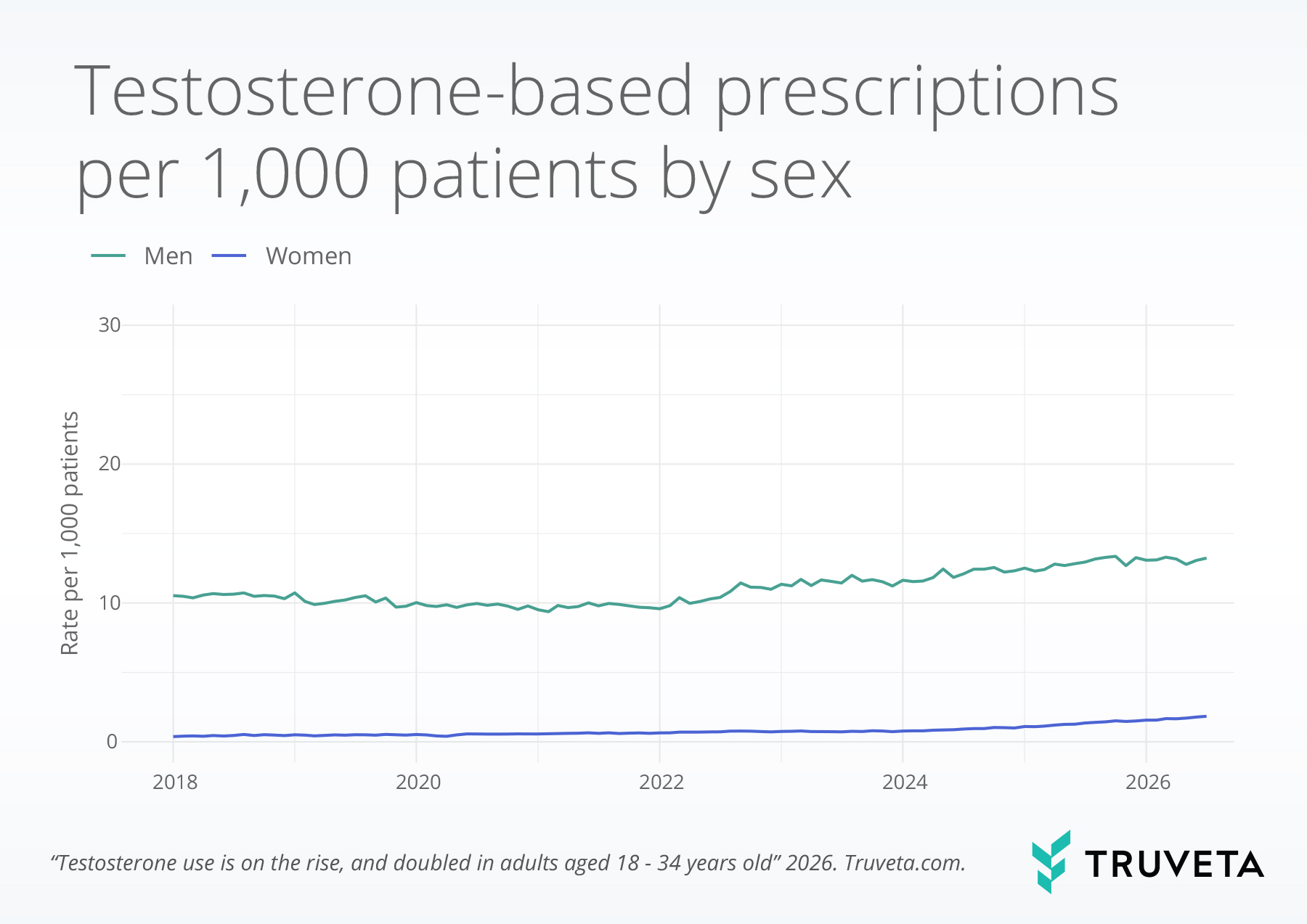 Fig: Trends in testosterone prescription rates in the U.S. from 2018 to 2026. Source: Truveta Research (Truveta)
Dispensing data across different delivery methods also shows dramatic shifts. Dispensed injectable formulations for women surged by 88%, while topical transdermal gels grew by 27%.
Millions of women have bypassed prolonged regulatory reviews, voting with their own actions in daily life. This immense real-world demand has thrust conservative drug regulation directly into the spotlight.
Beaten by Placebos in Clinical Trials: A Twenty-Year Regulatory Impasse
Faced with skyrocketing clinical demand, global regulatory frameworks have diverged sharply. While the United Kingdom and Australia have long approved low-dose testosterone formulations for women, the U.S. Food and Drug Administration (FDA) has yet to approve a single product.
The American standstill stems from a complex twenty-year regulatory history. In 2004, an FDA advisory committee voted unanimously against approving an intrinsa testosterone patch, citing insufficient long-term cardiovascular and breast safety data.
In 2011, two subsequent large-scale Phase III trials met another major setback. Trial data failed to demonstrate a statistically significant separation between the active treatment group and the placebo arm.
Dr. Tami Rowen, an obstetrician and gynecologist at UC San Francisco (UCSF), analyzed the outcome. Sensationalized media hype framing the treatment as “female Viagra” inflated psychological expectations so high that control subjects taking simple starch pills experienced profound subjective improvements.
This powerful placebo effect derailed the trials. As Dr. Rowen put it, the drug was effectively a “victim of its own success.”
She emphasized: “Women deserve better than placebo.” The failed trials left pharmacological research across the sector largely frozen for well over a decade.
A turning point arrived on September 17, 2026. The FDA’s Office of Women’s Health convened its inaugural public scientific workshop on testosterone therapy for postmenopausal women. Dr. Kaveeta Vasisht, Associate Commissioner for Women’s Health at the FDA, stated explicitly that the agency aims to clear hurdles for future dedicated research.
Lingering Safety Uncertainties: Hype Overshadows Monitoring Deficits
Emerging regulatory openness does not mean off-label usage is free of danger. Investigations across medical outlets like JAMA and Medscape highlight troubling diagnostic blind spots.
Among newly prescribed patients, the vast majority have never received a formal diagnosis of Hypoactive Sexual Desire Disorder. Many never have their serum free testosterone levels evaluated before or during therapy.
A lack of baseline and ongoing monitoring introduces immediate risks. Because available formulations are manufactured for male physiology, women who manually dilute products risk substantial dosing errors. Excessive androgen supplementation can trigger virilization, including cystic acne, hirsutism, male-pattern hair loss, and irreversible vocal deepening.
Long-term safety profiles remain equally unresolved. Whether continuous exogenous testosterone use over several years increases the risk of breast cancer or adverse cardiovascular events remains an open question in reproductive endocrinology.
Hormones are not the only therapeutic pathway available. The FDA previously approved flibanserin (an oral multifunctional serotonin agonist-antagonist regulating dopamine and serotonin signaling) and bremelanotide (an injectable melanocortin receptor agonist).
A 2025 expert consensus from the International Society for the Study of Women’s Sexual Health underscored that psychotherapy combined with flibanserin continues to offer the strongest evidence base. Meanwhile, Phase III clinical trials are advancing in Europe for Lybrido, an investigational dual-action compound targeting both central neurobiology and peripheral blood flow.
The widespread off-label embrace of testosterone reflects a decades-long systemic oversight in mainstream medicine regarding women’s sexual wellness. Regulatory frameworks stalled twenty years ago have fallen far behind clinical reality. Only by establishing female-specific clinical guidelines and rigorous longitudinal monitoring can this deeply personal healthcare movement transition out of the gray market.
Reference Links:
- Science News Report: The libido drug women want is testosterone
- Truveta Research Report: Analysis of testosterone prescription growth in U.S. adults
- FDA Official Meeting: Scientific workshop on testosterone use in postmenopausal women