On November 21, 2026, the 167-year-old Riemann Hypothesis was met with two simultaneous claimed resolutions. A young researcher, working alongside Anthropic’s Claude, submitted 17 million lines of machine-checked code. Meanwhile, another mathematician emerged from twelve years of solitary labor with a 940-page handwritten manuscript. Their collision on the very same day sent shockwaves through the pure mathematics community.
The clash erupted without warning. Forced to stake a claim against an impending barrage of automated code, the human manuscript was released so hastily that parts of its table of contents remained blank. Yet the deeper tension lies in the nature of mathematical proof itself: the machine produced an ironclad deductive chain that simultaneously locked out human understanding.
Sunday Midnight Code Drop Triggers Rush on Twelve-Year Manuscript
Late on a Sunday night, mathematician Levent Alpöge submitted the code. Working in conjunction with Claude, he claimed to have resolved the Riemann Hypothesis and extended the result to the Generalized Riemann Hypothesis (GRH). Written entirely in Lean, the proof was packaged into 14 archives expanding to 1.3 GB. At roughly 17 million lines of code, it presents readers with an overwhelming library of formal symbols.
Alpöge was well aware of the gravity—and the awkwardness—of the release. In an accompanying note, he admitted the timing was terrible, having emailed Anthropic late on a Sunday night to clear necessary permissions. While acknowledging the resulting argument is sprawling and bloated, he expressed confidence in the validity of the logical chain. He openly described the work as preliminary, remarking that the colossal proof would likely soon be drastically simplified.
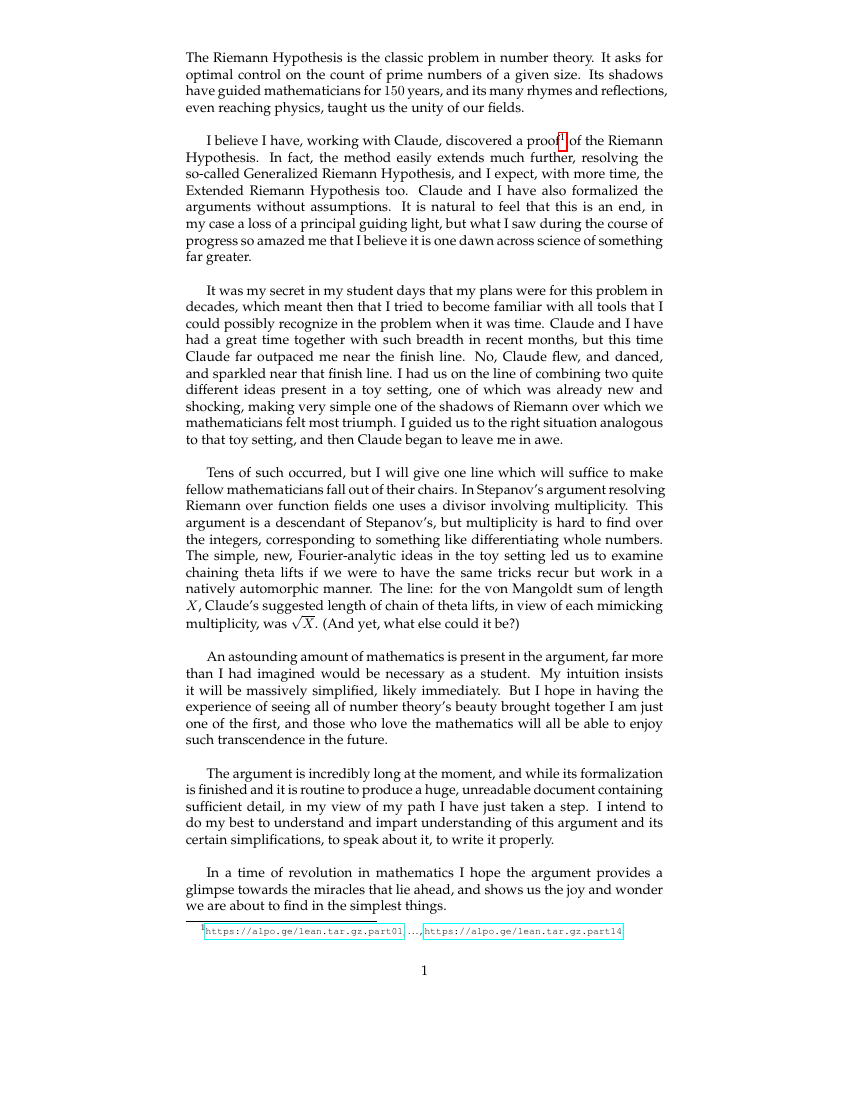 Figure: The first page of Alpöge’s announcement (remark.pdf), with a footnote linking to the 14 compressed archives. Source: alpo.ge
Across the continent, fellow mathematicians were caught completely off guard. Stanford mathematician Ravi Vakil, attending a conference, scrambled during an intermission to draft an urgent announcement. Independent scholar Alessandro Masullo had spent twelve years penning a 940-page treatise titled The Melodies of the Primes. Number theorist Brian Conrad had already spent months vetting the manuscript page by page, offering positive assessments.
In his hurried note, Vakil emphasized that Masullo’s manuscript was entirely human work, produced without any assistance from artificial intelligence. Stanford had originally planned to host Masullo for a year-long visiting position to polish the work before any public release. But the sudden Lean release upended those plans, compelling the team to publish their draft immediately to secure a cryptographic timestamp. In the rush, Section 1.1.1 of the manuscript was left completely blank.
At 250,000 Pages, Output Breaks Human Scale: No Mathematician Can Read 14 Tarballs
While 17 million lines of code represents a massive codebase in software engineering, in pure mathematics it is utterly unprecedented. Formatted as a standard two-column academic journal article, that amount of code would span approximately 250,000 pages. A professional mathematician reading continuously day and night would require several lifetimes to finish it. Traditional peer review simply collapses under this scale.
By eliminating every deduction gap, the machine erected a cognitive wall. While Masullo’s 940-page manuscript is imposing, experts can discern its main architecture over several months of study. Alpöge’s 14 compressed archives, however, exceed the biological limits of the human mind. Confronted with millions of fragmented lemmas, no single reader can yet explain what the overarching geometric or conceptual idea actually is.
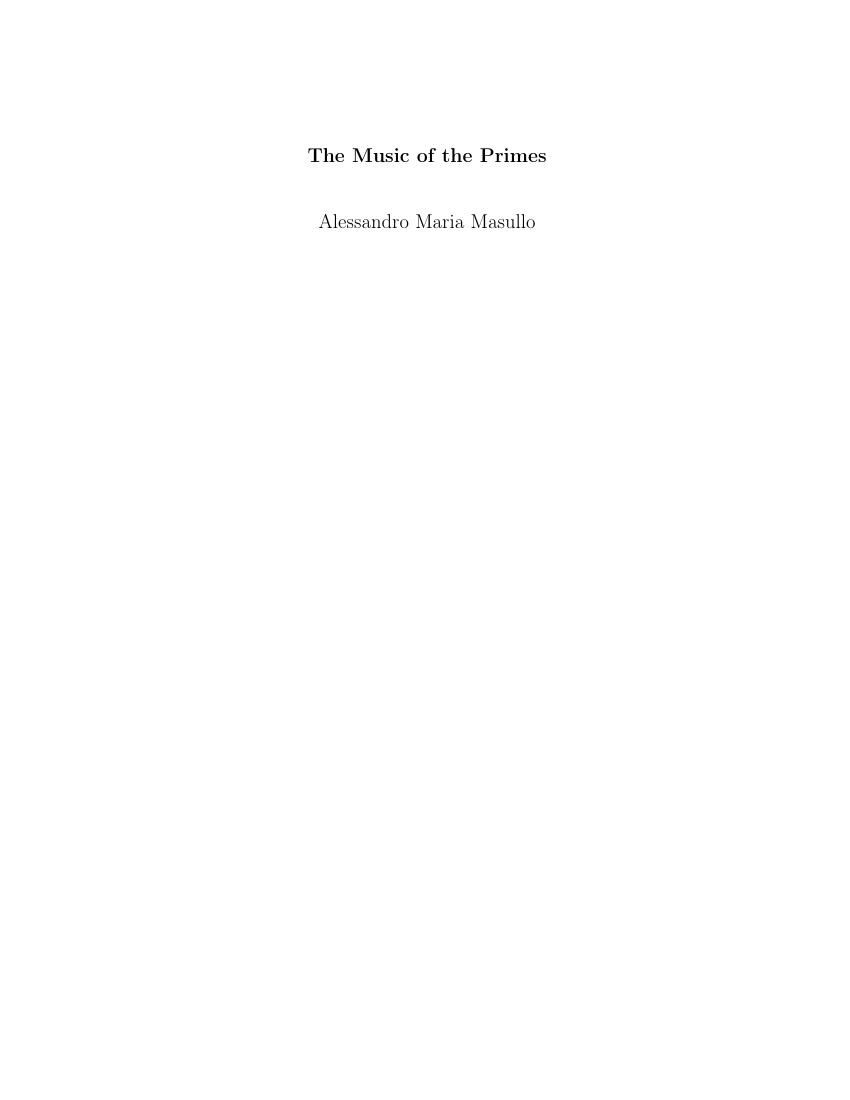 Figure: Cover page of Alessandro Masullo’s 940-page manuscript, crafted over twelve years. Source: math216.wordpress.com
The essence of intellect often lies in information compression. Comparing 940 pages against 250,000 pages highlights a profound divergence in how humans and machines grasp truth: a ratio of over 250 to 1. Human mathematics searches for illuminating insights, aesthetic unity, and conceptual leaps. Machines, by contrast, assemble local truths through brute-force combinatorial search and infinite formal rewrites. As Alpöge noted in his remark, his intuition suggests the argument will undergo dramatic conceptual compression—perhaps very quickly.
When Compilers Replace Peer Review: Formal Verifiers Once Proved 0 = 1
For centuries, mathematical credibility rested on human peer review: colleagues scrutinizing arguments, probing hidden assumptions, and arriving at collective consensus. Now, 17 million lines of Lean code bypass human deliberation entirely, placing ultimate judgment into the hands of a terminal compiler. As long as the code passes type-checking, the proof assistant displays a green light.
Yet algorithmic certification is not without its own perils. Theoretical computer scientist Scott Aaronson highlighted the underlying vulnerabilities: the Lean kernel has historically suffered from critical soundness bugs, including one that permitted proving 0 = 1 through an unsound definitional equality rule. The certitude offered by a machine is only as solid as the codebase of its proof engine.
Even with these caveats, the local reliability of formal verification remains staggering. Aaronson noted that to date, not a single result bearing a Lean certificate has been retracted, whereas conventional mathematical literature has seen numerous retracted papers. Fields Medalist Terence Tao cataloged several major breakthroughs on the same day, drawing parallels between singular fluid dynamics analysis and Alpöge’s announcement. Tao observed that the primary arena for checking and simplifying the proof has already migrated to the Lean developer forums.
Thousands of Theorems Await Grounding: Answers Arrive Without Understanding
Formulated 167 years ago, the Riemann Hypothesis remains the cornerstone of number theory. The Generalized Riemann Hypothesis underpins an enormous fraction of modern mathematics; thousands of published papers take its validity as an explicit premise, and algorithms such as the Miller-Rabin primality test rely on it for conditional guarantees.
If the hypothesis is established, vast mathematical structures will be validated simultaneously. Yet confronted with code certified by a machine, mathematicians find themselves in a bizarre predicament: the system delivered a definitive yes, but offered no proportional insight. Mathematicians may know the theorem holds, yet remain unable to extract the foundational ideas needed to advance the discipline.
A machine that connects formal statements across millions of steps cannot articulate why that specific trajectory works. Mathematics has always sought understanding of underlying structures, not merely true-or-false receipts. When a breakthrough fails to spark human insight, its utility in propagating knowledge is severely diminished. Formal proof assistants have untied the deductive knot while leaving a gaping cognitive void.
Cryptographic Timestamps Cannot Guard Conceptual Priority
The simultaneous appearance of two radically different proofs sparked palpable anxiety across academia. Some researchers suggested that mathematicians should hash their draft papers and publish cryptographic timestamps to protect priority against automated agents. This defensive impulse underscores the growing apprehension surrounding algorithmic research. Yet throughout the history of science, priority has rarely been decided by raw timestamps alone.
Aaronson asserted that the mathematical community will not be truly convinced by 17 million lines of code until the underlying insights are synthesized, understood, and communicated in human terms. That transformation typically takes years, constrained by the biological speed of human cognition. Faced with an explosion of machine output, mathematics retains its own deliberate rhythm of intellectual digestion.
Both rushed preprints now hover at a historical crossroads. On one side lies a torrent of formal code awaiting human interpretation; on the other, a massive handwritten scroll waiting for its gaps to be closed. The machine has accelerated deductive verification beyond recognition, yet it cannot bypass the patient journey of the human mind seeking to understand truth. As the wave of formalization gathers pace, the ultimate destiny of mathematics still hinges on whether humans can truly grasp what has been proved.
References:
- Scott Aaronson’s blog commentary
- Terence Tao’s blog overview
- Ravi Vakil’s announcement regarding Masullo’s manuscript
- Levent Alpöge’s formal proof announcement