On November 17, 2026, Microsoft unveiled seven proprietary large language models at its Ignite developer conference. Notably absent from the keynote screens were absolute dollar figures. In their place were aggressive comparative discount tags: 2%, 5%, and 20% of competitors’ prices.
The pricing mechanics of the AI industry have shifted. Over the past two years, leading AI labs sustained hefty profit margins and steep API bills by competing for benchmark high scores. Microsoft has charted a different course: deliver more than 90% to 98% of rival capabilities, then undercut market pricing with steep, cliff-like cost reductions.
Seven New Models: Pricing Pegged Directly to Competitor Percentages
The new family of models spans cybersecurity, code generation, multimodal imagery, and real-time audio. The most striking departure lies in how they are priced.
In artificial intelligence, a token represents the basic unit of text processed by a model—typically corresponding to several characters or part of a word. Traditionally, providers published rates calculated per million input and output tokens.
Microsoft bypassed these complex per-unit calculations entirely. Competitors became direct benchmarks for discount targets. Positioned for network offense and defense, MAI Cyber 2 Flash pushed this price war to its logical extreme.
On the industry-standard CyberGym-E2E benchmark, which evaluates automated security testing, vulnerability patching, and offensive-defensive simulations, the model outperformed GPT-6 Astra. Yet when executing the identical benchmark workload, Microsoft’s cost was less than 2% of its rival’s fee.
 Figure: MAI Cyber 2 Flash cost and quality comparison against competing offerings in cybersecurity benchmarks. Source: Microsoft AI (Ignite 2026 Keynote).
Slashing single-task costs to one-fiftieth alters engineering economics. Previously, scanning millions of lines of codebase required formal enterprise budget approvals. Today, automated penetration testing and vulnerability auditing can run directly inside continuous integration pipelines.
Reaching 98% Capability While Slicing API Expenses in Half
The cost reductions in code generation and multimedia have an immediate impact on developers. For programming tasks, Microsoft introduced two flagship offerings.
According to official Microsoft metrics, MAI Code 2 achieves 98% of GPT-6.1 Sol’s code quality at approximately 40% of the price. Compared against Anthropic’s flagship Opus 5.5, it maintains 96% of the output quality while costing a mere 5% of the API fee.
The lightweight MAI Code 2 Flash targets ultra-low latency. Its composite capability rivals GPT-6 Luna at 65% of the cost, while undercutting the comparable Haiku 5.5 tier by 80% (selling at just 20% of its price).
 Figure: Quality and price positioning of the MAI Code 2 series across coding benchmarks. Source: Microsoft AI (Ignite 2026 Keynote).
For complex logical deductions, Decision 1.1 operates 50 times faster than GPT-6.1 Sol at 1/79th the cost. The multimedia portfolio underwent similar downward revisions.
MAI Image 2.7 claimed top honors on the Artificial Analysis image editing leaderboard, yet its API invocation fee is one-fifth of tier-one alternatives.
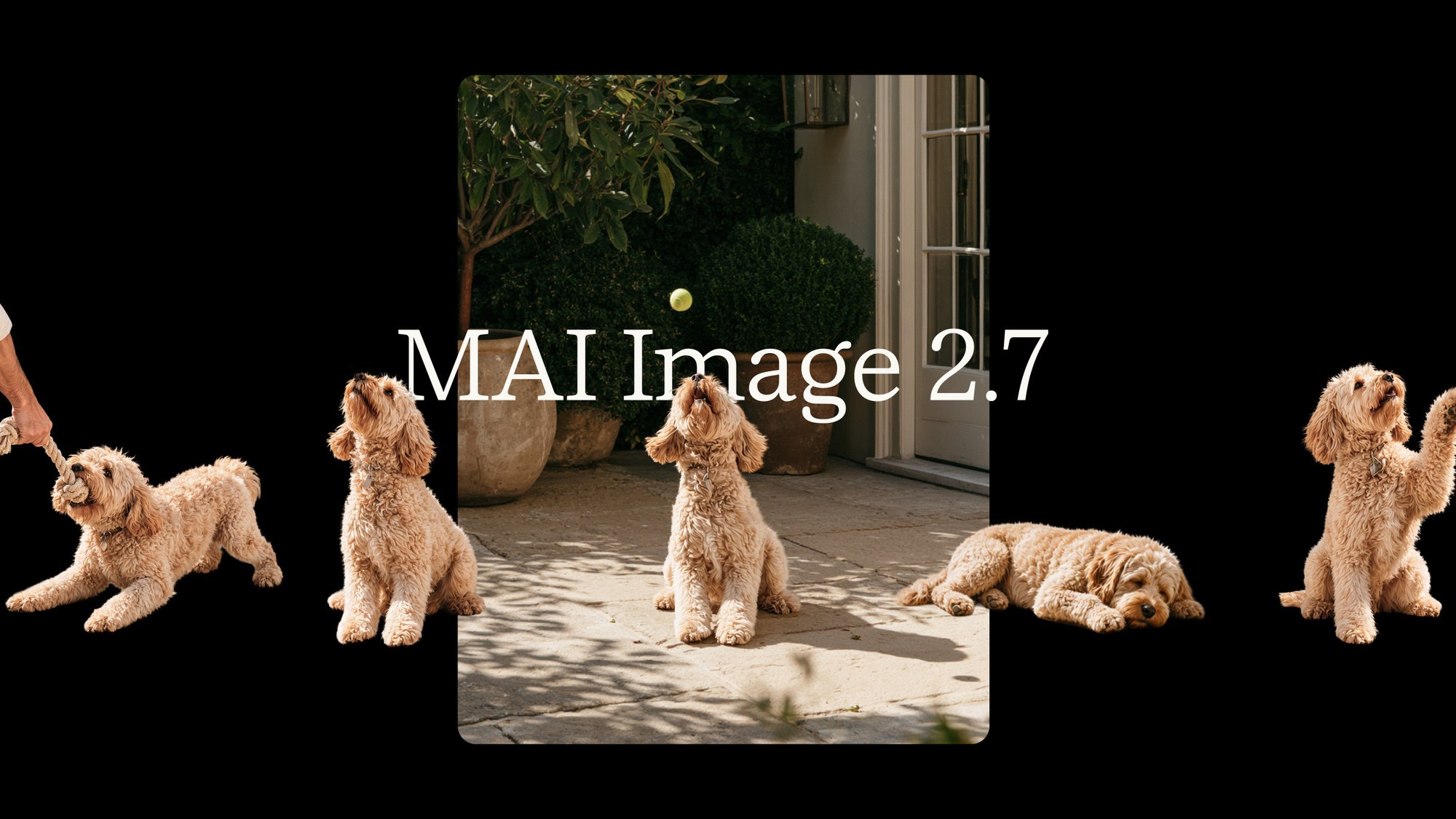 Figure: MAI Image 2.7 image editing benchmark rank and inference costs. Source: Microsoft AI (Ignite 2026 Keynote).
The audio model MAI Realtime 1 begins at $0.01 per minute of audio stream, outpacing GPT-Realtime 2.1 in round-trip latency. Powering tens of millions of monthly medical transcription dialogues, its multilingual error rate dropped by half.
These disclosures communicate an unmistakable strategy: Microsoft is stepping back from chasing elusive benchmark supremacy. By stabilizing model quality at 95% to 98% of frontier parity and pricing at a fraction of competitors, it aims to capture enterprise adoption across production workloads.
In-House Silicon Hits Volume: Cloud Giants Wage a War of Hardware Attrition
Slashing prices so dramatically is not a loss-leader gamble. Microsoft’s confidence stems from vertical integration down to the underlying silicon.
Alongside the model family, Microsoft announced volume mass production of its second-generation in-house AI accelerator, Maia 200. Optimized explicitly for the MAI architecture, these chips are already handling primary production inference clusters.
A vital efficiency metric in datacenter silicon is tokens-per-watt—the volume of text tokens generated per watt of electric power consumed. Official data indicates Maia 200 delivers a 1.7x increase in tokens-per-watt when serving Microsoft’s largest proprietary architectures.
Building upon hardware gains, Microsoft confirmed the expansion of Azure Maia datacenters to multi-gigawatt scale. A single gigawatt represents one billion watts—approximating the sustained generation capacity of a commercial nuclear reactor unit.
Custom silicon bypasses the vendor premiums of merchant GPUs, while multi-gigawatt buildouts compress marginal electrical and cooling costs. Independent foundation labs leasing external clusters face compounded margins at every layer; a vertically integrated cloud titan amortizes hardware depreciation across its enterprise software stack. Microsoft is competing for long-term Azure commitments—aggressive model pricing serves as the opening wedge.
Two Lines of Code to Switch: Foundation Models Become the New Electric Motor
This pricing disruption underscores a foundational technical reality: switching costs between leading LLMs have approached zero. Microsoft emphasized that enterprises require sustainable pricing to operate autonomous agents 24/7—programs capable of tool calling and complex multi-step execution.
Technical observers have compared large language models to the electric motor of the late 19th century. The electric motor powered the Second Industrial Revolution, delivering immense societal value. Yet no individual manufacturer extracted outsized monopoly rents merely by winding standard copper armatures.
Modern model interfaces are undergoing identical standardization. API schemas across major providers are virtually interchangeable. By modifying just two lines in a codebase—the base URL and the authorization token—an enterprise can migrate workloads onto lower-cost alternatives.
There are no proprietary file formats or complex architectural dependencies locking users in. When capability gaps are indistinguishable in real-world workflows, procurement decisions invariably favor lower costs.
The End of Frontier Premiums: Financial Markets Recalculate AI Economics
On the exact same day, Google unveiled Gemini 4 Neon and Genie 4. The window during which a frontier model commands uncontested superiority has collapsed from twelve months to mere weeks.
Rival engineering teams worldwide are closing capability differentials at unprecedented speed. This compression of competitive advantage is the primary catalyst igniting the pricing war.
Capital markets are visibly bifurcating. Investors are recalculating the economic returns of frontier foundational labs. If billions in capital expenditure secure only an eight-to-twelve-week competitive moat, relying solely on API token margins cannot justify staggering market valuations.
Technological optimists offer a counterpoint: commoditization currently threatens general coding and standard conversational queries, whereas breakthrough frontier architectures remain indispensable for scientific discovery and open-ended research.
While debates persist, enterprise procurement priorities have undeniably turned. When Microsoft projects “2% of competitor pricing” onto a keynote screen, the AI landscape shifts from speculative capability races to ruthless cost optimization. Any technology that can be discounted by percentages against rivals has officially transitioned into a standard, interchangeable industrial utility.
Reference links:
- Microsoft AI Official Announcement
- Hacker News Community Discussion
- Artificial Analysis Leaderboard Rankings