A collaborative research team from Duke University, UIUC, and Harvard University has introduced a miniature model with just 1.8 million parameters to the demanding arena of algorithmic reasoning. Evaluated on the widely recognized Sudoku-Extreme benchmark, this tiny network achieved a 99.9% test accuracy while consuming only 1/345th of the computational budget required by top-tier competing models.
The work, titled Energy-Based Reasoners, was published on arXiv (arXiv:2611.08977) by authors William Xingxu Chen, Alexi Gladstone, Zeyu Michael Li, Heng Ji, and Yilun Du. Rather than following the conventional path of scaling model parameters to brute-force reasoning capabilities, the researchers equipped the recurrent reasoning loop with an explicit progress metric, allowing the model to autonomously evaluate and steer its intermediate latent states.
Conventional Looped Reasoning: Blind Sprints with No Finish Line
In contemporary algorithmic reasoning research, Looped Reasoning Models have attracted significant attention. Instead of stacking dozens of transformer layers, these architectures execute the same compact network block recurrently over multiple iterations. The model iteratively refines a latent state—a high-dimensional vector capturing the ongoing reasoning trajectory. The design premise is intuitive: grant the network more computational cycles, and the logical chain will progressively fall into place.
However, standard looped reasoning models suffer from a fundamental drawback: they lack an internal metric to assess the quality of their current state. Operating on a fixed, predefined number of steps, the model cannot gauge how close its latent derivation is to the correct solution, nor can it detect when intermediate revisions begin to drift off course.
This setup resembles asking a problem solver to run blindfolded through a maze. If the protocol prescribes running for thirty steps before submitting an answer, the solver must charge forward regardless of whether they stumbled upon the exit at step ten or hit a dead end at step three. In the former case, computation runs needlessly; in the latter, the model fruitlessly circles inside a cul-de-sac. Iterating repeatedly without intermediate evaluation essentially reduces reasoning to an expensive roll of the dice.
The absence of an evaluation yardstick also incurs severe computational waste. To ensure challenging problems are solved, engineers routinely configure high iteration ceilings. For trivial instances that could be solved in a few steps, compute continues to spin in place. For difficult instances that derail early on, every subsequent iteration becomes pure sunken cost.
Learning an Energy Function: Descending the Gradient to Valid Solutions
The research team fundamentally overhauled this dynamic by introducing an energy function defined over the latent reasoning state. In statistical physics and machine learning, energy functions quantify the instability or incompatibility of a configuration. Here, the energy function evaluates the compatibility between the problem input and the current latent state: lower energy signifies higher consistency with a valid solution.
With this energy landscape in place, the previously opaque reasoning process acquires a topological map. Every update to the latent state is formulated mathematically as a step along the negative gradient. Because the negative gradient points in the direction of steepest energy decrease, it functions as an internal compass guiding the state toward the nearest minimum. The energy function scores state quality, while its gradient dictates the trajectory of refinement.
Even more crucial is the convergence criterion. As reasoning approaches a valid solution, the local energy terrain flattens, and the gradient norm shrinks dramatically. Once the gradient norm drops below a calibrated threshold, the model determines that a stable, optimal solution has been reached, terminating computation immediately.
Problem Input x ───> Initial Guess z₀ ───> Compute Energy E(z; x) & Gradient ∇z E
                                                          │
                                ┌─────────────────────────┘
                                ▼
                   Update State z along -∇z E ───> Is ||∇z E|| < Threshold?
                                │                               │
                               No                              Yes
                                │                               ▼
                                └───────────────> Output Solution & Halt Compute
To prevent the energy landscape from forming spurious local minima, the authors incorporated exploratory contrastive training. The training procedure samples broadly across the latent space, intentionally pushing up energy for incorrect configurations while carving a deep global basin for valid solutions. This leaves the landscape smooth and well-behaved. When multiple valid configurations exist, the model can navigate the terrain to select candidates residing in the lowest energy valleys.
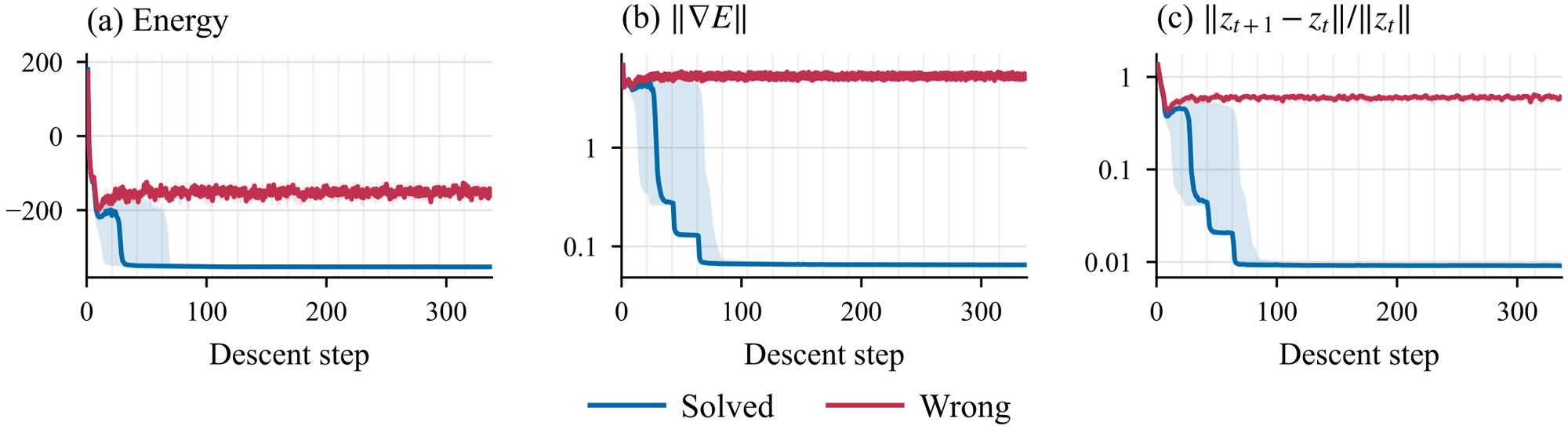 Figure: Evolution of energy, gradient magnitude, and residual errors across reasoning steps. Successful trajectories rapidly converge to low-energy steady states, whereas failing trajectories oscillate persistently without decaying to zero. Source: Energy-Based Reasoners project page.
Empirical convergence curves clearly illustrate this distinction. In successful derivations, both energy and gradient norm plunge within very few steps, stabilizing at a deep plateau. In unsuccessful derivations, the trajectory meanders, and the gradient norm fluctuates persistently at elevated levels—a clear diagnostic that reasoning has gone astray.
1.8M Parameters Outperform 5x Larger Baselines: Adaptive Stopping Slashes Compute by 345x
Armed with directional guidance and an automatic brake, the 1.8M-parameter model outperformed competitors several times its size. On the demanding Sudoku-Extreme benchmark, baseline models typically employ between 5M and 10M parameters.
In single-sample generation, the energy-based model attained 99.4% accuracy. In comparison, established models lagged substantially: TRM scored 87.4%, EqR reached 93.0%, FPRM scored 94.2%, GRAM managed 86.6%, and the top-performing Looped Flows plateaued at 97.9%. When scaled to 5 samples, the energy model climbed to 99.9% accuracy. By contrast, the prior state-of-the-art model, EqR, required generating 128 samples just to approach 99.8%.
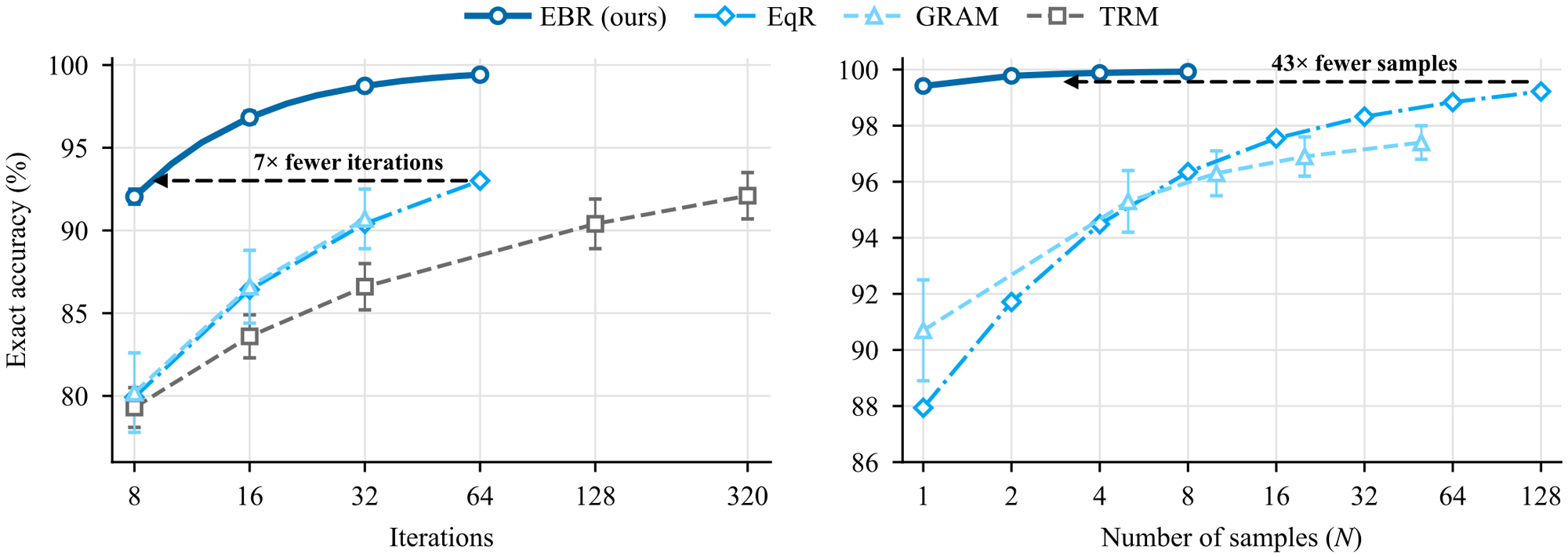 Figure: Accuracy progression on Sudoku-Extreme as a function of iteration steps and sample budget. With only 5 samples, the energy-based model eclipses competitor baselines requiring 128 samples. Source: Energy-Based Reasoners project page.
The disparity in compute consumption is even more striking. Traditional models incur heavy computational overhead by executing fixed recurrence depths. In contrast, the energy model adaptively halts execution as soon as gradient norms drop below threshold. Compared to its own fixed-depth variant, adaptive stopping eliminates 10.9x of floating-point operations (FLOPs). When compared against the standard EqR baseline, the overall compute advantage widens to 345x. Halting execution immediately upon reaching a solution collapses reasoning overhead from orders of magnitude down to near-zero waste.
The architecture displays similar efficiency in test-time scaling. To match the peak accuracy of baseline competitors, the energy model requires 7x fewer recurrence iterations and reduces sample requirements by a factor of 43x.
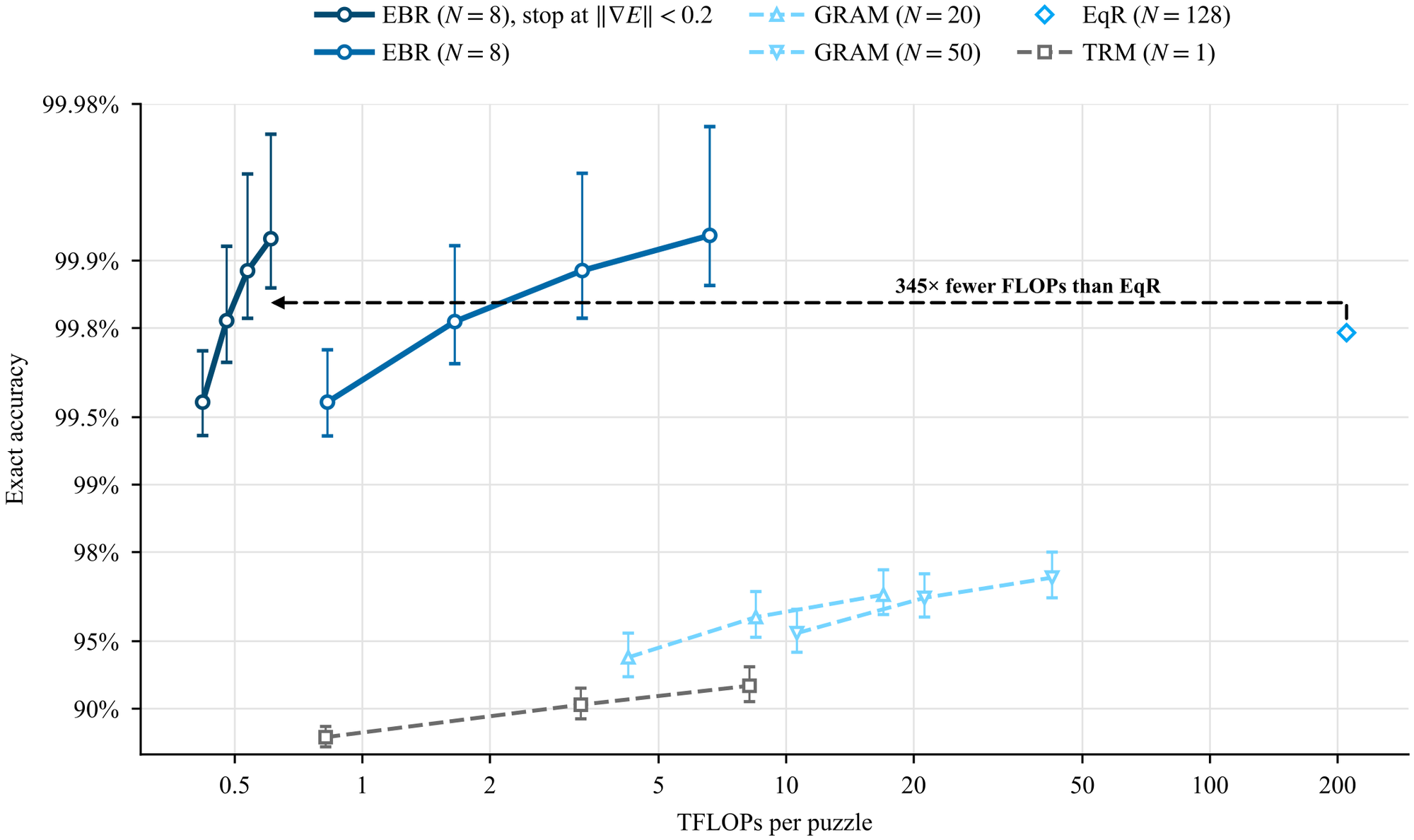 Figure: Trade-off between Sudoku-Extreme accuracy and computational cost per instance. The adaptive stopping mechanism bypasses redundant iterations while maintaining peak accuracy, yielding a 345x compute advantage. Source: Energy-Based Reasoners project page.
This directed optimization holds up across tasks with multiple valid solutions. In the 10x10 N-Queens extension, single-sample pass rate reached 99.5%, compared to 89.7% for GRAM and 17.5% for TRM. On graph coloring tasks across 8-vertex and 10-vertex graphs, constraint conflicts dropped to zero. In solution diversity metrics across 20 samples, the model achieved a 98.1% coverage rate, retaining a clear margin across the board.
Structured Algorithmic Domains: Intermediate Scoring Trumps Raw Scale
The capabilities of this architecture currently align with well-defined boundaries. Sudoku, N-Queens, mazes, and graph coloring are all algorithmic benchmarks characterized by two properties: unambiguous rules and virtually zero-cost verifiers. In structured search tasks where verification is cheap, scoring intermediate reasoning states proves far more effective than naively scaling parameter count.
This breakthrough does not imply that tiny networks can supplant large language models across open-domain tasks. Broad language understanding relies on vast amounts of world knowledge, and unstructured natural text lacks an analytical energy function from which exact gradients can be computed. The authors remain measured in their assessment, noting that energy-based reasoning represents a promising direction for deliberate algorithmic deduction, not a universal replacement for LLMs.
The technical community has tracked this direction closely. Teams including researchers around Yann LeCun have explored adjacent energy-based paradigms aimed squarely at addressing the vulnerabilities of autoregressive models on discrete logic.
Online discussions also touched on why external code environments were excluded from the evaluation. The authors clarified that LLMs frequently bypass internal deduction on algorithmic benchmarks by generating brute-force search scripts and delegating execution to a Python interpreter. By strictly forbidding external code execution, the benchmark isolates the model’s internal latent reasoning representations, eliminating external crutches.
On a lighter note, community members noticed that the interactive demo on the project page was placed behind an authentication barrier—prompting good-natured teasing about the polished packaging of cutting-edge research.
Knowing Where to Step: Algorithmic Reasoning Moves Beyond Brute Force
For years, the AI sector leaned heavily on scaling up parameters to unlock reasoning capabilities. Yet when confronted with intricate discrete logic, unguided models frequently drift into confusion.
Energy-Based Reasoners charts an alternative path: the essence of sharper reasoning lies in real-time self-awareness of progress. Guided by an explicit energy landscape, a lightweight 1.8M-parameter network can descend the gradient and solve complex problems with unprecedented efficiency.
Moving from blind, fixed iterations to self-aware energy minimization, logical reasoning is finding a smarter, leaner foundation.
References:
- Energy-Based Reasoners Project Page
- arXiv Paper (2611.08977)
- Hacker News Community Discussion