Step outside for an evening stroll on a clear autumn or winter night, gaze toward the northeastern sky away from streetlights, and you can spot an elusive smudge of light scarcely brighter than a grain of rice. That faint glimmer is the Andromeda Galaxy (the nearest major spiral galaxy to the Milky Way, just barely visible to the naked eye as a misty patch). The light entering your eyes has journeyed across 2.5 million light-years of void. When those photons first set out, Homo sapiens had not yet walked the Earth; our Homo erectus ancestors were still roaming the East African savannas, cracking nuts with primitive stones.
Yet within this patch of light—seemingly frozen across hundreds of human generations—astronomers have captured a spectacular cosmic event unfolding over seven years. Designated AT 2025abao, the system features two stellar companions nicknamed “Big Bao” and “Little Bao” by the research team. They formed a binary star system (two gravitationally bound stars orbiting a shared center of mass). On November 18, 2026, a paper published in Nature chronicled the entire journey: a smaller companion star plunging deep into the belly of its giant neighbor, culminating in their ultimate merger.
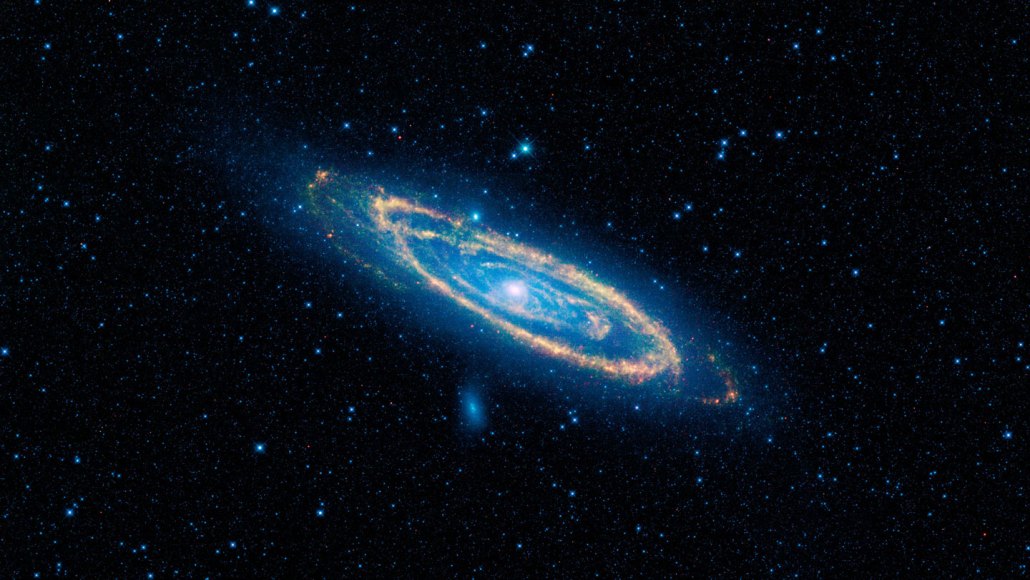 Figure: Artist’s concept of a binary star merger event. Credit: Science News.
Deep Inside a Faint Smudge: A Seven-Year Devouring
Stars in the cosmos rarely drift in solitude. In the Andromeda Galaxy, roughly half of all stars have a companion, locked in a long gravitational waltz. In their youth, both stars keep to their separate orbits in stable harmony. But as the more massive member enters its twilight years and burns through the hydrogen in its core, its outer envelope swells dramatically, transforming it into an engorged red giant (an expansive late-stage stellar phase where the radius balloons by hundreds of times).
The drama of “Big Bao” and “Little Bao” represents the catastrophic finale of this celestial dance gone awry. Big Bao was an immense red giant, while Little Bao was a compact companion star. Sky survey archives revealed that beginning in 2018, Big Bao began brightening anomalously, continuing an unbroken climb for seven straight years. During this period, Big Bao swelled to more than twice its original diameter, even as its surface temperature remained virtually unchanged.
For a star to more than double in physical size requires a tremendous infusion of external energy. With the giant’s internal nuclear furnace already in decline, that extra power had to originate from the outside. As Little Bao orbited progressively closer, it made contact with—and plunged directly into—the giant’s tenuous outer envelope.
Two Stars in One Shroud: The Companion Brakes into the Core
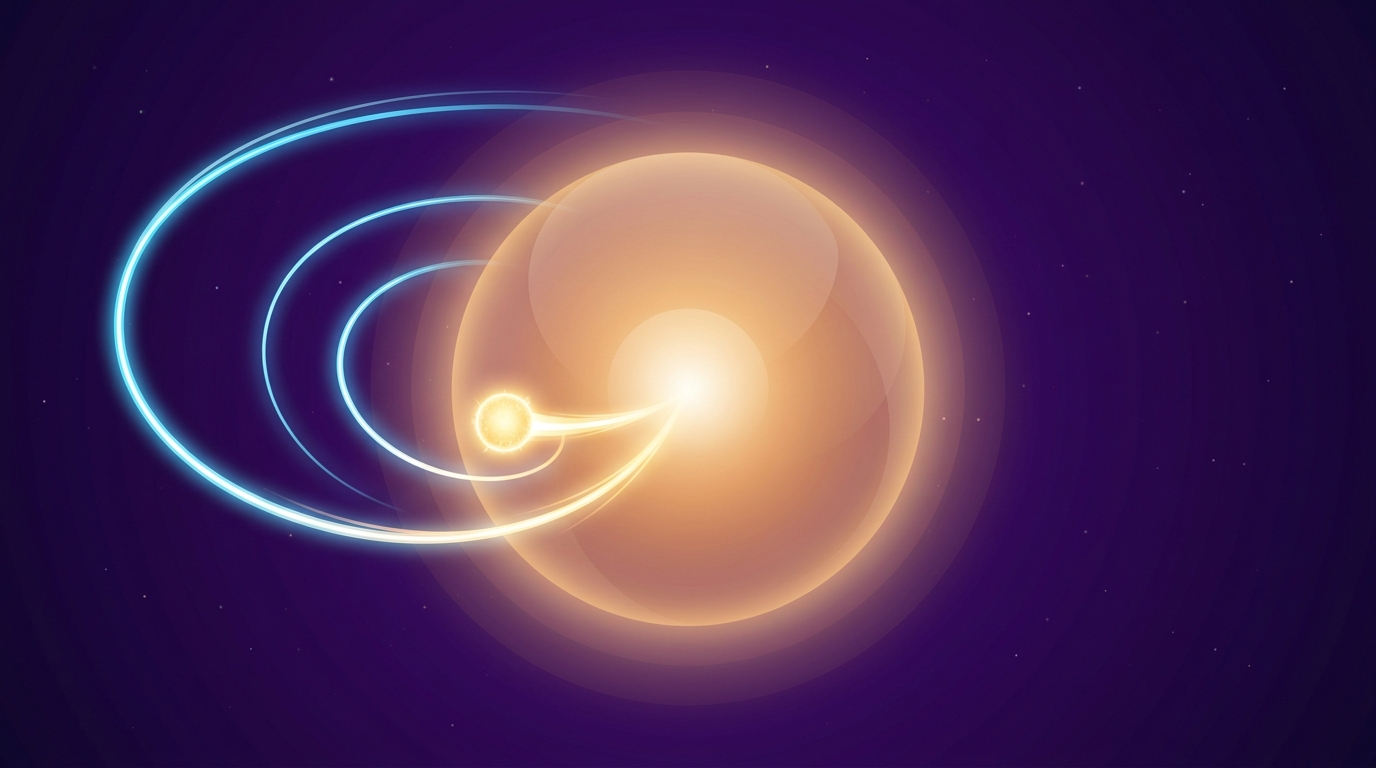
The instant the smaller star entered the red giant’s atmosphere, one of astrophysics’ most elusive chapters was initiated. The stars were now so close that the companion traveled directly through the giant’s outer gaseous layers. Astronomers term this shared-atmosphere configuration “common envelope evolution.”
Tearing through the dense stellar gas, the smaller star encountered severe hydrodynamic drag, akin to a speedboat slamming into molasses. This relentless aerodynamic friction acted like a continuous brake, steadily draining the companion’s orbital kinetic energy. The dissipated mechanical energy was converted into immense heat, warming the surrounding gaseous envelope and fueling seven straight years of steady brightening.
Depleted of orbital energy, the companion could no longer maintain altitude. It spiraled downward in an inescapable vortex toward the giant’s core. Deep inside the red giant, the two stellar cores collided and fused into one. On October 17, 2025, the ground-based Zwicky Transient Facility captured a luminous outburst, heralding the completion of the merger.
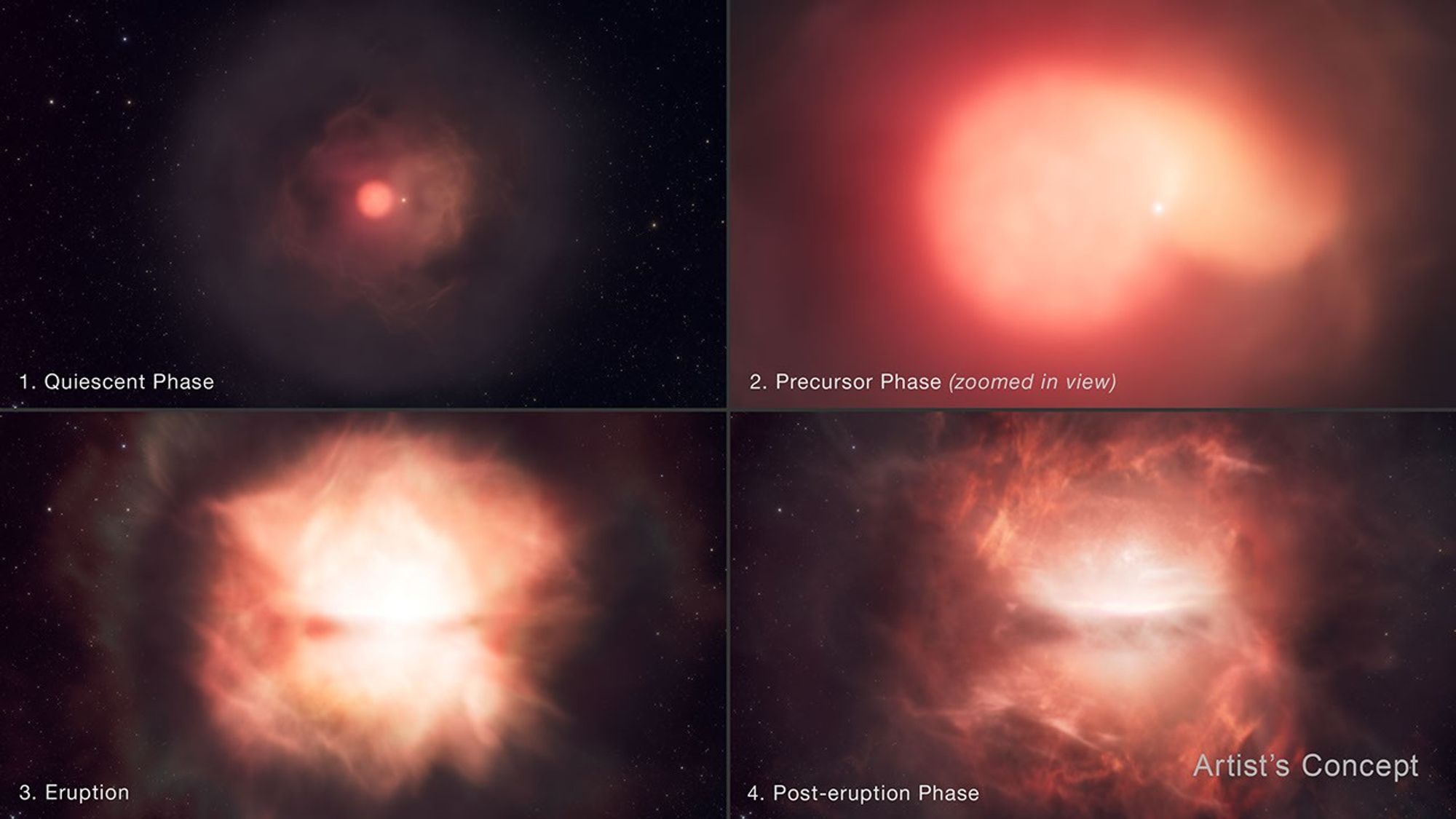 Figure: Schematic diagram illustrating the four key stages of common envelope evolution. Credit: NASA/STScI.
Thirty Years of Archives: Global Observatories Pass the Baton
Unraveling this cosmic story was made possible only by stitching together three decades of historical survey data. A team led by Hubble Fellow Viraj Karambelkar of Columbia University first inspected sky archives from 1989 through 2018. For nearly thirty years, the binary system had shone with steady, uninterrupted tranquility.
That long, quiet baseline made the subsequent changes stand out in stark relief. In February 2023, NASA’s NEOWISE spacecraft detected anomalous infrared brightening (thermal radiation invisible to the eye that easily pierces through obscuring dust). By September 2024, the ground-based WINTER telescope recorded massive clouds of dust being shed by the system.
In July 2025, the SPHEREx space observatory documented a dramatic shift. The object faded abruptly in visible light while surging in the infrared. The ejected dust formed an opaque shroud, temporarily masking the intense luminosity within. When the ultimate explosive outburst finally ruptured this shell in October, telescopes across the globe immediately swung into action to track the event.
Webb Glares for Three Hours: Settling the Verdict Through the Dust
While multiple ground observatories caught the initial flash, determining whether the companion had truly merged required decisive physical proof. Such encounters generally yield one of two outcomes: the stars collide and merge into a single entity, or the companion skims through, survives, and ejects the giant’s entire envelope. Wrapped in dense cosmic dust, the inner sanctum remained hidden from traditional optical telescopes.
On Christmas Eve, December 24, 2025, the James Webb Space Telescope dedicated a three-hour observing window to the target, using its ultra-sensitive infrared suite to pierce through the thick dust shroud. The spectroscopic data gathered across those three hours provided an incontrovertible answer. Calculations revealed that the total energy liberated in the explosion had ejected only about one-tenth of the giant’s outer envelope.
This modest 10% ejection ratio decisively ruled out the companion’s survival. Had the smaller star ricocheted and escaped, the recoil would have violently blown away the entire outer shell. Only by sinking to the core and surrendering its entire gravitational energy could such a massive envelope remain intact. Webb’s three-hour infrared gaze delivered the definitive seal on this seven-year merger.
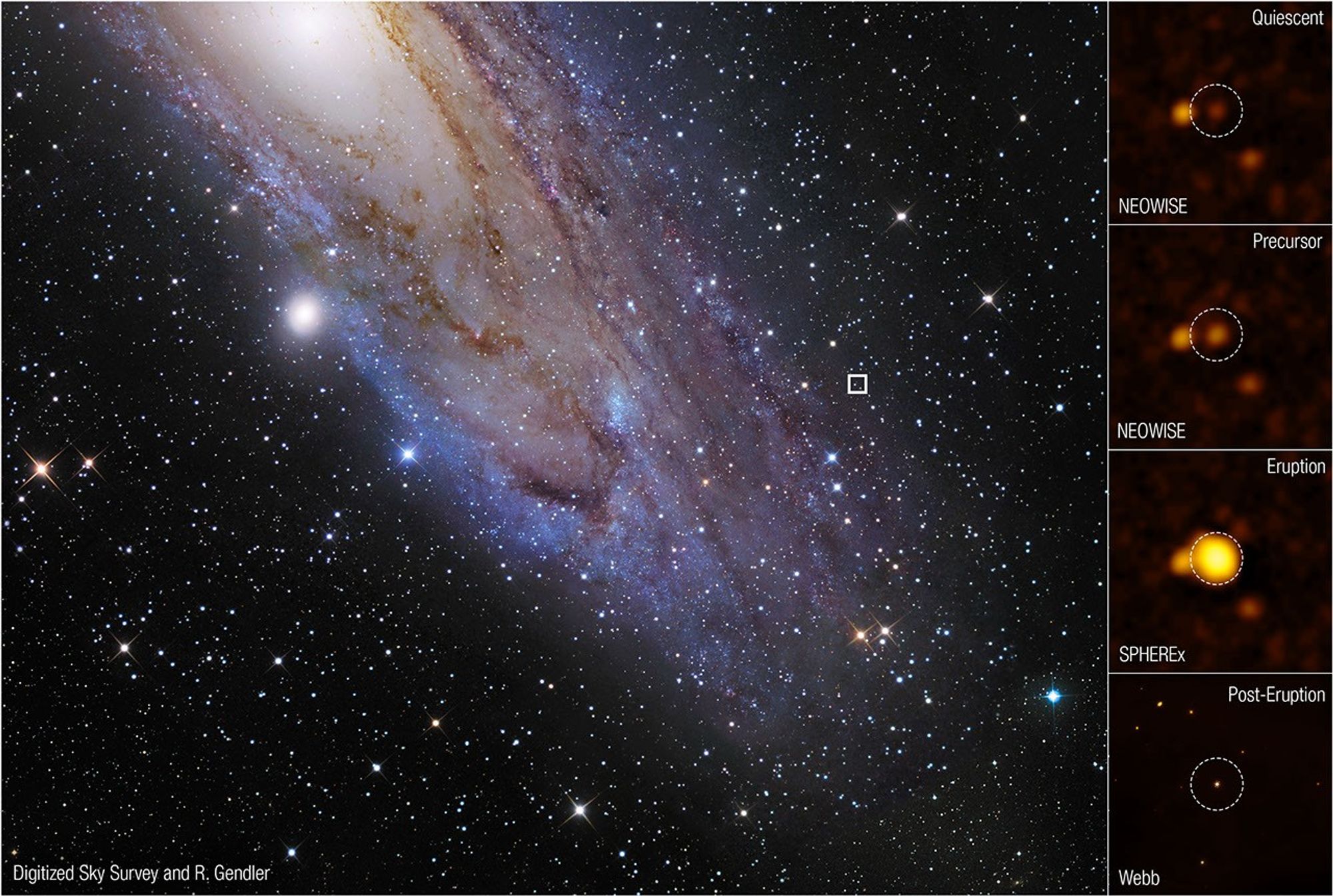 Figure: James Webb Space Telescope infrared image of AT 2025abao. Credit: NASA/STScI.
Beyond the Ruins: A 50-Year Theory Finally Gets Its Footage
For astrophysicists, this detection carries significance far beyond a fleeting stellar flare. In 1976, theoretical physicists proposed the common envelope hypothesis to explain the origin of tight binary systems, supernovae, and gravitational wave sources. Yet for half a century, humanity had never directly caught the phenomenon in action.
Across a star’s multi-billion-year lifespan, the common envelope phase is as brief as a lightning strike, typically lasting only a few decades to centuries. In human terms, that is less than half a second out of an eighty-year lifetime. Catching it in real time amidst the boundless cosmic sea seemed almost impossible. For fifty years, astronomers could study only the aftermath, piecing together parameters from stellar remnants like fire investigators sifting through ashes.
Karambelkar’s team followed this stellar engulfment from beginning to end. With direct, time-resolved measurements, they constrained the envelope-ejection efficiency parameter that astrophysicists have debated for decades. As Karambelkar noted, armed with this complete real-world timeline, researchers will be able to anticipate and identify similar binary systems long before they explode.
Today, the freshly merged core remains cloaked in a thick cocoon of dust. Unveiling its ultimate appearance will require astronomers to watch patiently for years, perhaps decades. But this beam of starlight, which began its journey before modern humans roamed the Earth, has finally allowed humanity to watch a 50-year textbook hypothesis play out live, from prologue to finale.
Reference Links:
- Science News coverage
- NASA Webb Telescope Observation Announcement
- Nature paper