A 3.2-Gigapixel Camera Captures 500,000 Galaxies in a Single Shot
500,000 galaxies packed into a single image.
On July 31, the Vera C. Rubin Observatory in Chile unveiled its first scientific image: a deep-field view of the COSMOS field containing more than 500,000 galaxies and 50,000 stars. Capturing this cosmic landscape was the world’s largest digital camera—a 3.2-gigapixel, 3-ton behemoth larger than a small car.
To put that in perspective: a standard smartphone camera features around 50 megapixels. Rubin’s camera boasts 64 times that resolution. A single exposure covers a sky area equivalent to 40 full moons side-by-side. Displaying the image at full resolution would require over 380 4K television screens tiled together.
A Single Sweep Across Hubble’s 20-Year Turf
COSMOS is one of the most famous patches of sky in astronomy, located in the direction of the constellation Sextans. Its prominence stems from a lucky cosmic geometry: it sits well clear of the Milky Way’s galactic plane, with minimal foreground stars and dust, allowing telescopes an unobstructed view deep into the cosmos. The Hubble Space Telescope has spent over two decades observing COSMOS since 2003, with the world’s premier observatories targeting it across wavelengths from radio to X-ray.
Rubin essentially re-surveyed this storied territory in one go—stacking hundreds of observations into a single deep-field composite that delivers 500,000 galaxies at once.
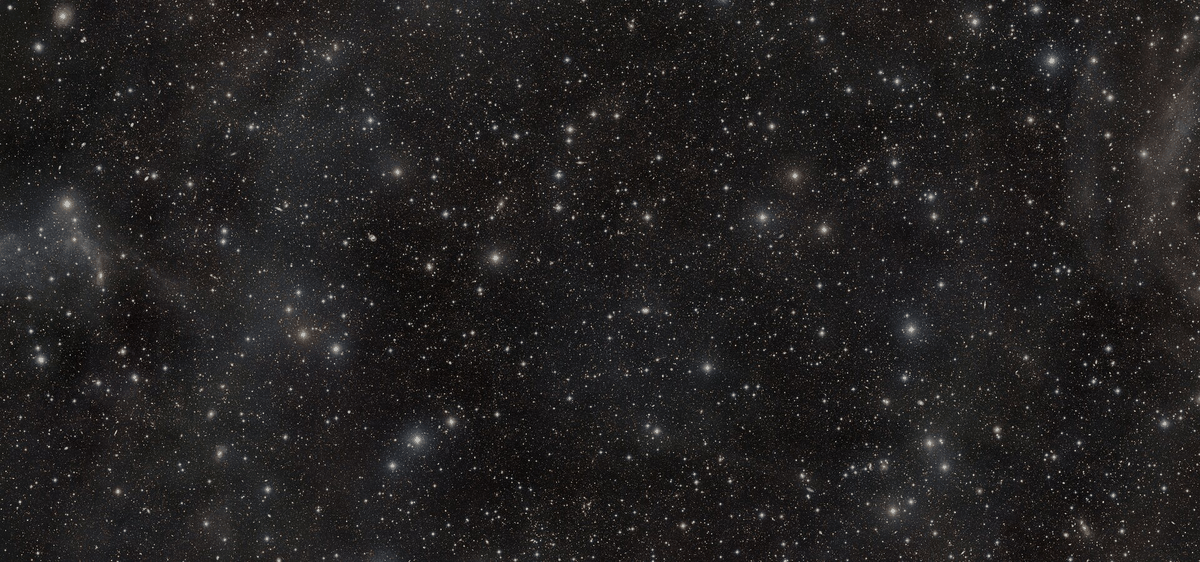
Image: Deep-field view of the COSMOS field captured by Rubin Observatory. Nearly all the dense points of light in this frame are distant galaxies, not stars. Source: Rubin Observatory / NOIRLab
What does 500,000 galaxies mean? A typical galaxy contains hundreds of billions of stars. Every faint pinpoint of light in this image represents hundreds of billions of stars clustered together. Visible within the frame are spiral arms, smooth elliptical galaxies, distorted pairs of merging galaxies, and deep-red distant galaxies from the very early universe.
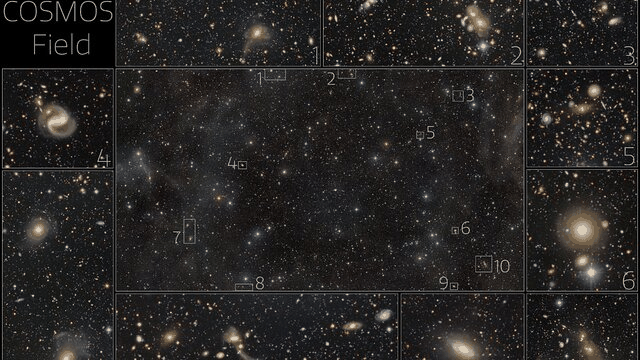
Image: Close-up selections of galaxies from the deep-field image, highlighting spiral, elliptical, and merging galaxies. Source: Rubin Observatory / NOIRLab
For context: in terms of sheer depth for a single image, Hubble still reigns supreme—it can resolve fainter individual objects. Rubin’s game is width and speed. Its field of view is more than a hundred times larger than Hubble’s primary camera, and it will repeatedly photograph the same sky night after night. One digs deep; the other sweeps broad. The two complement each other perfectly.
Why Build a 3-Ton Camera?
The answer lies in its namesake. The observatory honors astronomer Vera Rubin, who in the 1970s and 1980s discovered that outer stars in spiral galaxies rotated far too fast to be held by visible matter alone. Her explanation: the universe is filled with an invisible substance known as dark matter. Today, dark matter is estimated to account for 85% of all matter in the universe, yet its exact nature remains one of physics’ greatest mysteries.
Evidence for dark matter comes from observation, but verifying and mapping it requires looking at vast numbers of galaxies over extended periods. Rubin’s flagship endeavor is the Legacy Survey of Space and Time (LSST)—a 10-year mission to map the entire southern sky every 3 to 4 nights, constructing a decade-long time-lapse movie of the universe. The camera’s CCD sensors are chilled to -100°C to minimize electronic noise, fronted by a 1.5-meter primary lens and a wheel of 6 optical filters. Taking 15-second exposures, it will collect thousands of frames each clear night.
Mounted on an 8.4-meter survey telescope at an elevation of 2,682 meters on Cerro Pachón in northern Chile, the observatory benefits from roughly 300 clear nights a year, with dry, pristine air making it one of the best survey sites on Earth.
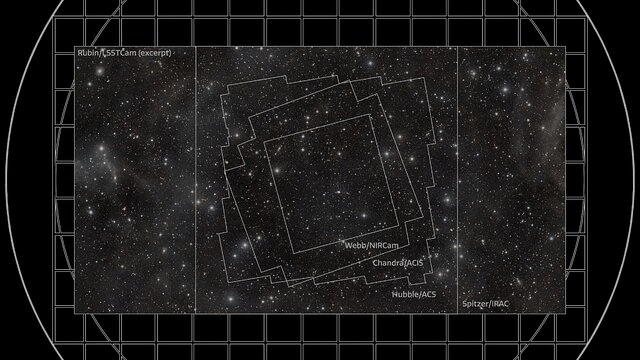
Image: Overlay schematic of repeated LSST observation footprints across the COSMOS field. Repeated imaging over time is key to detecting cosmic changes. Source: Rubin Observatory / NOIRLab
The applications of this decade-long movie extend far beyond dark matter:
- Dark Energy. The expansion of the universe is accelerating. What is driving it? Clues are hidden in the evolving positions and shapes of billions of galaxies over cosmic time.
- Asteroid Early Warning. Over 10 years, LSST is expected to discover around 6.2 million asteroids, potentially identifying most hazardous near-Earth objects larger than 140 meters in diameter. Planetary defense begins with knowing where the threats are.
- Transient Phenomena. Fleeting astronomical events—such as supernova explosions or black holes tearing stars apart—were historically missed due to lack of real-time sky monitoring.
- Milky Way Architecture. It will also catalogue billions of stars within our own galaxy.
This release is just a preview. The EDP2 dataset covers about 3,000 square degrees—one-sixth of the visible southern sky. 500,000 galaxies is only a fraction of what is to come: over 10 years, LSST expects to catalogue roughly 20 billion astronomical objects.
Astronomy Is Becoming Data Science
Consider the data volume: the camera generates about 20 TB of raw data per night, equivalent to thousands of HD movies. Over a decade, it will compile a multi-petabyte database recording brightness variations for 20 billion celestial objects.
Human eyes can no longer inspect data at this scale. Astronomers used to look at photographic plates or individual images; processing 20 TB every single night makes manual inspection impossible. Object classification, anomaly detection, and transient alerts must be automated via machine learning algorithms. An astronomer’s daily workflow is shifting toward model training, anomaly auditing, and pipeline engineering. By releasing EDP2, the Rubin team tested the end-to-end data processing pipeline, allowing the scientific community to refine algorithms ahead of full survey operations.
For the general public, this data deluge carries two major implications. First, planetary defense against near-Earth asteroids enters a new era of vigilance. Second, under Rubin’s data policy, datasets will become publicly accessible after a two-year proprietary window—allowing anyone to explore the 20-billion-object catalogue from home. Astronomy data is transitioning from institutional property into a global public good.
Two Decades of Overcoming Hurdles
The road to this milestone was anything but smooth. From concept to first light took over two decades, with costs more than doubling initial estimates, multiple schedule delays, and periods where cancellation was actively debated. This 500,000-galaxy snapshot represents the culmination of endless reviews, technical breakthroughs, and perseverance.
It is also a gift to Chile. On release day, the Rubin team dedicated the image to the residents of the Coquimbo Region, which had recently endured severe weather. The high Andean plateau continues to serve as humanity’s premier portal to the stars.
500,000 galaxies is just the warm-up. For the next decade, this 3-ton camera will operate every clear night, recording the changing universe frame by frame. Humanity is about to shoot a movie of the entire observable sky—and that alone is something to behold.
Reference links:
- Rubin Observatory News: Rubin Observatory’s first LSST Camera release
- Hacker News Discussion (item?id=49183079)
- SLAC Press Release: DOE-NSF Rubin Observatory opens a deep window on a famous cosmic field
- Phys.org Coverage: Rubin Observatory opens a deep window on a famous cosmic field