Jeff Dean Leaves Google to Build Discovery Loop: AI Autonomous Science Experiments
On August 5, 2026, Google CEO Sundar Pichai issued an internal memo announcing a major leadership transition: Chief Scientist Jeff Dean, after 27 years at Google, is leaving to co-found a new company, Discovery Loop, alongside his long-time collaborator Sanjay Ghemawat. The company’s core mission can be summed up in a single sentence: automate scientific experimentation with AI so that a small team can accomplish what previously required an entire laboratory.
The news reverberated across the tech industry. On Hacker News, the discussion rapidly racked up over 500 points and 300 comments within hours, becoming the top post of the day. The last time a departure created this level of frenzy was Sam Altman’s brief firing from OpenAI. Pichai’s memo also signaled a broader leadership restructuring in Google AI: Demis Hassabis, head of DeepMind, transitions from CEO to Chairman of the Board, succeeded by another veteran leader. Dean’s exit stands out as the most pivotal move in this executive reshuffle.
Who is Jeff Dean? While average internet users might not immediately recognize his name, their daily digital lives rely on infrastructure he helped create. Google Search, Google Translate, and Google Maps all run on systems built on his foundational work. In 2004, Dean and Ghemawat co-invented MapReduce—a paradigm for splitting massive computational workloads across thousands of machines—which powered the rise of Google Search and became a cornerstone of the modern big data era. In 2011, he co-founded Google Brain, and in 2015, he led the open-sourcing of TensorFlow, the deep learning framework that underpins much of today’s AI ecosystem. Following the merger of Google’s AI divisions in 2023, Dean served as Chief Scientist, the highest technical position at the company. Born in Hawaii in 1968, his technical career started even earlier: before graduate school, he wrote software for the World Health Organization to model HIV transmission dynamics.
 Figure: Jeff Dean in 2025. Source: upload.wikimedia.org
Why would an engineer at the pinnacle of his career choose to leave at age 58? Google’s official statement was gracious: after 27 years, Dean wanted to explore new frontiers, and Google is fully supportive, participating as a founding investor while continuing cloud service partnerships. Publicly, it appears to be a warm parting of ways. However, industry insiders point out that Google’s sheer scale today no longer affords the agility it once did: with nearly 200,000 employees and AI products serving 950 million monthly active Gemini users, moving an idea from research lab to production requires navigating endless layers of review. For someone like Dean, the most valuable asset—the freedom to iterate rapidly—has grown increasingly costly inside a tech giant. One veteran engineer’s comment on Hacker News captured the sentiment: “With Jeff and Sanjay gone, an era has truly ended. For many senior engineers, the last reason to stay at Google was ‘at least Jeff and Sanjay are still here’.”
This brings us to the core question: what exactly is the “automated discovery loop” they are building?
Consider how scientific discovery traditionally works. A researcher proposes a hypothesis, designs an experiment, runs it, analyzes the results, refines the hypothesis based on data, and designs the next test. This iterative cycle—hypothesis, experiment, observation, refinement—is the heartbeat of science. Simple in concept, it is painfully slow in execution. A single experiment can take weeks or months; a lab of dozens of researchers might only complete a handful of major studies a year. Discovery Loop aims to delegate this entire cycle to AI: AI formulates hypotheses, designs and runs experiments, analyzes outputs, and determines subsequent steps—running thousands of experiments concurrently. As stated on their website: imagine a future where a handful of individuals can drive scientific research with far higher speed and quality than massive traditional research organizations.
 Figure: “Automated Discovery Loop” concept diagram on Discovery Loop homepage. Source: discoveryloop.com
What makes this approach radical? For decades, accelerating research meant scaling up headcount—more laboratories, more researchers, bigger budgets. Dean’s bet is that the fundamental bottleneck of scientific progress is human: humans are slow, expensive, and limited by physical endurance. Automating the loop shifts the bottleneck from human capacity to compute power and parallelization. The team is aiming their first effort at the domain they know best: AI research itself. By letting AI automate AI experiments, they intend to optimize their own technology stack before expanding into other scientific disciplines. The founding team consists of four key figures: Jeff Dean, Sanjay Ghemawat, Quoc Le, and Oriol Vinyals. According to the company, three are among the most cited AI researchers in the world, and two are among the most cited in distributed systems. Their past accomplishments include foundational contributions to Google Search, TensorFlow, AlphaFold, and Gemini.
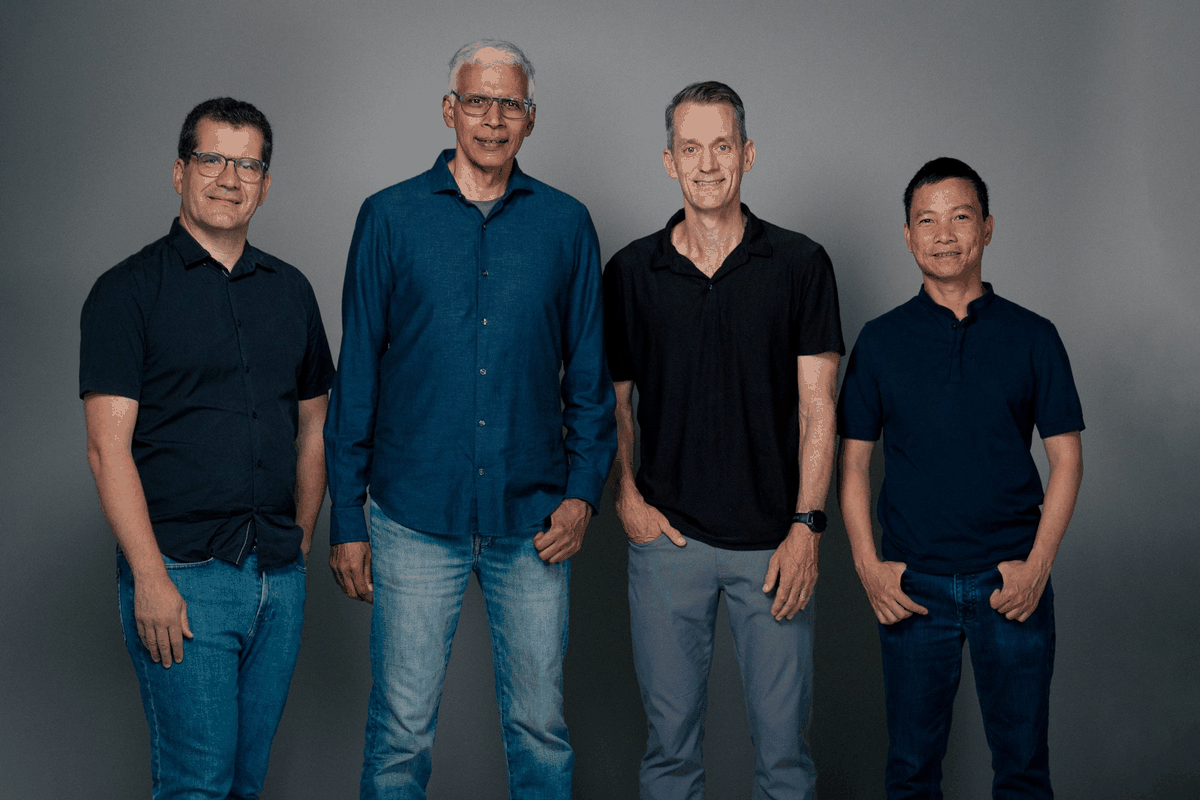 Figure: Discovery Loop founding team, left to right: Vinyals, Ghemawat, Dean, Le. Source: discoveryloop.com
Their ambitions extend far beyond AI software. The homepage features a target list aligned with the National Academy of Engineering’s 14 Grand Challenges for Engineering—making solar energy economical, achieving controlled nuclear fusion, securing clean water for humanity, engineering better medicines, safeguarding cyberspace, and building advanced tools for scientific discovery. On social media, Dean stated directly that their methodology can address critical sub-problems across almost all 14 challenges. Any single one of these challenges represents decades of effort and tens of billions of dollars in investment without a full solution. Making claims this bold either indicates genuine breakthrough capability or investor hype; in new ventures, both are often true at once.
Predictably, debate erupted immediately. On Hacker News, discussions flared around the recurring concern of AI replacing human workers. A top-voted comment by user beloch highlighted the skepticism: the core promise on the startup’s site essentially boils down to automating away human researchers so a tiny group can capture all the credit and rewards—the exact playbook of AI startups, now applied to scientists themselves. Following this logic, if AI automates experimentation, the first to face displacement won’t be senior scientists, but entry-level research assistants and lab technicians.
Conversely, supporters argue that scientific talent should not be consumed by repetitive execution. Developing a single breakthrough drug averages over a decade and more than a billion dollars; if automated experiment loops can compress this timeline by an order of magnitude, new therapeutics, novel materials, and advanced battery chemistries could emerge at unprecedented speeds, benefiting society as a whole. Other commentators countered pragmatically: why not try? If the system succeeds, its discoveries will silence detractors.
The central tension lies in equity and distribution. Whether the technology works is an engineering question; who reaps the rewards and whether broad society benefits is a societal one. Highlighting both perspectives is necessary because there are no easy answers yet. Furthermore, automating scientific loops introduces a fundamental reliability problem: when AI designs experiments and interprets data, how does it detect its own mistakes? History is rife with scientific irreproducibility in human-led labs; if human experiments struggle with replication, who audits AI-generated findings? Dean’s team may be among the best equipped globally to address this, but technical capability is still a step removed from proven execution.
For observers, the significance is straightforward: if Discovery Loop succeeds, the timeline for life-saving drugs, EV battery costs, and roof-top solar efficiency could be rewritten. If it fails, it will be remembered as another high-stakes gamble in the ongoing AI boom. In either scenario, the paradigm shift is evident: scientific discovery is pivoting from human scaling to algorithmic compute, and the steering wheel is held by a few veteran engineers in their fifties.
Reference Links:
- Discovery Loop Official Site
- Google Official Announcement: Next Chapter of AI Momentum
- HN Discussion (item?id=49184960)
- HN Discussion (item?id=49184755)