81 Years After Hiroshima, Scientists Discover a New Multicomponent Alloy in Atomic Fallout
At 8:15 AM on August 6, 1945, the atomic bomb codenamed “Little Boy” detonated approximately 580 meters above central Hiroshima. Shockwaves, thermal radiation, and radioactive fallout swept across the city, claiming between 60,000 and 80,000 lives on the day of the blast, with deaths surpassing 140,000 by the end of that year. Eighty-one years later, in late July 2026, a research team led by Luca Bindi from the University of Florence published a study in Science Advances: embedded within sand grains collected from Hiroshima Bay, they identified a multicomponent metallic alloy never before documented in science. The alloy was encased in a glass spherule just a few micrometers in diameter—far thinner than a human hair.
To grasp the conditions that birthed this material, consider a single statistic from the paper: the temperature of the fireball exceeded 7,000 °C. For comparison, the surface of the Sun is roughly 5,500 °C. In a matter of seconds, an object hotter than the solar surface appeared above Hiroshima. Steel rebar, aluminum window frames, copper wiring, glass, and soil melted and vaporized instantaneously into a roiling cloud of plasma. As the cloud expanded and cooled, the vaporized matter condensed into tiny glass droplets, falling to earth with the dust and burying themselves in the beach sands of Hiroshima Bay, where they lay undisturbed for over eight decades. Geologists and material scientists refer to these glass droplets as hiroshimaites.
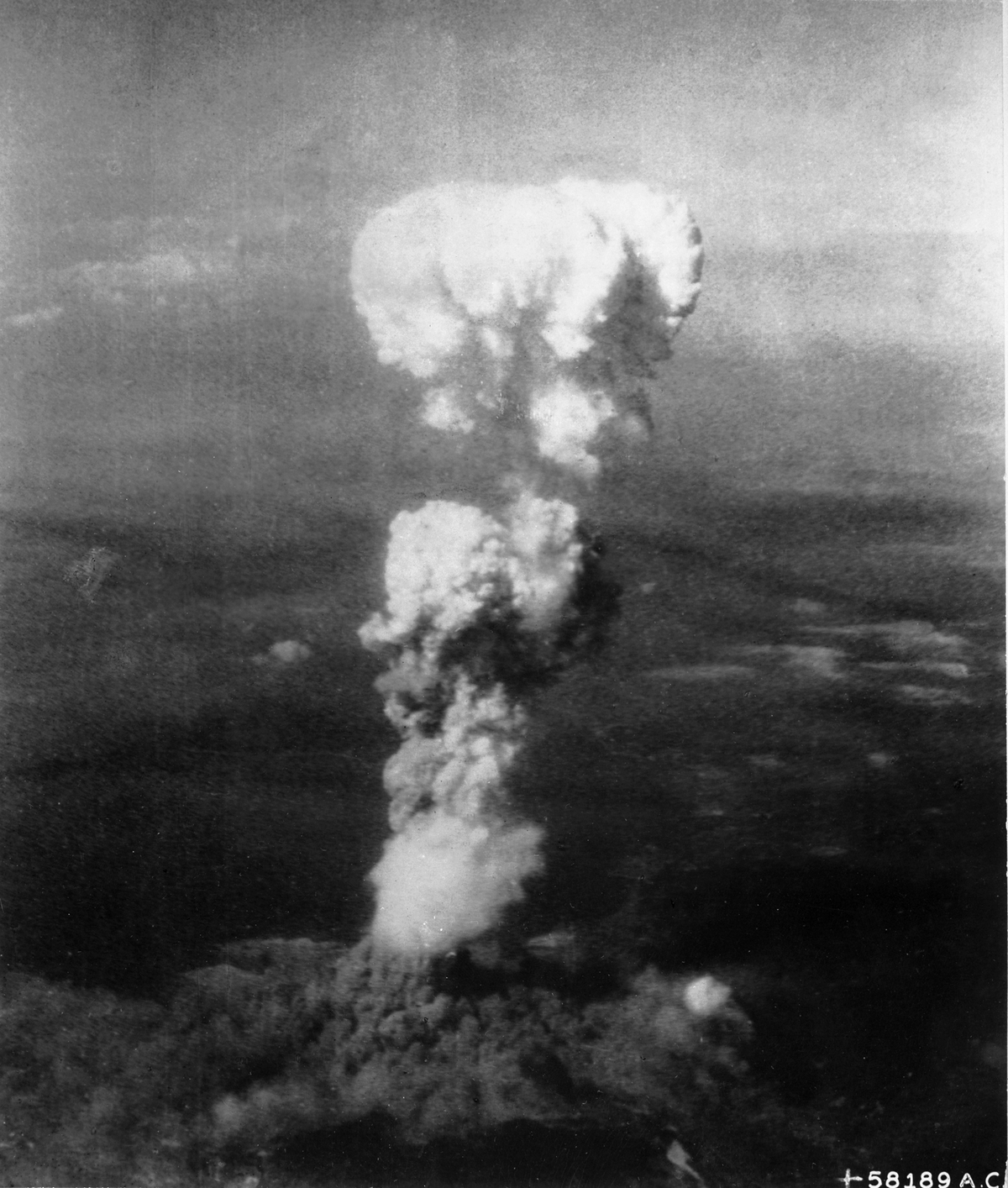 Figure: Mushroom cloud over Hiroshima on August 6, 1945. Source: George R. Caron / Wikimedia Commons (Public Domain)
Out of 34 Glass Spherules, Only One Stood Out
Bindi’s team examined 34 hiroshimaite samples, screening them meticulously using scanning electron microscopy (SEM), electron probe microanalysis (EPMA), and X-ray diffraction (XRD). The number 34 highlights the needle-in-a-haystack nature of the study: among millions of glass beads scattered across the coastline from a blast eight decades ago, scientists had to isolate and analyze each sample individually.
Previous research established that hiroshimaites formed at temperatures exceeding 1,800 °C, composed primarily of calcium, aluminum, and silicon. To put that in perspective, industrial steel furnaces operate at around 1,600 °C, while volcanic lava peaks at about 1,200 °C. The thermal environment at the periphery of the Hiroshima blast vastly exceeded the operational limits of conventional industrial metallurgy.
In this latest study, the team detected microscopic iron-chromium metal inclusions inside one of the 34 spherules. While most inclusions proved routine, one microscopic inclusion exhibited a composition and crystal structure unlike any known material. As the paper reports: “We report the discovery of a previously unknown multicomponent alloy found in beach sands from Hiroshima Bay, formed in the aerial detonation of August 6, 1945.”
An Alloy That “Should Not Exist”
Measuring only a few thousandths of a millimeter across, the particle is predominantly iron, alloyed with chromium, nickel, manganese, molybdenum, silicon, and aluminum—seven elements in total.
Combining seven distinct elements into a single alloy is extraordinary. Traditional alloys rely on one or two dominant metals with minor additives: stainless steel is primarily iron with added chromium and nickel, while carbon steel is iron with trace carbon. For decades, metallurgical consensus held that adding more elemental constituents would render an alloy brittle and unstable. It was not until the 1990s, when Professor Jien-Wei Yeh proposed the concept of “high-entropy alloys” (HEAs), that researchers realized mixing multiple metals in roughly equal proportions could yield exceptionally hard, heat-resistant, and corrosion-resistant stable structures. Today, multicomponent alloys represent one of the most active frontiers in materials science.
What makes the Hiroshima alloy remarkable is its structural order. While most multicomponent alloys feature disordered atomic arrangements similar to conventional stainless steel, this sample crystallized into an ordered cubic structure of the AlAu4 type, containing distorted icosahedral atomic clusters. It is the atomic equivalent of a perfectly ordered ice crystal freezing out of a chaotic elemental stew.
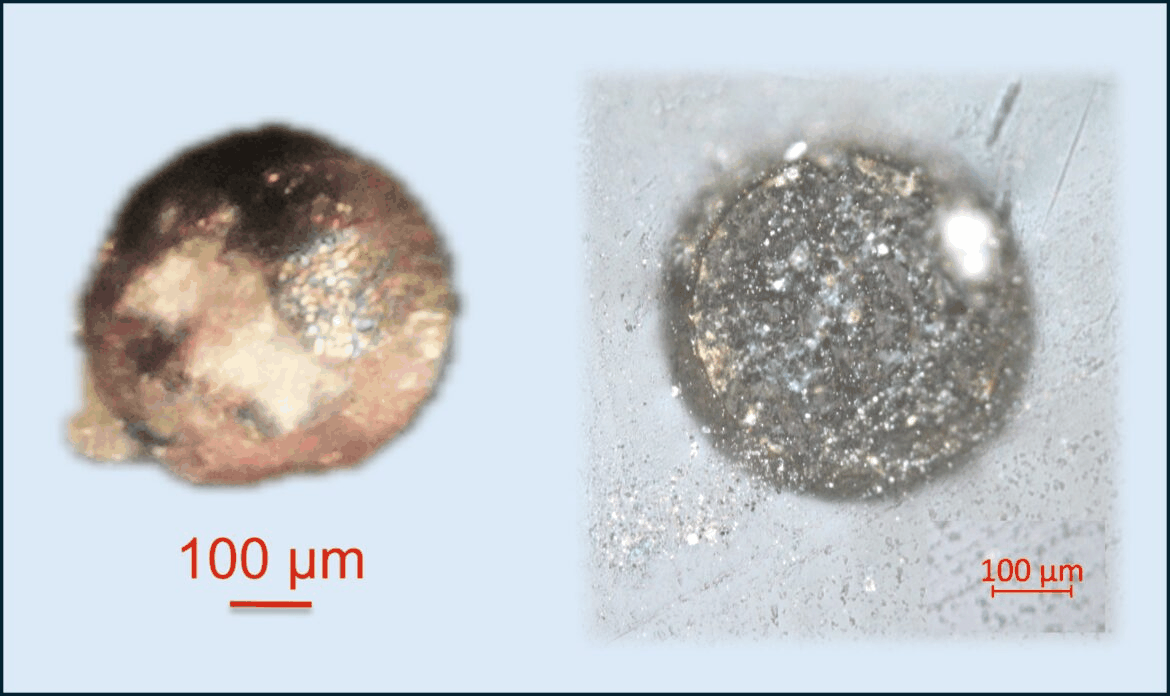 Figure: Micrograph of the metallic spherule containing the newly identified alloy. Source: Luca Bindi et al., 2026 (via arkeonews.net)
How did such a structure form? The authors hypothesize that after the fireball vaporized the city’s structural steel, aluminum, and copper, atoms of different metals mixed randomly within the vapor cloud. As the fireball rapidly expanded, temperatures plunged in seconds. Before the atoms could arrange into conventional equilibrium crystal lattices, they were instantaneously frozen into a metastable structure that typically only exists under extreme physical conditions. Replicating such a phase in a laboratory requires controlled induction melting coupled with ultra-fast quenching. The Hiroshima fireball maximized temperature, mixing, and cooling rate within seconds—effectively operating as a textbook laboratory for extreme-condition materials synthesis.
Forging Materials with Explosions: A Long History
Using extreme destructive force to synthesize materials is not unprecedented. Industrial manufacturing routinely employs explosive welding, using controlled detonations to bond dissimilar metals. During the Cold War, both the United States and the Soviet Union conducted underground nuclear explosion experiments for industrial applications; in 1981, the Soviet Union famously detonated a nuclear device to extinguish a runaway gas well fire. In the 1950s, “atomic gardening” exposed seeds to gamma radiation to induce beneficial crop mutations. Human ingenuity has long adapted explosive forces into technological tools, though this marks the first time an ordered, novel multicomponent alloy structure was documented condensing directly from a nuclear fireball.
A compelling precedent occurred in July 1945 at the Trinity test site in New Mexico—the world’s first nuclear detonation. In 2021, scientists discovered a previously unknown quasicrystal inside “trinitite,” the glassy residue produced by the Trinity explosion. Notably, Luca Bindi led that discovery as well. The same research team has now uncovered previously unseen material structures at two historical nuclear detonation sites, adding substantial weight and credibility to the Hiroshima findings.
 Figure: Cover of the official science communication video “A New Material Born in the Hiroshima Fireball” released by the University of Florence. Source: youtube.com (Università degli Studi di Firenze)
The Controversy: Did It Truly Originate in 1945?
Despite the published findings, scientific skepticism exists regarding the exact provenance of the sample.
Critics point out that the hiroshimaites were collected from beach sands along Hiroshima Bay, rather than directly from ground zero. Over eight decades of maritime shipping, port activities, and industrial operations have left residues across the bay. Could modern post-war metallic contaminants have mixed into the sand layers? Furthermore, short-lived radioactive isotopes from the 1945 blast decayed decades ago, making radiometric dating of individual micro-particles impossible. The attribution of a 1945 origin relies on chemical composition and structural modeling—a reasonable inference, but one that is difficult to prove beyond all doubt. A highly upvoted comment on Hacker News put it bluntly: “The phrase ‘natural experiment’ is doing a lot of heavy lifting here.”
Supporters counter with rigorous micro-analytical evidence. The paper presents comprehensive compositional and structural data matching theoretical predictions of rapid condensation from multi-element metallic vapor. The sediment layers where the spherules were collected correspond precisely to confirmed 1945 fallout horizons, and the study underwent peer review by leading crystallographers.
However one views the debate, the core scientific insight remains intact: extreme physical conditions can yield entirely novel atomic architectures. The paper’s authors themselves remain cautious, consistently using phrases like “consistent with” rather than definitive claims of absolute proof. Scientific progress advances through measured validation, and leaving room for scrutiny enhances credibility.
What Does This Alloy Mean for the Rest of Us?
The most immediate application lies in materials engineering. The atomic structure of this alloy could provide a blueprint for developing new iron-chromium-nickel-silicon material systems. If similar atomic arrangements can be replicated using rapid solidification or metal 3D printing, it could lead to materials offering superior hardness, thermal stability, and corrosion resistance—properties critically needed for nuclear reactors, aerospace propulsion, and deep-sea equipment.
Second, the discovery advances our fundamental understanding of matter under extreme pressures and temperatures. Phenomena like meteorite impacts, lightning strikes, and volcanic eruptions subject matter to similar violent conditions. Studying nuclear fallout debris provides insight into how nature processes materials under extreme energy densities. Furthermore, these microstructural signatures have applications in nuclear forensics: crystal structures and isotopic compositions function as physical fingerprints, allowing investigators to trace bomb materials and peak detonation temperatures in non-proliferation verifications.
Finally, the discovery connects back to history. Hiroshima remains first and foremost a city—the site of a tragedy where over 140,000 human lives were lost. As one Hacker News comment reflected: “May we never inflict that kind of suffering on humanity again in our lifetime.” Reframing a ruin as a natural laboratory is meaningful only when grounded in a solemn remembrance of why the ruin existed in the first place.
A bomb built for destruction revealed, 81 years later, a seed of discovery for materials science. The boundary between warfare and scientific insight remains deeply intertwined; on the beaches of Hiroshima Bay, more such microscopic seeds may still lie buried. One can only hope they continue to be examined solely under the microscope.
Reference Links:
- Science Advances paper: Discovery of a multicomponent alloy forged by the Hiroshima atomic blast
- HN Discussion (item?id=49115096)
- The Debrief: The World War II Atomic Blast Over Hiroshima Created a Previously Unidentified Multicomponent Metallic Alloy
- Arkeonews: Scientists Discover Never-Before-Seen Metal Alloy Forged Inside the Hiroshima Atomic Fireball
- CNBC TV18: Hiroshima atomic bomb created unique multicomponent alloy: Study