Lying in bed on a quiet summer night, the faint buzz of an insect wing near your ear triggers an involuntary shudder and a desperate urge to cover up. Many people routinely reach for a cotton swab after showering, twisting out a waxy, yellowish plug from the ear canal. In everyday hygiene culture, that oily secretion is treated as unsightly grime that must be eradicated.
Under the microscope, however, physicists see a completely different picture. On October 28, 2026, the Royal Society of Chemistry journal Soft Matter published a study detailing how bioengineers at the Georgia Institute of Technology systematically mapped the physical properties of this substance. Rather than useless waste, this unglamorous layer of lipids and dead skin turns out to be an ingenious, non-toxic physical defense system guarding the entrance to our ears.
36 Samples Under the Lens: Physical Proof in Plain Sight
Warm, sheltered, and leading directly to the fragile tympanic membrane, the deep ear canal would seem to be an ideal refuge for wandering bugs. Yet cases of insects actually invading or nesting inside human ears remain exceptionally rare. Bioengineer David Hu and doctoral researcher David Ancalle set out to uncover why through the lens of mechanics.
The first hurdle was securing enough raw material. Clinically termed cerumen, earwax is a waxy blend of secretions from sebaceous and ceruminous glands, mingled with shed skin cells. The average human ear canal produces only a rice-grain-sized amount, weighing a mere 10 to 20 milligrams. To gather sufficient volume for rheological and surface testing, Ancalle enlisted friends and colleagues, alongside veterinary clinics providing ear secretions from pigs, sheep, dogs, cows, and rabbits—yielding a combined library of 36 distinct samples.
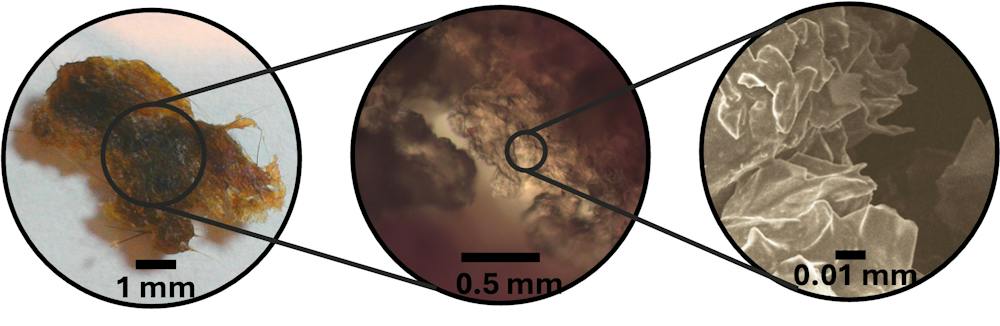 Figure: Magnified views of sheep earwax showing a matte surface formed by overlapping skin cells, crisscrossed by fluid-wicking micropores. Source: The Conversation (David Ancalle / David Hu)
Microscopic imaging laid bare the internal architecture of cerumen. Roughly 60 percent consists of shed corneocytes (dead skin cells), held together by a lipid matrix functioning as glue. This microscopic arrangement forms a porous, sponge-like network riddled with interconnected cracks and channels. During the Middle Ages, manuscript scribes even mixed earwax into pigments as a natural binding agent for miniature illuminations. Evolution paired keratinized dead cells with viscous oils to create a composite material that simultaneously provides structural stiffness and viscous flow retardance.
Capillary Wicking: Wet Suction Pads Slide Instantly
To observe how insects fare when encountering earwax, the researchers introduced ants to their testing apparatus. Insects rely on two distinct locomotion systems to scale three-dimensional terrains. When climbing rough rocks or tree bark, they dig in sharp tarsal claws. When confronting slick vertical glass or waxy plant leaves, they deploy adhesive pads called arolia—flexible, wet suction organs that secrete microscopic fluid films to cling via capillary force.
Using these capillary pads, ants can easily support more than 60 times their own body weight on smooth vertical glass. Scaled to human proportions, that is akin to an adult hanging by two palms against a skyscraper window while anchoring a fully loaded tractor-trailer beneath their feet. Conventional smooth surfaces pose virtually no challenge to climbing ants.
The team coated clean glass slides with an ultra-thin layer of earwax and set the ants in motion. High-speed cameras caught the bizarre results: the moment an ant stepped onto the coating, its wet suction pads completely lost purchase. Skidding like someone stepping onto oil-slicked black ice, the insects slipped and tumbled backward.
Earwax’s porous micro-network possesses remarkable capillary absorbency, capable of taking up more than twice its weight in liquid. The second an ant’s adhesive pad secretes its micron-thin lubricant layer to form an adhesive capillary bridge, the micropores in the earwax wick the fluid away. With the liquid layer instantly drained, the capillary bond collapses, rendering the ant’s vacuum pads entirely useless.
Shear-Thinning: The Harder They Struggle, The Deeper They Sink
A flat glass slide only simulates open surfaces; ear canals are tight, curved tubes. To recreate what happens when an insect crawls into a confined passage, the researchers constructed transparent miniature tunnels matching mammalian ear dimensions, coating the interior walls with uniform layers of cerumen.
Once inside, insects encounter another biomechanical property: shear-thinning behavior. Cerumen acts as a non-Newtonian fluid whose viscosity drops when disturbed by shear stress, but thickens into a dense paste when left at rest—resembling how vigorous shaking thins ketchup so it flows freely from a glass bottle. When an ant kicks against the coating, its leg movements exert localized shear forces. Under stress, the earwax softens and yields, engulfing the insect’s tiny joints.
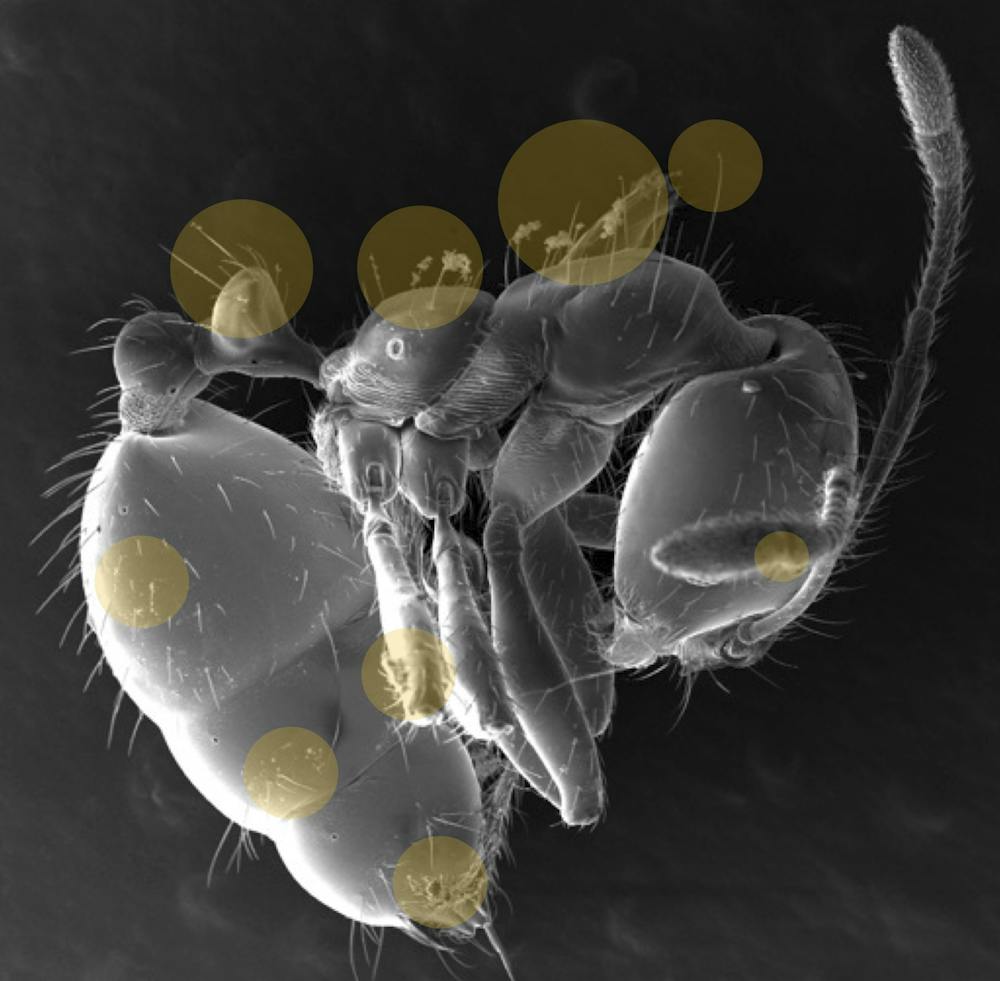 Figure: Close-up of earwax fragments sticking to an ant’s body (highlighted in yellow circles), prompting obsessive grooming behavior. Source: The Conversation (David Ancalle / David Hu)
The trap springs the instant the ant tries to lift its leg. Once shear force ceases, the earwax snaps back to a high-viscosity state in milliseconds, anchoring the foot segment firmly in place. The more violently the ant struggles and kicks, the more the sticky paste spreads across its leg joints, antennae, compound eyes, and thoracic hinges.
Video recordings showed trapped ants halting within seconds, plunging into frantic grooming spells. Immobilized on the spot, they repeatedly brushed their antennae and bodies with their forelegs, trying in vain to scrape off the residue. Minutes later, yellowish granules remained tenaciously wedged between their exoskeletal joints.
The Self-Cleaning Conveyor: Epithelial Migration Keeps the Shield Thin
Confronted with such an effective trap, one might assume that accumulating thicker wax offers superior protection. Mechanical tests revealed the exact opposite: an ultra-thin layer provides the most potent defense. When earwax accumulates over prolonged periods and dries into dense, rigid plugs, its surface develops firm, irregular ridges. Ants can easily hook their sharp tarsal claws into these fissures, striding right over the hardened mass.
The human ear canal is equipped with an elegant self-regulating mechanism: epithelial migration. The skin lining the canal slowly moves outward from the center of the eardrum toward the outer opening, a conveyor-like cleaning system that refreshes the lining every 8 to 10 weeks—matching the growth rate of human fingernails.
Everyday jaw movements from talking and chewing continually knead the outer ear canal. Old keratin flakes are gradually ground down and expelled, while fresh lipids spread evenly across the canal walls, preserving the coating at the optimal ultra-thin thickness that insects find impossible to climb.
Human earwax displays distinct genetic variations controlled by a single gene mutation. Most people of East Asian descent produce dry, flaky cerumen, whereas individuals of European and African descent typically have moist, honey-colored earwax. Mechanically, however, both variations maintain equivalent porous micro-defenses. In the United States alone, roughly 12 million medical visits occur each year due to cerumen impaction—affecting nearly one in twenty people. Otolaryngologists have long warned against inserting cotton swabs: instead of cleaning, swabs shove shed cells deep against the eardrum, packing them into hard plugs that destroy the delicate thin film and furnish invading insects with ready-made footholds.
From Human Ears to Grain Silos: Biomimetic Physical Repellents
The Georgia Tech team’s findings point toward a pesticide-free paradigm for pest control. Conventional domestic pest management and commercial grain storage rely heavily on neurotoxic insecticides or volatile fumigants, both of which breed chemical resistance and introduce long-term toxicological concerns.
Mimicking cerumen’s porous lipid architecture, the researchers formulated an artificial earwax substitute made from edible plant oils blended with inert micro-powders. In controlled warehouse trials, crawling insects completely lost traction against the synthetic barriers, unable to climb past protective rings ringing the bases of grain silos.
Stanislav Gorb, a functional morphologist at Kiel University in Germany, noted that this ubiquitous biological secretion offers a brilliant template for micro-mechanical barriers. Mechanical traps do not induce chemical resistance through genetic mutations. Consequently, this biomimetic approach shows tremendous promise for protecting bulk grain storage, safeguarding organic produce packaging, and mechanically sealing sensitive electronic cleanrooms.
That modest, slightly oily smear at the ear canal opening is a refined physical trap honed by millions of years of mammalian evolution. Micropores drain adhesive fluids to foil suction pads, shear-thinning traps clawed joints, and epithelial migration ensures the barrier remains paper-thin. Before picking up another cotton swab, reconsider that cleaning instinct. Letting this natural defensive film maintain its native profile remains the simplest, most effective way to safeguard your hearing.
References:
- Research Paper: Soft Matter
- Coverage: Science News
- Popular Science Feature: The Conversation