When frontier AI labs release open weights, the playbook is almost universally monotonic: show every benchmark bar climbing higher. But in its release notes for Kimi K3.1 Pro, Moonshot AI chose to highlight a contrarian metric. On xdev-bench-hard—an internal benchmark dedicated to measuring real-world exploit generation and high-risk vulnerability discovery—the research prototype hit a 90.5% success rate. The actual weights delivered to the open-source community, however, were deliberately capped at 81.0%.
That 9.5-percentage-point haircut was not accidental; it was engineered through two rigorous data filtering gates. The research team systematically purged offensive cybersecurity corpora across both pre-training and reinforcement learning stages. By putting this 3-trillion-parameter model with a 1-million-token context window front and center, Moonshot explicitly wrote voluntary capability curtailment into the main release narrative. The frontier of open-weight competition is beginning to pivot from brute-force compute scaling toward the publisher’s judgment on safety boundaries.
A Deliberate 9.5-Point Cutback: Putting Self-Restraint on the Front Page
During scaling experiments, Moonshot engineers identified an unmistakable trend: network penetration and vulnerability exploitation capabilities scaled monotonically alongside model parameter counts. The research team traced these capabilities back to two distinct data streams: general web scrape data saturated with security research and exploit writeups, and dedicated penetration tasks introduced into the reinforcement learning environment. The experimental findings indicated that if neither stage underwent targeted scrubbing, downstream offensive capabilities would proliferate uncontrollably.
To evaluate real-world exploitation fidelity, Moonshot developed xdev-bench-hard under a pass@3 evaluation standard. The benchmark challenges models against realistic vulnerability targets across the Linux kernel, Node.js, JavaScriptCore, Exim, and VirGL graphics drivers. The model must independently achieve arbitrary code execution inside an isolated sandbox and exfiltrate a designated secret. While the unscrubbed prototype achieved a 90.5% score, the final production checkpoint released as K3.1 Pro dropped to 81.0%.
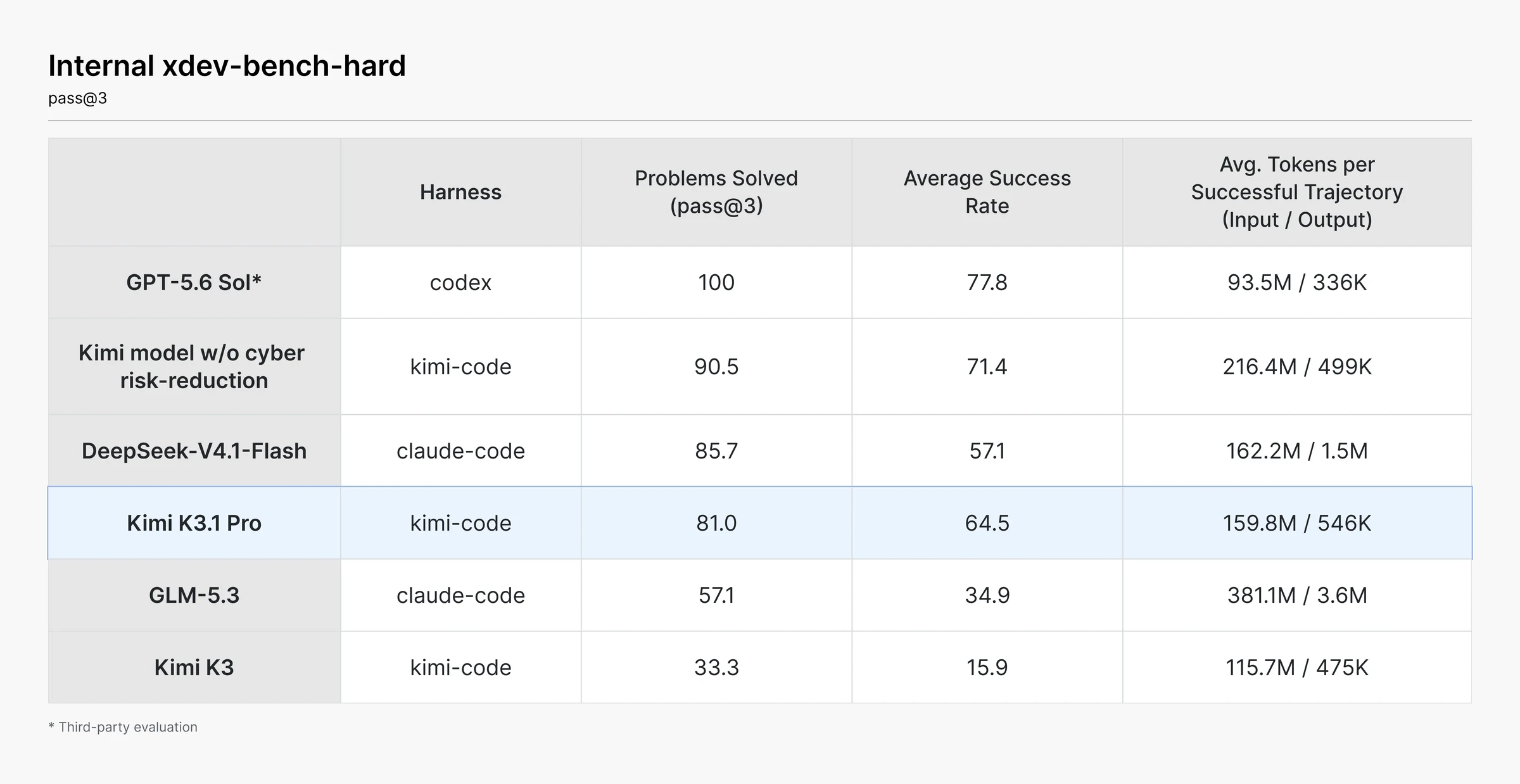 Figure: Comparative evaluation on the xdev-bench-hard vulnerability exploitation benchmark. The key takeaway is the 9.5-point gap between the unscrubbed prototype (90.5%) and the final open-weights release (81.0%). Source: Moonshot AI Official Blog
Benchmarking alongside contemporary models illustrates the broader capability landscape. On the identical benchmark, DeepSeek-V4.1-Flash logged 85.7%, GLM-5.3 recorded 57.1%, and the previous-generation Kimi K3 managed only 33.3%. In third-party evaluations, closed-source frontier model GPT-5.6 Sol reached a perfect 100%. Moonshot emphasized that it preserved standard software engineering and general programming data, applying aggressive filtering strictly to exploit development tools and attack payloads.
In its technical report, Moonshot made its stance unambiguous: the lab has no intention of releasing open weights that push the absolute frontier of offensive cyber capabilities forward. Moonshot stated plans to gradually restore and open up security auditing capabilities in the future to assist defenders with legacy codebase audits. Publishing an explicit audit trail of pre- and post-mitigation performance establishes a rare risk-management benchmark for the open-source ecosystem.
Breaking Out of Infinite Loops: 167 Iterations to Debug a Physics Engine
Static benchmarks capture isolated moments, but long-horizon engineering challenges test genuine depth of reasoning. In an experiment built upon the open-source anatomical human-atlas project, the model was tasked with constructing a human locomotion dynamics simulator spanning 296 skeletal structures and 402 muscular components. Over 167 continuous iterations and 420 independent code reviews, the model evolved a walking controller that initially collapsed within seconds into a sustained, alternating gait lasting 11.2 seconds.
When gait optimization hit a performance plateau, the simulator’s arm movements began experiencing severe, unnatural distortions. Instead of falling into the common trap of endlessly fine-tuning reward functions, K3.1 Pro shifted to open-loop probing of the simulator itself. It identified 36 distinct algorithmic errors in the shoulder muscle moment-arm calculations inside the dynamics module, corrected the underlying physics code, and only then resumed controller training.
This deep troubleshooting capability is mirrored across broader code benchmarks. On Moonshot’s internal Kimi Code Bench 3.0 Long-horizon evaluation, K3.1 Pro recorded a 61.2% pass rate—a 5.25-percentage-point increase over K3’s 55.95%. Diagnosing subtle algorithmic bugs in physical simulations demonstrates the caliber of endurance required for complex real-world engineering agents.
Parity with Closed-Source Benchmarks: Tool Calling in Specialized Workflows
On terminal interactions and multi-tool orchestration benchmarks, K3.1 Pro demonstrated performance on par with leading closed-source models. Evaluated on Terminal-Bench 4.0 using the Claude-Code test harness, K3.1 Pro achieved a 65.7% score. That places it above GPT-6 Astra (58.2%) and within striking distance of Claude Opus 5.5 (66.4%). The model’s proficiency in coordinating multi-tool chains narrows the historical gap between open and proprietary models in autonomous system administration.
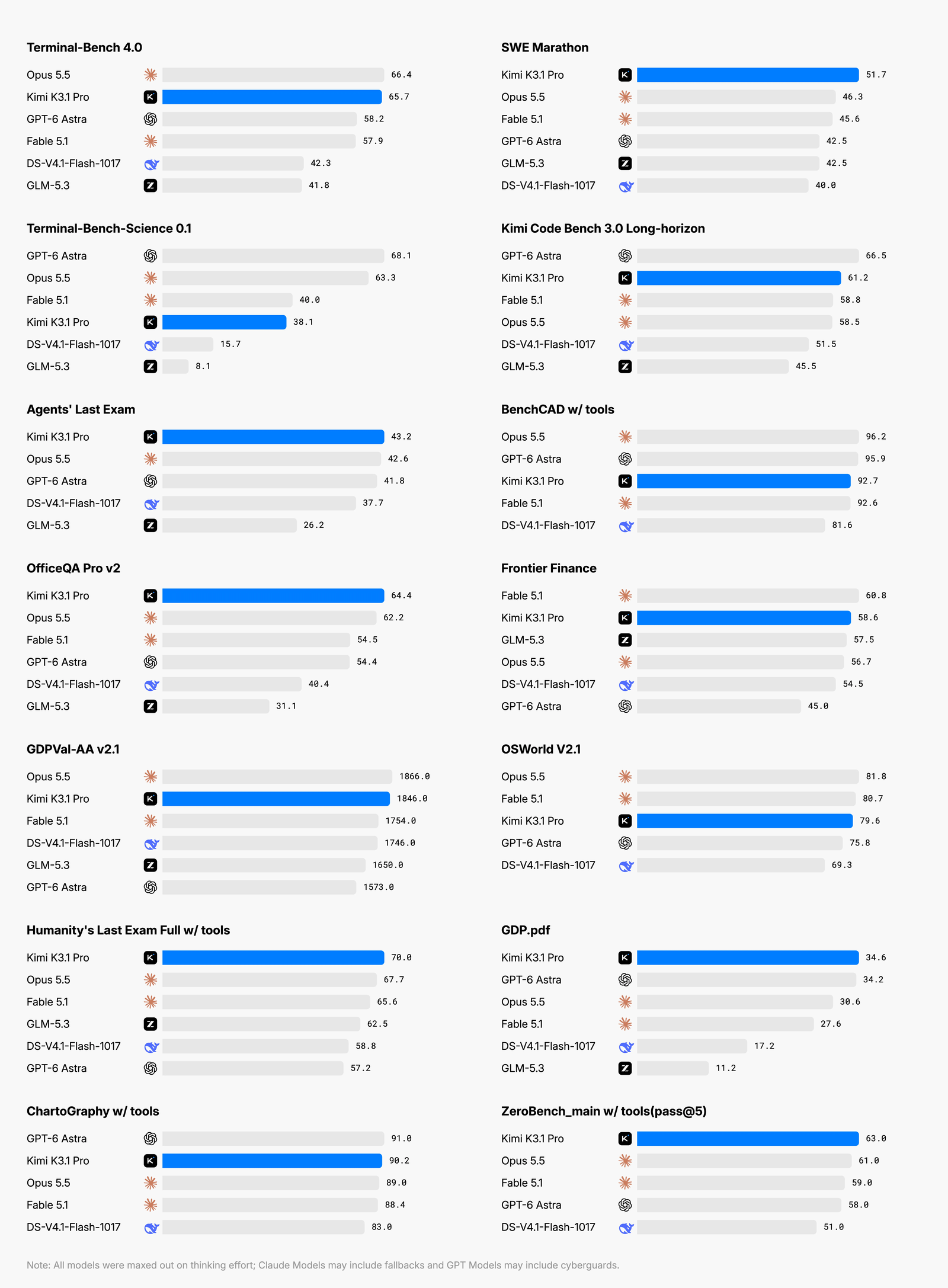 Figure: Performance of K3.1 Pro across 14 coding, scientific, and knowledge work benchmarks. When analyzing this chart, focus on score distributions under specific harnesses rather than sweeping claims of victory. Source: Moonshot AI Official Blog
The BenchCAD benchmark challenges models to synthesize parametric CAD code from multi-view images across 1,000 curated instances, scored via Voxel IoU. When allowed to use external rendering and visual inspection tools, K3.1 Pro recorded 92.7%, matching Claude Fable 5.1 (92.6%). While slightly trailing Claude Opus 5.5 (96.2%) and GPT-6 Astra (95.9%), it significantly outperformed DeepSeek-V4.1-Flash-1017 (81.6%).
Under pure zero-tool code generation, K3.1 Pro retained a 72.8% score, virtually tied with Claude Opus 5.5’s 73.0%, while DeepSeek’s tool-free score dipped to 41.2%. The comparison highlights that the model possesses strong intrinsic 3D spatial reasoning that remains resilient even without external feedback loops.
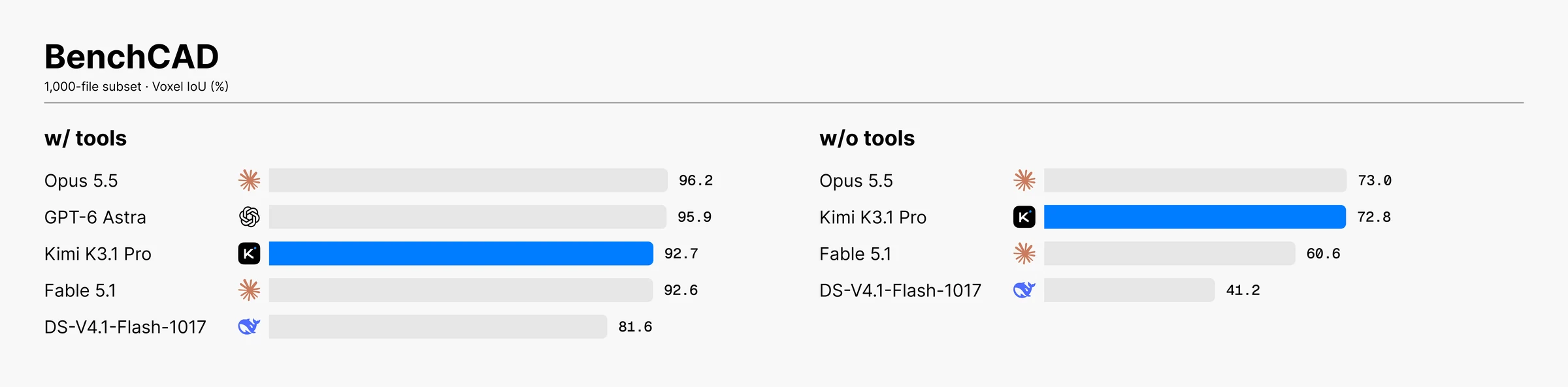 Figure: BenchCAD multi-view rendering to CAD code synthesis benchmark. Compare the Voxel IoU disparity between tool-assisted and unassisted modes, illustrating how tool access multiplies long-horizon reasoning advantages. Source: Moonshot AI Official Blog
Across dense multi-modal document analysis and financial evaluation, the model sustained robust performance. On OfficeQA Pro v2—where full PDF inputs are presented strictly as raw page images without machine-readable text—K3.1 Pro scored 64.4. Internal financial evaluations reached 57.6 in Financial Modeling and improved from 8.9 to 37 on business operations tasks compared to K3. In factual grounding, Kimi Hallu Bench Hard demonstrated a decline in claim-level hallucination rates from 23.4% down to 8.3%, cutting answers with factual flaws by more than half.
MXFP4 Quantization for 3T Weights: Preserving Throughput via QAT
Deploying a 3-trillion-parameter Mixture-of-Experts architecture using standard 16-bit floating-point weights would impose prohibitive VRAM footprints. K3.1 Pro introduces Quantization-Aware Training (QAT) to compress weights into the ultra-dense MXFP4 format while retaining activations in MXFP8. This design relieves memory footprint and memory bandwidth bottlenecks, ensuring that the 1M context window maintains practical inference throughput on standard enterprise hardware clusters.
Moonshot concurrently introduced a Kimi K3.1 Pro Highspeed variant that optimizes expert routing logic to boost inference throughput by 2x to 3x. For distribution, Moonshot adopted a dedicated Kimi K3.1 Pro License that establishes explicit compliance obligations for large-scale commercial deployments, underscoring the team’s deliberate governance over derivative model distribution.
Engineering Restraint as the New Metric of Open-Source Maturity
Frontier models are developing differentiated competitive profiles across varying engineering philosophies. In Tencent’s internal suite of 579 financial reasoning evaluations, Kimi K3.1 Pro scored 2.68 against DeepSeek-V4.1-Flash-1017’s 2.97, reflecting specialized domain trade-offs rather than unilateral dominance.
The most enduring signal from K3.1 Pro’s release is its decision to make capability reduction an audited, transparent metric. Delivering a 3T-scale model with a 1M window forces builders to reckon with the balance between raw capability and unchecked proliferation. By publishing explicit accounts of what was removed, Moonshot demonstrates that engineering discipline and safety accountability are essential prerequisites for open-weight intelligence to remain viable and trusted.
Reference Links:
- Moonshot Official Release Blog
- Kimi K3.1 Pro Technical Report & Release Documentation
- Terminal-Bench 4.0 Official Leaderboard
- BenchCAD Paper and Benchmark Specifications