
Cooling Hot Soup in Space: A Familiar Gesture Taken 400 Kilometers Above Earth
When lifting a steaming bowl of broth, people instinctively blow gently across the surface. The breeze sweeps away the fastest, most energetic molecules, steadily dropping the average thermal energy of the soup. In physics, this everyday reflex is known as evaporative cooling.
A standard home freezer hovers around -18°C. In the frozen interior of Antarctica, the lowest temperature ever recorded on Earth reached -89°C. On November 5, 2026, Chinese researchers published groundbreaking results in the journal Science. By launching an ultra-precise cooling apparatus into orbit 400 kilometers above Earth, they generated the coldest matter ever produced by humanity aboard the Tiangong space station.
The automated experimental setup chilled atoms down to 9.7 picokelvins. A picokelvin—one trillionth of a kelvin—is an unimaginably tiny thermal scale. Modern physics posits an absolute theoretical basement known as absolute zero (approximately -273.15°C), where particle thermal motion ceases almost entirely. The cloud of atomic gas forged aboard the Chinese space station sat just ten-trillionths of a degree above absolute zero.
Gravity Crushes Fragile Atomic Clouds: Escaping Earth to Find Room to Breathe
Why go to such extraordinary lengths to haul delicate cooling equipment into orbit? The answer lies in Earth’s omnipresent gravitational pull. Temperature in the microscopic domain reflects the kinetic violence of atomic motion: the hotter the liquid, the faster its molecules jostle. Cooling an object simply means slowing atomic motion to a crawl.
To trap and cool atoms within a vacuum chamber, physicists use lasers to construct invisible force fields. These confining structures are known as potential wells, acting much like a frictionless bowl. When temperatures plunge below billionths of a degree, this optical bowl must be tuned exceptionally flat and shallow so the atomic cloud has room to expand and relax.
On the ground, however, this approach runs into a fundamental physical wall. Gravity relentlessly tugs at microscopic particles. As soon as the optical confinement is flattened, the atomic cloud collapses under its own weight and spills out from the bottom of the shallow trap. German physicists famously built a 146-meter drop tower in Bremen to achieve brief moments of free fall, but experiments there were limited to roughly two seconds of observation before crashing down.
To suspend ultracold atoms for extended periods, researchers must escape terrestrial gravity altogether. Operating inside the Mengtian lab module aboard Tiangong, the experiment floats in persistent microgravity—the weightless environment where objects in orbit experience near-zero gravitational stress. With the downward tug stripped away, fragile atomic clouds can finally hover in place without collapsing.
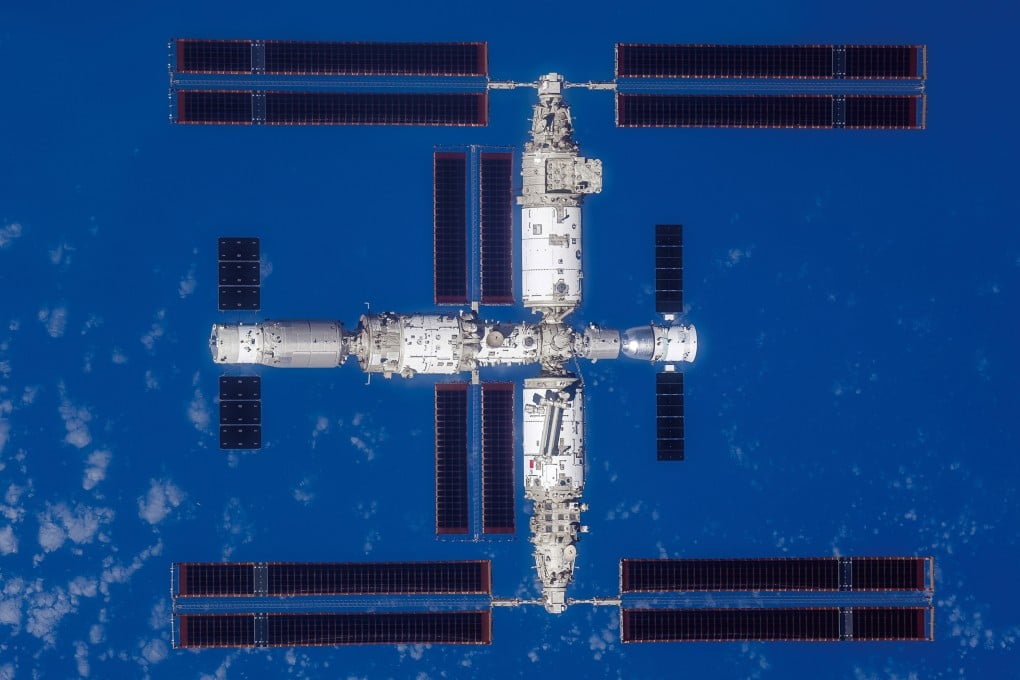 Figure: The Tiangong space station operating in orbit. Credit: CMSA / SCMP
Lowering the Shallow Bowl with Lasers: 20,000 Atoms Slower Than a Garden Snail
The Mengtian laboratory houses the Cold Atom Physics Rack (CAPR), an automated scientific facility. Inside, researchers deployed an optical dipole trap—an arrangement of intersecting laser beams that acts as optical tweezers, holding atoms via electromagnetic forces. In the ultra-high vacuum chamber, the crossed beams initially trapped approximately two million rubidium-87 atoms, an alkali isotope well suited for optical manipulation.
The team initially fired a 5-watt laser to confine the atoms within a tiny 54-micrometer space. The automated control system then gradually ramped laser power down to a mere 0.2 milliwatts. Just like blowing steam off hot soup, the most energetic atoms escaped the shallow rim, cooling the remaining population to 3.1 nanokelvins and condensing them into a Bose-Einstein Condensate (BEC)—a macroscopic quantum state where individual atoms march in complete lockstep.
Next, researchers gently transferred the BEC into a broader, 124-micrometer optical trap. Unburdened by gravitational sag, the atomic cloud expanded freely. As atomic collisions dropped dramatically, its effective temperature fell to 9.7 picokelvins. This smashed the previous record of 38 picokelvins set in the Bremen drop tower by nearly a factor of four, and eclipsed the 52 picokelvins achieved in 2020 by NASA’s Cold Atom Lab aboard the International Space Station.
The cosmic microwave background radiation permeating deep space sits at approximately 2.7 kelvins. The atomic gas generated inside Tiangong is over 200 billion times colder than the natural void of outer space. At 9.7 picokelvins, the expansion velocity of the 20,000 rubidium atoms fell below 200 micrometers per second. A common garden snail moves roughly one centimeter every 50 seconds—an identical speed of around 200 micrometers per second. These ultracold atoms drift no faster than a snail, taking more than thirty seconds to cross the width of a single human hair.
 Figure: Schematic of the optical dipole trap confining ultracold atoms aboard the space station. Credit: Xiaoji Zhou / Peking University (via DongA Science)
Seven Seconds of Free Expansion: An Observation Window Worth More Than the Record
To quantum physicists, setting a record-low temperature was only the preamble. The far more consequential breakthrough was sustaining the atomic cloud in free expansion for seven full seconds—during which researchers continuously tracked and imaged its evolution.
Terrestrial drop towers cannot exceed roughly two seconds due to physical height limits. Previous experiments on the ISS were constrained to observation windows of around one second. Holger Müller, a physicist at UC Berkeley, emphasized that seven seconds is a far more impactful benchmark than reaching sub-10 picokelvins. While future ground experiments might eventually touch similar temperatures, keeping an expanding cloud undisturbed for seven seconds without gravity pulling it away is virtually impossible on Earth.
Expanding the observation window to seven seconds gives scientists the quantum equivalent of an ultra-long-exposure high-speed camera. The slower the atoms move and the longer they hover in free fall, the more environmental noise can be filtered out. The precision and resolution of quantum measurements scale directly with available observation time.
Ernst Rasel, the German physicist whose Bremen team held the previous world record, extended sincere congratulations to the Chinese researchers. Weibiao Chen, a researcher at the Shanghai Institute of Optics and Fine Mechanics under the Chinese Academy of Sciences, noted that the Cold Atom Physics Rack is open for international collaboration, inviting the global scientific community to leverage Tiangong’s ultra-cold platform.
Beyond Gravity’s Squeeze: Tiangong Sets a New Benchmark for Precision Metrology
Cooling matter to near absolute zero and floating it for seconds on end serves fundamental physics. The primary goal is testing Einstein’s equivalence principle, which asserts that all masses fall at identical accelerations in a gravitational field, regardless of composition.
In upcoming experiments, researchers plan to release clouds composed of two distinct atomic elements simultaneously in orbit. A seven-second free-fall window will elevate comparisons of microscopic gravitational acceleration to unprecedented precision. Ultracold atomic ensembles can also act as ultra-sensitive quantum gravimeters, mapping subtle variations in Earth’s gravitational field from orbit to monitor groundwater movements and the melting of polar ice caps.
Gravity has long crushed terrestrial attempts to sustain ultra-cold atomic clouds in ultra-shallow traps. By taking advantage of microgravity, China’s space station chilled 20,000 rubidium atoms to 9.7 picokelvins—four times colder than any prior benchmark. The accompanying seven-second observation window sharpens humanity’s sharpest ruler yet for probing the quantum realm and the fundamental laws of gravity.
References:
- Science: Quantum gases below 10 picokelvin in space
- Science News: China space station cold atom experiment creates record low temperature
- SCMP: Chinese scientists chill atoms to record low on Tiangong space station
- DongA Science: Chinese scientists break record for coldest temperature in space