On August 5, database provider Neon released a surprising benchmark report: a fine-tuned 4-billion parameter open-weight model (based on Alibaba’s open Qwen3.5) scored 1.447 on a specialized retrieval task. In comparison, OpenAI’s flagship frontier model, GPT-5.6 Sol, scored 1.369. The lightweight open-source model came out ahead, while serving queries at roughly 1/100th the cost of its closed competitor.
The announcement sparked nearly 200 upvotes and dozens of technical discussions on Hacker News, eliciting equal parts amazement and skepticism. In this article, we break down what retrieval actually entails, how Neon calculated the 100x cost disparity, and whether these benchmark results hold up under scrutiny.
Retrieval: The Critical First Step in AI Question Answering
To understand the breakthrough, we first need to define retrieval. When you ask an AI assistant a question like “How many days in advance should I book travel for expense reimbursement?”, the model does not memorize the entire corporate library to formulate an answer. Instead, it locates the relevant shelf, pulls the specific manual, opens to the correct page, and reads the solution to you. This act of searching and fetching context is retrieval.
For AI systems such as ChatGPT or internal enterprise assistants, overall accuracy depends heavily on retrieval quality. If the system retrieves the correct document, downstream response quality is generally assured. If it misses the source material, even the most fluent language generation will produce hallucinations. The dependency is even starker in enterprise settings: customer support bots and internal Q&A systems rely on retrieving relevant segments from vast repositories of docs, tickets, and manuals.
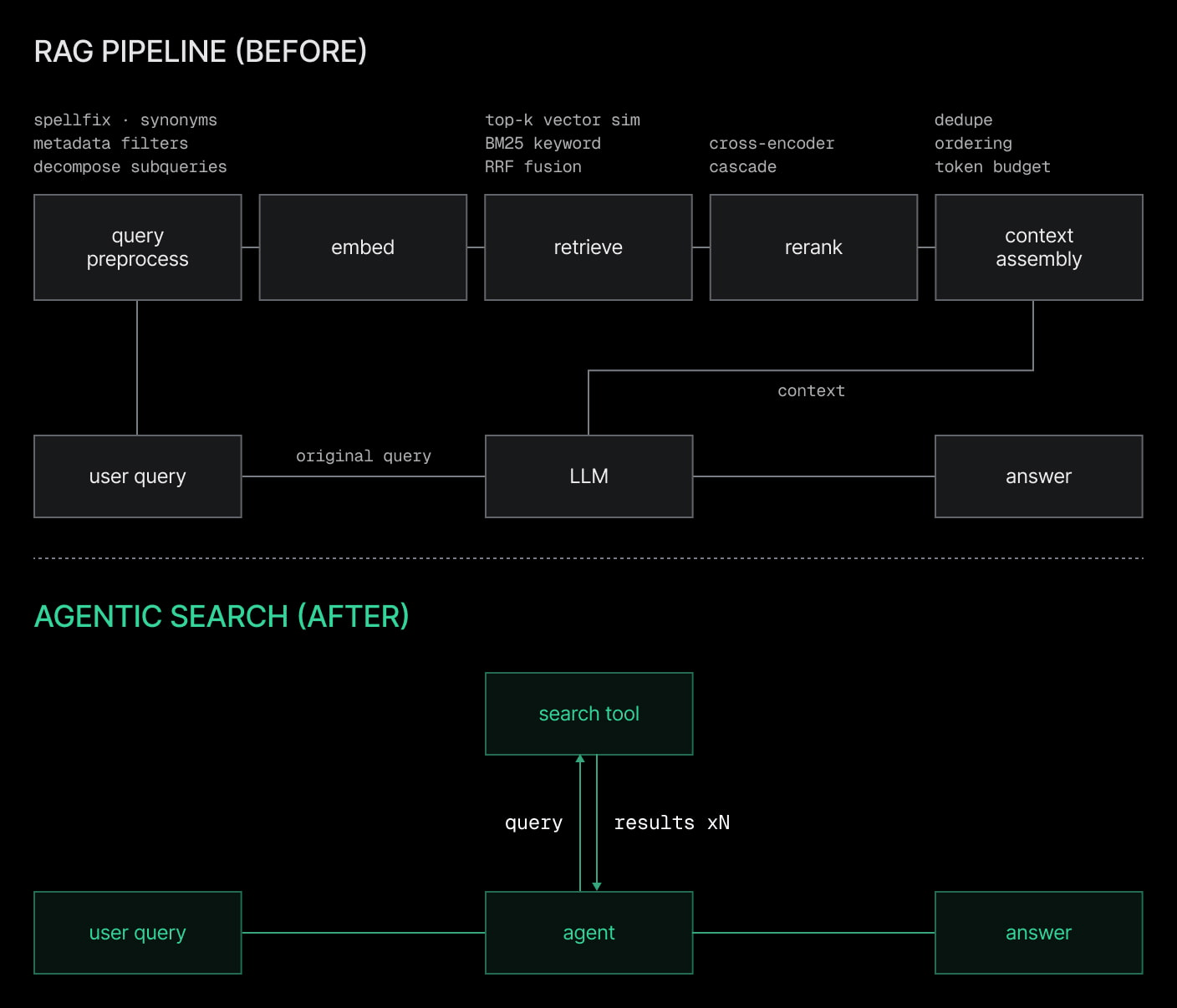 Figure: Comparison between traditional single-pass retrieval and agentic retrieval involving multi-turn, iterative search steps. Source: neon.com
Historically, retrieval was executed as a single-pass lookup. Modern agentic workflows, however, mirror human research habits: searching once, reviewing results, refining the query, and searching again across multiple iterations to converge on an accurate answer. Neon calculated that running an iterative multi-turn retrieval workflow with GPT-5.6 Sol takes upwards of 10 seconds and costs roughly 3 cents per query. As each additional search iteration consumes top-tier frontier model tokens, retrieval becomes one of the most expensive links in the chain.
Why Retrieval Was the First Frontier to Fall
Why did an open-source small model manage to surpass a closed-source frontier giant specifically on retrieval? Three main factors stand out.
First, the task scope is highly focused. The goal of retrieval is straightforward: locate the exact right material. Specializing in this single operation is far easier than mastering general-purpose reasoning. As one popular Hacker News comment put it: “You don’t hire a PhD to work on an assembly line.” For repetitive, structured retrieval, a specialized, lightweight model is more than sufficient.
Second, retrieval performance is objectively measurable. Whether the correct document was retrieved can be automatically graded by machines. This objectivity enables reinforcement learning (RL): the model interacts with search tools through trial and error, earning rewards for correct fetches and penalties for incorrect ones. Over tens of thousands of steps, the model learns when and what to search. Neon’s model started with an average reward score of 0.382 before training and climbed to 1.447. The performance improvement was earned through RL iterations, demonstrating the rapid maturity of open-source fine-tuning techniques without requiring pre-training from scratch.
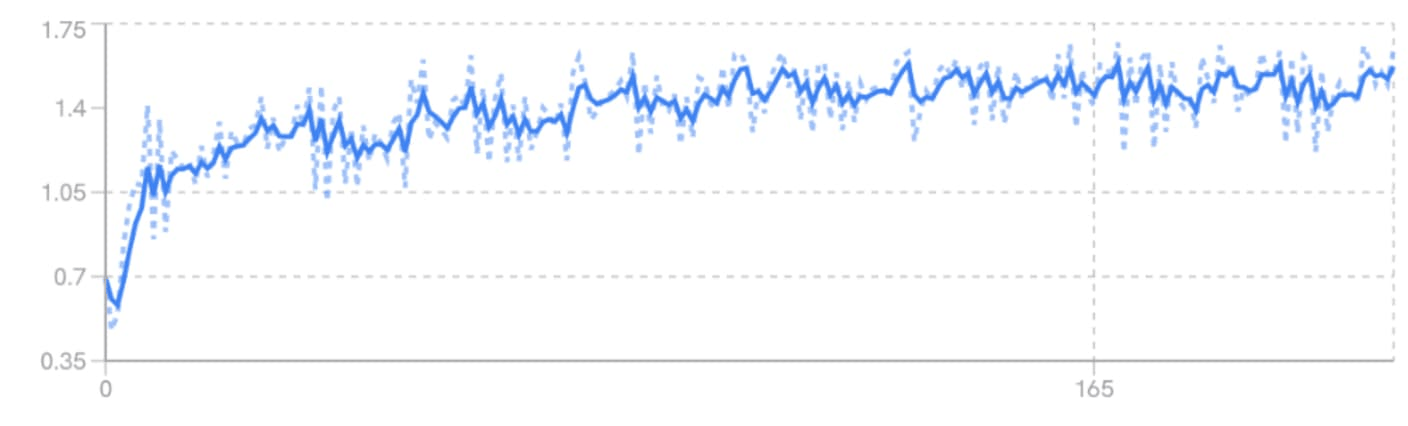 Figure: The average reward score climbing consistently over training steps. Source: neon.com
Third, the training data resides within enterprise boundaries. Organizations can automatically convert internal documentation into synthetic question-answer pairs to fine-tune custom domain models. This approach keeps proprietary data local while addressing privacy and data governance concerns.
Doing the Math: How the 100x Cost Gap Is Calculated
A “100x cost reduction” might sound like marketing hyperbole, but the underlying arithmetic is straightforward to verify.
First, examine raw API token pricing. GPT-5.6 Sol is priced at $5 per million input tokens and $30 per million output tokens—frontier models carry a premium on every request. Hosted open-weight small models, by contrast, cost around $0.03 per million input tokens and $0.15 per million output tokens, representing a raw unit price difference of 160x to 200x.
Second, consider actual empirical request costs. Neon measured the average cost of a single complex retrieval request at $0.0873 for GPT-5.6 Sol, compared to $0.00092 for the fine-tuned 4B model. That yields a real-world cost ratio of 94.9x, rounded publicly to “100x cheaper.”
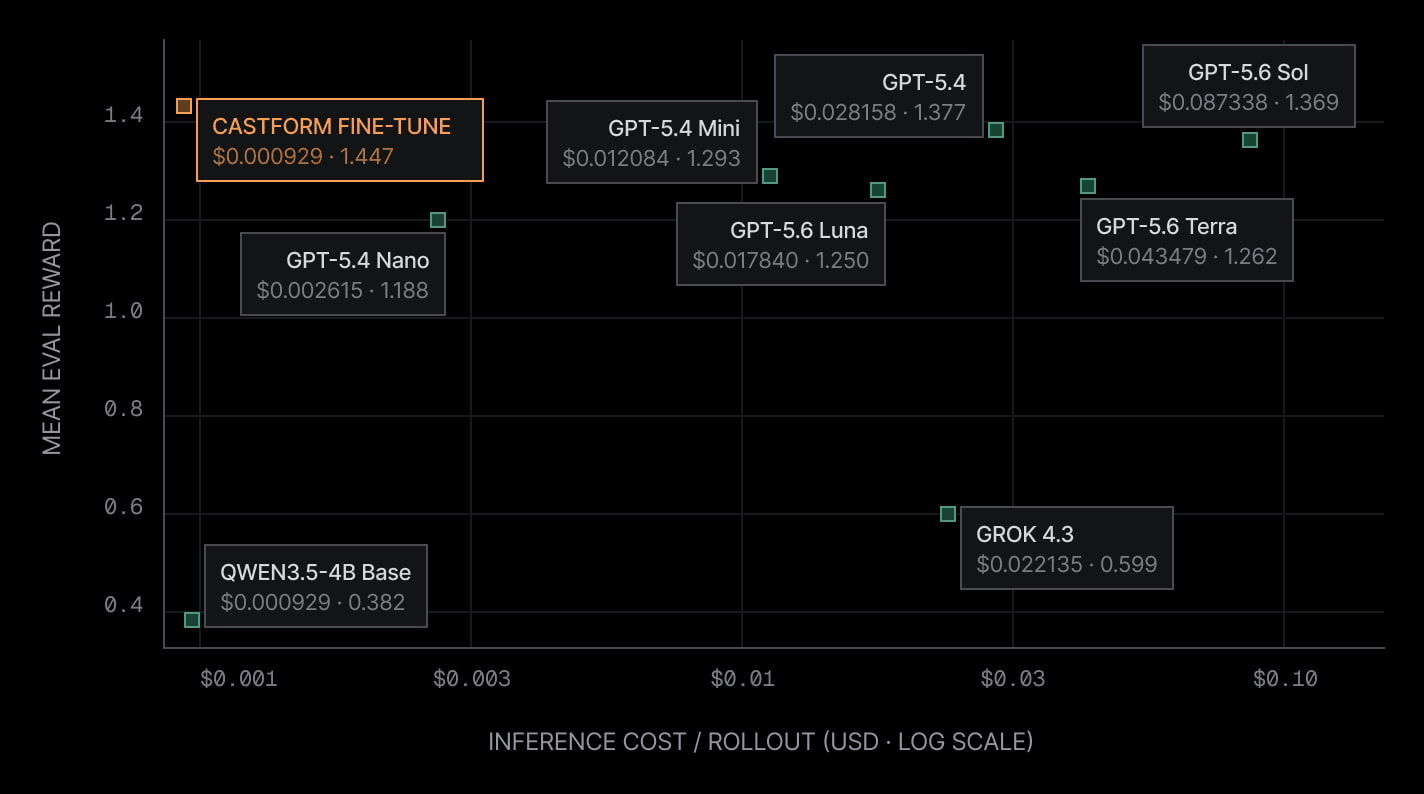 Figure: Cost per request on the x-axis vs. evaluation score on the y-axis (top-left is optimal). Source: neon.com
Extrapolating to production workloads: an enterprise executing 100,000 retrieval queries per day would pay approximately $8,700 daily (over $260,000 monthly) using Sol, compared to just $92 per day with the specialized small model. At scale, a 100x cost difference determines whether a product feature is commercially viable. The ongoing AI price war has shifted from general API price cuts to small-model substitution.
The Controversy: Arguments from Both Sides
The primary criticism revolves around evaluation methodology. The comparison was conducted internally by Neon using synthetic, proprietary test sets; the full prompt dataset has not been released, nor was the model benchmarked against standard public retrieval suites (such as BEIR). Skeptical Hacker News users expressed zero trust in vendor-authored benchmarks, noting that “every benchmark is optimized for the vendor’s own narrative.” Independent analysis from AI Pricing Guru also noted a lack of granular numeric logs, making independent reproduction difficult.
Proponents, however, highlight valid counterpoints. Scoring retrieval accuracy is relatively objective, and the RL progress curve (0.382 → 1.447) demonstrates verifiable optimization. Community members noted from their own experiments that small, specialized models often outperform larger generalist models at simple fact-retrieval because frontier models tend to overthink or over-reason on straightforward lookups. Furthermore, the token price discrepancy is undeniable, as public API pricing schedules clearly confirm a 200x rate differential.
Our assessment is that the 100x cost difference is real, while the claim of beating frontier models currently applies specifically to Neon’s internal evaluation benchmark. Notably, even Neon’s blog text mentions a single-query cost of ~3 cents while the comparison chart plots Sol at 8.7 cents, illustrating how sensitive cost accounting can be. Real-world enterprise retrieval is significantly messier than benchmark datasets—documents are outdated, queries are ambiguous, and answers are deeply buried. Whether small models maintain their edge under dirty production conditions remains to be proven. For complex coding and long-context reasoning, specialized small models are far from replacing frontier generalists.
Where the AI Price War Is Headed Next
Looking at the broader implications: while the performance advantage requires broader independent replication, the trend is clear—AI deployment is evolving from monolithic all-purpose giants toward ensembles of low-cost, domain-specific specialists. For developers and businesses, this means enterprise AI tools (such as knowledge base search and customer support automation) are becoming drastically more affordable.
For the industry, the battlefield of the price war has expanded from “how much API tokens cost” to “which model size is needed for a given task.” Every time an open-source small model catches up to a frontier giant on a specific task, the pricing power of proprietary API lock-in weakens. Retrieval is merely the first domain to be unbundled—it will not be the last.
Reference Links:
- Neon Blog: How Castform + Neon Beats Frontier Models on Price and Efficiency
- Hacker News Discussion (item?id=49186762)
- AI Pricing Guru: Castform Beats GPT-5.6 Sol: Cost Impact (August 2026)